
Medicare Planning Guide
Medicare Planning in Harford County, Maryland
Medicare decisions made at enrollment are often permanent. Our guides walk through Part B timing, Medicare Advantage versus Medigap, IRMAAIncome-Related Monthly Adjustment Amount — a surcharge added to your Medicare Part B and Part D premiums if your income exceeds certain thresholds. Based on your income from two years prior, IRMAA can add thousands of dollars per year to your Medicare costs, making income management in the years before Medicare enrollment a critical planning opportunity. surcharges, and healthcare cost planning in retirement, written by a CFP professional serving Forest Hill and the Baltimore metro area.

How does Medicare work, and what decisions do you need to make when enrolling to avoid costly mistakes?
Medicare is the federal health insurance program for people 65 and older and certain individuals with disabilities. Planning for Medicare means understanding when to enroll to avoid permanent late-enrollment penalties, choosing between Original Medicare and Medicare Advantage, selecting the right Part D drug plan, deciding whether a Medigap supplement policy makes sense, and projecting how income affects IRMAA surcharges on Part B and Part D premiums.
Start here
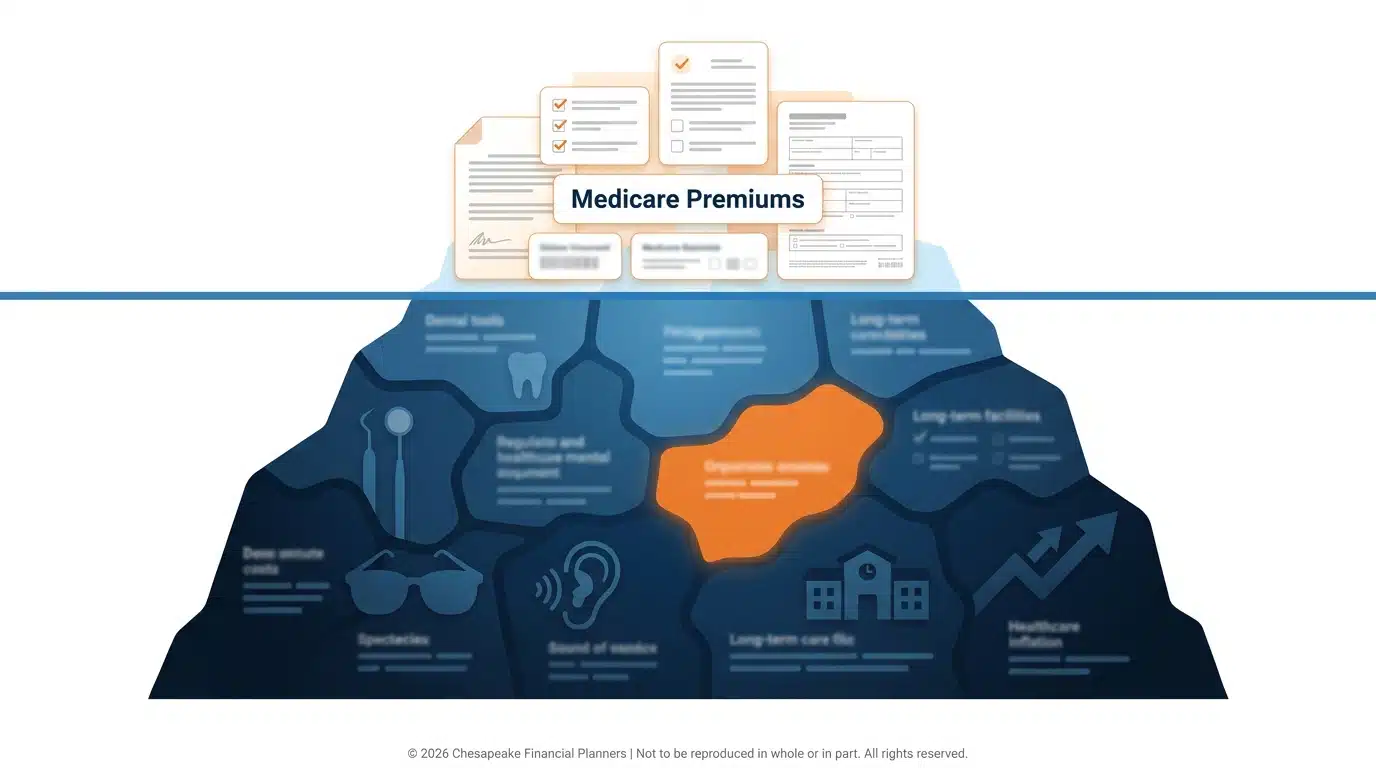
Healthcare Costs in Retirement: What to Expect
A 65-year-old couple retiring today needs roughly $345,000 for healthcare, and that excludes long-term care. This guide breaks down Medicare gaps, Medigap versus Medicare Advantage, the pre-65 coverage gap, long-term care, and how IRMAA quietly raises your bill.
Read the complete guide →Explore by topic
The major decisions within Medicare enrollment and healthcare cost planning, each with its own guide and articles.
What Are the Different Parts of Medicare and What Do They Cover?
Medicare has four parts, and each one covers something different. Part A covers hospital care, Part B covers doctor visits and outpatient…
How do I get health insurance between early retirement and Medicare?
The gap between an early retirement date and Medicare eligibility at 65 is one of the most expensive planning windows of a…
What is IRMAA, and how does income raise my Medicare premium?
IRMAA stands for Income-Related Monthly Adjustment Amount, the extra money higher-income Medicare beneficiariesThe people or entities designated to receive your assets when you die — through retirement accounts, life insurance policies, or trusts. Keeping beneficiary designations current is one of the simplest but most overlooked parts of estate planning, and outdated designations can completely override what your will says. pay on top of standard Part B and Part…
What should I review during Medicare open enrollment each year?
A Medicare open enrollment checklist is the short list of items you review every fall between October 15 and December 7, the…
How can Roth conversions and RMDs trigger higher Medicare premiums (IRMAA)?
Most people think of Medicare as a fixed cost. It isn't. The 2026 IRMAA rules tie your Part B and Part D…
All articles in this guide
Every article in the Medicare and healthcare pillar, from enrollment timelines to IRMAA planning.
What Are the Different Parts of Medicare and What Do They Cover?
- What is long-term care insurance and do I need it?
- What are the best alternatives to long-term care insurance?
- How Do I Care for Aging Parents Without Ruining My Retirement?
- How Do I Help Aging Parents Financially Without Ruining My Retirement?
- How do I plan for rising healthcare costs in retirement?
- What Financial Planning Challenges Do American Expats Face?
How do I get health insurance between early retirement and Medicare?
- Do You Need Medicare While Still Working Past Age 65?
- How Do I Cover Health Insurance If I Retire Before 65?
- Am I saving enough to retire by age 60?
- What Should You Prioritize Financially in the 5 Years Before Retirement?
- Can I retire early without running out of money?
- What questions should women ask about retirement planning?
Also in this guide
Frequently asked questions
When should I sign up for Medicare?
Most people should enroll in Medicare at 65 even if still working, unless they have active employer coverage from a current employer with 20 or more employees. Delaying Medicare Part B without qualifying coverage results in a permanent 10% penalty for each 12-month period you were eligible but did not enroll.
What is the difference between Original Medicare and Medicare Advantage?
Original Medicare covers hospital stays under Part A and outpatient care under Part B but leaves significant gaps. Medicare Advantage is a private plan that replaces Original Medicare, typically includes Part D drug coverage and extra benefits, but restricts you to a network.
What is IRMAA and how does it affect my Medicare premiums?
IRMAA is a surcharge added to Medicare Part B and Part D premiums for higher-income beneficiaries. In 2026, single filers with modified adjusted gross income above $106,000 pay more than the standard premium. The surcharge uses income from two years prior.
What is Medigap and do I need it?
Medigap is private supplemental insurance that works alongside Original Medicare to cover costs like copays, coinsurance, and deductibles. It cannot be used with Medicare Advantage. Plan G is currently the most comprehensive plan available to new enrollees.
How do I cover healthcare if I retire before 65?
Options include COBRAA federal law that lets you continue your employer-sponsored health insurance for up to 18–36 months after leaving a job. COBRA preserves your existing coverage, but you pay the full premium — both the employee and employer share — making it often expensive compared to marketplace alternatives. continuation for up to 18 months, marketplace coverage through the ACA with potential premium tax credits, a spouse's employer plan, or short-term coverage as a bridge.
Can I contribute to an HSA after enrolling in Medicare?
Once enrolled in Medicare, you generally cannot contribute to a Health Savings AccountA triple-tax-advantaged account available to those enrolled in a high-deductible health plan: contributions are tax-deductible, growth is tax-free, and withdrawals for qualified medical expenses are tax-free. At 65, you can withdraw for any reason and pay ordinary income tax — making the HSA one of the most powerful savings vehicles available.. To preserve HSA contribution eligibility, you can delay Medicare enrollment past 65 only if you have active coverage through a current employer.

Managing Partner of Chesapeake Financial Planners in Forest Hill, Maryland, serving families and business owners across Harford County and the Baltimore metro area.
Ready to navigate Medicare without the guesswork?
Schedule a Fit Call to review your Medicare options alongside your broader retirement income plan.
See If You’re A Fit