

What Are the Tax Implications of Working in Retirement?
Last reviewed: July 2026
Working in retirement taxes work differently than the paycheck taxes you knew during your career. Your wages now stack on top of Social Security, retirement account withdrawals, and required minimum distributions, and that stacking can quietly raise your effective tax rate, increase how much of your Social Security is taxable, and even bump up your Medicare premiums two years later. The income itself is rarely the problem. The interactions are.
Key Takeaways
- Working before full retirement age can trigger the Social Security earnings test, withholding $1 in benefits for every $2 earned above $24,480 in 2026.
- Up to 85% of your Social Security benefits can become taxable once work income pushes your combined income past the IRS thresholds.
- Higher income can raise Medicare premiums through IRMAA, with surcharges starting at $109,000 for single filers in 2026.
- Self-employment in retirement adds a 15.3% self-employment tax on top of regular income tax.
About the Author: Jeff Judge, CFP®, AEP®, ChFC®, CLU® is Managing Partner of Chesapeake Financial Planners in Forest Hill, Maryland. He has been helping families and business owners in Harford County and the Baltimore metro area navigate retirement income decisions since earning his CFP® certification in 2013, by using Chesapeake Financial Planners’ signature process, the R.U.D.D.E.R. method™. Jeff often tells clients that the part-time job they took for fun ends up taxed like a raise they never planned for, because nobody warned them how the pieces interact.
How Does Work Income Affect Your Social Security Benefits?
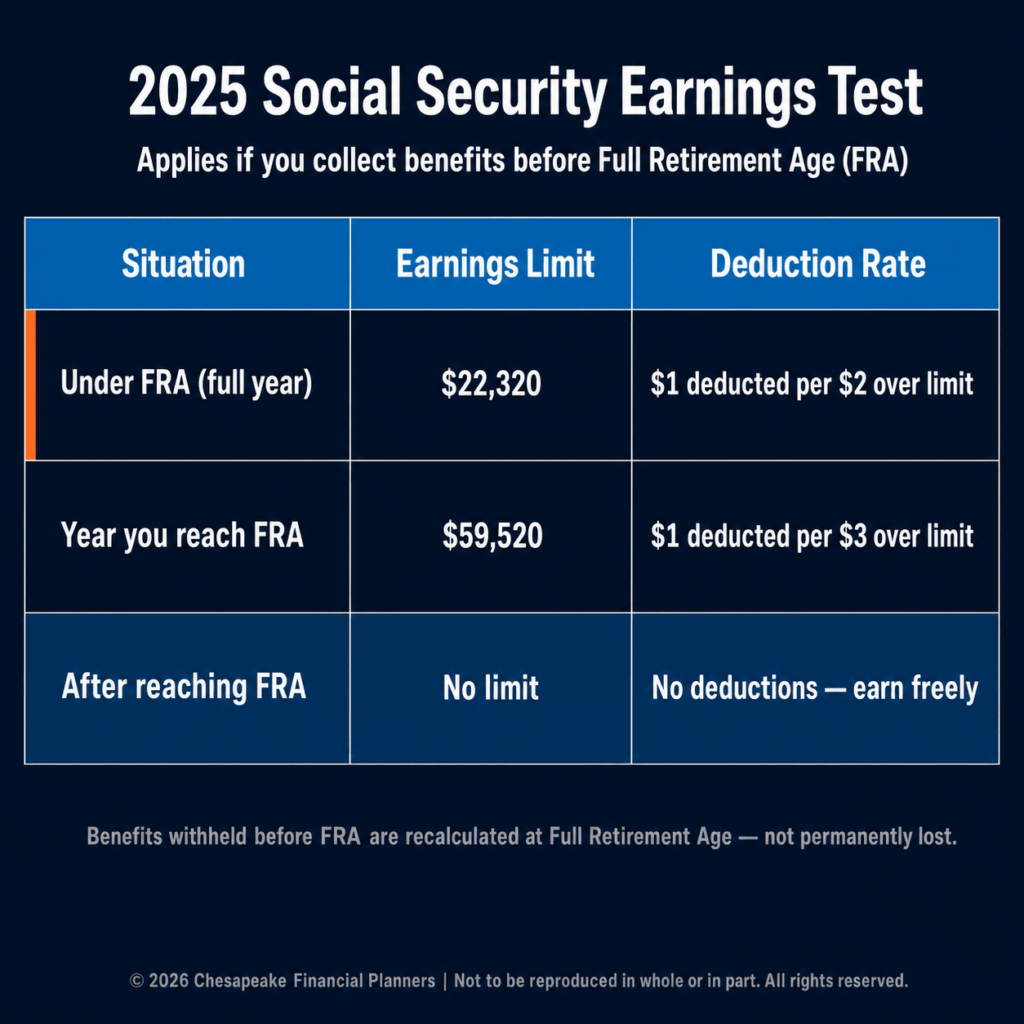
If you claim Social Security before your full retirement age and keep working, you may trigger the earnings test, which temporarily reduces your benefits. For 2026, the Social Security Administration deducts $1 in benefits for every $2 you earn above $24,480 if you are under full retirement age for the whole year. That works out to roughly $2,040 per month before benefits start shrinking.
In the year you reach full retirement age, the limit jumps to $65,160, and the SSA withholds $1 for every $3 you earn above it. Once you actually hit full retirement age, the earnings test disappears entirely. You can earn any amount with no benefit reduction.
Here is the part people miss: withheld benefits are not gone forever. When you reach full retirement age, Social Security recalculates your benefit to credit the months that were reduced. The short-term cash flow hit is real, but the long-term value is largely restored. Sometimes the smarter move is delaying your claim until you stop working, letting the benefit grow while you earn wages. Run the numbers before you decide. For a deeper look at sequencing these decisions, see What Should You Prioritize Financially in the 5 Years Before Retirement?.
How Does Working Increase Taxes on Your Social Security and Income?
Even after the earnings test no longer applies, work income can raise the taxes you pay on your Social Security benefits. Up to 85% of your benefits can be taxable depending on your "combined income," which the IRS defines as your adjusted gross income, plus tax-exempt interest, plus half of your Social Security benefits.
For married couples filing jointly, once combined income passes $32,000, up to 50% of benefits may be taxable; above $44,000, up to 85% becomes taxable. For single filers, those thresholds drop to $25,000 and $34,000. Adding a part-time wage can push you over a threshold fast, creating an effective marginal rate higher than your stated bracket suggests.
Work income also stacks directly onto your adjusted gross income. Consider a married couple with $50,000 in retirement withdrawals and Social Security, sitting comfortably in the 12% bracket. If one spouse takes a $30,000 part-time job, that income does not just face 12%. It can:
- Push some income into the 22% bracket
- Make more Social Security benefits taxable
- Raise Medicare premiums two years out
- Trigger or increase state income taxes
The effective marginal rate on that $30,000 can easily clear 30% once every factor combines. This is exactly where the R.U.D.D.E.R. Method™™ — Chesapeake Financial Planners' six-step planning process of Review and Recognize, Uncover and Understand, Design and Develop, Discuss and Decide, Execute and Empower, and Reassess and Refine — earns its keep by modeling the full picture before you accept the work.
How Does Work Income Raise Your Medicare Premiums (IRMAA)?
This is where working in retirement gets expensive for higher earners. Income-Related Monthly Adjustment Amounts, or IRMAA, raise your Medicare Part B and Part D premiums when your modified adjusted gross income crosses certain lines. For 2026, Medicare sets the first surcharge tier at $109,000 for single filers and $218,000 for married couples filing jointly.
The tricky part is the two-year lookback. Medicare bases your 2026 premiums on your 2024 tax return. So if you return to work and your income crosses a threshold, the premium increase shows up two years later, not immediately. And when you stop working, you keep paying the higher premium for two years after your income drops. Jeff has watched retirees get blindsided by an IRMAA letter for a job they already quit.
The increases are not small. At the top income tiers, monthly Part B premiums climb well above the standard rate, and Part D adds its own surcharge per person, per month. Coordinating withdrawals to stay under a tier can save thousands a year. For strategies that lower modified AGI, see How do Roth conversions affect IRMAA and Medicare Part B premiums? and How Much Should I Budget for Healthcare Costs in Retirement?.
What About Self-Employment Tax and RMDs?
If your retirement work is consulting, freelancing, or any 1099 arrangement, you owe self-employment tax. As an employee, your employer covers half of Social Security and Medicare payroll taxes (7.65%). Self-employed, you pay both halves: a 15.3% self-employment tax on earnings up to the Social Security wage base, plus 2.9% Medicare tax above it. You can deduct half of the self-employment tax, but the effective burden stays high once income tax layers on top.
Required minimum distributions add another wrinkle. Once you reach age 73, the IRS forces withdrawals from traditional IRAs and 401(k)s whether you need the money or not, and those RMDs add straight to your taxable income. One exception: if you still work for an employer and participate in their 401(k), you can delay RMDs from that specific plan until you retire, as long as you do not own more than 5% of the company. This does not apply to IRAs or old 401(k)s. One option for retirees who must take RMDs but want to lower the tax hit is How Can I Donate From My IRA and Reduce Taxes?.
Frequently Asked Questions
Does working in retirement reduce my Social Security benefits?
Working only reduces your Social Security benefits if you claim before full retirement age and earn above the annual limit, which is $24,480 in 2026. Once you reach full retirement age, there is no earnings limit, and any benefits withheld earlier are credited back to you through a recalculation.
How much of my Social Security is taxable if I keep working?
Up to 85% of your Social Security benefits can be taxable, depending on your combined income. For single filers, taxation begins at $25,000 of combined income; for married couples filing jointly, it begins at $32,000. Work income raises your combined income, which often pushes more of your benefit into the taxable range.
Will a part-time job raise my Medicare premiums?
A part-time job can raise your Medicare premiums through IRMAA if it pushes your modified adjusted gross income above $109,000 single or $218,000 married for 2026. Because Medicare uses a two-year lookback, the higher premium appears two years after the income year, not in the same year you earn the wages.
Do I pay self-employment tax on consulting work in retirement?
Yes, consulting or freelance work in retirement is subject to the 15.3% self-employment tax, covering both the employee and employer halves of Social Security and Medicare. You can deduct half of that tax on your return, but the income still also faces ordinary income tax, making the combined burden significant.
Can I avoid RMDs if I am still working?
You can delay RMDs only from your current employer's 401(k) if you are still working there and own 5% or less of the company. This "still working" exception does not apply to traditional IRAs or 401(k)s from former employers, which still require distributions starting at age 73.
What is the effective tax rate on retirement work income?
The effective rate on retirement work income is frequently higher than your stated bracket because the income can make more Social Security taxable, push you into a higher bracket, and trigger IRMAA. For many retirees, a $30,000 part-time job carries an effective marginal rate above 30% once all factors combine.
If you want a clear, plain-English breakdown of how a paycheck would interact with your specific Social Security, Medicare, and retirement accounts, download our free retirement income tax guide at chesapeakefp.com. It walks through the exact stacking effects covered here so you can decide whether that job is worth it on your terms, not by surprise.
Disclosures
The information provided is for educational purposes only and should not be construed as investment advice. Investment strategies should be tailored to individual circumstances, risk tolerance, and goals. Past performance doesn't guarantee future results. Consult with qualified financial professionals regarding your specific situation.
Advisors associated with Chesapeake Financial Planners may be either (1) LPL Financial Registered Representatives offering securities through LPL Financial, Member FINRA and SIPC, and investment advisor representatives offering investment advice through Great Valley Advisor Group; or (2) solely investment advisor representatives offering investment advice through Great Valley Advisor Group and not affiliated with LPL Financial. Great Valley Advisor Group, and Chesapeake Financial Planners are separate entities from LPL Financial.


