

Medigap or Medicare Advantage: How Do I Choose?
Last reviewed: July 2026
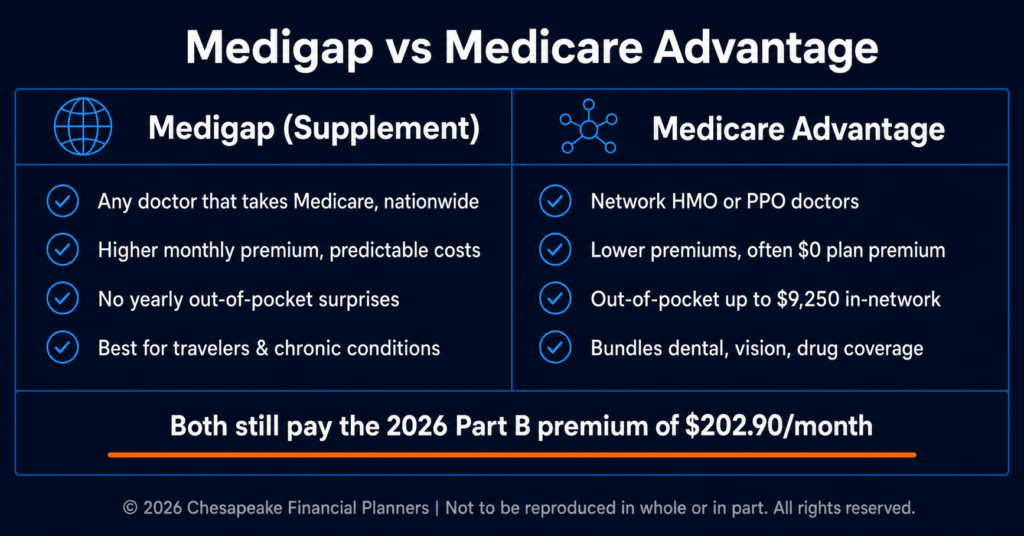
Choosing between Medigap and Medicare Advantage comes down to a single trade-off: predictable costs and nationwide doctor access (Medigap) versus lower upfront premiums and bundled extras like dental and vision (Medicare Advantage). Medigap pairs with Original Medicare and lets you see any doctor who accepts Medicare. Medicare Advantage replaces Original Medicare with a private plan that uses networks and often requires referrals. The right answer depends on your health, your budget, and how much you travel.
Key Takeaways
- Medigap offers nationwide access to any Medicare-accepting doctor; Medicare Advantage restricts you to a plan network.
- The standard 2026 Medicare Part B premium is $202.90 per month, which both paths require.
- Medicare Advantage out-of-pocket maximums can reach $9,250 in-network for 2026, a real risk in a bad health year.
- Switching from Advantage back to Medigap later may require medical underwriting in most states.
About the Author: Jeff Judge, CFP®, AEP®, ChFC®, CLU® is Managing Partner of Chesapeake Financial Planners in Forest Hill, Maryland. He has been helping families and business owners in Harford County and the Baltimore metro area navigate Medicare and retirement healthcare decisions since earning his CFP® certification in 2013, by using Chesapeake Financial Planners’ signature process, the R.U.D.D.E.R. method™. Jeff often tells clients that the Medigap-versus-Advantage choice is less about this year's premium and more about which path keeps its doors open if your health changes a decade from now.
This decision trips up smart people every year. The marketing for Medicare Advantage is loud, the premiums look low, and the extras sound great. But the structure underneath matters more than the brochure. Here is how to work through it step by step.
Step 1: Understand What Each Option Actually Is
Before you compare costs, get the structure straight. Medigap (also called Medicare supplement insurance) is a private policy that sits on top of Original Medicare, Parts A and B. It pays some or all of the deductibles, copays, and coinsurance that Original Medicare leaves you owing. You keep Original Medicare and add a Part D prescription plan separately.
Medicare Advantage (Part C) is different. A private insurer takes over your Medicare coverage entirely. You still pay your Part B premium, but the plan administers your benefits, usually through an HMO or PPO network, and most plans bundle in drug coverage plus extras like dental, vision, and hearing.
The core difference is access. With Medigap and Original Medicare, you can see any provider in the country who accepts Medicare, and that is the vast majority of physicians. With Medicare Advantage, you are limited to that plan's network, and networks change. In Jeff's experience with pre-retirees, the people who regret an Advantage plan are almost always the ones whose specialist left the network the year they needed that specialist most. Jeff Judge notes: "Networks look fine on paper until the oncologist or cardiologist you actually need isn't in them anymore, and with Medicare Advantage you may have no out-of-network option at a reasonable cost — that's the risk Original Medicare with a Medigap plan eliminates entirely."
Step 2: Compare the Real Costs Side by Side
Premiums tell only part of the story. You have to look at the total potential outlay in a bad year, not just the monthly bill in a good one.
Both paths require the standard 2026 Part B premium of $202.90 per month, and both can be affected by income-related surcharges. The annual Part B deductible for 2026 is $283. After that, the structures diverge sharply.
| Factor | Medigap + Original Medicare | Medicare Advantage |
|---|---|---|
| Monthly premium | Higher (varies by plan and age) | Often $0 beyond Part B |
| Out-of-pocket predictability | High; many costs covered | Lower; copays add up |
| 2026 in-network out-of-pocket max | Not applicable | Up to $9,250 in-network |
| Provider access | Any Medicare provider nationwide | Plan network only |
| Drug coverage | Separate Part D plan | Usually bundled |
| Extras (dental, vision) | Not included | Often included |
A Medigap policy costs more each month, but it caps your exposure. A Medicare Advantage plan can cost nothing extra in a healthy year and several thousand dollars in a year with surgery or a long hospital stay. The 2026 maximum out-of-pocket limit for in-network Advantage care can run to $9,250, and combined in-and-out-of-network limits run higher still.
Step 3: Weigh Your Health, Travel, and Provider Needs
This is where the decision gets personal. Run through these questions honestly.
Do you travel often or split time between states? Medigap travels with you because Original Medicare is accepted nationwide. Most Advantage plans are tied to a regional network, so care outside that area may not be covered except in emergencies.
Do you have a chronic condition or see specialists regularly? Medigap removes the referral and network friction. Advantage plans often require referrals and prior authorization, and prior authorization requests in Medicare Advantage were denied at a meaningful rate, creating delays when you can least afford them.
Are you generally healthy and budget-conscious right now? Advantage can be a reasonable fit, especially if you value the bundled dental and vision. Just understand you are trading predictability for lower premiums.
How Much Should I Budget for Healthcare Costs in Retirement?
Step 4: Time Your Enrollment to Protect Your Options
Timing is the most overlooked part of this decision, and it is the one with the highest cost if you get it wrong.
When you first enroll in Medicare Part B at 65, you get a six-month Medigap open enrollment window during which insurers must sell you any Medigap policy regardless of your health. This is guaranteed issue. Miss it, and in most states an insurer can use medical underwriting, charge you more, or decline you entirely.
Here is the trap. If you choose Medicare Advantage first because the premium is low, then try to switch to Medigap years later when your health declines, you may no longer qualify for guaranteed issue. Maryland and a handful of other states offer broader protections, but most do not. Jeff has watched clients box themselves in this way. The Advantage plan looked cheaper at 65, and by 72 they could not get the Medigap coverage they suddenly needed.
The Medicare Open Enrollment period runs October 15 to December 7 each year and lets you change Advantage or Part D plans, but it does not restore guaranteed-issue Medigap rights. Review your coverage every fall regardless of which path you chose.
What do you need to review and change during Medicare open enrollment?


Step 5: Account for Income-Related Premium Surcharges
If your retirement income is meaningful, your Medicare premiums will be too. The income-related monthly adjustment amount, or IRMAA, adds surcharges on top of your Part B and Part D premiums once your modified adjusted gross income crosses certain thresholds.
For 2026, IRMAA surcharges begin for single filers and married couples above the base income thresholds set by CMS, and the surcharge climbs in tiers. This matters for the Medigap-versus-Advantage choice because IRMAA applies under both. It is driven by your tax return from two years prior, so a large Roth conversion or capital gain at 63 can raise your Medicare premiums at 65.
This is exactly the kind of interaction the R.U.D.D.E.R. Method™, Chesapeake Financial Planners' six-step planning process of Review and Recognize, Uncover and Understand, Design and Develop, Discuss and Decide, Execute and Empower, and Reassess and Refine, is built to catch before it becomes an expensive surprise.
How do Roth conversions affect IRMAA and Medicare Part B premiums?
What Is the Best Medigap Plan for New Medicare Beneficiaries?
Frequently Asked Questions
Is Medigap or Medicare Advantage better for someone who travels a lot?
Medigap is better for frequent travelers. Because it pairs with Original Medicare, you can see any provider nationwide who accepts Medicare, with no regional network restriction. Medicare Advantage plans are usually tied to a local network, so routine care outside your service area often is not covered except in emergencies.
Can I switch from Medicare Advantage back to Medigap later?
You can try, but it is not guaranteed. Outside your initial six-month Medigap open enrollment window, most states allow insurers to use medical underwriting, which means they can charge more or decline coverage based on your health. A few states, including Maryland, offer broader protections, but you should never assume the door stays open.
Does Medicare Advantage cost less than Medigap?
Medicare Advantage often costs less in monthly premiums, frequently $0 beyond your Part B premium. But in a year with major medical needs, out-of-pocket costs under Advantage can reach the in-network maximum, up to $9,250 for 2026. Medigap costs more monthly but caps your exposure far more tightly, making total annual cost more predictable.
Do I still pay the Part B premium with Medicare Advantage?
Yes. Whether you choose Medigap or Medicare Advantage, you must continue paying the standard 2026 Part B premium of $202.90 per month, plus any income-related surcharge that applies to you. Medicare Advantage does not replace your Part B premium; it administers your benefits while you keep paying Part B.
Which option includes prescription drug coverage?
Most Medicare Advantage plans bundle prescription drug coverage into the plan automatically. With Medigap, drug coverage is separate; you must enroll in a standalone Part D plan to cover prescriptions. If you choose Medigap and skip Part D when first eligible, you may face a permanent late-enrollment penalty later.
Ready to Get This Decision Right?
The Medigap-versus-Advantage choice shapes your healthcare access and costs for the rest of your retirement, and it interacts with your taxes, your income, and your timing in ways a brochure will never show you. Jeff Judge and the Chesapeake team serve families and business owners across Harford County and the Baltimore metro. Schedule a free fit call at chesapeakefp.com to weigh medigap vs medicare advantage against your full retirement picture before open enrollment closes.
Want to go deeper? Our Medicare and Social Security Guide walks through this step by step.
Disclosures
The information provided is for educational purposes only and should not be construed as investment advice. Investment strategies should be tailored to individual circumstances, risk tolerance, and goals. Past performance doesn't guarantee future results. Consult with qualified financial professionals regarding your specific situation.
Advisors associated with Chesapeake Financial Planners may be either (1) LPL Financial Registered Representatives offering securities through LPL Financial, Member FINRA and SIPC, and investment advisor representatives offering investment advice through Great Valley Advisor Group; or (2) solely investment advisor representatives offering investment advice through Great Valley Advisor Group and not affiliated with LPL Financial. Great Valley Advisor Group, and Chesapeake Financial Planners are separate entities from LPL Financial.


