Financial Planning for Business Owners
Your Business Has a Strategy—Why Doesn’t Your Wealth?
Financial guidance that helps you turn business success into personal freedom with less guesswork and more confidence.

Featured In


























You’ve built something remarkable, but your financial life behind the scenes may not feel quite as organized. From unpredictable cash flow to tax headaches, retirement avoidance, and the weight of having to figure it all out yourself. Being a business owner or entrepreneur often means flying without a financial co-pilot. That’s where we come in. We meet you where you are, help you separate personal from business finances, and create a plan that’s built for both growth and eventual freedom. Whether you’re in scale mode, planning a sale, or somewhere in between, you’ll have a clear path forward and a trusted guide who speaks your language and respects your time. No judgment. No jargon. Just smart, personalized strategy that puts you back in control.
Without a clear financial strategy, you’re left making high-stakes decisions on the fly, juggling business and personal expenses, second-guessing tax moves, and putting off retirement or exit planning for “someday.” That mental load adds up. You might be overpaying taxes, building wealth inefficiently, or missing out on opportunities to make your business more sellable. And perhaps most importantly, you’re doing it all alone, without a trusted partner to help you step back, see the full picture, and chart the right course forward.
Key Benefits

Confidence in Where Your Money’s Going
No more second-guessing or mixing business with personal. You’ll finally have clear financial boundaries and peace of mind that it’s all organized.

Fewer Tax Surprises
You’ll stop holding your breath at tax time. With a proactive plan, you’ll know what’s coming and keep more of what you earn.

A Business That's Ready for Whatever's Next
Whether you're scaling, stepping back, or prepping to sell, you'll know your business (and your finances) are set up to support the next chapter.

Less Mental Load, More Focus
You don’t have to carry the weight of every financial decision. You’ll have a thinking partner to help you navigate complexity and stay on track.

A Personal Wealth Plan That Actually Works
Your business is thriving—but what about you? We make sure your financial life outside the business is growing, protected, and aligned with what matters most.

He helped me consolidate several accounts into one manageable asset. He took the guesswork out of what could have been a complicated process.
I trust him to be there and guide me through issues in which I have no expertise. But he does this all the time and has proven to be trustworthy.
I do recommend Mr. Judge. You will not be disappointed.


Frequently Asked Questions
If you’re a business owner without access to a traditional 401(k), the good news is—you actually have more flexible, powerful options to build retirement wealth.
Here are a few common tools we use with clients:
- SEP IRA:
Simple, low-cost option that lets you contribute up to 25% of your net business income (up to $69,000 in 2024).
- Solo 401(k):
Ideal for owner-only businesses. Offers higher contribution limits than a SEP and allows Roth contributions and loan features.
- Defined Benefit Plans or Cash Balance Plans:
Great for high-income earners who want to rapidly accelerate retirement savings—especially in their 50s and 60s.
- Taxable investment accounts:
While not tax-deferred, these offer full flexibility, long-term capital gains treatment, and access before age 59½ without penalties.
- Business exit or liquidity planning:
For many owners, their business is their biggest asset. We help turn that into a reliable income stream when the time is right.
At Chesapeake, we tailor retirement strategies to your income, goals, and business structure—then adjust as you grow.
Selling a business can create significant wealth—but also a substantial tax bill if not planned carefully. The key is proactive, integrated planning—before the sale happens.
Here are strategies we use to help clients reduce or defer taxes:
- Entity structure review
Whether you’re an LLC, S-Corp, or C-Corp can drastically affect how the sale is taxed.
- Installment sales
Spreading payments over multiple years may reduce your tax bracket and spread out the hit.
- Qualified Small Business Stock (QSBS) exclusion
If you meet certain conditions, you may exclude up to $10M in gains—or more—from federal taxes.
- Charitable planning
Donating part of your business to a Donor-Advised Fund or Charitable Remainder Trust before the sale can reduce capital gains and support causes you care about.
- Coordinated tax and investment planning
Timing matters—especially when coordinating business income, capital gains, retirement contributions, and your broader financial plan.
At Chesapeake, we work alongside your CPA and attorney to create a personalized exit strategy that preserves more of your wealth—so your next chapter starts stronger.
The best exit strategy is the one that aligns with your financial goals, family dynamics, business structure, and long-term vision.
There’s no one-size-fits-all answer—but here are some common paths we help business owners evaluate:
- Sell to a third party
This could mean a strategic buyer, private equity, or competitor. Seeks to optimize value—but may come with culture or legacy trade-offs.
- Family succession
Transferring the business to children or relatives can preserve legacy—but requires careful planning around ownership, taxes, and fairness among heirs.
- Management or employee buyout (ESOP or MBO)
Keeps continuity and rewards loyal team members—but financing and structure matter.
- Liquidation or wind-down
Sometimes the cleanest path—especially for small service businesses or sole proprietors nearing retirement.
- Partial sale or phased exit
Step back gradually, take chips off the table, and retain income or advisory roles.
What’s “best” depends on what you value most—cash, control, legacy, or lifestyle. We help you evaluate trade-offs, protect your family’s financial future, and coordinate the legal, tax, and planning pieces so nothing gets missed.
Chesapeake Financial Planners, Great Valley Advisors, and LPL Financial do not provide tax or legal advice or services.
Years before you plan to sell.
The sooner you understand your business’s value, the more time you have to improve it—and the more leverage you’ll have when the time comes.
Here’s why early value estimates matters:
- Uncovers value gaps—so you can fix them before buyers do
- Helps with tax planning—especially if gifting or trust strategies are involved
- Supports retirement and exit planning—your business may be your largest asset
- Sets a realistic timeline—and avoids last-minute surprises
- Improves negotiating power—when you know what your business is actually worth
At Chesapeake, our goal is to help business owners integrate value estimates into their long-term financial plan—so your exit isn’t just profitable, it’s strategic and intentional.
Even if you’re not ready to sell yet, understanding your business’s worth is one of the smartest moves you can make.
Yes—and for many business owners, your business is your single biggest retirement asset. But turning it into reliable retirement income takes careful planning.
Here are a few strategies that can help clients make that transition:
- Max out tax-advantaged plans
Use tools like a Solo 401(k), SEP IRA, or defined benefit plan to shelter income while building a personal retirement nest egg.
- Strategic business sale
A well-planned sale can generate a lump sum or structured payout to fund retirement—but tax planning and timing are critical.
- Ongoing income from the business
You may be able to retain equity or take on an advisory role post-exit for continued cash flow.
- Gifting or succession planning
If family is taking over, your income may shift from ownership to structured retirement payments or buyout agreements.
- Diversify before the exit
We often help owners gradually move profits into personal investments, reducing reliance on the business for retirement.
At Chesapeake, our goal is to help business owners turn their life's work into lasting financial well-being—without leaving money (or clarity) on the table.
It depends—but probably not what your gut (or your accountant) tells you.
Your business’s true market value depends on several factors:
- Earnings (especially EBITDA or SDE)
- Industry and market conditions
- Recurring revenue and growth potential
- Owner dependence (can it run without you?)
- Systems, staff, and customer concentration
- Comparable sales in your niche
Valuation multiples vary widely—from 2× to 10× earnings—based on risk, scalability, and buyer appetite.
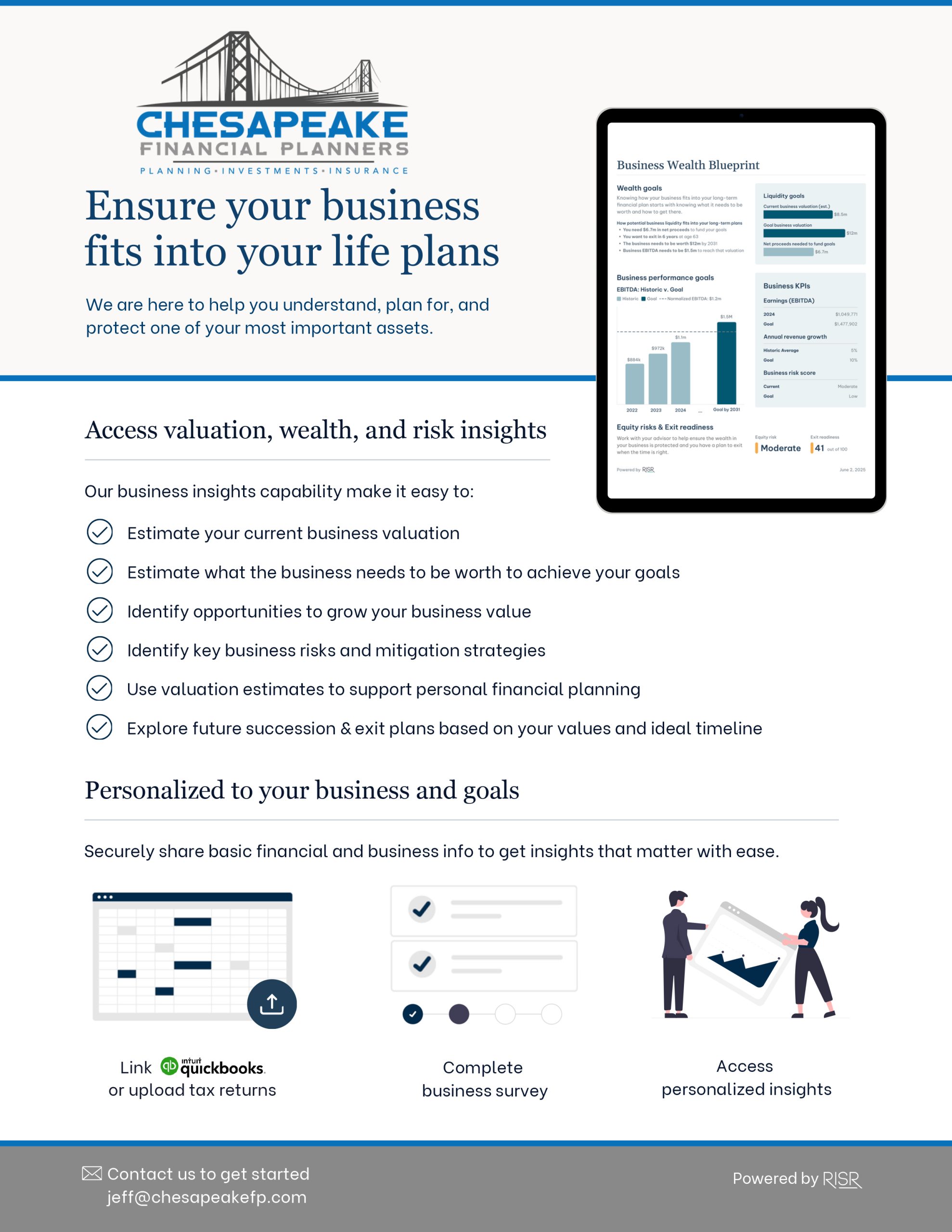
At Chesapeake, we don’t just throw out a number, we provide business value estimates using LPL approved software and help you:
- Get a realistic, value estimates using the software or defensible value estimates from a qualified business appraiser.
- Identify what’s driving—or dragging down—your value
- Create a game plan to grow that value before selling
- Coordinate the tax and financial planning needed for a smooth transition
If you’re within 5–10 years of selling, now’s the time to get serious about what your business is really worth.
The best strategy depends on how your business is structured, your income needs, and your timeline. But the goal is always the same: seek to optimize value, minimize taxes, and create sustainable income.
Here are some common strategies we help clients explore:
- Sell the business outright
A full sale to a third party or strategic buyer can generate a large lump sum to fund your retirement. Planning ahead helps reduce taxes and increase value.
- Set up a buyout agreement
If transitioning to family or employees, you can structure payments over time for steady income and potentially favorable tax treatment.
- Take profits out gradually
Shift income from salary to distributions, rent, or dividends—depending on your entity type—to reduce taxes and start building personal wealth before the sale.
- Use tax-advantaged retirement plans
Max out your Solo 401(k), SEP IRA, or even set up a cash balance plan to pull money out while deferring taxes.
- Create a liquidity strategy
Diversify profits into a personal investment portfolio early so you’re not entirely dependent on a big sale.
At Chesapeake, our goal is to help you design a retirement income strategy that treats your business as a valuable wealth-building asset—without leaving money on the table.
This is one of the most common—and most critical—questions for business owners. If most of your net worth lives inside your business, you don’t just need a retirement plan—you need an exit strategy.
Here's how we help you bridge the gap between business equity and retirement independence:
- Start with a business value estimate
Know what your business is worth now—and what could increase that value before you sell.
- Build personal wealth before the sale
Use tax-advantaged retirement plans, owner distributions, and smart investment strategies to gradually shift some wealth out of the business.
- Create an exit strategy that aligns with your life
Whether you're planning a full sale, family transition, or phased exit, timing and structure matter.
- Coordinate tax and income planning
A large liquidity event can create a huge tax bill. Our goal is to help reduce that with proactive strategies—like installment sales, trusts, or charitable planning.
- Stress-test your retirement income
We model different sale values, tax outcomes, and withdrawal strategies to ensure your business exit can fully support your future lifestyle.
At Chesapeake, we specialize in helping owners turn years of hard work into long-term financial independence—with clarity, control, and confidence.
That depends on how well you’ve planned—but without a clear strategy, the answer could be: confusion, chaos, or lost value.
If you’re the key decision-maker and income driver, your business could face:
- Disruption to clients, cash flow, and operations
- Conflicts among family, partners, or staff
- Forced sale or liquidation under pressure
- Lost value if there’s no succession or continuity plan
Here’s how we aim to help clients avoid that outcome:
- Create a clear succession or continuity plan
Outline who steps in, what happens to ownership, and how decisions are made.
- Review and update your operating agreement or buy-sell plan
Especially if you have business partners or family involved.
- Set up appropriate insurance
Key person insurance or life insurance can provide liquidity to keep the business afloat—or help family buy time and options.
- Incorporate your business into your estate plan
Make sure your legacy is protected, not lost in probate or tied up in tax issues.
At Chesapeake, we help business owners protect what they’ve built—and the people they care about—long before something unexpected happens.
The most tax-efficient exit depends on your business structure, timing, and long-term goals—but the key is planning well before the sale. Waiting until after an offer is on the table is often too late to capture the biggest savings.
Here are strategies we help business owners explore:
- Entity structure optimization
The way your business is taxed (LLC, S-Corp, C-Corp) has a major impact on how proceeds are taxed—capital gains vs. ordinary income.
- Qualified Small Business Stock (QSBS) exclusion
If eligible, this strategy can exclude up to $10M (or more) in capital gains from federal taxes. Timing and structure matter.
- Installment sales
Spread payments (and taxes) over time to reduce bracket creep and preserve cash flow.
- Charitable planning
Donating shares before the sale—via a Donor-Advised Fund or Charitable Remainder Trust—can significantly reduce capital gains and support causes you care about.
- Family or trust strategies
Gifting business interest ahead of the sale may reduce estate tax exposure and transfer wealth efficiently.
- Coordinated tax and financial planning
We work closely with your CPA, attorney, and valuation team to design a plan that strives to minimize friction—and maximizes your net after-tax proceeds.
At Chesapeake, we specialize in exit strategies that aims to turn business equity into long-term, tax-efficient wealth—for you and your family.
*Advisors are only obligated to apply the fiduciary standard in advisory relationships. They are not legally obligated to apply the fiduciary standard when working in Brokerage only relationships
**Mark Rossbach is the only advisor who has attained the RICP and CPA Designations and Jeff Judge is the only advisor who has attained the CFP, ChFC and CLU Designations