

How Do I Care for Aging Parents Without Ruining My Retirement?
Last reviewed: July 2026
Caring for aging parents means protecting their well-being and your own retirement at the same time, and the way you do that is by setting a firm contribution budget before the costs start, keeping your own retirement contributions running, and pulling in family, government programs, and tax breaks to spread the load. You cannot borrow for retirement the way your kids borrow for college, so the money you give up during caregiving years rarely comes back. The families who handle this well decide what they can afford up front instead of writing checks reactively.
Key Takeaways
- Set a fixed caregiving budget before costs begin so you never raid your own retirement savings to cover a gap.
- Family caregivers spend roughly $7,200 a year out of pocket, per AARP, on top of unpaid time.
- Medicare does not cover custodial long-term care, the kind most seniors eventually need, so plan that cost separately.
- Medicaid, Veterans Aid and Attendance, and the medical expense deduction can offset a large share of eldercare costs.
About the Author: Jeff Judge, CFP®, AEP®, ChFC®, CLU® is Managing Partner of Chesapeake Financial Planners in Forest Hill, Maryland. He has been helping families and business owners in Harford County and the Baltimore metro area navigate eldercare and retirement planning since earning his CFP® certification in 2013, by using Chesapeake Financial Planners’ signature process, the R.U.D.D.E.R. method™. Jeff sees the same pattern again and again: the adult child who quietly absorbs every cost is usually the one who ends up financially short a decade later, and almost always it is a daughter.
This is the heart of the sandwich generation problem. You are supporting aging parents and often your own kids while trying to fund a retirement that nobody else will fund for you. The good news is that family caregiver financial planning is solvable with a plan that names the real numbers and assigns the real work.
What Does Caring for Aging Parents Actually Cost?
The cost of caring for aging parents splits into direct costs you can see and hidden costs you feel later. AARP estimates the average family caregiver spends about $7,200 per year out of pocket, and that figure does not capture the biggest expenses or the lost income behind them.
Direct costs include home modifications for aging in place, home health aides or adult day programs, assisted living or memory care, medical bills not covered by insurance, transportation, medications, and equipment. According to Genworth's Cost of Care Survey, the national median cost of a private nursing home room and assisted living facility runs into the thousands of dollars per month, which can drain a parent's savings quickly.
Hidden costs are the ones that quietly damage your own retirement. They include lost wages if you cut hours or leave a job, lower future Social Security benefits from reduced earnings years, retirement contributions you skip during caregiving, a delayed retirement date, and the health toll of caregiver stress. For women already facing a retirement savings gap, absorbing these costs without a plan compounds the problem.
A reader who only reads this section should leave knowing one thing: the visible bills are not the expensive part. The career and contribution gaps are.
How Do I Protect My Own Retirement While Helping My Parents?
Protect your own retirement by setting a hard contribution ceiling, continuing to fund your retirement accounts throughout the caregiving years, and refusing to drain your emergency fund or take on debt to cover parent care. Decide in advance the maximum dollar amount you can give without compromising your own future, and treat that number as a fixed line, not a starting point.
Keep contributing to your 401(k) or IRA even while helping parents. Those caregiving years are often your highest-earning years, and the compounding you skip now is the hardest to replace. If you must reduce work hours, understand the long-term hit to your Social Security benefit, which is calculated from your highest 35 earning years. A few years of zero or reduced earnings can lower that benefit permanently.
This is where Jeff's R.U.D.D.E.R. Method™ helps families think clearly. The R.U.D.D.E.R. Method™ is Chesapeake Financial Planners' six-step planning process: Review and Recognize, Uncover and Understand, Design and Develop, Discuss and Decide, Execute and Empower, and Reassess and Refine. The "Discuss and Decide" step is where eldercare contribution limits get set as real numbers instead of vague intentions. Jeff often tells clients that the most generous thing they can do for their children is to not become a financial burden themselves later, which means guarding their own plan even while they help their parents.
If your retirement timeline is already tight, walk through What Should You Prioritize Financially in the 5 Years Before Retirement? before you commit to large parent-care contributions.
What Resources and Tax Breaks Reduce Eldercare Costs?
Several government programs and tax benefits cut the cost of caring for aging parents, and most families never use all of the ones they qualify for. Medicaid covers long-term care for parents who meet income and asset limits, and many states run Medicaid waiver programs that pay for care at home instead of in a nursing facility. Veterans Aid and Attendance benefits may apply if your parent served in the military.
On the tax side, the IRS medical expense deduction lets you deduct qualified medical costs that exceed 7.5% of your adjusted gross income, and parent care expenses can count if you provide more than half their support. If you cover more than half a parent's support, you may be able to claim them as a qualifying relative dependent. A Dependent Care FSA may help if your parent lives with you and you pay for care so you can work. Jeff Judge notes: "Most families I meet have never checked whether they can claim a parent as a qualifying relative dependent, and that single oversight can cost them thousands in deductions they were fully entitled to take."
Community resources often deliver support at far lower cost than private options: adult day programs, meal delivery, respite care that gives caregivers a break, and subsidized transportation to appointments. The Eldercare Locator from the U.S. Administration for Community Living connects families with local services by ZIP code.
Long-term care planning deserves its own conversation. If your parents lack coverage, review What is long-term care insurance and do I need it? and the What Are the Best Alternatives to Long-Term Care Insurance? before assuming insurance is off the table.
How Should Siblings Share the Cost of Caring for Parents?
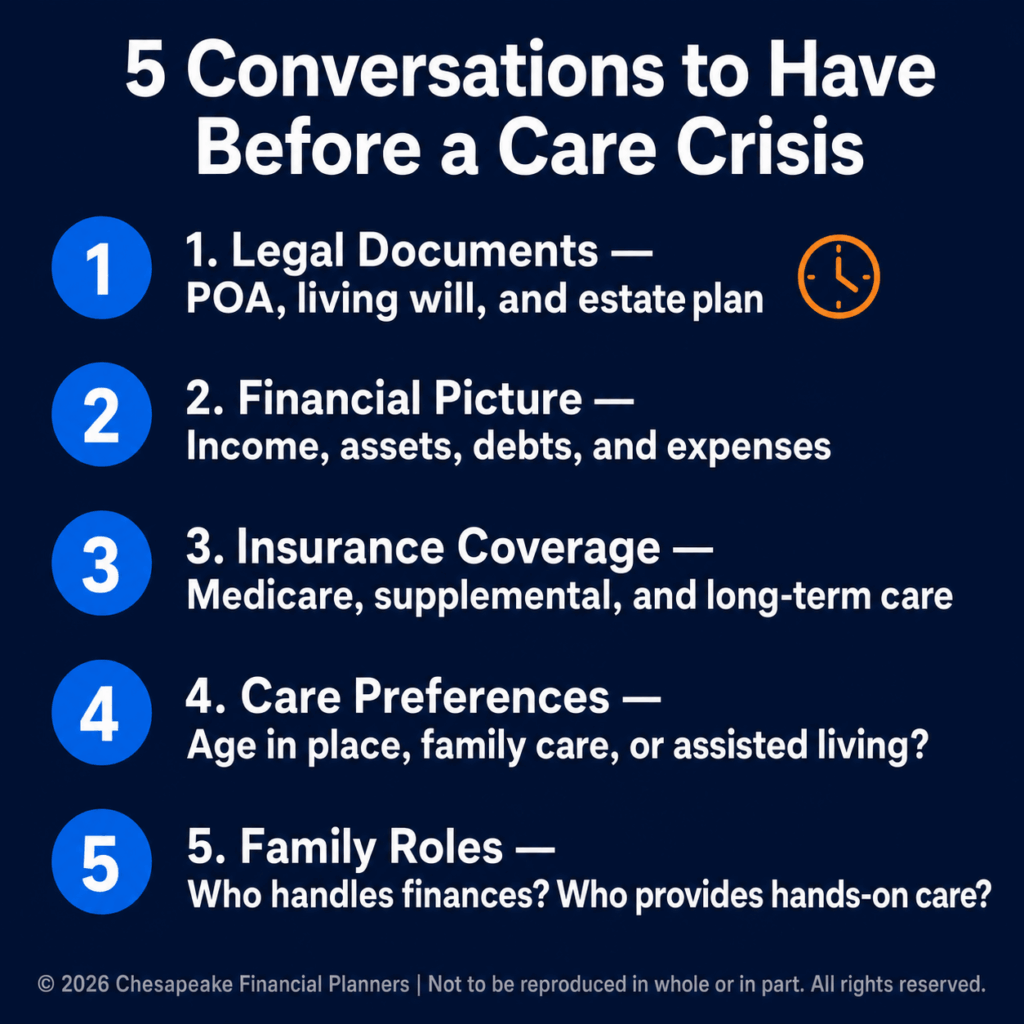
Siblings should share parent care through an explicit, written agreement that assigns both money and hands-on work, because the default is that one person absorbs everything. Hold an honest family meeting early. One sibling may be better positioned to contribute financially while another provides daily care and a third handles administration, insurance claims, and legal coordination.
Decide how costs get split. Will everyone contribute proportionally to income? Will those who cannot pay provide more direct care? Will you spend the parents' own assets first before children contribute? Document these decisions. Clear roles reduce resentment and stop the entire load from landing on one person, which, as Jeff has watched for years, too often lands on a daughter who then sacrifices her own retirement quietly.
This is also the moment to confirm the legal documents exist: financial and healthcare powers of attorney, a living will, and current estate documents. If those are missing, making them a priority protects the whole family before a crisis forces rushed decisions.
Frequently Asked Questions
Does Medicare pay for long-term care for my parents?
No, Medicare does not pay for custodial long-term care, which is the help with bathing, dressing, and daily living that most seniors eventually need. Medicare covers short skilled-nursing stays and home health under narrow conditions, but ongoing custodial care falls to Medicaid, long-term care insurance, or family resources.
How much do family caregivers spend out of pocket?
Family caregivers spend roughly $7,200 per year out of pocket on average, according to AARP, covering items like home modifications, medications, transportation, and care services. That figure excludes the larger hidden cost of lost wages and reduced retirement contributions, which often dwarfs the direct spending for caregivers who cut back at work.
Can I claim my aging parent as a dependent on my taxes?
Yes, you may claim a parent as a qualifying relative dependent if you provide more than half of their total support for the year and they meet the IRS gross income limit. You do not have to live together. Claiming a parent can also unlock medical expense deductions for costs you paid on their behalf.
Should I reduce my retirement contributions to help my parents?
No, you should generally keep funding your retirement accounts while helping parents, because you cannot borrow for retirement and the compounding you skip during peak earning years is the hardest to recover. Set a fixed caregiving budget instead, and fund parent care only from money beyond your retirement savings target.
What government programs help pay for aging parent care?
Medicaid covers long-term care for parents who meet income and asset limits, and many states offer Medicaid waivers that fund care at home. Veterans Aid and Attendance benefits help eligible wartime veterans and surviving spouses. The Eldercare Locator from the Administration for Community Living connects families with local low-cost support services by ZIP code.
How do I get my siblings to share caregiving costs fairly?
Hold an early family meeting and put a written agreement in place that assigns both money and hands-on duties. Decide whether contributions are proportional to income, whether non-paying siblings provide more direct care, and whether you spend the parents' assets first. Documenting these terms prevents the load from defaulting onto one sibling.
At Chesapeake Financial Planners, eldercare and the sandwich generation squeeze come up in client conversations almost every week, and the families who plan ahead protect both their parents and their own retirement. If this was helpful, our guide on building a coordinated care-and-retirement plan walks through the budgeting and tax steps in depth. Download it at chesapeakefp.com to start caring for aging parents without putting your own future at risk.
Want to go deeper? Our 10 Signs You're Ready for a Certified Financial Planner walks through this step by step.
Disclosures
The information provided is for educational purposes only and should not be construed as investment advice. Investment strategies should be tailored to individual circumstances, risk tolerance, and goals. Past performance doesn't guarantee future results. Consult with qualified financial professionals regarding your specific situation.
This information is not intended to be a substitute for specific individualized tax, investment or legal advice. We suggest that you discuss your specific situation with a qualified tax, legal or financial advisor.
Advisors associated with Chesapeake Financial Planners may be either (1) LPL Financial Registered Representatives offering securities through LPL Financial, Member FINRA and SIPC, and investment advisor representatives offering investment advice through Great Valley Advisor Group; or (2) solely investment advisor representatives offering investment advice through Great Valley Advisor Group and not affiliated with LPL Financial. Great Valley Advisor Group, and Chesapeake Financial Planners are separate entities from LPL Financial.


