

What Are the Different Parts of Medicare and What Do They Cover?
Last reviewed: July 2026
Medicare has four parts, and each one covers something different. Part A covers hospital care, Part B covers doctor visits and outpatient care, Part C (Medicare Advantage) bundles A and B through a private plan, and Part D covers prescription drugs. Understanding how these Medicare parts fit together is the difference between smooth coverage and a lifetime of avoidable penalties. Most people turning 65 assume Medicare is one program. It isn't, and that misunderstanding costs real money.
On This Page
- Key Takeaways
- Medicare Part A: What Does Hospital Insurance Cover?
- Medicare Part B: What Does Medical Insurance Cover?
- Medicare Part C: How Does Medicare Advantage Work?
- Medicare Part D: How Does Prescription Drug Coverage Work?
- Original Medicare vs. Medicare Advantage: Which Should You Choose?
- How Do Medicare Enrollment Periods and Penalties Work?
- Where Does Medicare Fit in Your Retirement Income Plan?
- Frequently Asked Questions
- Bringing It All Together
- Disclosures
Key Takeaways
- Medicare has four parts: A (hospital), B (medical), C (Medicare Advantage), and D (prescription drugs), each with separate rules and costs.
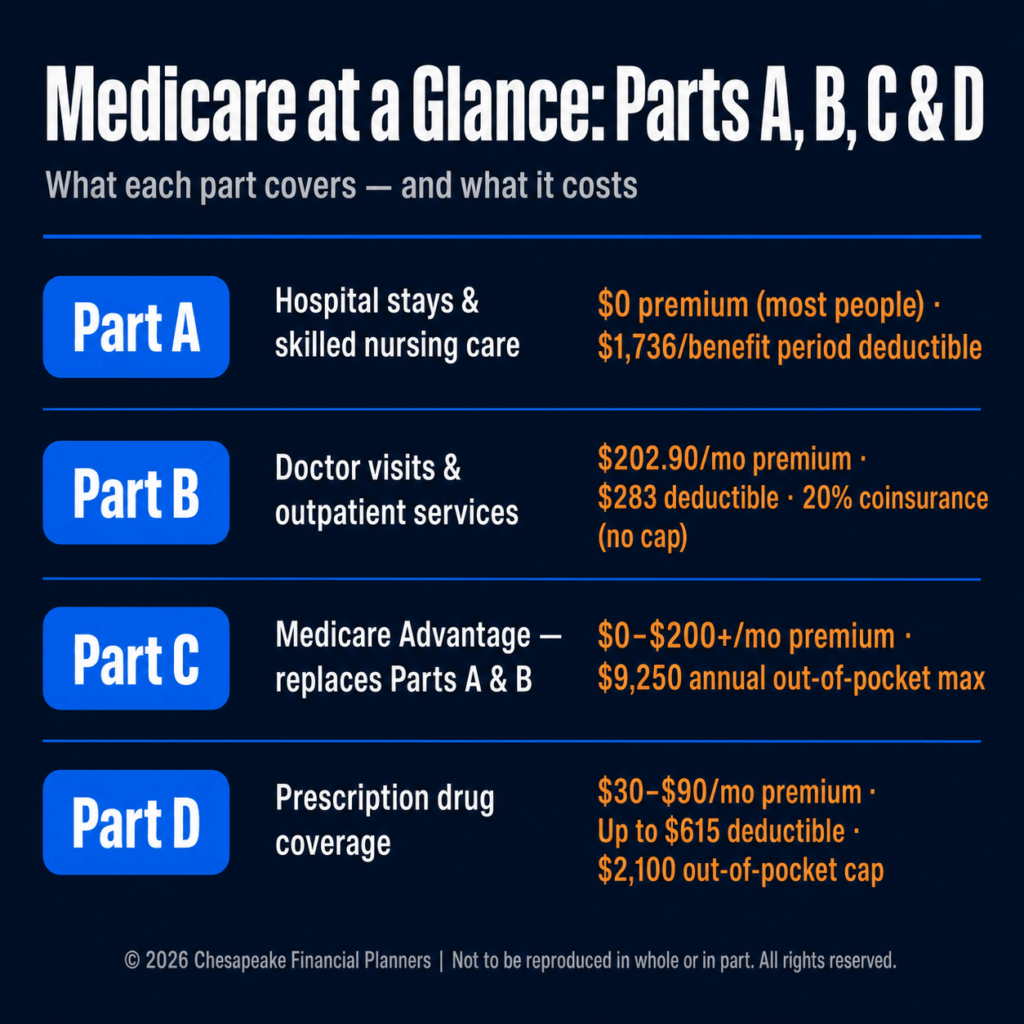
- Most people pay no Part A premium, but the standard Part B premium is $202.90 per month in 2026.
- Missing your Part B enrollment window triggers a 10% lifetime penalty for every 12 months you delay without creditable coverage.
- Part D out-of-pocket drug costs are now capped at $2,100 in 2026 thanks to the Inflation Reduction Act.
- High earners pay IRMAA surcharges on Parts B and D based on income from two years prior.
About the Author: Jeff Judge, CFP®, AEP®, ChFC®, CLU® is Managing Partner of Chesapeake Financial Planners in Forest Hill, Maryland. He has been helping families and business owners in Harford County and the Baltimore metro area navigate Medicare and retirement income decisions since earning his CFP® certification in 2013, by using Chesapeake Financial Planners’ signature process, the R.U.D.D.E.R. method™. Jeff has watched more clients get tripped up by Medicare's enrollment deadlines than by any investment decision they've ever made.
Medicare Part A: What Does Hospital Insurance Cover?
Part A is Medicare's hospital insurance. It covers inpatient hospital stays, skilled nursing facility care that follows a qualifying hospital stay, hospice care, and some home health services. If you read only this section, here's the headline: Part A handles the big, acute events, not the everyday medical care.
Most people pay no premium for Part A. You earned it. If you or your spouse paid Medicare payroll taxes for at least 10 years (40 quarters) while working, your Part A premium is zero. If you don't have enough work history, you can buy in, but it gets expensive fast. According to the Centers for Medicare & Medicaid Services, people with fewer than 30 quarters of coverage pay up to $522 per month for Part A in 2026.
What does Part A actually pay for?
Part A coverage breaks down into four buckets, and each one has its own cost-sharing rules:
- Hospital stays: Part A covers inpatient hospital care, but you pay a deductible of $1,736 per benefit period in 2026, plus coinsurance for extended stays beyond 60 days.
- Skilled nursing: Covers up to 100 days in a skilled nursing facility after a qualifying three-day inpatient hospital stay. Days 1 through 20 are fully covered. Days 21 through 100 require coinsurance of $217 per day in 2026.
- Hospice: Covers hospice care for terminally ill patients with very limited cost-sharing.
- Home health: Covers medically necessary skilled care at home following a hospital or skilled nursing facility stay.
The most dangerous gap in Part A is what it does not cover. Part A does not pay for long-term custodial care, meaning help with bathing, dressing, eating, and other activities of daily living when you don't need skilled medical care. This is the single most expensive care gap retirees face, and it's why long-term care planning sits on a separate track from Medicare entirely. Jeff Judge often reminds clients that Medicare was never designed to cover years of assisted living or memory care. Families who assume otherwise discover the truth at the worst possible moment.
When does Part A enrollment happen automatically?
Part A enrollment is automatic if you're already collecting Social Security benefits when you turn 65. If you're not collecting Social Security yet, which is increasingly common as people delay benefits, you have to actively enroll during your Initial Enrollment Period. That window runs the three months before your birth month, your birth month, and the three months after.
What is long-term care insurance and do I need it?
Medicare Part B: What Does Medical Insurance Cover?
Part B is medical insurance, and it covers the care you'll actually use most often: doctor visits, outpatient procedures, physical therapy, lab tests, durable medical equipment like wheelchairs and walkers, and preventive screenings. If Part A is for the hospital, Part B is for everything that happens outside the hospital.
Unlike Part A, Part B always carries a monthly premium. The standard Part B premium is $202.90 per month in 2026, but high earners pay more through Income-Related Monthly Adjustment Amounts, known as IRMAA. The Social Security Administration adjusts your premium upward once your modified adjusted gross income crosses certain thresholds, and the surcharge climbs on a sliding scale for the highest earners.
How much does Part B really cost out of pocket?
The premium is only part of the story. Here's the rest:
- Annual deductible: $283 in 2026, per the CMS fact sheet.
- Coinsurance: You typically pay 20% of the Medicare-approved amount for most services, and there is no out-of-pocket maximum on Original Medicare Part B.
- Preventive services: Many screenings, including mammograms, colonoscopies, and cardiovascular checks, are covered at no cost when you use participating providers.
That phrase "no out-of-pocket maximum" deserves a second read. Part B pays 80% after your deductible, but there's no cap on the 20% you owe. A serious illness or a long stretch of treatment can leave you with a bill that has no ceiling. This is exactly why so many people pair Original Medicare with a Medigap policy to cover those gaps.
The IRMAA trap nobody warns you about
Your Part B premium isn't based on this year's income. It's based on your tax return from two years prior. So a one-time spike in income, selling a business, a large Roth conversion, or a property sale, can inflate your Medicare premiums two years later. Jeff has seen clients accidentally trigger thousands in extra IRMAA surcharges because nobody connected the dots between a single profitable year and their future Medicare costs. The good news: if you retired recently and your income dropped, you can file Form SSA-44 to request a reduction based on a qualifying life-changing event. This interaction between income planning and Medicare premiums is one reason Roth conversion timing matters so much.
How do Roth conversions affect IRMAA and Medicare Part B premiums?
If you don't enroll in Part B when first eligible and you don't have creditable coverage like active employer insurance, you'll face a 10% premium penalty for every 12-month period you delayed. That penalty isn't temporary. It lasts for the rest of your life.
What Is the Best Medigap Plan for New Medicare Beneficiaries?
Medicare Part C: How Does Medicare Advantage Work?
Medicare Part C, better known as Medicare Advantage, is a private-plan alternative to Original Medicare. Instead of getting your coverage directly through the federal program, you get all your Part A and Part B benefits through a private insurance company that Medicare approves and pays. Roughly half of all Medicare beneficiaries now choose Advantage plans, according to KFF research.
The structure works like an HMO or PPO applied to Medicare. You typically pick a plan with a network of doctors and hospitals, and the plan manages your care. Medicare Advantage plans must cover everything Original Medicare covers, and most go further by bundling Part D drug coverage and adding extras like dental, vision, hearing, fitness memberships, and over-the-counter allowances.
What does a Medicare Advantage plan cost?
The cost picture looks different from Original Medicare:
- You still pay your Part B premium ($202.90 per month in 2026 for most people).
- Plan premiums vary widely. Some Advantage plans advertise a $0 premium; others charge $50 to $200 or more per month.
- You'll have copays or coinsurance for services, often $10 to $50 for a doctor visit and a few hundred dollars per day for a hospital stay.
- Every Advantage plan has an annual out-of-pocket maximum. In 2026 the federal limit caps in-network out-of-pocket costs, after which the plan pays 100% of covered services.
That out-of-pocket maximum is the feature Original Medicare lacks, and it's the main reason healthy budget-conscious retirees gravitate toward Advantage plans.
What's the catch with Medicare Advantage networks?
The trade-off is access. Most Advantage plans restrict you to a network of providers. Go out-of-network and you'll pay more, or you may have no coverage at all except in emergencies. Original Medicare, by contrast, lets you see any provider in the country who accepts Medicare, with no referrals. Jeff Judge tells clients to think hard about this trade before chasing a $0 premium. If you travel often, split time between states, or already see specialists at a major medical center, a network restriction can quietly undo the savings. The R.U.D.D.E.R. Method™ is Chesapeake Financial Planners' six-step planning process: Review and Recognize, Uncover and Understand, Design and Develop, Discuss and Decide, Execute and Empower, and Reassess and Refine. We run the Medicare Advantage versus Original Medicare decision through exactly that framework, because the right answer depends entirely on the person.
What Are the Different Medicare Supplement Plans and Which Is Best?

Medicare Part D: How Does Prescription Drug Coverage Work?
Part D is prescription drug coverage, delivered through private insurance plans that Medicare approves. If you stay with Original Medicare (Parts A and B) and don't have an Advantage plan that bundles drugs, you need to buy a standalone Part D plan to cover your medications. Skip it without other creditable drug coverage, and a permanent penalty kicks in.
Premiums vary by plan, generally landing between $30 and $90 per month. Just like Part B, high earners pay an IRMAA surcharge on top of the base premium once income crosses the thresholds.
How is Part D coverage structured in 2026?
The mechanics changed dramatically over the past two years. Here's where things stand:
- Deductible: Up to $615 in 2026, depending on the plan, per CMS.
- Copays and coinsurance: You pay a portion of drug costs based on tier (generic, preferred brand, non-preferred brand, specialty).
- No more donut hole: The old "donut hole" coverage gap is gone, eliminated under the Inflation Reduction Act. Standard cost-sharing now applies straight through until you hit the annual cap.
- Out-of-pocket cap: Once you spend $2,100 out of pocket on covered drugs in 2026, your plan covers 100% of covered prescription costs for the rest of the year.
That $2,100 cap is one of the most meaningful protections to land in Medicare in years. Before it existed, retirees on expensive specialty drugs could face open-ended costs running into the tens of thousands. As the Inflation Reduction Act guidance explains, the cap shields beneficiaries from catastrophic drug spending for the first time. According to CMS, beneficiaries can also opt into a payment plan that spreads those out-of-pocket costs across the year instead of paying them all at once.
Why does comparing Part D plans matter so much?
Part D plans differ wildly in which drugs they cover, which pharmacies are in-network, and how they tier medications. A drug that costs you $10 on one plan might cost $150 on another. Jeff sees clients overpay every single year simply because they auto-renewed a plan that no longer fit their prescriptions. Use the Medicare.gov Plan Finder every fall during open enrollment to confirm your plan still covers your drugs at the best price. The few minutes it takes can save hundreds of dollars.
If you don't enroll in Part D when first eligible and lack creditable prescription coverage, the penalty is 1% of the national base premium for every month you delayed. Like the Part B penalty, it follows you for life.
Medicare Open Enrollment Guide: What to Review Every October 15
Original Medicare vs. Medicare Advantage: Which Should You Choose?
This is the single biggest Medicare decision you'll make, and there's no universal right answer. The choice comes down to how you value flexibility against predictability and cost. A side-by-side comparison makes the trade-offs clear.
| Feature | Original Medicare (+ Medigap + Part D) | Medicare Advantage (Part C) |
|---|---|---|
| Provider access | Any provider nationwide that accepts Medicare | Limited to plan network, except emergencies |
| Referrals | Not required | Often required for specialists |
| Out-of-pocket maximum | None on Part B alone; Medigap fills gaps | Yes, capped annually by plan |
| Extra benefits (dental/vision) | Not included; buy separately | Often bundled |
| Monthly cost structure | Higher premiums, lower surprises | Lower premiums, copays at point of care |
| Prescription drugs | Separate Part D plan needed | Usually bundled |
| Best fit | Frequent travelers, complex conditions, flexibility seekers | Healthy retirees wanting low premiums and bundled extras |
Original Medicare paired with a Medigap supplement and a standalone Part D plan gives you maximum freedom and predictable cost-sharing, at a higher monthly premium. Medicare Advantage lowers your monthly outlay and bundles extras, but ties you to a network. The right answer depends on your health, your travel habits, and your tolerance for managing networks. One pattern Jeff sees repeatedly: people choose Advantage when healthy, then struggle to switch back to Original Medicare later when their health declines, because Medigap insurers can deny coverage or charge more outside your initial guaranteed-issue window. That asymmetry is worth thinking about before you choose.
How Much Should I Budget for Healthcare Costs in Retirement?
How Do Medicare Enrollment Periods and Penalties Work?
Medicare runs on deadlines, and missing one is expensive. The most important window is your Initial Enrollment Period, the seven-month stretch around your 65th birthday: three months before your birth month, the birth month itself, and three months after. Enroll in this window and you avoid penalties entirely.
If you're still working at 65 with creditable employer coverage, you can delay Part B without penalty and enroll later through a Special Enrollment Period, which gives you eight months after your employer coverage ends. The trap is assuming COBRA or retiree coverage counts as creditable for this purpose. Often it doesn't. Jeff has watched clients lose their Special Enrollment Period because they mistook COBRA for active employer coverage, then ate a lifetime Part B penalty as a result.
The Annual Enrollment Period runs October 15 through December 7 every year. This is when you can switch between Original Medicare and Medicare Advantage, change Advantage plans, or change Part D plans. Use it to re-shop your drug coverage annually.
The penalties, once more, because they matter:
- Part B: 10% premium increase for every 12 months you delayed without creditable coverage. Permanent.
- Part D: 1% of the national base premium per month of delay. Permanent.
What Should You Prioritize Financially in the 5 Years Before Retirement?

Where Does Medicare Fit in Your Retirement Income Plan?
Medicare doesn't exist in isolation. It interacts directly with your taxes, your Social Security timing, and your withdrawal strategy. The income you report drives your IRMAA surcharges. The year you convert a traditional IRA to a Roth can spike your Medicare premiums two years later. Even a large capital gain from selling a home can ripple into higher Part B and Part D costs.
This is the part most people miss until it's too late to fix. Healthcare is one of the largest and least predictable expenses in retirement. Fidelity's most recent Retiree Health Care Cost Estimate found that a 65-year-old retiring in 2025 could expect to spend an average of $172,500 on health care over the rest of their life. That number is not a premium quote. It's the cumulative weight of premiums, deductibles, coinsurance, and out-of-pocket costs across decades.
Smart Medicare planning means coordinating your enrollment choices with your broader income strategy. If you're planning Roth conversions, you want to model the IRMAA impact before you convert, not after. If you're choosing between Original Medicare and Advantage, you want to weigh your expected health needs against your travel and provider preferences. None of these decisions happens in a vacuum, which is exactly why we run them through a structured planning process rather than treating Medicare as a one-time enrollment form.
How Much Will Healthcare Cost Me in Retirement?
How do I plan for rising healthcare costs in retirement?
Frequently Asked Questions
What are the four parts of Medicare and what does each cover?
Medicare has four parts. Part A covers inpatient hospital stays, skilled nursing, and hospice. Part B covers doctor visits, outpatient care, and preventive services. Part C, or Medicare Advantage, bundles A and B through a private plan. Part D covers prescription drugs through private plans.
Do I have to pay a premium for Medicare Part A?
Most people pay no premium for Part A because they or a spouse paid Medicare payroll taxes for at least 10 years, or 40 quarters. If you don't have enough work history, you can buy Part A, but it can cost up to $522 per month in 2026 for those with fewer than 30 quarters of coverage.
How much does Medicare Part B cost in 2026?
The standard Medicare Part B premium is $202.90 per month in 2026, with an annual deductible of $283. Higher earners pay more through IRMAA surcharges based on income from two years prior. If your modified adjusted gross income crosses the thresholds, your premium rises on a sliding scale set by the Social Security Administration.
What is the difference between Original Medicare and Medicare Advantage?
Original Medicare (Parts A and B) lets you see any provider nationwide that accepts Medicare, with no referrals, but has no out-of-pocket maximum on its own. Medicare Advantage (Part C) is a private plan that bundles benefits, caps your annual out-of-pocket costs, and adds extras, but restricts you to a network of providers.
What is the Medicare Part D out-of-pocket cap in 2026?
In 2026, once you spend $2,100 out of pocket on covered prescription drugs, your Part D plan pays 100% of covered drug costs for the rest of the year. This cap, created by the Inflation Reduction Act, replaced the old "donut hole" and protects retirees from open-ended catastrophic drug spending for the first time.
What happens if I enroll in Medicare late?
Late enrollment without creditable coverage triggers permanent penalties. Part B adds 10% to your premium for every 12 months you delayed, and Part D adds 1% of the national base premium for every month of delay. Both penalties last for the rest of your life, so enrolling during your Initial Enrollment Period matters.
Does Medicare cover long-term care?
No, Medicare does not cover long-term custodial care, meaning ongoing help with daily activities like bathing, dressing, and eating when you don't need skilled medical care. Part A covers only short-term skilled nursing after a qualifying hospital stay. Long-term care requires separate planning, such as long-term care insurance or self-funding.
How does my income affect my Medicare premiums?
Higher earners pay IRMAA surcharges on Parts B and D, based on the modified adjusted gross income reported on your tax return from two years prior. A one-time income spike, such as a Roth conversion or a property sale, can raise your Medicare premiums two years later, though you can appeal using Form SSA-44 after a qualifying life event.
Bringing It All Together
Medicare's four parts work as a system, and the choices you make at 65 echo for decades. Get your enrollment timing right, weigh Original Medicare against Advantage honestly, and coordinate your coverage with your income strategy so you don't accidentally inflate your own premiums. The Medicare parts that confuse people most, B and D and the IRMAA surcharges riding on top of them, are exactly the ones where a little planning pays off the most.
If you want to go deeper on coordinating Medicare with your retirement income and tax strategy, our healthcare-in-retirement guide breaks down the numbers in detail. Download it at chesapeakefp.com to see how the pieces fit together before you enroll.
Disclosures
The information provided is for educational purposes only and should not be construed as investment advice. Investment strategies should be tailored to individual circumstances, risk tolerance, and goals. Past performance doesn't guarantee future results. Consult with qualified financial professionals regarding your specific situation.
Advisors associated with Chesapeake Financial Planners may be either (1) LPL Financial Registered Representatives offering securities through LPL Financial, Member FINRA and SIPC, and investment advisor representatives offering investment advice through Great Valley Advisor Group; or (2) solely investment advisor representatives offering investment advice through Great Valley Advisor Group and not affiliated with LPL Financial. Great Valley Advisor Group, and Chesapeake Financial Planners are separate entities from LPL Financial.


