

Featured In
















































You’ve built something meaningful and managing it wisely matters more than ever. At Chesapeake, we use a Core & Satellite investment philosophy designed to keep you grounded and growing, even as markets shift.
Your “core” investments are built for long-term strength and stability, efficient, evidence-based, and tailored to your goals. Around that, we position “satellites” to adapt to opportunities, manage tax impact, and respond to what life or the market throws your way.
It’s a strategy that blends structure with flexibility, so you’re never stuck chasing headlines or making guesses in a vacuum. You stay in control, supported by a fiduciary team that explains the why, not just the what, behind every move.


Thomas Cowley
6 days ago
Mark and Jeff have handled my finances for over a decade. They have been great stewards for my investments which have grown substantially. They listen to my goals and give me recommendations and options to carry them out. I highly recommend them.

Jane Towery
3 months ago
I have been extremely pleased with Mark’s services over the last 15 years and would very highly recommend. Mark has taken the time to get to know my needs, interests, long and short term goals. We evaluate my portfolio yearly for any adjustments, reevaluation, or study trends. Mark objectively presents the pros and cons of options, answers questions, and leaves the final decision to me. I have never felt pressured and always appreciate how understood and listened to I have felt. More recently I have had some opportunity to work with Jeff as well. Mark and Jeff present a unified team who want to make your investments work for your needs.

Joyce Ducksworth
5 months ago
I have had the pleasure of entrusting my finances with Jeff and Mark for many years. Their expertise and advice are invaluable. My portfolio has grown significantly and has allowed me to retire comfortably with tremendous financial security. Mark is always available to answer my questions and provide solutions. I highly recommend Chesapeake Financial Planners.

stephen kinsley
5 months ago
Mark and Jeff have been my retirement advisors since 2011 and I could not be happier with them. They are knowledgeable and easy to talk with. They respond quickly to any questions and clearly explain all my options. I have been retired for 5 years and am fully confident that my financial future will continue to improve as it has so far with them. I would recommend them to anyone, and I only wish that I had met them sooner.

Bob Burris
6 months ago
I have been working with Mark and Jeff for 10+ years. I recently asked for a review of my financial plan and was provided outstanding feedback that provided me a much better solution.

Kim Wright
7 months ago
I am delighted with LPL. They've stayed with me for years and Jeff Judge has been exceptionally helpful. I've gotten good advice. He's managed my assets professionally and has always been available answer my questions.
He helped me consolidate several accounts into one manageable asset. He took the guesswork out of what could have been a complicated process.
I trust him to be there and guide me through issues in which I have no expertise. But he does this all the time and has proven to be trustworthy.
I do recommend Mr. Judge. You will not be disappointed.

Sharon Lewis
7 months ago
My husband and I met Mark and Jeff in 2014 when my husband left his job after 23 years. We met with Mark and Jeff to decide where to invest his retirement money. Before that decision was made, they took their time to understand our entire financial picture and based on that they gave us several options on where we could invest. They were very easy to talk with and made the conversation easy to understand. They are easy to get in touch with if you have questions and provide answers quickly. When it came time for me to retire, I also rolled my retirement investments into accounts managed by Mark and Jeff. We have also setup our estate planning as well as long term health planning based on advice we have had in review meetings in the years following our initial meeting. We have even referred our daughter and son in law to them. Highly satisfied with the investment service and customer service.

Andrew Benner
7 months ago
I check in with Mark a couple times a year and he always helps me keep my money that he manages growing. He also helps us with general advise regarding the type of places our 401k money should be (growth vs value, etc)

Mark Gray
9 months ago
Jeff has been helping me since 2014 with life insurance and retirement investment products. After a bad experience with a big insurance company, I found Mark and I’ve been working with him ever since. I’m successfully retired now and will begin drawing on my investments this year. I highly recommend Chesapeake Financial Planners for your retirement planning. – Mark G.

David Carrington
10 months ago
Jeff has been my financial advisor/ planner for several years. He has always guided me in the right direction and I have seen my retirement account continuously moving in the right direction. During the current uncertainty of the financial world right now Jeff has given me peace of mind that I continue to be in a safe and secure position with my finances. Jeff is very professional and quick to respond to my emails. As I approach my retirement years it is comforting to know my finances will be there when I need them.

Matt Hurson
11 months ago
I have been working with Jeff Judge and Chesapeake Financial Planners for about 3 years. Jeff has provided timely and well considered advice and acted promptly when I've needed access and changes to my portfolio. Highly recommend their services.

John Komoroski
12 months ago
We have worked with Jeff at Chesapeake Financial Planners for over 10 years. Throughout that time he has provided valuable investment and retirement information. Our investments have navigated this turbulent market far better than expected. Thank you Jeff.

Charles Gaither
12 months ago
I've been working with Chesapeake Financial Planners for a little over six years, and it's been an outstanding experience. They're knowledgeable, responsive, and consistently provide clear, personalized advice that aligns with my financial goals. Their long-term commitment and reliability have given me real peace of mind.
Core Satellite Philosophy

Who Holds Your Assets Matters
When you're trusting someone with your wealth, it's not just about who manages your investments but who safeguards them.
At Chesapeake, we’ve chosen to partner with LPL Financial as our custodian, because your financial security deserves strength, scale, and transparency. LPL is not a bank, product manufacturer, or insurance company and that matters. We remain independent fiduciaries, free to focus solely on what’s best for you, not on selling proprietary products or meeting quotas.
Our role is to help you navigate financial complexity with clarity. LPL's role is to provide a secure foundation behind the scenes, so you can move forward with confidence.
You stay in control. We stay accountable. Together, we use LPL’s robust platform to help you build a portfolio that serves your goals, not someone else’s.
Why LPL?
💼 Over $1.9 trillion in brokerage and advisory assets serviced or custodied
🔒 Cyber Fraud Guarantee: 100% reimbursement for losses due to unauthorized access
🏦 SIPC + FDIC Protection: Account coverage up to $500K (SIPC), with additional FDIC insurance through multi-bank
👥 29,000+ independent advisors use LPL’s platform to serve clients with integrity
🧭 Zero proprietary product push—your advisor recommends what’s right for you
💪 Fortune 500 company (#340 in 2025), with the scale to protect and support your investments
Our role is to help you navigate financial complexity with clarity. LPL's role is to provide a secure foundation behind the scenes, so you can move forward with confidence.
What's Your Investment Risk Profile?
A short, personalized assessment that helps align your portfolio with your goals, timeline, and true comfort with risk.
Start the AssessmentFrequently Asked Questions
Is my portfolio diversified enough to handle market volatility?
Your portfolio is diversified enough when it holds the right mix for your goals, risk tolerance, and timeline, not just a variety of funds. True diversificationSpreading investments across multiple asset classes, sectors, and geographies so a loss in one area doesn't devastate your entire portfolio. It's the financial equivalent of not putting all your eggs in one basket — and it's one of the few strategies that can reduce risk without necessarily reducing expected returns. spans asset classes, sectors, and geographies. It also means your holdings align with your income needs, tax picture, and withdrawal strategy. Stress-testing against different market scenarios is part of good portfolio construction. A well-diversified portfolio won't prevent losses, but it can reduce the panic-driven decisions that cause the most damage.
All investing involves risk including loss of principal. No strategy assures success or protects against loss. There is no guarantee that a diversified portfolio will enhance overall returns or outperform a non-diversified portfolio. Diversification does not protect against market risk.
Should I manage my own investments or hire a professional?
Managing your own investments works well if you have the time, interest, and skill to coordinate taxes, allocation, and long-term planning consistently. Most people benefit from professional help when complexity increases.
Hiring an advisor tends to make the biggest difference when:
1. You're too busy to stay current on markets and planning changes
2. You've made emotional decisions during past market swings
3. Your finances are growing more complex (equity comp, business, inheritance, or multiple accounts)
4. You want someone accountable for the strategy, not just the account
A fiduciary advisor doesn't just pick investments. They coordinate taxes, cash flow, and long-term goals in a way that's hard to replicate alone.
Should I rebalance my portfolio every year?
Yes, you should rebalance your portfolio at least annually, and more often when markets move significantly. Without rebalancingThe process of periodically restoring your portfolio to its target asset allocation after market movements cause it to drift. Regular rebalancing enforces a buy-low, sell-high discipline and keeps your risk level aligned with your original plan over time., a strong run in stocks can quietly shift your allocation well beyond your intended risk level.
Four reasons regular rebalancing matters:
1. It resets your risk level back to your target allocation
2. It instills discipline: you sell assets that have run up and buy those that have lagged
3. It keeps your portfolio matched to your current life stage and timeline
4. Done strategically, it can also improve tax efficiency
Rebalancing doesn't require a calendar trigger. The better approach is threshold-based: act when your allocation drifts meaningfully, not just because the year flipped.
Rebalancing a portfolio may cause investors to incur tax liabilities and/or transaction costs and does not assure a profit or protect against a loss.
What investment mix may be appropriate for my age and goals?
The right investment mix depends on your goals, timeline, risk tolerance, and tax situation as much as your age. Age is a starting point, not a formula.
Five factors that shape an appropriate allocation:
1. What you're investing for (retirement, early exit, a major purchase, legacy)
2. When you'll need the money and how much flexibility you have
3. Your real tolerance for volatility, not just what a questionnaire says
4. Your income, tax bracket, and other assets
5. Whether you have a pensionA defined benefit retirement plan where your employer promises a specific monthly payment for life in retirement, typically based on salary and years of service. Pensions are increasingly rare in the private sector but remain common in government and some union jobs — and if you have one, understanding your payout options is an important financial decision., Social Security timing, or other guaranteed income
Rules of thumb like "100 minus your age in stocks" are outdated shortcuts. A thoughtful portfolio starts with your actual life, not a generic model.
Can a financial advisor help me during market downturns?
Yes, a financial advisor is often most valuable during market downturns, when emotions are high and the cost of bad decisions spikes. Staying calm and strategic when headlines are loud is harder than it sounds.
A good advisor helps you:
1. Stay focused on your long-term plan rather than reacting to daily swings
2. Rebalance your portfolio if the drop creates a better entry point
3. Identify tax-loss harvesting opportunities that can reduce your tax bill
4. Confirm your cash reserves are sufficient so you're not forced to sell low
5. Talk through what you're worried about, without judgment
The clients who come through downturns best are usually those who had a clear plan before markets fell and someone to hold them to it.
How can I reduce investment fees and keep more of my returns?
You can reduce investment fees by choosing low-cost index fundsLow-cost mutual funds or ETFs designed to track the performance of a specific market index, like the S&P 500. By owning the entire market rather than trying to pick winners, index funds offer broad diversification, lower fees, and historically competitive long-term returns. and ETFs, minimizing unnecessary trading, consolidating scattered accounts, and focusing on tax efficiency. Each of these compounds over time.
Five practical steps:
1. Use cost-efficient funds: institutional-quality ETFs and index funds typically carry expense ratiosThe annual percentage fee charged by a mutual fund or ETF to cover its operating costs. Even a seemingly small difference — 0.05% versus 1.0% — compounds into tens of thousands of dollars over a long investment horizon, making low expense ratios one of the clearest signals of a well-structured investment. well under 0.20%, compared to actively managed funds that can run 0.75% or more
2. Reduce turnover: excess trading creates transaction costs and taxable events
3. Consolidate accounts: fragmented accounts often carry duplicate fees and overlap
4. Avoid high-commission products: if a commission-based solution is ever recommended, ask how the advisor is compensated and what alternatives exist
5. Build tax efficiency in from the start: a lower tax bill is a higher real return
How much do investment management fees typically cost?
Investment management fees typically range from 0.25% to 1.5% of assets per year, depending on your portfolio size, the firm, and what services are included. Fee-only, fiduciary advisors tend to be more transparent about this than commission-based brokers.
At Chesapeake, fees are tiered by portfolio size:
- Smaller portfolios: around 1.30% per year
- Mid-sized portfolios: often closer to 0.80%-1.00%
- Larger portfolios: as low as 0.35%, depending on complexity and total assets managed
Those fees cover more than investment selection. They include ongoing rebalancing, tax planning, withdrawal strategy, and direct access to your advisor. No call centers.
We're transparent about costs before you commit. If you want to compare what you're currently paying versus what you'd pay here, that conversation is straightforward to have.
What should my investment portfolio look like in retirement?
In retirement, your portfolio should shift from accumulating wealth to distributing it without running out. That requires balancing growth, income, and stability at the same time.
Five elements of a well-built retirement portfolio:
1. Diversified income sources: dividends, interest, and planned withdrawals coordinated so you're not forced to sell in a down market
2. Continued growth exposure: you still need some stock allocation to keep pace with inflation over a 20-to-30-year retirement
3. Tax-smart asset locationThe strategy of placing different types of investments in the most tax-efficient accounts — for example, putting bonds in a tax-deferred IRA and growth stocks in a taxable brokerage account. Done well, asset location can meaningfully improve your after-tax returns without changing your overall risk profile.: where you hold assets (Roth, IRA, taxable) matters as much as what you hold
4. Short-term reserves: one to two years of spending in cash or conservative holdings reduces the pressure to sell low
5. A flexible withdrawal strategy: one that adjusts to markets, spending, and life changes rather than a fixed percentage rule
A retirement portfolio built only for safety often runs out of money just as reliably as one built only for growth.
How do financial advisors choose investments for my portfolio?
A financial advisor chooses investments by first understanding your goals, timeline, risk tolerance, and tax situation, then building an allocation that fits that specific picture.
The process at a fiduciary firm typically follows five steps:
1. Define your goals and when you'll need the money
2. Assess your real tolerance for volatility, through conversation, not just a questionnaire
3. Select an asset allocationHow you divide your investments among different asset classes — stocks, bonds, real estate, cash — to balance risk and return based on your goals, timeline, and comfort with volatility. Getting your allocation right is one of the most important investment decisions you'll make, and it should shift over time as your life changes. across stocks, bonds, and alternatives suited to your profile
4. Choose cost-efficient, high-quality funds that match each part of the allocation
5. Review and adjust as your life and the market change
A good advisor isn't picking stocks based on trends or predictions. They're building a structure that supports your plan through different market cycles and life stages.
Should I move my 401(k) to an independent financial advisor?
Moving your 401(k) to an IRA managed by an independent advisor can make sense, but it's not automatic. The right answer depends on what's in your current plan and what you're trying to accomplish.
Rolling over to an IRA typically makes sense when:
- Your old plan has limited investment options or high fees
- You want your investments coordinated with your full financial picture
- You have multiple old 401(k)s scattered across former employers
- You want proactive Roth conversionMoving money from a traditional pre-tax IRA to a Roth IRA, paying income taxes now in exchange for tax-free growth and withdrawals in the future. Conversions make the most sense when your current tax rate is lower than what you expect in the future — making the years between retirement and RMD age a prime window for strategic action. or withdrawal planning built in
Staying in your 401(k) may be better if:
- Your plan offers institutional funds with very low expense ratios
- You're still working and want to delay required minimum distributionsMandatory annual withdrawals from tax-deferred retirement accounts — like traditional IRAs and 401(k)s — that the IRS requires starting at age 73. RMDs are taxed as ordinary income, and failing to take them triggers a steep penalty, making proactive RMD planning a critical part of any retirement income strategy.
- You're between 55 and 59 and a half and may retire early (the Rule of 55 allows penalty-free withdrawals in some cases)
The decision deserves a side-by-side comparison, not a default rollover. A fiduciary advisor should be able to show you the math either way.
What’s the average return I should expect from my investments?
A realistic average investment return depends on what you're invested in, how long you stay invested, and how much you lose to fees, taxes, and emotional decision-making. There's no single number that applies to everyone.
Some context that's useful:
- A diversified stock portfolio has historically returned roughly 7-10% annually before inflation, though actual individual results vary widely based on timing and behavior
- Balanced portfolios (mix of stocks and bonds) have historically returned less, with lower volatility
- The return you capture is usually lower than the return the market delivers, because of fees, taxes, and buying or selling at the wrong time
The more useful question isn't "what return should I expect?" It's "what return do I need to reach my goals, and am I taking the right amount of risk to get there?"
What’s the difference between active and passive investment management?
Active investment management means a fund manager or advisor selects specific securities trying to outperform a market benchmark. Passive management tracks a market index, like the S&P 500, using low-cost funds with minimal trading.
The key tradeoffs:
- Cost: Active funds typically carry higher fees. Passive index funds often carry expense ratios below 0.10%
- Tax efficiency: Passive funds generate less turnover and fewer taxable events
- Performance: According to S&P Dow Jones Indices SPIVA data, the majority of actively managed funds underperform their benchmark over 10-to-15-year periods, though certain asset classes benefit from active selection
- Flexibility: Active management can respond to changing market conditions; passive management stays the course by design
Neither approach is universally better. Most thoughtfully built portfolios use both, with passive funds as the core and selective active strategies in areas where the evidence supports them.
*Advisors are only obligated to apply the fiduciary standard in advisory relationships. They are not legally obligated to apply the fiduciary standard when working in Brokerage only relationships
**Mark Rossbach is the only advisor who has attained the RICP and CPA Designations and Jeff Judge is the only advisor who has attained the CFP, ChFC and CLU Designations
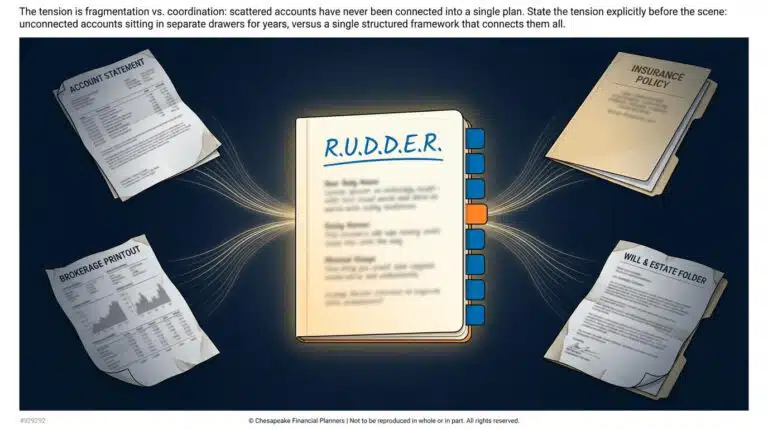

Ready to stop second-guessing and start feeling in control?
Book a short “Fit Call” to see if we’re the right partner for your financial life. No pressure, no jargon, just a conversation focused on your goals and whether our approach makes sense for your needs.