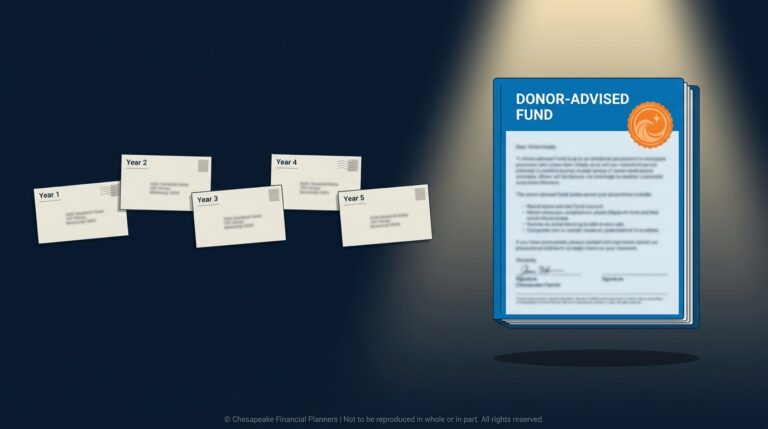
Donor-Advised Fund and Charitable Bunching Calculator
Could Bunching Charitable Gifts Lower Your Federal Tax?
It can, if your yearly gifts plus other deductions fall short of the standard deduction, which is $32,200 on a joint return for 2026 (IRS 2026 inflation adjustments). Bunching several years of gifts into one year, often through a donor-advised fund, lets you itemize that year. This calculator compares giving each year with bunching in cash or appreciated stock.
What Does the Charitable Bunching Calculator Estimate?
Charitable gifts reduce federal tax only to the extent your itemized deductions beat the standard deduction, which is $32,200 on a joint return in 2026 (IRS 2026 inflation adjustments). If your yearly giving, state and local taxes, and mortgage interest add up to less than that, the gifts may not change your tax at all. Charitable bunching means putting two or more years of gifts into one year, often through a donor-advised fund, so you itemize in that year and take the standard deduction in the others. A donor-advised fund is an account at a sponsoring charity: a gift to it is deductible when you make it, and you recommend grants to charities later.
The rules changed in 2026. Itemizers now deduct only the gifts above 0.5% of adjusted gross income, people who take the standard deduction can deduct up to $1,000 of cash gifts ($2,000 on a joint return) (26 U.S.C. 170), and the cap on state and local taxes is $40,400 for 2026 (26 U.S.C. 164(b)(7)). This calculator applies those rules year by year, compares giving each year with bunching in cash and bunching with appreciated stock, and, from age 70½, giving straight from an IRA. It is an educational estimate of federal income tax only. It does not recommend a giving pattern, a charity, or a donor-advised fund sponsor, and it is not advice.
How Is the Tax Change From Bunching Calculated?
What it estimates: total federal income tax over the years in your plan for each giving pattern, the change from bunching, the gifts lost to the 0.5% floor, your year 1 tax bracket with and without the bunched gift, and, when you give stock, the gain you do not pay tax on.
What you enter: Your Giving: Yearly Giving, Years in the Plan, Years in Each Bunch, Appreciated Stock You Could Give, Cost Basis of That Stock, and the Cost-Basis Election for Stock. Your Tax Picture: Filing Status, 65 or Older by Year End (and your spouse on a joint return), IRA Owner 70½ or Older and Yearly IRA Withdrawals in Your Income, Yearly Medical Expenses and whether to move planned care into the bunch years, Income Each Year, One-Time Income in Year 1, State and Local Taxes Paid, and Other Itemized Deductions. The calculator opens in Quick estimate mode with your giving, stock, filing status, ages, income, and deductions; Detailed mode adds the bunch schedule, the cost-basis election, medical expenses, and one-time income.
1. Giving each year
Each year’s federal tax with the same gift every year, taking the larger of the standard deduction (plus the non-itemizer deduction for cash gifts) or itemized deductions.
2. Bunching in cash
The same total given in fewer years, for example all of it in year 1 through a donor-advised fund, itemizing in the bunch year and taking the standard deduction in the others.
3. Bunching with stock
The same bunch made with appreciated stock held more than a year, deducted at its value up to the 2026 limits, so you do not pay tax on the gain.
4. 2026 rules each year
The 0.5% floor on itemized gifts, the 2/37 reduction in the 37% bracket, the SALT cap and its phase-down, the senior deduction from 65 through 2028, and the percentage-of-income limits.
5. Giving from an IRA (optional)
From age 70½, a qualified charitable distribution, which is left out of income instead of deducted.
6. Moving planned care (optional)
The tax change from receiving care you can schedule, such as dental work, in a bunch year.
What you see: Federal Tax Change From Bunching first, then each pattern’s Total Federal Tax, the Non-Itemizer Deduction Used, Gifts Under the 0.5% Floor, Year 1 Tax Bracket Without a Gift and With the Bunched Gift, and for stock, the Change Compared With Giving Each Year, the Gain You Do Not Pay Tax On, and the Federal Tax a Sale Would Have Cost. A year-by-year table shows each pattern’s deduction and tax.
What Assumptions and Sources Does It Use?
- Data year: 2026 federal brackets and standard deduction (IRS Revenue Procedure 2025-32). Later years in the plan apply the changes the law already makes by year; the inflation adjustments for 2027 and later are not published, so the 2026 amounts are used.
- 0.5% floor: from 2026, an itemizer’s charitable deduction counts only gifts above 0.5% of adjusted gross income (IRC 170(b)(1)(I)).
- 37% bracket: from 2026, itemized deductions are reduced by 2/37 of the smaller of the deductions or the income above the start of the 37% bracket (IRC 68).
- Non-itemizers: up to $1,000 ($2,000 on a joint return) of cash gifts to public charities; gifts to a donor-advised fund do not count (IRC 170(p)).
- Limits: cash up to 60% of income; stock held more than a year at its value up to 30%, or at cost basis by election up to 50% (IRC 170(b)(1); IRS Publication 526). A plan with a carryover above the limits is held back.
- SALT: deductible up to $40,400 in 2026, shrinking above $505,000 of income but not below $10,000 (IRC 164(b)(7)).
- QCDs: from age 70½ (IRS Publication 590-B), up to $111,000 in 2026 is left out of income (IRS Notice 2025-67), and a QCD cannot go to a donor-advised fund (IRC 408(d)(8)).
- Not modeled: state income tax, the alternative minimum taxA parallel tax system designed to ensure high-income earners pay a minimum level of federal tax regardless of deductions. If you have significant income from stock options, depreciation, or certain other tax preferences, you may owe AMT — which is why planning ahead is essential., and the carryover of gifts above the limits. Income is treated as ordinary income and held the same each year.
Worked Example
The example
This is the calculator’s built-in Detailed example (the “Reset to example” values). Every figure below is the calculator’s own output for these inputs. It is hypothetical and uses 2026 rules.
Inputs
| Input | Example value |
|---|---|
| Yearly Giving | $10,000 |
| Years in the Plan | 3 |
| Years in Each Bunch | Not entered (all gifts bunched into year 1) |
| Appreciated Stock You Could Give | $30,000 |
| Cost Basis of That Stock | $10,000 |
| Cost-Basis Election for Stock | Use It in a Year It Gives the Larger Deduction |
| Filing Status | Married Filing Jointly |
| 65 or Older by Year End | No |
| Spouse 65 or Older by Year End | No |
| IRA Owner 70½ or Older | No |
| Yearly Medical Expenses | Not entered |
| Income Each Year | $250,000 |
| One-Time Income in Year 1 | Not entered |
| State and Local Taxes Paid | $15,000 |
| Other Itemized Deductions | $8,000 |
Results
| Result | Estimate |
|---|---|
| Federal Tax Change From Bunching | $2,989 Less |
| Giving each year: Total Federal Tax | $110,964 |
| Giving each year: Non-Itemizer Deduction Used | $6,000 |
| Giving each year: Gifts Under the 0.5% Floor | $0 |
| Bunching into a donor-advised fund: Total Federal Tax | $107,975 |
| Bunching into a donor-advised fund: Gifts Under the 0.5% Floor | $1,250 |
| Year 1 Tax Bracket Without a Gift | 24% |
| Year 1 Tax Bracket With the Bunched Gift | 22% |
| Bunching with appreciated stock: Total Federal Tax | $107,975 |
| Change Compared With Giving Each Year | $2,989 Less |
| Gain You Do Not Pay Tax On | $20,000 |
| Federal Tax a Sale Would Have Cost | $3,760 |
The calculator summarizes it this way: “Bunching gifts into year 1 (2026) comes to $2,989 less federal tax than giving each year, for the same total given. Giving stock also means you do not pay tax on a gain of $20,000. A comparison for your numbers, not a recommendation.” Its year-by-year table shows why: giving each year, the couple takes a $34,200 deduction every year (the $32,200 standard deduction plus the non-itemizer deduction for cash gifts). Bunching all $30,000 into 2026 gives a $51,750 itemized deduction that year and the $32,200 standard deduction in 2027 and 2028. Results for your own inputs will differ.
Reviewed by Jeff Judge, CFP®, AEP®, ChFC®, CLU®, Managing Partner, Chesapeake Financial Planners. Last updated November 2, 2026. Tax year 2026.
Frequently Asked Questions
What is charitable bunching?
Bunching means giving two or more years’ worth of gifts in one tax year, so your itemized deductions beat the standard deduction in that year, and then taking the standard deduction in the years you give less. The total given is the same; the timing changes.
How does a donor-advised fund help with bunching?
A gift to a donor-advised fund is deductible in the year you make it, and you can recommend grants to charities from the fund in later years. That lets you take a large deduction in one year while still supporting charities on your usual schedule. A gift to a donor-advised fund is irrevocable.
What changed for charitable deductions in 2026?
Itemizers now deduct only the gifts above 0.5% of adjusted gross income, and in the 37% bracket itemized deductions are reduced so each dollar is worth about 35 cents. People who take the standard deduction can deduct up to $1,000 of cash gifts to public charities, or $2,000 on a joint return, but not gifts to a donor-advised fund.
Why give appreciated stock instead of cash?
Stock held more than a year is generally deductible at its value, and you do not pay capital gainsThe profit you make when you sell an asset for more than you paid for it. Short-term gains (assets held less than a year) are taxed at your ordinary income rate; long-term gains (held more than a year) qualify for preferential rates of 0%, 15%, or 20% — a meaningful difference that shapes many investment decisions. tax on the growth. In the example, giving $30,000 of stock with a $10,000 basis means you do not pay tax on $20,000 of gain, which a sale would have cost about $3,760 in federal tax.
Does bunching always lower my tax?
No. It depends on your income, your other deductions, and how far your giving is from the standard deduction. If you already itemize every year by a wide margin, bunching may change little, and the 0.5% floor takes a slice of each bunched year. The calculator shows the comparison for your numbers.
Related planning services: Windfall, Sale of Business, Financial Planning for Retirees and Pre-Retirees, Financial Planning for Tech and SaaS Professionals.
Related calculators: Concentration Risk and Diversification Analyzer, Required Minimum Distribution Calculator and Federal Estate and Gift Tax Calculator.
See all financial planning calculators
Want to talk through your own numbers with an adviser?
Important disclosures
This calculator is for educational purposes only. It provides a simplified, hypothetical estimate of federal income tax under 2026 rules for different patterns of charitable giving, based on the information you enter. It does not include state income tax or the alternative minimum tax, and later years use 2026 amounts where the inflation adjustments are not yet published. It does not recommend any giving pattern, charity, or donor-advised fund sponsor. A gift to a donor-advised fund is irrevocable. It is not tax, legal, investment, or financial planning advice. Rules change, and results are not guaranteed.
The opinions voiced in this material are for general information only and are not intended to provide specific advice or recommendations for any individual. This information is not intended to be a substitute for specific individualized tax, investment or legal advice. We suggest that you discuss your specific situation with a qualified tax, legal or financial advisor. All investing involves risk including loss of principal. No strategy assures success or protects against loss. There is no guarantee that a diversified portfolio will enhance overall returns or outperform a non-diversified portfolio. DiversificationSpreading investments across multiple asset classes, sectors, and geographies so a loss in one area doesn’t devastate your entire portfolio. It’s the financial equivalent of not putting all your eggs in one basket — and it’s one of the few strategies that can reduce risk without necessarily reducing expected returns. does not protect against market risk.
Advisors associated with Chesapeake Financial Planners may be either (1) LPL Financial Registered Representatives offering securities through LPL Financial, Member FINRA and SIPC, and investment advisor representatives offering investment advice through Great Valley Advisor Group; or (2) solely investment advisor representatives offering investment advice through Great Valley Advisor Group and not affiliated with LPL Financial. Great Valley Advisor Group and Chesapeake Financial Planners are separate entities from LPL Financial.