

Will a Lump Sum Affect My Social Security or Medicare?
Last reviewed: July 2026
A lump sum will not reduce your Social Security retirement benefit, but it can make more of that benefit taxable and can raise your Medicare premiums through IRMAA if you take it as cash instead of rolling it over. Whether a lump sum affects Medicare comes down to one thing: how the money lands on your tax return. A pension payout rolled directly to an IRA stays off your income that year. The same payout taken as cash can push you into higher Medicare brackets two years later.
Key Takeaways
- A lump sum never reduces your Social Security benefit, which is based only on your lifetime earnings record.
- A large cash lump sum can make up to 85% of your Social Security taxable in that year.
- In 2026, IRMAA Part B surcharges start above $109,000 MAGI for singles and $218,000 for joint filers.
- Rolling a pension lump sum directly to an IRA keeps it off your income and avoids the IRMAA hit entirely.
About the Author: Jeff Judge, CFP®, AEP®, ChFC®, CLU® is Managing Partner of Chesapeake Financial Planners in Forest Hill, Maryland. He has been helping families and business owners in Harford County and the Baltimore metro area navigate retirement income and Medicare decisions since earning his CFP® certification in 2013, by using Chesapeake Financial Planners’ signature process, the R.U.D.D.E.R. method™. Jeff has watched more than one client take a six-figure pension as cash, only to get surprised by a Medicare premium spike two years later that could have been avoided with a single rollover form.
Will a Lump Sum Reduce Your Social Security Benefit?
No. A pension lump sum, inheritance, business sale proceeds, or any other one-time payment will not reduce your Social Security retirement benefit. Your monthly benefit is calculated from your lifetime earnings record, specifically your highest 35 years of indexed wages, and a lump sum does not touch that history.
The Social Security Administration bases your primary insurance amount on those indexed earnings alone. Investment income, pension payouts, and inherited money are not wages, so they never enter the benefit formula. Whatever you do with a windfall, your earned benefit stays the same. The catch is what happens to the taxation of that benefit, which is a different question entirely.
Can a Lump Sum Affect How Much of My Social Security Is Taxed?
Yes. While a lump sum does not lower your benefit, it can increase how much of that benefit is subject to federal income tax. Social Security taxation is driven by your "combined income," calculated as your adjusted gross income plus tax-exempt interest plus half of your Social Security benefits.
Up to 85% of benefits become taxable above certain thresholds. For single filers, the IRS taxes up to 50% of benefits between $25,000 and $34,000 of combined income, and up to 85% above $34,000. For married couples filing jointly, the ranges are $32,000 to $44,000, then above $44,000.
Here is where the lump sum matters. If you take a $400,000 pension as cash rather than rolling it over, that entire amount counts as income in one year. It will almost certainly make 85% of your Social Security taxable that year. Roll the same payout directly to an IRA, and the rollover is not taxable income, so your Social Security taxation does not budge. Only future IRA withdrawals count as income.
Does a Lump Sum Count Against the Social Security Earnings Test?
No. A pension lump sum does not count as earnings for the Social Security earnings test. If you claim benefits before your full retirement age and keep working, Social Security withholds $1 for every $2 you earn above the annual limit, which is $24,480 for 2026 and indexed upward annually.
The earnings test only applies to wages from a job or net self-employment income. Lump sums, investment income, pensions, and IRA distributions do not trigger it. Once you reach full retirement age, the earnings test disappears entirely, and you can earn any amount while collecting your full benefit.
This is a point Jeff Judge raises often with clients who are still working in their early sixties. They worry a pension payout will cost them benefits under the earnings test. It will not. The real exposure from a lump sum shows up on the Medicare side, not the earnings side.
Will a Lump Sum Raise My Medicare Premiums Through IRMAA?
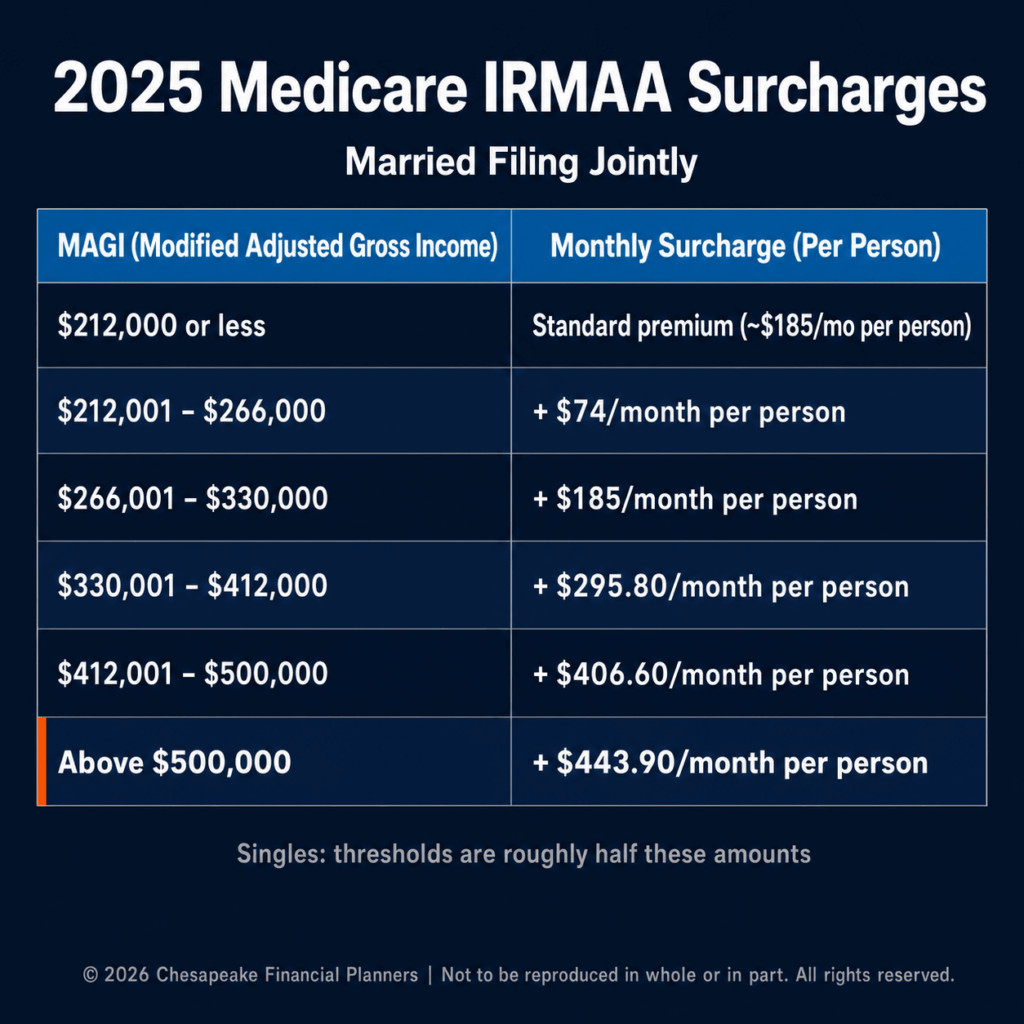
Yes, if the lump sum is large enough and you take it as taxable income. This is the area where a lump sum can do real financial damage. IRMAA, the Income-Related Monthly Adjustment Amount, raises your Medicare Part B and Part D premiums when your modified adjusted gross income climbs above set thresholds.
For 2026, Medicare charges the standard Part B premium below the first IRMAA tier and adds surcharges above it. Single filers cross the first surcharge tier above $109,000 of MAGI; married couples filing jointly cross it above $218,000. A large cash pension payout can vault you several brackets higher in a single year, adding thousands of dollars in surcharges across both Part B and Part D.
Take a $300,000 pension lump sum as cash, and you can land in a top IRMAA bracket for that year. Depending on where you start, that can mean an extra several thousand dollars in Medicare premiums for both spouses combined.
How does the IRMAA two-year lookback work?
IRMAA is based on the income reported on your tax return from two years prior. Your 2026 Medicare premiums are determined by your 2024 return. This lookback creates both a trap and an opportunity.
The trap: you take a lump sum at 63, before you are on Medicare, and forget that two years later at 65 your premiums will spike because of that income. The opportunity: if you know a large income event is coming, you can time it. Taking the lump sum in a year that falls outside your IRMAA lookback window, or rolling it to an IRA so it never hits your income, sidesteps the surcharge. Many of these moves fit inside the R.U.D.D.E.R. Method™, Chesapeake Financial Planners' six-step planning process: Review and Recognize, Uncover and Understand, Design and Develop, Discuss and Decide, Execute and Empower, and Reassess and Refine.
How Do I Minimize the Impact of a Lump Sum?
The single most effective move is a direct rollover. If you are receiving a pension lump sum or a 401(k) distribution, roll it straight to an IRA. A direct rollover is a tax-free transfer that does not count as income, so it keeps your Social Security taxation flat and your IRMAA bracket unchanged. From there, you control the timing and size of future withdrawals.
If a lump sum must be taken as income, spread the tax impact where you can, and watch the IRMAA lookback so a one-year spike does not catch you off guard at 65. For inherited traditional IRAs subject to the 10-year distribution rule, plan the withdrawal schedule deliberately rather than taking large distributions in a single high-income year. Coordinating these moves with a planner who watches both the Social Security and Medicare sides at once is where the dollars get saved.
Frequently Asked Questions
Does a pension lump sum lower my monthly Social Security check?
No. A pension lump sum does not lower your monthly Social Security benefit. Your benefit is calculated only from your lifetime earnings record, the highest 35 years of indexed wages. A one-time payment does not change your work history, so your monthly check stays exactly the same regardless of the windfall.
Will taking a lump sum in cash affect my Medicare premiums?
Yes. Taking a lump sum as taxable cash raises your modified adjusted gross income, which can push you into higher IRMAA brackets and increase your Medicare Part B and Part D premiums. Because IRMAA uses a two-year lookback, that premium increase shows up two years after the year you take the lump sum.
How can I avoid an IRMAA surcharge on a pension payout?
Roll the pension payout directly to an IRA. A direct rollover is a tax-free transfer that does not count as income, so it keeps your MAGI flat and avoids the IRMAA surcharge entirely. You then control future taxable income by timing your IRA withdrawals across multiple lower-income years instead of one spike.
Does an inheritance count as income for Social Security or Medicare?
Inheriting cash or property is generally not taxable income, so it does not affect Social Security or Medicare on its own. The exception is an inherited traditional IRA. Distributions you take from it under the 10-year rule do count as income and can increase Social Security taxation and trigger IRMAA surcharges.
When does the IRMAA increase from a lump sum actually hit me?
The IRMAA increase hits two years after the year you take the lump sum, because Medicare uses a two-year income lookback. If you take a large cash lump sum at age 63, the resulting Medicare premium increase appears at age 65 when you first enroll, based on that earlier year's tax return.
Where to Go From Here
A lump sum is one of those moments where a single decision, rolling the money over instead of cashing it out, can save you thousands in unnecessary taxes and Medicare surcharges. The timing of when income hits your return matters as much as the amount. If you want a clear-eyed look at how a pending payout interacts with your lump sum and Medicare picture, our guide on managing healthcare costs in retirement walks through the moving parts. Download it at chesapeakefp.com.
How do Roth conversions affect IRMAA and Medicare Part B premiums?
How Much Should I Budget for Healthcare Costs in Retirement?
How Does Working in Retirement Affect My Taxes and Social Security?
Want to go deeper? Our Medicare and Social Security Guide walks through this step by step.
Disclosures
The information provided is for educational purposes only and should not be construed as investment advice. Investment strategies should be tailored to individual circumstances, risk tolerance, and goals. Past performance doesn't guarantee future results. Consult with qualified financial professionals regarding your specific situation.
Contributions to a traditional IRA may be tax deductible in the contribution year, with current income tax due at withdrawal. Withdrawals prior to age 59 ½ may result in a 10% IRS penalty tax in addition to current income tax.
Advisors associated with Chesapeake Financial Planners may be either (1) LPL Financial Registered Representatives offering securities through LPL Financial, Member FINRA and SIPC, and investment advisor representatives offering investment advice through Great Valley Advisor Group; or (2) solely investment advisor representatives offering investment advice through Great Valley Advisor Group and not affiliated with LPL Financial. Great Valley Advisor Group, and Chesapeake Financial Planners are separate entities from LPL Financial.


