403(b) and 457(b) Contribution Calculator
How Much Can You Put in a 403(b) and 457(b) In 2026?
In 2026 you can defer up to $24,500 into a 403(b) and a separate $24,500 into a 457(b), because the two limits stack (IRS Notice 2025-67). Catch-ups add $8,000 from age 50, or $11,250 at ages 60 to 63. This calculator estimates your total room, the amount per paycheck and the federal tax effect.
What Does the 403(b) and 457(b) Calculator Estimate?
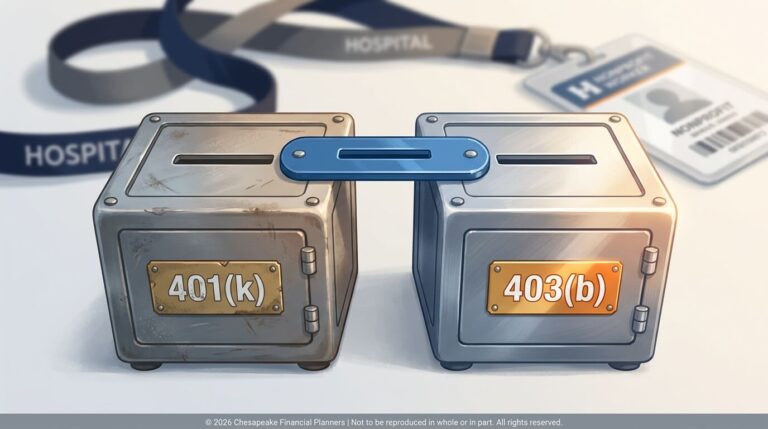
A 403(b) is a workplace retirement plan offered by schools, hospitals and other nonprofit employers, and a 457(b) is a deferred compensation plan offered mainly by state and local governments. Many school, hospital, university, and government employers offer a 403(b) or 401(k) and a 457(b) at the same time. The two plans have separate federal limits, so someone with both may be able to save far more than a single plan allows. Catch-up rules differ by plan and by age, employer money is treated differently in each, and a special 457(b) catch-up is available only in the years just before the plan’s normal retirement age.
This calculator estimates the most you can contribute to these plans in 2026, the amount per paycheck to get there, and how much pre-tax contributions could lower your federal income tax. You can also add a pension and see how a pension, these plans, and Social Security might cover the years from leaving work to age 70. It uses 2026 IRS limits and is an educational estimate, not advice. Your plan administrator has the final figures.
How Are Your 403(b) and 457(b) Limits Calculated?
What it estimates: your 2026 contribution room in a 403(b), 401(k) or TSP and in a 457(b), the amount per paycheck to reach it, and the federal income tax effect of the pre-tax share.
What you enter: Your plans: 403(b), 401(k) or TSP, 457(b) Plan, Your Date of Birth, Yearly Pay From This Employer, Employer Contributions to That Plan, Deferrals to Another Employer’s 401(k), 403(b) or TSP, Employer Contributions to This 457(b), and Deferrals to Another Employer’s 457(b) This Year. Catch-up contributionsAdditional retirement account contributions available to people age 50 and older, above the standard annual limits. In 2026, you can contribute an extra $8,000 to a 401(k) — a meaningful opportunity to accelerate savings in the final years before retirement if you have the cash flow to do it. Those age 60-63 may contribute an additional $11,250, if their plan allows.: 2025 Social Security Wages From This Employer Over $150,000?, In the 3 Years Before Your 457(b) Normal Retirement Age?, How to Enter Your Unused 457(b) Limit (shown when In the 3 Years Before Your 457(b) Normal Retirement Age is Yes), Unused 457(b) Limit From Earlier Years (shown when How to Enter Your Unused 457(b) Limit is One Total From My Plan’s Worksheet), Number of Earlier Years (shown when How to Enter Your Unused 457(b) Limit is Year by Year), Earlier year: Tax Year, Earlier year: Deferrals That Year, and 15 or More Years With a School, Hospital or Church Employer? (shown when 403(b), 401(k) or TSP is 403(b)). Paychecks and taxes: Tax Filing Status, Other Household Income, Pre-Tax Share of Your Contributions, Paychecks Per Year, Contributed So Far This Year, and Paychecks Left This Year. PensionA defined benefit retirement plan where your employer promises a specific monthly payment for life in retirement, typically based on salary and years of service. Pensions are increasingly rare in the private sector but remain common in government and some union jobs — and if you have one, understanding your payout options is an important financial decision. (optional): Pension, Monthly Pension at Retirement (shown when Pension is Monthly Amount From My Statement), Benefit Factor Per Year of Service (shown when Pension is My Plan’s Formula), Final Average Salary, Years of Service at Retirement, and Age When You Retire (shown when Pension is FERS (Federal Employees)). Leaving work and Social Security (optional): Show the Years From Leaving Work to Age 70?, Age When You Leave Work (shown when Show the Years From Leaving Work to Age 70 is Yes), Wages Until Federal Retirement (shown when Pension is FERS and the age you retire from federal service is later than the age you leave work), Age You Plan to Start Social Security (shown when Show the Years From Leaving Work to Age 70 is Yes), Monthly Social Security at That Age (shown when Show the Years From Leaving Work to Age 70 is Yes), Yearly Spending Need (shown when Show the Years From Leaving Work to Age 70 is Yes), 457(b) Balance When You Leave (shown when Show the Years From Leaving Work to Age 70 is Yes), 403(b), 401(k) or TSP Balance When You Leave (shown when Show the Years From Leaving Work to Age 70 is Yes), Pension Cost-of-Living Raise (shown when Show the Years From Leaving Work to Age 70 is Yes), and Yearly Growth Rate (Optional) (shown when Show the Years From Leaving Work to Age 70 is Yes).
Two modes: Quick estimate mode, the default, asks for 403(b), 401(k) or TSP, 457(b) Plan, Your Date of Birth, Yearly Pay From This Employer, 2025 Social Security Wages From This Employer Over $150,000?, Tax Filing Status, Other Household Income, Contributed So Far This Year, and Paychecks Left This Year, and holds every other field at the calculator’s default; Detailed mode shows every field. Both modes run the same calculation.
1. Shared deferral limit
The 2026 limit of $24,500 (IRS Notice 2025-67) applies to your own deferrals across every 403(b), 401(k), and TSP you contribute to, including a plan at another employer.
2. A separate 457(b) limit
A 457(b) has its own $24,500 limit for 2026, so the two plans stack. Employer money in a 457(b) counts toward that same limit, and the limit is one per person across all 457(b) plans.
3. Age catch-ups
Based on your age on December 31, 2026: $8,000 more from age 50, or $11,250 at ages 60 to 63 (IRS Notice 2025-67). The 457(b) age catch-up applies only to a governmental 457(b). If your 2025 Social Security wages from this employer were over $150,000 (IRS Notice 2025-67), catch-ups must go in as Roth.
4. Special 457(b) catch-up
In the three years before your plan’s normal retirement age, you may make up unused limit from earlier years, up to twice the regular limit (26 U.S.C. 457(b)(3)). The calculator applies whichever ceiling is larger, the special catch-up or the age catch-up, as the regulations require.
5. Ceilings and pay
Your contributions plus employer money in a 403(b), 401(k), or TSP cannot exceed $72,000 (IRS Notice 2025-67) or your pay, and each plan’s contributions cannot exceed your pay.
6. Per paycheck and tax
What is left of the yearly amount after what you have contributed so far is spread over your remaining paychecks. The pre-tax share lowers federal taxable income using the 2026 brackets and standard deduction.
7. Pension and bridge (optional)
Add a pension from your statement or plan formula, including FERS (see the FERS pension and TSP calculator) or a state teachers’ plan, and see each year from leaving work to age 70 with the federal income tax on it.
What you see: Total You Can Contribute in 2026 first, then each plan’s regular limit and catch-up room, the amount per paycheck, the per-paycheck cost after tax, and the federal income tax lowered in 2026. Optional pension and bridge tables appear when you fill in those sections.
What Assumptions and Sources Does It Use?
- Limits year: 2026. Elective deferral and 457(b) limits of $24,500 and the age catch-ups from IRS Notice 2025-67; the $72,000 annual additions limit under IRC 415(c) (IRS Notice 2025-67).
- 457(b) rules: One limit per person across all 457(b) plans (IRC 457(c)); employer contributions count toward it (26 CFR 1.457-2(b)); the special catch-up is capped at twice the limit and is used only when its ceiling is larger than the age catch-up ceiling (26 CFR 1.457-4(c)).
- Earlier 457(b) years: Year-by-year entries use each year’s verified 457(b) limit. A year without a verified limit is held back rather than estimated, and the calculator assumes your pay was at least the limit each year; your plan’s worksheet governs.
- Roth catch-up rule: Catch-ups are Roth when prior-year Social Security wages from the employer exceed $150,000 (2025 wages for 2026, per IRS Notice 2025-67).
- Federal tax: 2026 brackets and standard deduction applied to pay plus other household income. State tax is not included.
- Plan features: Assumes your plans offer the catch-ups shown; some plans offer fewer.
- Not modeled: The 403(b) 15-year long-service catch-up, 403(b) employer contributions after you leave, after-tax contributions, Roth balances at withdrawal, and state tax on withdrawals.
Worked Example
The example
This is the calculator’s built-in example (the “Reset to example” values): a hypothetical 55-year-old with a 403(b) and a governmental 457(b). Every figure below is the calculator’s own output for these inputs, for the 2026 limits year.
Inputs
| Input | Example value |
|---|---|
| 403(b), 401(k) or TSP | 403(b) |
| 457(b) Plan | Governmental 457(b) |
| Your Date of Birth | 1971-05-10 |
| Yearly Pay From This Employer | $85,000 |
| Employer Contributions to That Plan | $0 |
| Deferrals to Another Employer’s 401(k), 403(b) or TSP | $0 |
| Employer Contributions to This 457(b) | $0 |
| Deferrals to Another Employer’s 457(b) This Year | $0 |
| 2025 Social Security Wages From This Employer Over $150,000? | No |
| In the 3 Years Before Your 457(b) Normal Retirement Age? | No |
| 15 or More Years With a School, Hospital or Church Employer? | No |
| Tax Filing Status | Married Filing Jointly |
| Other Household Income | $60,000 |
| Pre-Tax Share of Your Contributions | 100% |
| Paychecks Per Year | 24 (Twice a Month) |
| Contributed So Far This Year | $0 |
| Paychecks Left This Year | 24 |
| Pension | No Pension |
| Show the Years From Leaving Work to Age 70? | No |
Results
| Result | Estimate |
|---|---|
| Total You Can Contribute in 2026 | $65,000 |
| 403(b) Regular Limit | $24,500 |
| Age Catch-Up | $8,000 |
| 457(b) Regular Limit | $24,500 |
| Room Under the Age Catch-Up | $8,000 |
| 457(b) Total | $32,500 |
| Per Paycheck to Reach It | $2,708 |
| Per-Paycheck Cost After Tax | $2,333 |
| Federal Income Tax Lowered in 2026 | $9,000 |
The calculator summarizes it this way: “You can contribute about $65,000 to these plans in 2026. The 457(b) has its own limit, so the two plans stack. At that level, take-home pay drops about $2,333 a paycheck after the federal tax saved.” Results for your own inputs will differ.
Reviewed by Jeff Judge, CFP®, AEP®, ChFC®, CLU®, Managing Partner, Chesapeake Financial Planners. Last updated November 2, 2026. Tax year 2026.
Frequently Asked Questions
Can I contribute to a 403(b) and a 457(b) in the same year?
Yes. The two plans have separate limits, so in 2026 you may be able to defer up to $24,500 into each (IRS Notice 2025-67), plus any catch-ups each plan allows. A 401(k) or TSP shares the 403(b) limit, not the 457(b) limit, so a second 457(b) at another job would share the 457(b) limit instead.
What changes at ages 60 to 63?
For 2026 the age catch-up is $11,250 instead of $8,000 if you are 60, 61, 62, or 63 on December 31 and your plan offers it. From 64 it returns to the regular catch-up amount. The higher amount is set each year by the IRS (IRS Notice 2025-67 for 2026).
What is the special 457(b) catch-up?
In the three tax years before your plan’s normal retirement age, a 457(b) may let you contribute up to twice the regular limit by making up limit you left unused in earlier years. You cannot use it and the age catch-up in the same year; the larger of the two applies. Your plan administrator figures the unused amount on a worksheet.
Do employer contributions reduce my limit?
In a 403(b), 401(k), or TSP, employer money does not reduce your $24,500 deferral limit, but your contributions and the employer’s together cannot exceed $72,000 or your pay. In a 457(b), employer money counts toward the same limit as your own deferrals.
Do my catch-ups have to be Roth?
Starting in 2026, yes if your 2025 Social Security wages from that employer were over $150,000. The amount you can contribute is the same; only the tax treatment changes. Roth catch-ups are taxed now, so they do not lower your 2026 federal income tax, and qualified withdrawals later are tax free.
Related planning services: Retirement Readiness, Switching Jobs, Financial Planning for Retirees and Pre-Retirees, Financial Planning for Emerging Affluent Professionals.
Related calculators: First Job 401(k) Match and Roth Calculator, FERS Pension and TSP Calculator and Pension Lump Sum vs. Monthly Pension Calculator.
See all financial planning calculators
Want to talk through your own numbers with an adviser?
Important disclosures
This calculator is for educational purposes only. It provides a simplified, hypothetical estimate based on the information you enter and on 2026 IRS contribution limits and federal tax rules. Your plan’s own terms decide which contributions and catch-ups it allows, and your plan administrator has the final figures, including the special 457(b) catch-up worksheet. Pension figures are the ones you enter from your plan, and any growth rate is one you choose, so projections are illustrations, not forecasts. It is not tax, legal, investment, or financial planning advice. Tax laws change, and results are not guaranteed.
The opinions voiced in this material are for general information only and are not intended to provide specific advice or recommendations for any individual. This information is not intended to be a substitute for specific individualized tax, investment or legal advice. We suggest that you discuss your specific situation with a qualified tax, legal or financial advisor. All investing involves risk including loss of principal. No strategy assures success or protects against loss. There is no guarantee that a diversified portfolio will enhance overall returns or outperform a non-diversified portfolio. DiversificationSpreading investments across multiple asset classes, sectors, and geographies so a loss in one area doesn’t devastate your entire portfolio. It’s the financial equivalent of not putting all your eggs in one basket — and it’s one of the few strategies that can reduce risk without necessarily reducing expected returns. does not protect against market risk.
A Roth IRAA retirement account funded with after-tax dollars where your money grows completely tax-free and qualified withdrawals in retirement are also tax-free — including all the gains. There are no Required Minimum Distributions during your lifetime, making the Roth one of the most flexible and powerful long-term savings tools available. offers tax deferral on any earnings in the account. Qualified withdrawals of earnings from the account are tax-free. Withdrawals of earnings prior to age 59 ½ or prior to the account being opened for 5 years, whichever is later, may result in a 10% IRS penalty tax. Limitations and restrictions may apply.
Advisors associated with Chesapeake Financial Planners may be either (1) LPL Financial Registered Representatives offering securities through LPL Financial, Member FINRA and SIPC, and investment advisor representatives offering investment advice through Great Valley Advisor Group; or (2) solely investment advisor representatives offering investment advice through Great Valley Advisor Group and not affiliated with LPL Financial. Great Valley Advisor Group and Chesapeake Financial Planners are separate entities from LPL Financial.