

What Is the Best Financial Planning Strategy for a Tech Company Employee With Equity Compensation?
Last reviewed: July 2026
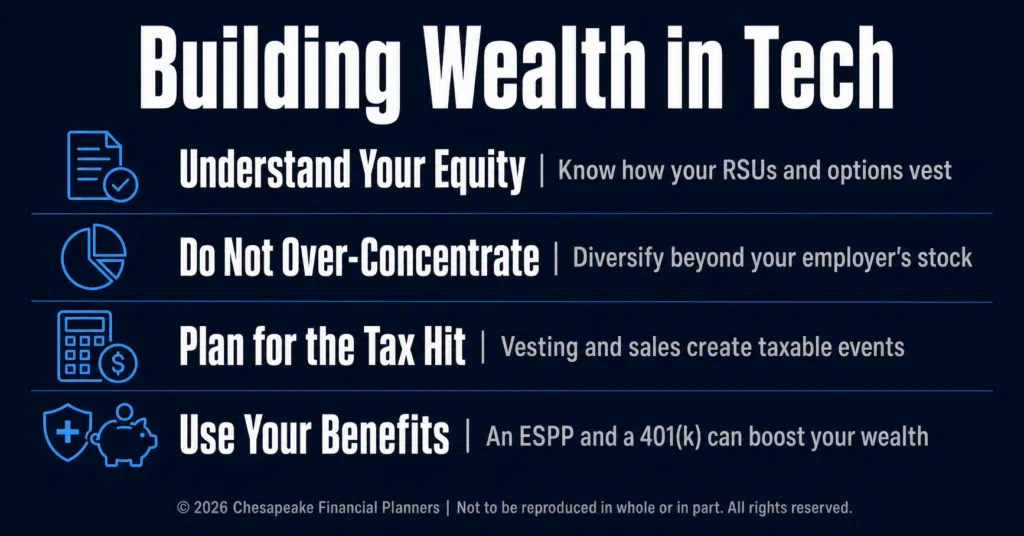
The best financial planning strategy for a tech company employee with equity compensation starts with treating your equity as a concentrated, tax-heavy asset that needs a written sell-and-diversify plan, not a lottery ticket. You build it in a specific order: understand exactly what you own, cover your tax liability before it surprises you, diversify out of company stock on a schedule, and only then optimize for growth. Most tech employees get the order wrong and pay for it twice, once in taxes and once in concentration risk when the stock drops.
On This Page
- Key Takeaways
- How to Understand What Equity You Actually Own
- How to Plan for the Tax Hit Before It Lands
- How to Decide When to Sell Vested RSUs
- How to Handle Stock Options and the AMT Trap
- How to Diversify a Concentrated Company Stock Position
- How to Build the Rest of Your Financial Plan Around Equity
- How the R.U.D.D.E.R. Method Applies to Equity Compensation
- Frequently Asked Questions
- Disclosures
Key Takeaways
- Equity compensation is taxable income first and an investment second; plan for the tax bill before the vest date arrives.
- RSU withholding defaults to a flat 22% federal rate, which underwithholds most tech employees in higher brackets.
- The 2026 AMT exemption is $90,100 for single filers and $140,200 for married joint filers, a key threshold when exercising incentive stock options.
- A concentrated position over roughly 10% of your net worth is the single largest avoidable risk most tech employees carry.
- Selling RSUs the moment they vest is usually the right default because they are taxed as ordinary income at vesting regardless.
About the Author: Jeff Judge, CFP®, AEP®, ChFC®, CLU® is Managing Partner of Chesapeake Financial Planners in Forest Hill, Maryland. He has been helping families and business owners in Harford County and the Baltimore metro area navigate equity compensation and concentrated stock decisions since earning his CFP® certification in 2013, by using Chesapeake Financial Planners’ signature process, the R.U.D.D.E.R. method™. Jeff has watched more tech employees lose money holding vested RSUs out of loyalty than from any bad investment they actively chose.
How to Understand What Equity You Actually Own
Before you do anything else, you need to know precisely what type of equity you hold, because the tax treatment is completely different across types and the planning flows from there. Tech compensation packages mix restricted stock units, incentive stock options, non-qualified stock options, and employee stock purchase plans, and each one has its own rules, deadlines, and tax traps.
Start by pulling your grant documents and your equity management portal. Write down the type, the grant date, the vesting schedule, and the strike price if it is an option grant. This sounds obvious. In practice, most people I meet cannot tell me whether their options are ISOs or NSOs, and that one distinction changes the entire tax strategy.
What is the difference between RSUs, ISOs, NSOs, and ESPP?
RSUs are shares the company gives you outright on a vesting schedule, taxed as ordinary income at the moment they vest. ISOs (incentive stock options) give you the right to buy shares at a fixed strike price, with potential favorable long-term capital gains treatment and an alternative minimum tax exposure. NSOs (non-qualified stock options) work similarly but are taxed as ordinary income at exercise on the spread between strike and market price. ESPP lets you buy company stock at a discount, typically up to 15%, through payroll deductions. For a side-by-side tax breakdown, see What is the difference between RSUs, ISOs, NSOs, and ESPP, and how are they taxed?.
Why does the equity type change your entire plan?
The type dictates when you owe tax, how much, and whether you control the timing. RSUs give you no timing control; you owe tax at vest no matter what. Options give you a choice about when to exercise, which means you can plan around your tax bracket. A single tech employee can hold three or four of these at once, each pulling in a different direction. According to the National Center for Employee Ownership, millions of U.S. employees participate in some form of equity compensation plan, yet most receive no guidance on coordinating the pieces.
How to Plan for the Tax Hit Before It Lands
The most expensive mistake in equity compensation is treating the tax bill as a surprise instead of a known liability. Equity compensation is income. The IRS treats your vested RSUs exactly like a cash bonus, and your stock option exercises generate taxable events you can often see coming a year in advance.
Here is the step-by-step sequence to get your tax planning right.
- Identify every taxable event for the year. List each RSU vest date, any planned option exercises, and your ESPP purchase and sale dates. Each one creates income or a gain.
- Estimate the true tax owed, not the amount withheld. Your employer withholds, but the withholding rate is often wrong for your bracket. This is where people get blindsided in April.
- Set aside the gap. If your withholding falls short of your actual liability, hold the difference in cash or pay estimated quarterly taxes to avoid an underpayment penalty.
- Coordinate exercises with your income. For options you control, time exercises in lower-income years when possible.
Why is your RSU withholding almost never enough?
When RSUs vest, employers typically withhold federal tax at the flat supplemental wage rate of 22%. If your marginal federal bracket is 32%, 35%, or 37%, you are underwithheld by 10 to 15 percentage points on every vested dollar. On a $150,000 RSU vest, that gap can exceed $20,000. The IRS taxes that income at your real marginal rate when you file, and the withholding shortfall lands as a bill you did not budget for. Jeff Judge tells clients the single most common April shock he sees from tech employees is a five-figure tax bill on RSUs they assumed were "already taxed." For the deeper mechanics, see Why isn't my 22% RSU withholding enough, and what will I owe?.
What about the high-earner surtaxes?
Once your income climbs, two additional taxes appear that most people forget. The Net Investment Income Tax adds 3.8% on investment income above $200,000 for single filers and $250,000 for married joint filers, and these thresholds are not indexed for inflation, so more tech employees hit them every year. There is also an additional 0.9% Medicare surtax on wages above those same thresholds. When you sell appreciated company stock, the NIIT can stack on top of your capital gains rate, raising the real cost of waiting to diversify.
How to Decide When to Sell Vested RSUs
For most tech employees, the right default with vested RSUs is to sell them as soon as they vest and reinvest the proceeds into a diversified portfolio. This surprises people. The reasoning is simple and worth internalizing.
When an RSU vests, you have already paid ordinary income tax on its full value. Holding the shares afterward is mathematically identical to taking that after-tax cash and choosing to buy your own company's stock with it. Ask yourself directly: if your employer handed you the cash equivalent, would you go out and buy that much of a single stock? Almost no one would. Yet holding vested RSUs is exactly that decision, made by default.
Is holding company stock ever the right move?
Sometimes, but for specific reasons, not loyalty. If you have a credible, informed view that the stock is undervalued, or you are inside a blackout window, or you have a tax reason to wait for long-term capital gains treatment on the post-vest appreciation, holding can make sense. The key is that the decision should be deliberate. Selling at vest also resets your cost basis to the vesting price, which means future gains or losses are measured from there, and you avoid layering concentration risk on top of the concentration you already carry through your salary and unvested equity.
How do you sell without insider-trading risk?
If you have access to material nonpublic information, which most senior tech employees do at some point, a 10b5-1 trading plan lets you pre-schedule sales in advance so they execute automatically regardless of what you know later. This removes the timing guesswork and the legal exposure. The SEC requires a cooling-off period before the first trade under such a plan, which is why setting it up early matters. For the full walkthrough, see What is a 10b5-1 plan, and how does it let me sell company stock safely?.

How to Handle Stock Options and the AMT Trap
Stock options are where the real planning value lives, and also where the most expensive mistakes happen. Unlike RSUs, options give you control over timing, which is both an opportunity and a trap. The biggest trap is the alternative minimum tax that incentive stock options can trigger.
Here is the sequence for handling options well.
- Confirm whether your options are ISOs or NSOs. This determines the entire tax path.
- Model the AMT impact before exercising ISOs. Exercising and holding ISOs creates a "preference item" that can trigger AMT even though no cash changed hands.
- Decide whether to exercise-and-hold or exercise-and-sell. Holding past one year from exercise and two years from grant qualifies for long-term capital gains; selling immediately is a disqualifying disposition taxed as ordinary income.
- Track your AMT credit. AMT paid in one year can often be recovered in later years.
When does exercising ISOs trigger the AMT?
Exercising ISOs and holding the shares creates an AMT preference equal to the spread between your strike price and the fair market value at exercise. If that spread is large, it can push you into AMT even with no sale. The 2026 AMT exemption is $90,100 for single filers and $140,200 for married filing jointly, and the exemption phases out at higher income levels. Exercise a large ISO grant in a single year and you can owe tens of thousands in AMT on paper gains you have not yet realized in cash. This is the trap that has cost tech employees fortunes, especially those who exercised at a high valuation and then watched the stock fall. For the full mechanics, see When does exercising incentive stock options trigger the AMT?.
Can you recover the AMT you paid?
Often, yes. AMT paid on an ISO exercise generally becomes a minimum tax credit you can use to offset regular tax in future years, sometimes over many years. This is one of the most overlooked recovery opportunities in equity planning, and it requires deliberate tracking on IRS Form 8801. Jeff Judge has seen clients leave thousands in unclaimed AMT credit sitting on the table simply because no one tracked it after the exercise year. For the recovery strategy, see How do I recover the AMT credit after exercising ISOs?.
What if you are at a startup with private stock?
Private company equity adds its own layer. Double-trigger RSUs at a private company do not become taxable until both vesting and a liquidity event occur, which changes your planning timeline entirely. Founders and early employees should also examine the 83(b) election, a deadline-driven filing that can dramatically reduce future tax, and Qualified Small Business Stock rules, which can exempt a large share of gains from federal tax under Section 1202. See What is the 83(b) election, and why does the deadline matter? and What is QSBS, and how can founders exclude millions in tax?.
How to Diversify a Concentrated Company Stock Position
A concentrated position is the silent risk in nearly every tech employee's portfolio. When your salary, your bonus, your unvested equity, and your vested shares all depend on one company, a single bad quarter can hit your paycheck and your net worth at the same time. That correlation is the danger.
The general rule among planners is that no single stock should make up more than roughly 10% of your investable net worth. Many tech employees carry 40%, 60%, or more in company stock and do not realize how exposed they are until the price drops.
Here is how to unwind a concentrated position without a punishing tax bill.
- Quantify the concentration. Calculate what percentage of your investable net worth sits in company stock today.
- Separate the lots by tax treatment. Identify which shares would generate short-term versus long-term gains, and which carry the lowest cost basis.
- Build a multi-year sell schedule. Spread sales across tax years to manage your capital gains rate and avoid spiking into a higher bracket.
- Use tax-loss harvesting and gifting where appropriate. Offset gains with losses elsewhere, and consider charitable gifting of appreciated shares to eliminate the embedded gain.
Why is concentration the risk that hurts most?
Concentration risk is uncompensated risk. The market does not pay you extra for holding one stock instead of a diversified basket with the same expected return. According to research summarized by J.P. Morgan Asset Management, a meaningful share of individual stocks have historically underperformed a broad index over long periods, and a notable percentage have suffered catastrophic, permanent declines. Betting your financial future on the one company that also pays your salary doubles down on a risk you are not compensated for taking. Jeff often reminds clients that the goal is not to predict whether their company will do well; it is to make sure their family is fine either way.
How do you sell appreciated stock without a huge tax bill?
You spread it out and you use the tax code. Long-term capital gains rates in 2026 are 0%, 15%, or 20% depending on taxable income, far lower than ordinary rates. By selling across multiple years and staying within a target bracket, you can harvest gains at the 15% rate rather than triggering the 20% rate plus the 3.8% NIIT. The IRS sets these brackets, and timing your sales around them is the core of the strategy. Charitable gifting of low-basis shares, exchange funds, and donor-advised funds are additional tools. For the full diversification playbook, see How do I diversify a concentrated company stock position without a huge tax bill?.

How to Build the Rest of Your Financial Plan Around Equity
Equity compensation is the centerpiece, but it is not the whole plan. Tech employees often optimize the stock and neglect the boring foundation that actually protects them. The boring stuff is what holds the plan together when the equity does not cooperate.
Build the foundation in this order.
- Fund an emergency reserve in cash. Three to six months of expenses, more if a large share of your income is variable equity.
- Max out tax-advantaged accounts. The 2026 employee 401(k) deferral limit is $24,500, with an additional $8,000 catch-up at age 50 and over. Capture every dollar of employer match first.
- Coordinate your ESPP with your cash flow. A 15% discount through an ESPP is one of the best guaranteed returns available, but do not let it deepen your concentration; sell the shares promptly.
- Layer in insurance and estate basics. Disability coverage protects the income stream; an estate plan protects what the equity builds.
What should a high earner prioritize after maxing the 401(k)?
After the 401(k) match and deferral, high earners should consider a backdoor Roth IRA, a Health Savings Account if eligible, and a taxable brokerage account funded with diversified holdings rather than more company stock. The Social Security Administration caps the wage base subject to Social Security tax, so high earners stop paying into that system partway through the year, which can free up cash flow for additional saving in the back half. The point is to keep building wealth outside the single basket your career already sits in.
How does job change affect your equity plan?
Leaving a job sets off a cascade of equity deadlines that catch people off guard. Vested stock options typically come with a short post-termination exercise window, often 90 days, after which unexercised options are forfeited. Unvested RSUs are usually lost entirely. Before you give notice, map out exactly what you will lose and what it will cost to keep. See What happens to my stock options when I leave my job? and What happens to my stock options when I leave my job?. And when you are weighing one offer against another, remember that headline total comp and base salary tell very different stories; see What Is the Difference Between Total Comp and Base Salary?.
How the R.U.D.D.E.R. Method™ Applies to Equity Compensation
At Chesapeake Financial Planners, we run equity compensation decisions through a structured process so nothing falls through the cracks. The R.U.D.D.E.R. Method™ is Chesapeake Financial Planners' six-step planning process: Review and Recognize, Uncover and Understand, Design and Develop, Discuss and Decide, Execute and Empower, and Reassess and Refine.
For a tech employee with equity, that means we first review and recognize exactly what you hold and what tax events are coming. We uncover and understand your goals, your risk tolerance, and how much concentration you are actually comfortable carrying. We design and develop a sell-and-diversify schedule and a tax plan around your vests and exercises. We discuss and decide the tradeoffs together, including how aggressively to unwind company stock. We execute and empower by putting trading plans, estimated tax payments, and account funding in motion. And we reassess and refine every year as new grants vest, tax laws shift, and your stock price moves.
The reason a structured process matters here is that equity decisions are interlocking. A choice about when to exercise ISOs affects your AMT, which affects your cash flow, which affects how fast you can diversify, which affects your concentration risk. Pull one lever and three others move. The CFP Board emphasizes this kind of coordinated, fiduciary planning, and it is exactly what equity compensation demands.
Frequently Asked Questions
Should I sell my RSUs as soon as they vest?
For most tech employees, yes. RSUs are taxed as ordinary income at vesting whether you sell or not, so holding them is the same as using after-tax cash to buy a single concentrated stock. Selling at vest and reinvesting in a diversified portfolio removes concentration risk without creating any additional tax cost beyond what you already owe.
How much tax will I owe on my equity compensation?
You owe ordinary income tax on RSUs at vesting and on NSO exercises, taxed at your full marginal rate up to 37%, plus potential Net Investment Income Tax of 3.8% and state tax. Employer withholding of 22% usually falls short for higher earners, so set aside the difference. ISOs may trigger alternative minimum tax instead, depending on the exercise spread.
What is the AMT trap with incentive stock options?
The AMT trap occurs when you exercise ISOs and hold the shares, creating a paper gain equal to the spread between strike price and market value. That spread is an AMT preference item that can trigger alternative minimum tax even though you received no cash. If the stock later falls, you can owe tax on gains you never actually realized, which is why modeling the AMT before exercising is essential.
How much of my net worth should be in company stock?
A common planning guideline is no more than roughly 10% of your investable net worth in any single stock, including your employer's. Many tech employees unknowingly carry far more because their salary, unvested equity, and vested shares all depend on one company. Reducing that concentration on a planned, multi-year schedule protects you from a single company-specific downturn.
What happens to my stock options if I leave my tech job?
When you leave, unvested RSUs and unvested options are typically forfeited, and vested options usually must be exercised within a short window, often 90 days, or they are lost. Exercising can require significant cash and may trigger taxes, so map out exactly what you hold and what it costs to keep before you give notice.
Is an ESPP worth participating in?
Yes, an ESPP offering up to a 15% discount on company stock is one of the best low-risk returns available, because you are buying at a guaranteed discount. The key is to sell the shares promptly after purchase rather than holding them, so you capture the discount without adding to your concentration risk in company stock.
Do I need a financial planner if I work at a tech company with equity?
Equity compensation creates interlocking tax, timing, and concentration decisions that are difficult to coordinate alone, especially when RSUs, ISOs, NSOs, and an ESPP all overlap. A planner who understands equity comp can help you avoid AMT surprises, underwithholding penalties, and overconcentration, which often saves far more than the cost of advice.
If you work at a tech company and your equity is now a meaningful part of your net worth, the worst time to build a plan is the week your stock drops or the week you give notice. Jeff Judge and the Chesapeake team work through equity compensation, AMT planning, and concentrated stock diversification with tech professionals every week. Schedule a free fit call at chesapeakefp.com to put a written plan around your equity before the next vest date.
Want to go deeper? Our Navigating Tech Equity Like a Pro walks through this step by step.
Disclosures
The information provided is for educational purposes only and should not be construed as investment advice. Investment strategies should be tailored to individual circumstances, risk tolerance, and goals. Past performance doesn't guarantee future results. Consult with qualified financial professionals regarding your specific situation.
Advisors associated with Chesapeake Financial Planners may be either (1) LPL Financial Registered Representatives offering securities through LPL Financial, Member FINRA and SIPC, and investment advisor representatives offering investment advice through Great Valley Advisor Group; or (2) solely investment advisor representatives offering investment advice through Great Valley Advisor Group and not affiliated with LPL Financial. Great Valley Advisor Group, and Chesapeake Financial Planners are separate entities from LPL Financial.


