
What Is the Difference Between RSUs, ISOs, NSOs, and ESPP, and How Are They Taxed?
Last reviewed: July 2026
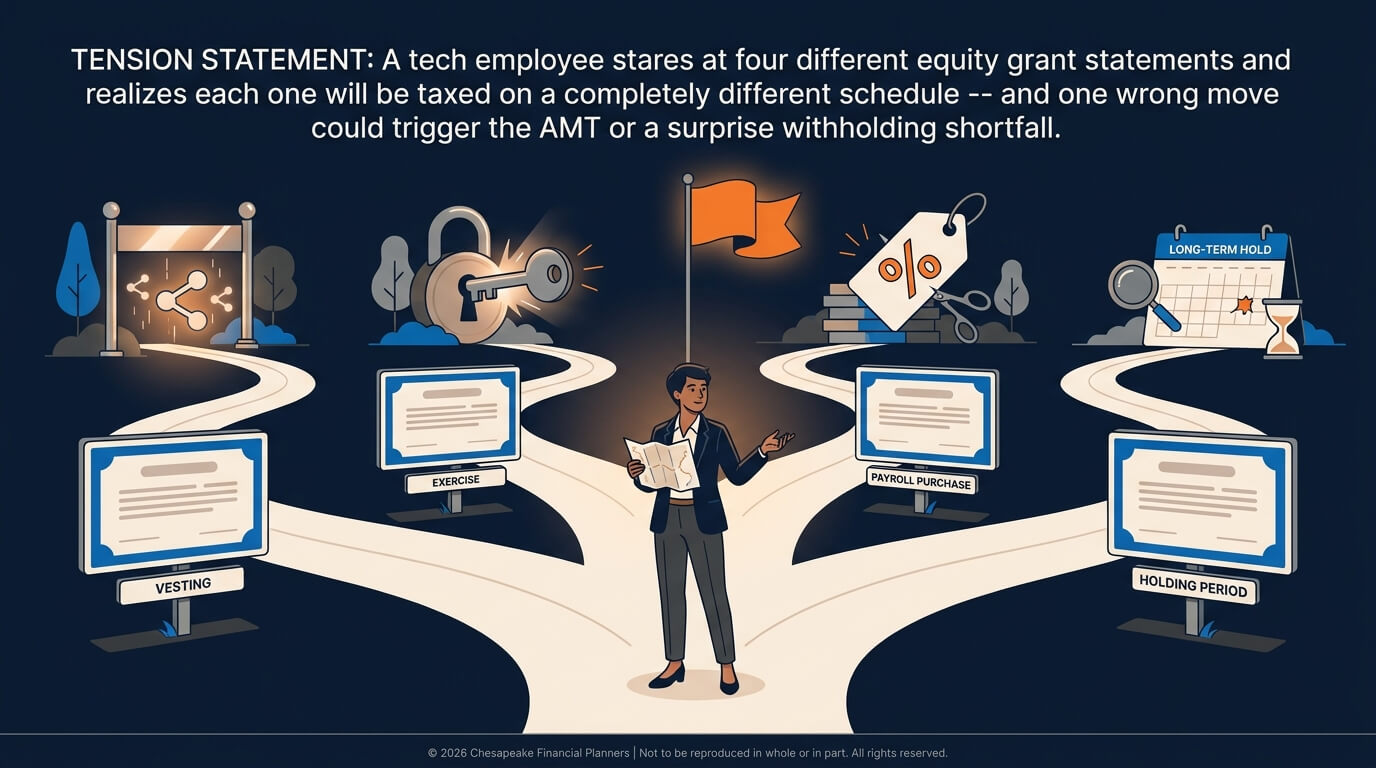
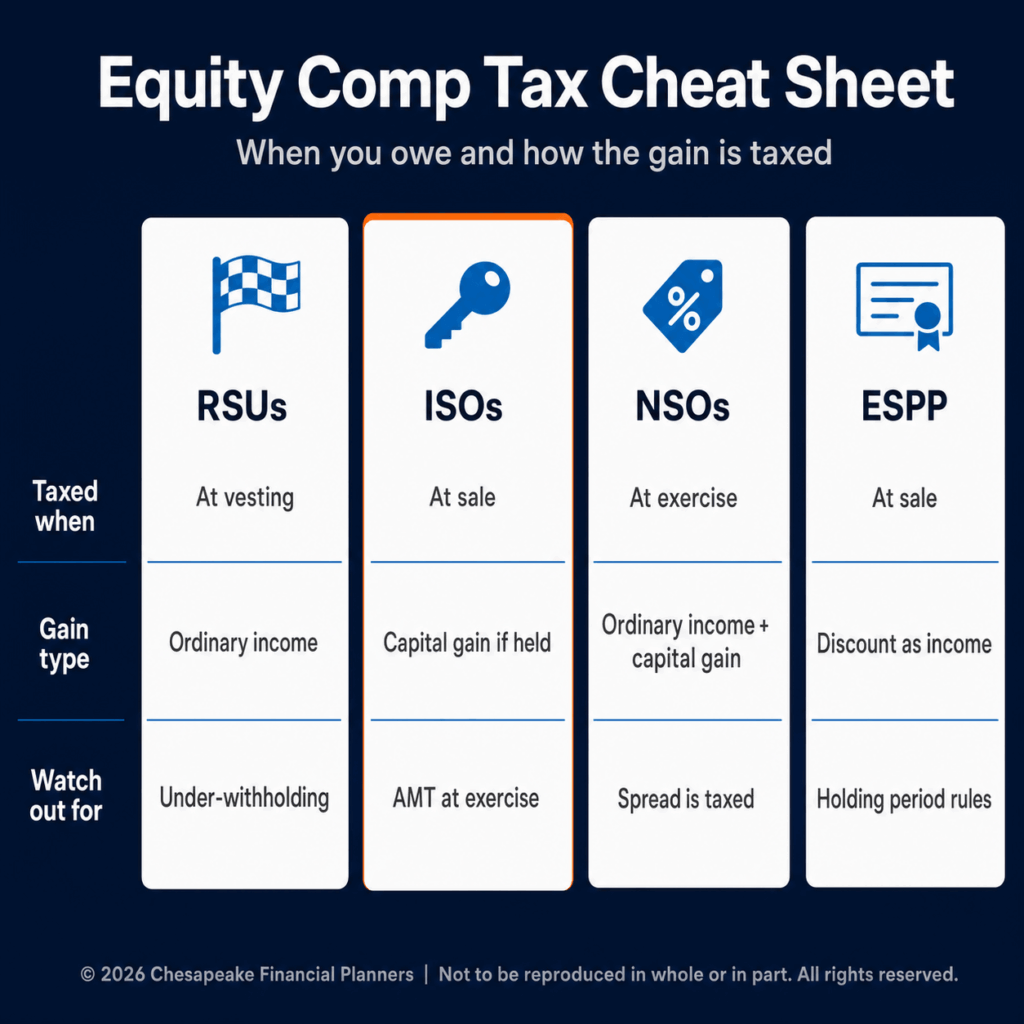
RSUs, ISOs, NSOs, and ESPP are four ways tech companies hand you equity, and each one is taxed on a different schedule. RSUs are taxed as ordinary income when they vest. NSOs are taxed as ordinary income when you exercise. ISOs can dodge ordinary income tax entirely but can trigger the alternative minimum tax. ESPP shares get taxed when you sell, with part of the gain treated as ordinary income. Get the rsu vs iso vs nso distinction wrong and you can overpay by tens of thousands of dollars or, worse, owe tax on money you never received in cash.
Key Takeaways
- RSUs are taxed as ordinary income at vesting, and the standard 22% supplemental withholding rarely covers what high earners actually owe.
- ISOs avoid ordinary income tax at exercise but the bargain element counts toward the alternative minimum tax calculation.
- NSOs are taxed as ordinary income on the spread at exercise, then again as capital gains when you sell.
- ESPP plans cap purchases at $25,000 per year and reward holding shares long enough for a qualifying disposition.
About the Author: Jeff Judge, CFP®, AEP®, ChFC®, CLU® is Managing Partner of Chesapeake Financial Planners in Forest Hill, Maryland. He has been helping families and business owners in Harford County and the Baltimore metro area navigate equity compensation since earning his CFP® certification in 2013, by using Chesapeake Financial Planners’ signature process, the R.U.D.D.E.R. method™. Jeff sees the same pattern every year: smart engineers who understand their codebase cold, then get blindsided by a tax bill because their RSUs vested in a year their salary also jumped.
What Is the Side-by-Side Difference Between RSUs, ISOs, NSOs, and ESPP?
The fastest way to understand equity compensation is to line up all four against the questions that actually matter: when you owe tax, how the gain is classified, and what you control. RSUs are grants of actual shares you receive once they vest. ISOs and NSOs are options, meaning you get the right to buy shares at a fixed price. ESPP lets you buy company stock through payroll deductions, usually at a discount.
Here is the comparison at the level that drives real decisions.
| Feature | RSUs | ISOs | NSOs | ESPP |
|---|---|---|---|---|
| What you get | Actual shares | Right to buy at strike price | Right to buy at strike price | Discounted shares via payroll |
| Taxable event | Vesting | Sale (regular tax); exercise (AMT) | Exercise | Sale |
| Tax at the event | Ordinary income on full value | None for regular tax; bargain element hits AMT | Ordinary income on the spread | Ordinary income on discount, plus capital gains |
| Who typically gets them | Public-company employees | Early employees, startups | Contractors, later-stage hires | Public-company rank and file |
| Biggest risk | Underwithholding | AMT surprise | Cash to exercise plus full tax | Holding too short |
This is why a blanket rule like "always hold your shares" is useless. The right move for an ISO is the opposite of the right move for an RSU. The grant type determines the playbook.
Why isn't my 22% RSU withholding enough, and what will I owe?
How Are RSUs and NSOs Taxed as Ordinary Income?
RSUs and NSOs share one important trait: both generate ordinary income, taxed at your marginal rate, which can run as high as 37% federally before state tax.
With RSUs, the taxable event is vesting. The full fair market value of the shares on the vesting date gets added to your W-2 as compensation. Your employer typically withholds at the 22% federal supplemental rate, which is the trap. If your marginal bracket is 32% or higher, that 22% withholding leaves a gap you discover at filing time. Jeff has watched clients owe an extra $15,000 or more simply because nobody told them the default withholding was set below their actual rate.
NSOs work differently because you choose when to exercise. The spread between the strike price and the market price at exercise becomes ordinary income that year. After exercise, you own the shares outright, and any further gain or loss is a capital gain or loss based on how long you hold. Exercise low, sell high after a year, and the appreciation gets the friendlier long-term capital gains treatment.
Why does the 22% RSU withholding leave a tax gap?
The 22% supplemental rate is a flat IRS default, not a calculation based on your income. If you earn enough to land in the 32%, 35%, or 37% bracket, the withholding falls short by 10 to 15 percentage points on every dollar of RSU value. The fix is making an estimated payment or adjusting your W-4 in advance.
How Do ISOs Avoid Ordinary Income but Trigger the AMT?
ISOs get favorable tax treatment that no other grant type matches, but the trade-off is the alternative minimum tax. When you exercise an ISO and hold the shares, you owe no regular income tax at exercise. That is the headline benefit. If you then hold the shares at least one year past exercise and two years past the grant date, the entire gain qualifies for long-term capital gains rates rather than ordinary income.
The catch lives in the AMT system. The bargain element, meaning the spread between your strike price and the fair market value at exercise, counts as income for AMT purposes even though it is invisible to the regular tax calculation. Exercise a large block of appreciated ISOs in a single year, and you can trigger a five-figure AMT bill on stock you have not sold and cannot necessarily even sell yet. The good news: AMT paid on ISOs often generates a credit you can recover in later years. Jeff Judge notes: "The AMT bill on ISOs can blindside people because they owe real tax on paper gains they may not be able to sell yet, so we model the spread at exercise before you pull the trigger, not after."
Companies also cap how many ISOs become exercisable in a year. The first $100,000 of ISOs that become exercisable in any calendar year (measured at grant-date value) keep ISO status. Anything above that limit is treated as an NSO.
When does exercising incentive stock options trigger the AMT?

When does exercising ISOs make sense despite the AMT risk?
Exercising ISOs makes sense when the bargain element is small enough to stay under the AMT threshold, or when you can spread exercises across multiple years to manage the AMT hit. The R.U.D.D.E.R. Method™ is Chesapeake Financial Planners' six-step planning process: Review and Recognize, Uncover and Understand, Design and Develop, Discuss and Decide, Execute and Empower, and Reassess and Refine. We run ISO exercise timing through that framework so the tax tail never wags the investment dog.
How Is ESPP Stock Taxed When You Sell?
ESPP lets you buy company stock through payroll deductions, typically at a 15% discount and often with a lookback that prices shares at the lower of the start or end of the offering period. The IRS limits qualified ESPP purchases to $25,000 of stock value per year under Section 423.
Taxation depends on how long you hold. A qualifying disposition (shares held more than two years from the offering date and more than one year from purchase) splits the gain: the discount counts as ordinary income, and the rest is long-term capital gain. A disqualifying disposition (selling sooner) treats more of the gain as ordinary income. The discount you receive is real money, so even a disqualifying disposition can be worthwhile, but holding to the qualifying threshold improves the after-tax result.
Long-term capital gains rates in 2026 run 0%, 15%, or 20% depending on your taxable income, which is meaningfully lower than ordinary income rates for most tech employees. That spread is exactly why the holding period matters across ISOs and ESPP alike.
How do I diversify a concentrated company stock position without a huge tax bill?
Frequently Asked Questions
What is the main difference between RSUs, ISOs, NSOs, and ESPP?
RSUs are shares you receive at vesting and are taxed as ordinary income immediately. ISOs and NSOs are options to buy shares at a set strike price, taxed at exercise or sale. ESPP lets you buy discounted company stock through payroll. Each one is taxed on a different schedule, so the right strategy differs for every type.
Which equity type is taxed most favorably?
ISOs offer the most favorable tax treatment because exercising triggers no regular income tax, and holding the shares long enough converts the entire gain to long-term capital gains rates. The catch is the alternative minimum tax, which can apply to the bargain element at exercise. ISOs reward patient holders who plan exercise timing carefully around the AMT.
Do I owe tax on RSUs even if I never sell the shares?
Yes, you owe ordinary income tax on RSUs at vesting whether or not you sell. The full fair market value on the vesting date is added to your W-2 as compensation. This surprises many employees because the standard 22% withholding often falls short of what high earners actually owe, leaving a balance due at filing.
What happens to the tax when I exercise NSOs?
Exercising NSOs creates ordinary income equal to the spread between your strike price and the fair market value at exercise, reported on your W-2 that year. Once you own the shares, any further gain is a capital gain. Hold the shares more than a year after exercise and that appreciation qualifies for lower long-term capital gains rates.
How much can I contribute to an ESPP each year?
The IRS caps qualified ESPP purchases at $25,000 of stock value per calendar year under Section 423, measured at the offering-date price. Most plans also let you contribute up to 15% of pay through payroll deductions. The discount, frequently 15% with a lookback feature, makes ESPP one of the most reliable returns available to employees who participate.
Should I hold my ISOs or sell right away?
It depends on the AMT exposure. Holding ISOs at least one year past exercise and two years past grant qualifies the gain for long-term capital gains rates, but a large bargain element can trigger AMT in the exercise year. Spreading exercises across multiple years often keeps you under the AMT threshold while still capturing favorable treatment.
If you found this helpful, our equity compensation guide for tech professionals breaks down vesting schedules, exercise timing, and concentration risk in depth. Download it at chesapeakefp.com.
Want to go deeper? Our Tech Equity Tax Traps Guide walks through this step by step.
Disclosures
The information provided is for educational purposes only and should not be construed as investment advice. Investment strategies should be tailored to individual circumstances, risk tolerance, and goals. Past performance doesn't guarantee future results. Consult with qualified financial professionals regarding your specific situation.
This information is not intended to be a substitute for specific individualized tax, investment or legal advice. We suggest that you discuss your specific situation with a qualified tax, legal or financial advisor.
Advisors associated with Chesapeake Financial Planners may be either (1) LPL Financial Registered Representatives offering securities through LPL Financial, Member FINRA and SIPC, and investment advisor representatives offering investment advice through Great Valley Advisor Group; or (2) solely investment advisor representatives offering investment advice through Great Valley Advisor Group and not affiliated with LPL Financial. Great Valley Advisor Group, and Chesapeake Financial Planners are separate entities from LPL Financial.


