

The Backdoor Roth IRA: A Step-by-Step Guide
Last reviewed: July 2026
A backdoor Roth IRA is a perfectly legal workaround for high earners who can't contribute directly to a Roth IRA. You make a nondeductible contribution to a traditional IRA, then convert it to a Roth IRA, paying tax only on any gains between the contribution and the conversion. If you have no other pre-tax IRA money, the tax bill on the conversion is close to zero. The strategy matters most for people whose income exceeds the Roth income limit but who want a growing pool of tax-advantaged Roth retirement money.
On This Page
- Key Takeaways
- What Is a Backdoor Roth IRA?
- When Does a Backdoor Roth IRA Make Sense?
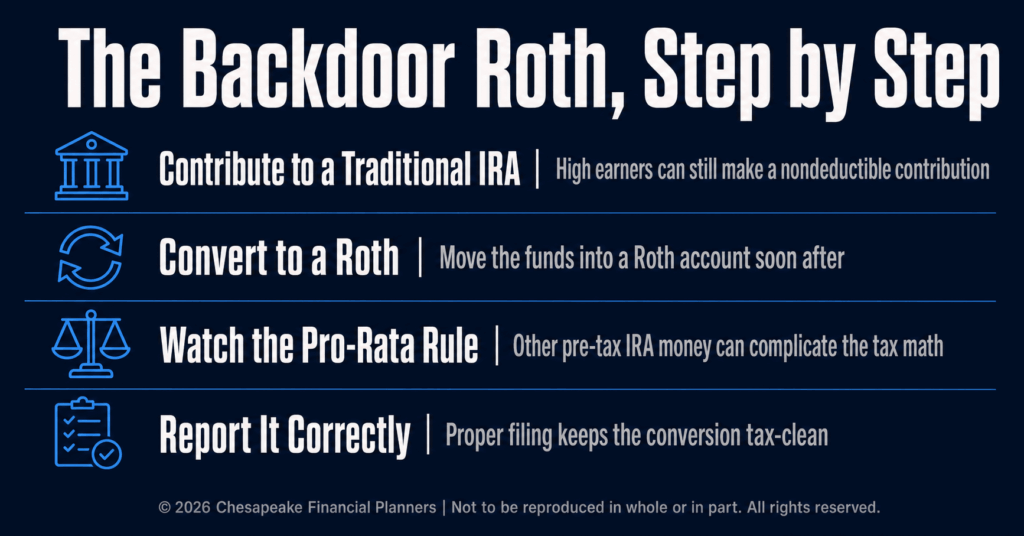
- How Do You Execute a Backdoor Roth IRA in Six Steps?
- What Is the Pro-Rata Rule and Why Does It Matter?
- Backdoor Roth vs. Mega Backdoor Roth: What's the Difference?
- Related Topics Worth Reading
- Frequently Asked Questions
- Disclosures
Key Takeaways
- A backdoor Roth IRA lets high earners route up to $7,500 in 2026 into a Roth IRA legally.
- Direct Roth IRA contributions phase out between $153,000 and $168,000 for single filers and $242,000 to $252,000 for joint filers.
- The pro-rata rule taxes the conversion in proportion to pre-tax IRA money you already hold across all traditional IRAs.
- Each step must be reported on IRS Form 8606, or the IRS may tax the same dollars twice at distribution.
- The strategy is most powerful for high earners with no other traditional IRA balances and a long runway to retirement.
About the Author: Jeff Judge, CFP®, AEP®, ChFC®, CLU® is Managing Partner of Chesapeake Financial Planners in Forest Hill, Maryland. He has been helping families and business owners in Harford County and the Baltimore metro area navigate Roth conversion strategy since earning his CFP® certification in 2013, by using Chesapeake Financial Planners’ signature process, the R.U.D.D.E.R. method™. Jeff often sees high earners assume they can't have a Roth at all, when the backdoor route was sitting in front of them the whole time.
What Is a Backdoor Roth IRA?
A backdoor Roth IRA is a two-step contribution method. You contribute after-tax dollars to a traditional IRA, then convert that traditional IRA into a Roth IRA. The IRS allows this because the income limits on direct Roth contributions do not apply to conversions. There is no income limit on Roth conversions, which is the provision the strategy depends on.
The mechanics matter because a "backdoor" Roth is not a special account type. There is no application for one. You open a regular traditional IRA and a regular Roth IRA at the same custodian, deposit money in the traditional, and convert it. The IRS treats the result as if you had contributed directly to a Roth.
The backdoor was effectively created in 2010 when Congress repealed the $100,000 modified adjusted gross income cap on Roth conversions. Before that change, high earners could neither contribute to a Roth directly nor convert into one. After the repeal, the conversion side opened up to everyone, and tax planners spotted that combining a nondeductible IRA contribution with an immediate conversion produced the same end result as a direct Roth contribution. The IRS has accepted the technique since then, and Congress has discussed eliminating it but never has.
Jeff Judge often tells clients the most useful way to think about this is that the Roth conversion provision is the open back door, and the nondeductible IRA contribution is the key. Congress could close the door in a future tax bill, but it has not closed it yet.
When Does a Backdoor Roth IRA Make Sense?
The backdoor Roth makes sense in three situations. First, your income is over the Roth income limit. For 2026, the IRS sets the Roth IRA phase-out between $153,000 and $168,000 for single filers and head of household. For married couples filing jointly, the phase-out runs from $242,000 to $252,000 per IRS Notice 2025-67. If you're above the top of the range, direct Roth contributions are blocked. Second, you have no other pre-tax money in any traditional, SEP, or SIMPLE IRA. That keeps your tax bill on the conversion to near zero. Third, you're maxing out your 401(k) and still want more tax-advantaged retirement savings.
The math gets dramatically more attractive the longer the money stays in the Roth. A 35-year-old who funds the $7,500 limit for 30 years and earns a 7% average annual return ends up with roughly $750,000 in Roth assets, which can produce tax-free distributions in retirement. The same contribution at age 55 with a 10-year runway grows to around $15,000. Still useful, but the compounding case is much weaker. The earlier you start, the more the backdoor Roth pays back.
The strategy is less compelling if you have a large rollover IRA from a prior 401(k). The pro-rata rule (covered below) can turn what should be a cheap conversion into a meaningful tax bill. We've worked with clients who solved this by rolling the rollover IRA back into a current 401(k) first, then doing the backdoor conversion the following year.
The R.U.D.D.E.R. Method™ is Chesapeake Financial Planners' six-step planning process: Review and Recognize, Uncover and Understand, Design and Develop, Discuss and Decide, Execute and Empower, and Reassess and Refine. The Review and Recognize step is where the backdoor Roth question first surfaces. We look at your current IRA balances across every custodian before recommending the strategy, because the pro-rata math runs on the total balance, not just the account you plan to use.
What is a Roth IRA, and how is it different from a traditional IRA?
How Do You Execute a Backdoor Roth IRA in Six Steps?
The backdoor Roth steps are mechanical once the strategy fits your situation. Each step has a reason behind it.
- Open a traditional IRA in your name (if you don't already have one at the custodian you want to use). It can be empty at the start.
- Open a Roth IRA at the same custodian. Most providers can do both in a single online application.
- Contribute the annual IRA limit to the traditional IRA. For 2026, the IRA contribution limit is $7,500, plus a $1,100 catch-up if you're 50 or older. Mark the contribution as nondeductible when you make it.
- Wait for the contribution to settle (usually one to two business days). Some advisors recommend waiting a few weeks to avoid the IRS step transaction doctrine, though there is no published guidance requiring a specific waiting period.
- Convert the traditional IRA balance to your Roth IRA. Most custodians handle this through a single online form. Any growth between contribution and conversion is taxable as ordinary income.
- File IRS Form 8606 with your tax return for the year of both the contribution and the conversion. This is the step most people skip, and it is the single most expensive mistake we see.
If you contribute and convert in two different tax years (for example, contribute in late 2026 and convert in January 2027), you file Form 8606 twice. Once for the nondeductible contribution and once for the conversion the following year. Either way, the form keeps the IRS from taxing your basis a second time when you eventually take distributions.
The waiting period between contribution and conversion is one of the most debated tactical details. The IRS has not formally adopted a specific waiting period, and most major custodians process same-day or next-day conversions without issue. The more conservative read says wait a few weeks so the contribution and conversion clearly look like two separate transactions rather than a single coordinated maneuver. In practice, the IRS has not contested same-day conversions in published guidance, but conservative tax planning still leans toward letting the contribution sit briefly.
The mistakes we see most often: skipping Form 8606 (which creates a basis tracking gap), holding existing pre-tax IRA money on December 31 (which triggers pro-rata tax), and waiting until April 15 of the following year to fund and convert without leaving time for clean filing. None of these are catastrophic on their own, but each adds friction to a strategy that should be easy.
What Is the Pro-Rata Rule and Why Does It Matter?
The pro-rata rule is the single biggest reason a backdoor Roth IRA can produce a tax surprise. When you convert from a traditional IRA, the IRS treats the conversion as a proportional withdrawal from all of your traditional, SEP, and SIMPLE IRAs combined, not just from the account you happen to be converting. Pre-tax dollars and after-tax dollars get blended on a percentage basis.
A concrete example. Suppose you contribute $7,500 nondeductible to a new traditional IRA, but you also hold a $92,500 rollover IRA from a prior employer's 401(k). Your total IRA basis is $100,000, of which 7.5% is after-tax. When you convert $7,500, only 7.5% of that conversion ($562.50) is considered after-tax. The other 92.5% ($6,937.50) is taxable as ordinary income, even though the dollars you "moved" came from the new nondeductible contribution.
There are two clean ways to neutralize the pro-rata rule. The first is to roll any existing pre-tax IRA money back into your current employer's 401(k), if the plan accepts incoming rollovers. After the rollover, your IRA balance is zero on December 31, the basis math works out cleanly, and the conversion produces a near-zero tax bill. The second is to convert the entire traditional IRA in a year when your taxable income is low, between jobs or in the first year of retirement before Social Security or required minimum distributions begin, and absorb the full tax bill at a discounted rate.
The pro-rata calculation uses the balance across all of your traditional IRAs on December 31 of the conversion year, not the day you converted. That timing detail catches people who think they can do a clean conversion in March, then roll a 401(k) into an IRA in November, without consequence. The IRS sees both transactions as part of the same year. See IRS Publication 590-A for the underlying rules.
One detail that surprises clients is which accounts count toward the pro-rata calculation. The IRS aggregates all your traditional IRAs, all SEP IRAs, and all SIMPLE IRAs (after the two-year SIMPLE holding period). Workplace plans such as 401(k), 403(b), 457, and TSP do not count. Spousal IRAs are calculated separately. That means your spouse can do their own clean backdoor Roth even if your IRA side has pre-tax money, because the math runs per-person on Form 8606.

Backdoor Roth vs. Mega Backdoor Roth: What's the Difference?
Both strategies route money into a Roth account, but they use different vehicles and have different ceilings. The "backdoor" version uses an IRA. The "mega backdoor" version uses a 401(k) that allows after-tax contributions and in-plan conversions.
| Feature | Backdoor Roth IRA | Mega Backdoor Roth |
|---|---|---|
| Account vehicle | Traditional IRA converted to Roth IRA | After-tax 401(k) converted to Roth 401(k) or Roth IRA |
| 2026 contribution ceiling | $7,500 ($8,600 if age 50 or older) | Substantially higher than the standard $24,500 employee limit, subject to the IRS total annual additions cap |
| Required plan feature | None, works at any IRA custodian | Employer 401(k) must allow after-tax contributions plus in-service withdrawals or in-plan Roth conversions |
| Pro-rata rule applies? | Yes, across all traditional IRAs | No, the 401(k) is segregated |
| Tax form required | IRS Form 8606 | Plan recordkeeper handles reporting |
| Best for | High earners with no rollover IRA who already max the 401(k) | High earners whose employer plan has the feature |
The mega backdoor is the more powerful strategy when it's available, because the contribution ceiling is much higher. Most 401(k) plans do not offer the after-tax contribution feature, so check the plan document before assuming it's available. We've helped clients confirm the option with their HR department and then coordinate the timing across both routes.
In some high-income households, both strategies run in parallel. Each spouse maxes their own backdoor Roth IRA ($7,500 each, or $15,000 total), while the high earner with the mega backdoor 401(k) feature stacks tens of thousands more into Roth space. The combined annual Roth contribution can meaningfully exceed what's possible through standard Roth and Roth 401(k) routes, and it stays inside the IRS rules.
What is a mega backdoor Roth, and how do I use one?
Related Topics Worth Reading
The backdoor Roth IRA fits inside a larger Roth strategy conversation. These related guides cover the adjacent decisions you should think through alongside the backdoor route.
- Roth IRA basics. What a Roth IRA is, who can contribute directly, and why tax-advantaged growth matters for long-horizon investors. Useful if you're newer to Roth accounts or want to confirm whether you might be eligible to skip the backdoor entirely. What is a Roth IRA, and how is it different from a traditional IRA?
- Roth conversion rules. Full rules for converting a pre-tax IRA or 401(k) balance to Roth, including the tax timing and the five-year clock that applies to each conversion. Read this before doing a large conversion in a low-income year. When does a Roth conversion make financial sense and how do you execute it?
- Mega backdoor Roth strategy. How to use after-tax 401(k) contributions plus in-plan conversions to move much larger sums into Roth space each year. The right next read if your employer plan offers the feature. What is a mega backdoor Roth, and how do I use one?
Frequently Asked Questions
Is a backdoor Roth IRA legal in 2026?
Yes, the backdoor Roth IRA is legal in 2026. The IRS recognizes the two-step process of contributing nondeductible dollars to a traditional IRA and converting those dollars to a Roth IRA. Congress has discussed eliminating the strategy in past tax proposals but has not enacted any legislation that removes it. Until a future law changes the rules, the technique remains available to every taxpayer.
How much can I contribute through a backdoor Roth IRA in 2026?
You can contribute up to the annual IRA limit through a backdoor Roth in 2026. The IRS limit is $7,500 per person, plus a $1,100 catch-up for those age 50 and older, for a total of $8,600. A married couple can each open their own traditional IRA, contribute the limit, and convert separately, doubling the household amount to $15,000 or $17,200.
Do I owe taxes on a backdoor Roth conversion?
You owe tax on any pre-tax amount converted and on any investment growth between the contribution and the conversion. If your only IRA balance is the new $7,500 nondeductible contribution, the conversion produces almost no tax bill. If you also hold pre-tax IRA money, the pro-rata rule taxes most of the conversion as ordinary income, even though you moved only the new contribution.
What is the pro-rata rule for a backdoor Roth?
The pro-rata rule says that when you convert from a traditional IRA, the IRS treats the conversion as a proportional withdrawal from all of your traditional, SEP, and SIMPLE IRAs combined. Pre-tax and after-tax dollars are blended on a percentage basis using your total IRA balance on December 31 of the conversion year, not the conversion date.
Do I have to file Form 8606 for a backdoor Roth IRA?
Yes, you must file IRS Form 8606 for both the nondeductible contribution and the Roth conversion. Form 8606 establishes your basis in the traditional IRA and prevents the IRS from taxing those same dollars again when you eventually take Roth distributions. Skipping the form is the most common backdoor Roth mistake and creates a needless tax problem at distribution time.
Can I do a backdoor Roth IRA if I have a 401(k) at work?
Yes, having a 401(k) at work does not prevent you from doing a backdoor Roth IRA. The pro-rata rule only counts balances in traditional, SEP, and SIMPLE IRAs, not 401(k) balances. Many high earners actually use their 401(k) as a parking spot for pre-tax money, rolling old IRA balances into the current 401(k) so the IRA side stays clean for backdoor conversions.
If a backdoor Roth IRA fits your situation, Chesapeake Financial Planners' guide to Roth strategy walks through how this stacks with conversions and other tax-advantaged moves over a multi-year window. Download the guide at chesapeakefp.com to see whether the strategy belongs in your plan this year.
A Roth IRA offers tax deferral on any earnings in the account. Qualified withdrawals of earnings from the account are tax-free. Withdrawals of earnings prior to age 59 ½ or prior to the account being opened for 5 years, whichever is later, may result in a 10% IRS penalty tax. Limitations and restrictions may apply.
Traditional IRA account owners have considerations to make before performing a Roth IRA conversion. These primarily include income tax consequences on the converted amount in the year of conversion, withdrawal limitations from a Roth IRA, and income limitations for future contributions to a Roth IRA. In addition, if you are required to take a required minimum distribution (RMD) in the year you convert, you must do so before converting to a Roth IRA.
Contributions to a traditional IRA may be tax deductible in the contribution year, with current income tax due at withdrawal. Withdrawals prior to age 59 ½ may result in a 10% IRS penalty tax in addition to current income tax.
CFP Board owns the marks CFP®, CERTIFIED FINANCIAL PLANNER®, and CFP® (with plaque design) in the U.S.
The ChFC® is the property of The American College of Financial Services, which reserves sole rights to its use, and is used by permission.
The CLU® is the property of The American College of Financial Services, which reserves sole rights to its use, and is used by permission.
Want to go deeper? Our Roth Conversion Window walks through this step by step.
Disclosures
The information provided is for educational purposes only and should not be construed as investment advice. Investment strategies should be tailored to individual circumstances, risk tolerance, and goals. Past performance doesn't guarantee future results. Consult with qualified financial professionals regarding your specific situation.
Contributions to a traditional IRA may be tax deductible in the contribution year, with current income tax due at withdrawal. Withdrawals prior to age 59 ½ may result in a 10% IRS penalty tax in addition to current income tax.
A Roth IRA offers tax deferral on any earnings in the account. Qualified withdrawals of earnings from the account are tax-free. Withdrawals of earnings prior to age 59 ½ or prior to the account being opened for 5 years, whichever is later, may result in a 10% IRS penalty tax. Limitations and restrictions may apply.
Advisors associated with Chesapeake Financial Planners may be either (1) LPL Financial Registered Representatives offering securities through LPL Financial, Member FINRA and SIPC, and investment advisor representatives offering investment advice through Great Valley Advisor Group; or (2) solely investment advisor representatives offering investment advice through Great Valley Advisor Group and not affiliated with LPL Financial. Great Valley Advisor Group, and Chesapeake Financial Planners are separate entities from LPL Financial.


