

What is the 83(b) election, and why does the deadline matter?
Last reviewed: July 2026
The 83(b) election is a one-page tax filing that lets you pay tax on restricted stock or restricted property at the moment it's granted, instead of paying tax later as the shares vest. The deadline is firm: 30 days from the date the property was transferred to you, per IRS Publication 525. Miss it, and the default rule applies for the life of the grant. No extension exists, and the IRS does not grant relief except in narrowly defined cases.
For most founders and very early employees, the 83b election is the most consequential single piece of paper they'll sign in the first month of their company. The math works in their favor when shares are worth almost nothing at grant and could be worth a great deal later. The math turns against them if shares are forfeited, the company fails, or the value at grant is already substantial.
On This Page
- Key Takeaways
- Who can file an 83(b) election, and when does it apply?
- How does the 83(b) election change the tax math?
- What is the 83(b) deadline, and how do you file it correctly?
- When does an 83(b) election backfire?
- Related Topics Worth Reading
- Frequently Asked Questions
- Disclosures
Key Takeaways
- The 83(b) election must be filed within 30 days of property transfer, and the IRS does not grant extensions.
- Filing shifts future appreciation from ordinary income at vesting into long-term capital gains at sale.
- The election applies to restricted property that vests over time, including founder stock and early-exercised options.
- Forfeited shares produce no refund of taxes already paid under the election.
- Filing can start the QSBS five-year clock early, unlocking up to 100% gain exclusion on later sale.
About the Author: Jeff Judge, CFP®, AEP®, ChFC®, CLU® is Managing Partner of Chesapeake Financial Planners in Forest Hill, Maryland. He has been helping founders, equity-compensated employees, and families in Harford County and the Baltimore metro area work through startup equity tax decisions since earning his CFP® certification in 2013, by using Chesapeake Financial Planners’ signature process, the R.U.D.D.E.R. method™. Jeff has seen the 83(b) deadline trip up brilliant operators who missed it by a week, and watched founders save seven figures by filing it on time.
Who can file an 83(b) election, and when does it apply?
The Section 83(b) election (sometimes called a restricted stock election) is available to anyone who receives property in connection with services that is subject to a substantial risk of forfeiture. In plain English, that means restricted stock or other restricted property you can lose if you leave or fail to perform. Common scenarios include founder shares subject to a vesting schedule, restricted stock awards (RSAs) granted to early employees, and shares acquired through the early exercise of unvested options.
Restricted stock units (RSUs) at public companies are different. RSUs are a contractual promise to deliver shares in the future, not a present transfer of property, and the IRS has been clear that an 83(b) election does not apply to standard RSUs. Founders and pre-IPO employees often miss this distinction, especially when working at a private company whose plan documents use the word "restricted" loosely.
The election also covers certain partnership interests, including profits interests under Rev. Proc. 93-27 and Rev. Proc. 2001-43, though the analysis is more situational. For LLCs taxed as partnerships, a properly filed election can prevent ordinary-income treatment on the spread between liquidation value and what the recipient paid. The mechanics resemble the corporate version; the strategic stakes vary widely by deal structure.
Jeff has watched the same scene play out a dozen times: a founder signs a stock purchase agreement on incorporation day, the lawyer mentions 83(b) once in a list of follow-up items, and the founder files it away alongside the corporate kit. Two weeks later, the founder is heads-down building product, and the 30-day clock runs out without anyone catching it. The filing itself takes an hour. The recovery from missing it can take a decade.
How does the 83(b) election change the tax math?
The election shifts the moment income is recognized. Without an 83(b) election, you recognize ordinary income at each vesting event, based on the spread between the fair market value at vesting and the price you paid. With an 83(b) election, you recognize all of that ordinary income at grant, based on the spread at grant, and any future appreciation is taxed as capital gain when you sell.
For a founder with shares purchased at par value on incorporation day, the spread at grant is usually zero or negligible. The election therefore results in little or no current tax. The shares vest over the next four years with no further income recognition, and any sale gains a year or more after grant are taxed at long-term capital gains rates, which top out at 20% for high earners. The 3.8% Net Investment Income Tax can also apply for taxpayers above certain thresholds, but the combined rate is still well below the top federal ordinary rate.
The math gets more interesting in two cases. First, on an early exercise of unvested options, the 83(b) locks in a starting basis equal to the exercise price plus the spread, capping ordinary income at the small spread that exists today rather than the much larger spread at vesting. Second, when shares qualify as qualified small business stock under IRC §1202, filing an 83(b) starts the five-year holding clock at grant, accelerating eligibility for the gain exclusion that can shield the greater of $10 million or 10x adjusted basis from federal capital gains tax.
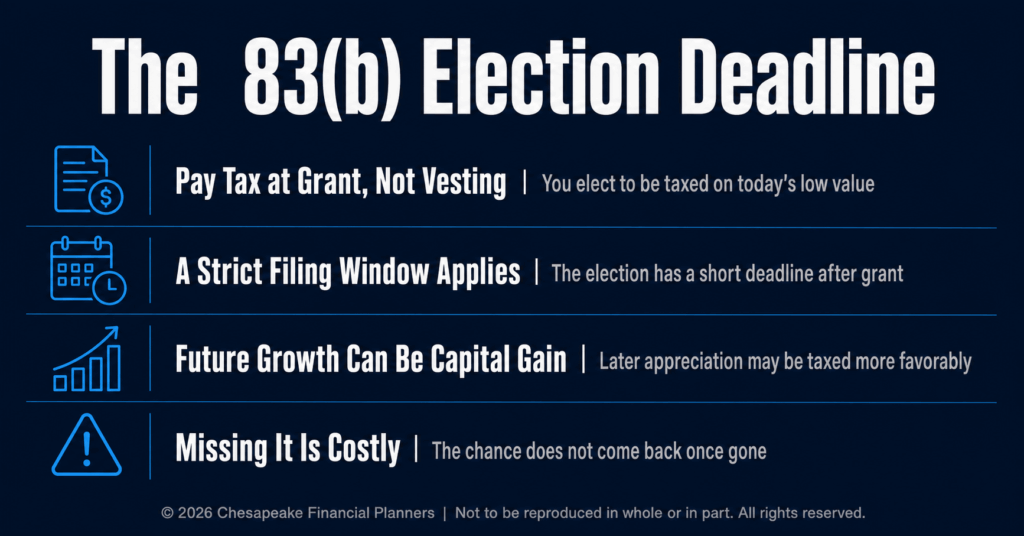
The downside is the mirror image of the upside. If you forfeit the shares before they vest, the tax you paid under the election is not refundable. If the company fails, you've prepaid tax on phantom income. If you can't afford the tax bill at grant in the first place, the math doesn't work at all. The election rewards conviction; it punishes hedging.
What is the 83(b) deadline, and how do you file it correctly?
The 83(b) deadline is 30 days from the date the property was transferred, with no exceptions. Per IRS Publication 525, the written statement or Form 15620 must be filed with the IRS office where you file your federal income tax return no later than 30 days after the date the property was transferred. Day one is the day after the transfer, and the count runs in calendar days, including weekends and holidays.
In 2024, the IRS released Form 15620, which standardized the historic patchwork of self-drafted statements that taxpayers had been filing for decades. The form asks for the taxpayer's name and Social Security number, a description of the property, the transfer date, the fair market value at transfer, the amount paid, and the amount included in gross income. You sign it, mail it, and keep a stamped copy with your tax records.
The mechanics deserve precision. Send the election by certified mail with return receipt requested, addressed to the IRS service center where you file your annual return. Provide a copy to the company that granted the property so payroll and 1099 reporting can be adjusted. Keep a stamped copy for your own files, because if the IRS ever loses its copy, the certified mail receipt is the only thing standing between you and a denied election. Attaching the election to your tax return is no longer required, but many practitioners still do it as a paper trail.
If you miss the deadline by a single day, the election is invalid. The IRS has very limited authority to grant relief, and the available § 9100 regulatory-relief procedures generally do not extend to statutorily fixed deadlines. The strongest claim founders sometimes raise, that the lawyer or company should have warned them, does not change the deadline. Mark day 28 on your calendar, set a second reminder on day 25, and file early.
When does an 83(b) election backfire?
The election backfires when the value at grant is high, the forfeiture risk is real, or the appreciation never comes. A late-stage employee receiving restricted stock at a $5 fair market value per share will owe ordinary income tax on that full spread at grant, with no liquidity to pay it. If they then leave before vesting, they've prepaid tax on shares they no longer own. The IRS does not refund that money, and the lost capital is gone.
The election can also backfire when the company is in a sector that frequently restructures, recapitalizes, or runs through painful down rounds. A founder who filed an 83(b) at a $0.001 per share basis but later watched the cap table get scrubbed in a recapitalization may discover their shares were canceled and reissued at a higher basis to incoming investors, leaving them with a tax bill paid on shares that no longer exist in their original form.
This is where the R.U.D.D.E.R. Method™ earns its keep. The R.U.D.D.E.R. Method™ is Chesapeake Financial Planners' six-step planning process: Review and Recognize, Uncover and Understand, Design and Develop, Discuss and Decide, Execute and Empower, and Reassess and Refine. Applied to an 83(b) decision, it means reviewing the actual grant documents and forfeiture provisions, uncovering the current fair market value and the founder's cash position, designing scenarios that compare filing vs. not filing across vesting outcomes, discussing the tradeoffs with a tax professional and family, executing the filing on time when the analysis supports it, and reassessing if the cap table changes in a way that affects the original basis.

As Jeff Judge puts it: "The 83(b) election is the cheapest insurance policy a founder will ever pass up if they pass it up. A stamp, an hour of paperwork, and a calendar reminder for day 28. That's the cost. The downside of missing it can compound for a decade."
Related Topics Worth Reading
The 83(b) decision rarely stands alone. The mechanics interact with stock options, partnership equity, exit planning, and the broader timing of an equity-heavy compensation package. A few related guides help prevent the most common mistakes.
- When does exercising incentive stock options trigger the AMT?. Founders who early-exercise ISOs and file an 83(b) often trigger AMT on the spread, even when the regular tax bill is zero. Knowing the AMT consequences before exercising is essential.
- What is QSBS, and how can founders exclude millions in tax?. The five-year QSBS clock starts at grant when an 83(b) is filed, which can shave years off the wait to qualify for the gain exclusion.
- What do double-trigger RSUs at a private company mean for me?. RSUs work differently from RSAs, and the 83(b) election does not apply to standard double-trigger RSUs even at late-stage private companies.
- How do I diversify a concentrated company stock position without a huge tax bill?. Founders who file an 83(b) and ride the position to liquidity often face concentration risk that dwarfs the original tax planning question.
- How should I invest the proceeds after selling my business?. Once an exit happens, the after-tax cash needs a plan that connects back to the original equity decisions.
Frequently Asked Questions
Is the 83(b) election the same as a 409A valuation?
No, they govern different things. The 83(b) election is a tax timing choice you make when you receive restricted property, telling the IRS to recognize income now instead of at vesting. A 409A valuation is the company's appraisal of common stock fair market value, which sets the exercise price for options and the spread used in the 83(b) calculation. The 409A drives the number; the 83(b) decides when you pay tax on it.
Can I file an 83(b) election after the 30-day deadline?
No. The 30-day deadline is statutory under IRC §83(b)(2) and is not subject to extension or late-filing relief from the IRS under the standard procedures. Once the window closes, the default vesting-event taxation applies to your shares for the life of the grant, even if the missed filing was the result of an attorney's oversight. Set the reminder, then back it up with a second one.
What happens if I file an 83(b) election and then forfeit the shares?
You do not get a refund of the tax you paid at grant. If shares are forfeited before vesting, you can generally claim a capital loss equal to the amount you paid for the shares (your basis), but the ordinary income you recognized under the election is not deductible or recoverable. This is why the election rewards conviction and punishes hedging on whether you'll stay long enough to vest.
Do I need to attach the 83(b) election to my tax return?
No, the IRS removed the requirement to attach a copy of the 83(b) election to your annual tax return for filings starting with the 2015 tax year. You still must file the election with the IRS within 30 days of the property transfer, and you still must keep a stamped copy of the election for your records. Many practitioners attach a copy of the election anyway as belt-and-suspenders documentation.
Does the 83(b) election affect my employer's payroll or my W-2?
Yes. The company must include the amount you reported as income from the election in your W-2 wages for the year of grant and withhold employment taxes on it. Provide your employer a copy of the filed election promptly so they can adjust payroll. If you are a founder paying par value, the W-2 inclusion may be zero or very small; for later employees with substantial spread at grant, the withholding can be meaningful.
Should I make an 83(b) election if my shares were already partially vested at grant?
The election applies only to the portion of the property that is still subject to a substantial risk of forfeiture at the time of transfer. Shares that vest immediately are already includible in income at grant under the default rule and do not require an election. For partially vested grants, the election would cover the unvested portion, and the analysis is the same: low value plus high upside favors filing.
Is there any benefit to filing an 83(b) when the spread at grant is zero?
Yes. Even with a zero spread, filing locks in the start of the long-term capital gains holding period and, for QSBS-eligible shares, starts the five-year clock at grant. Both effects can matter later. The election costs nothing at zero spread, which makes it a high-impact piece of paper for founders who buy shares at par on incorporation day.
The 83(b) election rewards two things: low value at grant and conviction. If you have both, file it on time. If you found this helpful, our founder equity planning guide covers the 83b election alongside ISO exercise timing, QSBS qualification, and 409A valuations in depth. Download it at chesapeakefp.com.
Want to go deeper? Our 10 Signs You're Ready for a Certified Financial Planner walks through this step by step.
This material is for educational purposes only and should not be considered tax or legal advice. Please consult with your tax advisor or attorney regarding your specific situation.
The opinions voiced in this material are for general information only and are not intended to provide specific advice or recommendations for any individual.
All investing involves risk including loss of principal. No strategy assures success or protects against loss.
Stock investing includes risks, including fluctuating prices and loss of principal.
Disclosures
The information provided is for educational purposes only and should not be construed as investment advice. Investment strategies should be tailored to individual circumstances, risk tolerance, and goals. Past performance doesn't guarantee future results. Consult with qualified financial professionals regarding your specific situation.
This information is not intended to be a substitute for specific individualized tax, investment or legal advice. We suggest that you discuss your specific situation with a qualified tax, legal or financial advisor.
Advisors associated with Chesapeake Financial Planners may be either (1) LPL Financial Registered Representatives offering securities through LPL Financial, Member FINRA and SIPC, and investment advisor representatives offering investment advice through Great Valley Advisor Group; or (2) solely investment advisor representatives offering investment advice through Great Valley Advisor Group and not affiliated with LPL Financial. Great Valley Advisor Group, and Chesapeake Financial Planners are separate entities from LPL Financial.


