

Why Isn't My 22% RSU Withholding Enough, and What Will I Owe?
Last reviewed: July 2026
Your 22% RSU withholding isn't enough because the IRS treats vested RSUs as supplemental wages and applies a flat 22% withholding rate, but if your total income lands you in the 32%, 35%, or 37% federal bracket, you've underpaid by 10 to 15 percentage points on every dollar that vested. That gap is real money, and it shows up as a surprise tax bill in April. The fix is to estimate your actual marginal rate, calculate the shortfall, and cover it through extra withholding or quarterly estimated payments before the IRS adds penalties.
On This Page
- Key Takeaways
- What Are RSUs and How Are They Taxed?
- Why Does My Company Only Withhold 22%?
- How Much Will I Actually Owe on My RSUs?
- What Happens When My RSU Income Tops $1 Million?
- How Do I Cover the RSU Tax Shortfall?
- Should I Sell My RSUs at Vesting or Hold Them?
- How Do RSUs Affect the Rest of My Tax Picture?
- Frequently Asked Questions
- Where to Go From Here
- Disclosures
Key Takeaways
- RSUs are taxed as ordinary income at vesting, and the IRS requires only 22% flat withholding on supplemental wages under $1 million.
- High earners in the 32% to 37% bracket face a 10 to 15 point gap between what's withheld and what they actually owe.
- Supplemental wages above $1 million in a year are withheld at a mandatory 37%, the top IRS supplemental rate.
- You can close the gap by adjusting W-4 withholding, making quarterly estimated payments, or selling shares at vest to raise cash.
- Concentrated RSU positions create a second problem beyond taxes: too much net worth tied to one employer's stock price.
About the Author: Jeff Judge, CFP®, AEP®, ChFC®, CLU® is Managing Partner of Chesapeake Financial Planners in Forest Hill, Maryland. He has been helping families and business owners in Harford County and the Baltimore metro area navigate equity compensation and RSU taxation since earning his CFP® certification in 2013, by using Chesapeake Financial Planners’ signature process, the R.U.D.D.E.R. method™. Jeff has watched more than a few tech employees treat a vesting event as a windfall, only to discover in April that a third of it already belonged to the IRS, and that the 22% their company withheld covered barely two-thirds of the real bill.
What Are RSUs and How Are They Taxed?
Restricted stock units are a promise from your employer to give you company shares once you meet a vesting condition, usually staying employed for a set period. Until they vest, RSUs are just a promise. The day they vest, they become real shares you own, and the IRS treats their full market value as ordinary income, exactly like a cash bonus.
Here's the part that trips people up. The taxable amount is the share price on the vesting date multiplied by the number of shares that vested. If 1,000 shares vest at $150, you have $150,000 of ordinary income that year, whether or not you sell a single share. You owe tax on that $150,000 even if the stock drops to $90 the next morning and you're still holding it. Jeff Judge notes: "Most clients don't realize the tax bill on RSU vesting hits whether or not they sell a share, so if the stock drops right after the vesting date, you can end up owing taxes on income that no longer exists in the account."
Restricted stock units explained in one line: they're compensation that becomes taxable the moment you can no longer lose them. According to the IRS, the income is reported on your W-2 in the year of vesting, and your employer is required to withhold federal income tax, Social Security, and Medicare on it.
When exactly is the income taxed?
The income is taxed at vesting, not at grant and not at sale. This matters because it removes any choice about timing. Unlike incentive stock options, where you decide when to exercise, RSUs vest on a schedule your employer set. You don't get to defer the income to a lower-income year. Jeff Judge often tells clients that the single most expensive misunderstanding he sees is the belief that RSU tax happens when you sell. It doesn't. It happens when it vests, and the clock on your tax bill starts that day.
When you later sell the shares, you have a second, separate taxable event: a capital gain or loss measured from the vesting-date price. Sell within a year of vesting and any gain is a short-term capital gain taxed at ordinary rates. Hold longer than a year and you qualify for long-term capital gains treatment, which the IRS taxes at preferential rates of 0%, 15%, or 20% depending on your income.
Why Does My Company Only Withhold 22%?
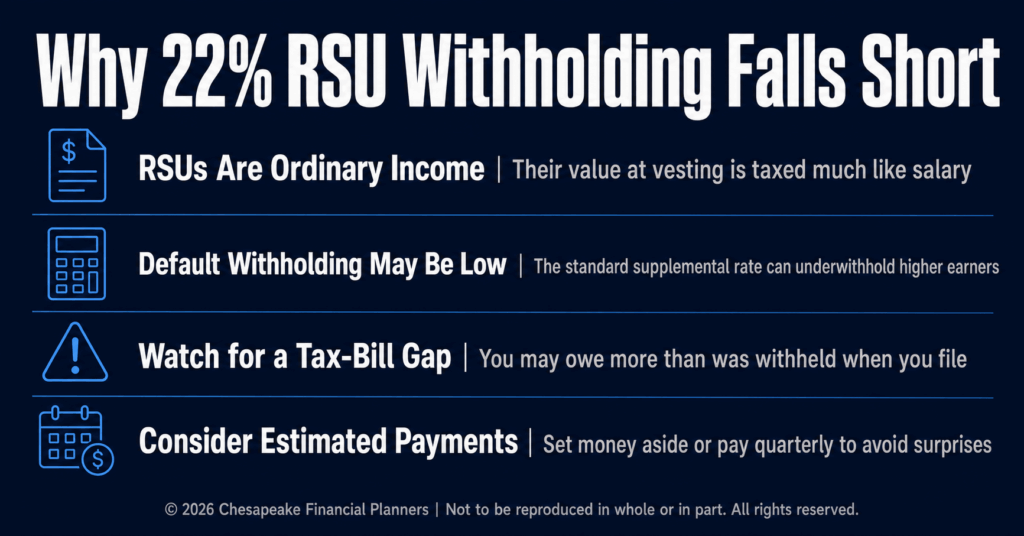
Your company withholds 22% because the IRS classifies RSU income as supplemental wages, and the default federal withholding rate for supplemental wages under $1 million in a calendar year is a flat 22%. This is the law, not a mistake by your payroll department. Per IRS Publication 15, employers may use the flat-rate method for supplemental wages, and most large employers do because it's simple to administer across thousands of employees.
The problem is that 22% is a one-size-fits-all number, and it fits almost no one in tech. A flat 22% withholding rate is designed around an employee whose marginal tax bracket is roughly 22%. If your salary plus your RSU income pushes your total taxable income into the 32%, 35%, or 37% bracket, the company still only withholds 22% on the RSU portion. The difference between what was withheld and what you owe doesn't disappear. It waits for you on your tax return.
Can I ask my employer to withhold more?
Some employers let you elect a higher supplemental withholding rate or adjust your W-4 to pull extra tax from your regular paychecks, but many large companies lock the supplemental rate at the flat 22% and won't change it per employee. This is one of those places where the system is built for the average and quietly penalizes high earners. Restricted stock units explained honestly means admitting that the withholding default was never designed for someone with a $200,000 salary and $300,000 of vesting RSUs.
If your employer won't budge on the supplemental rate, your tools are a revised W-4 (using the extra-withholding line) or quarterly estimated payments to the IRS directly. We'll walk through both below.
How Much Will I Actually Owe on My RSUs?
You'll owe federal income tax at your actual marginal bracket, which for most tech employees with significant RSU income is 32%, 35%, or 37%, not the 22% your company withheld. The shortfall is the difference between your real bracket and 22%, multiplied by your RSU income.
Let's run the math on a real-feeling example. Say you earn a $220,000 salary and $300,000 of RSUs vest this year, for $520,000 of total income. As a single filer, the top of that income sits in the 35% federal bracket per the IRS 2026 tax bracket schedule. Your company withheld 22% of the $300,000 RSU income, or $66,000. But a large chunk of that RSU income is taxed at 32% and 35%. If your effective marginal rate on the RSU dollars is roughly 33%, you actually owe about $99,000 of federal tax on them. That's a $33,000 gap, and that's before state taxes.
| Item | Amount |
|---|---|
| RSU income vested | $300,000 |
| Federal withheld at 22% | $66,000 |
| Federal actually owed (≈33% effective) | $99,000 |
| Federal shortfall | $33,000 |
| Maryland state tax (varies) | additional |
The exact number depends on your state, your filing status, and how the RSU dollars stack on top of your salary, but the direction is always the same: a high earner underwithholds. Jeff Judge has seen this gap run from $15,000 to north of $80,000 for clients at larger tech firms, and almost none of them saw it coming.
Does the 22% rate ever actually cover my bill?
The 22% withholding can be enough if your total household income keeps you inside the 22% or 24% bracket, which happens for employees with modest salaries and small RSU grants. The trouble is that RSUs are concentrated among higher earners, exactly the people whose marginal rates exceed 22%. The more your equity compensation matters to your net worth, the bigger the underwithholding gap tends to be.

What Happens When My RSU Income Tops $1 Million?
When your aggregate supplemental wages exceed $1 million in a single calendar year, the IRS requires a mandatory 37% withholding rate on the portion above $1 million, which is the highest supplemental rate. Per IRS Publication 15, this is not optional and applies regardless of what you put on your W-4.
This rule actually helps high earners in one narrow way: above $1 million, your withholding finally matches the top bracket. The 37% mandatory rate lines up almost perfectly with the 37% top marginal federal bracket. So the truly massive vesting years often underwithhold less, on a percentage basis, than the $300,000 to $800,000 years where you're stuck at the flat 22%.
The cruel middle is the employee whose supplemental wages land between, say, $400,000 and $900,000. They're well into the 35% bracket but still withheld at only 22%, and they never hit the $1 million trigger that would fix it. That's the danger zone for an April surprise.
How is the $1 million threshold measured?
The threshold is measured across all your supplemental wages from a single employer in the calendar year, including bonuses, commissions, and RSU income combined, not RSUs alone. If you have $400,000 in bonuses and $700,000 in RSUs vest, your combined $1.1 million in supplemental wages crosses the line, and the amount above $1 million is withheld at 37%. Knowing where you sit relative to that threshold helps you predict your withholding behavior before vesting day arrives.
How Do I Cover the RSU Tax Shortfall?
You cover the shortfall with one of three tools: increase your W-4 withholding, make quarterly estimated tax payments directly to the IRS, or sell enough shares at vesting to raise the cash. Most clients use a combination. This is where the R.U.D.D.E.R. Method™ becomes useful. The R.U.D.D.E.R. Method™ is Chesapeake Financial Planners' six-step planning process: Review and Recognize, Uncover and Understand, Design and Develop, Discuss and Decide, Execute and Empower, and Reassess and Refine. Applied to RSUs, the "Uncover and Understand" step is where we surface the withholding gap most people never knew existed.
The cleanest approach for many tech employees is to sell-to-cover plus a quarterly estimated payment. Many employers automatically sell a portion of vesting shares to cover the 22%. You then make a quarterly estimated payment for the extra 10 to 15 points yourself.
Will I owe penalties if I just pay it all in April?
You may owe an underpayment penalty if you wait until April, even if you pay in full, because the IRS expects taxes to be paid throughout the year. According to the IRS, you generally avoid the penalty if you pay the smaller of 90% of the current year's tax or a safe-harbor amount based on last year's tax. For taxpayers with prior-year AGI above $150,000, that safe harbor is 110% of the prior year's total tax. Hitting the safe harbor through withholding or quarterly payments protects you from penalties even if a big vesting year leaves a balance due.
Here's a practical sequence. First, estimate your full-year tax including the RSU income at your real bracket. Second, total your expected withholding (salary plus the 22% RSU withholding). Third, the difference is your shortfall, which you spread across the remaining quarterly estimated payment deadlines. The federal deadlines fall in April, June, September, and January.

Should I Sell My RSUs at Vesting or Hold Them?
For most people, selling RSUs at vesting and reinvesting the proceeds into a diversified portfolio is the financially rational default, because holding the shares is an active bet that your single employer's stock will beat the broad market. There's no tax reason to hold. You already paid ordinary income tax on the full value at vesting, so holding only exposes you to concentration risk and future capital gains tax on any appreciation.
This is a concentration-risk question more than a tax question. If you let RSUs vest and accumulate year after year without selling, a growing share of your net worth becomes tied to one company. When that company is also your paycheck, your health insurance, and your career, a single bad quarter can hit your income and your savings at the same time. Jeff Judge frames it this way with clients: would you take your annual cash bonus and immediately buy that exact dollar amount of your employer's stock? Almost no one says yes. Yet holding vested RSUs is functionally identical to doing exactly that, every quarter.
When does it make sense to hold?
Holding can make sense if you have a specific, considered reason, such as an expectation of a near-term long-term capital gains qualification, a tax year where you want to control gain realization, or a 10b5-1 plan that schedules sales in advance to avoid insider-trading concerns. The decision should be deliberate, not the result of inertia. We're not making a recommendation on any individual security here. The point is to choose your concentration level on purpose rather than by default.
A disciplined approach many clients use is to sell shares automatically at each vest and redirect the proceeds into a diversified mix. It removes the emotional pull of trying to time the stock and keeps your portfolio from quietly tilting toward a single name.
How Do RSUs Affect the Rest of My Tax Picture?
RSU income raises your adjusted gross income, which can push you into higher brackets, trigger additional surtaxes, and reduce or eliminate certain deductions and credits. The effects ripple well beyond the headline income tax.
Two surtaxes deserve attention. The Additional Medicare Tax of 0.9% applies to wages above $200,000 for single filers and $250,000 for married filing jointly, per the IRS. Since RSU income is wages, large vesting years routinely cross this line. Separately, the Net Investment Income Tax of 3.8% can apply to investment income, including capital gains when you eventually sell appreciated shares, once your modified AGI exceeds those same threshold ranges, according to the IRS.
A spike in AGI from a big vesting year can also affect things you might not connect to your stock: phaseouts of certain credits, the cost of Medicare premiums two years down the road if you're near retirement, and your eligibility for direct Roth IRA contributions. Jeff Judge often points out that a single large vest can quietly cost a client thousands in lost benefits and surtaxes that have nothing to do with the headline tax rate.
Does RSU income affect my state taxes too?
Yes, RSU income is taxed by your state in the year of vesting, and high-tax states can add meaningfully to your total bill on top of the federal shortfall. If you move states between grant and vesting, allocation rules can get complicated, and some states tax a portion of the income based on where you worked during the vesting period. This is one area where getting the rules right before a move can save real money, and where a coordinated plan between your tax preparer and your advisor pays for itself.
Frequently Asked Questions
What is RSU tax withholding and why does it matter?
RSU tax withholding is the tax your employer takes out when your restricted stock units vest, defaulting to a flat 22% federal supplemental rate under $1 million. It matters because that 22% rarely matches a high earner's true 32% to 37% bracket, leaving a shortfall you must cover yourself through estimated payments or extra withholding to avoid a surprise April bill.
Are RSUs taxed twice?
RSUs are not taxed twice, but they create two separate taxable events. First, the full market value at vesting is taxed as ordinary income on your W-2. Second, when you later sell, any change in value since vesting is a capital gain or loss. You only pay tax on the appreciation after vesting, not on the original value again, so it is two events, not double taxation.
How do I know if my RSU withholding is too low?
You know your RSU withholding is too low if your total household income, salary plus vested RSUs, lands you in a federal bracket above 22%. Estimate your full-year tax at your real marginal rate, total your expected withholding, and compare. If your projected tax exceeds your withholding by more than a small cushion, you have a shortfall to plan for before filing season.
What happens if I don't pay the RSU tax shortfall until April?
If you wait until April to pay an RSU tax shortfall, you may owe an IRS underpayment penalty even though you pay in full, because taxes are expected throughout the year. You generally avoid the penalty by meeting a safe harbor, such as paying 110% of last year's total tax when your prior-year AGI exceeds $150,000, through withholding or quarterly estimated payments.
Should I sell my RSUs as soon as they vest?
For most people, selling RSUs at vesting is the rational default because you have already paid ordinary income tax on the full value, so holding adds concentration risk without a tax benefit. Holding only makes sense for a deliberate reason, such as a planned long-term capital gains hold or a scheduled 10b5-1 sale, rather than out of inertia or hope the stock keeps climbing.
What is the mandatory 37% RSU withholding rate?
The mandatory 37% rate applies when your total supplemental wages, including bonuses and RSU income from one employer, exceed $1 million in a calendar year. The portion above $1 million must be withheld at 37%, the top supplemental rate, regardless of your W-4. This actually aligns withholding with the top federal bracket, so very large vesting years often underwithhold less than mid-range years stuck at 22%.
Do RSUs affect my Medicare and Roth IRA eligibility?
Yes, RSU income raises your adjusted gross income, which can trigger the 0.9% Additional Medicare Tax on wages above the IRS thresholds and can push your modified AGI past the limit for direct Roth IRA contributions. A large vesting year can also affect future Medicare premiums and certain credit phaseouts, so the impact reaches well beyond the headline income tax rate.
Can I change my RSU withholding rate?
Some employers let you elect a higher supplemental withholding rate or add extra withholding through your W-4, but many large companies lock the supplemental rate at the flat 22% per employee. If yours won't adjust it, your practical tools are increasing W-4 withholding on regular paychecks using the extra-withholding line or making quarterly estimated payments directly to the IRS to cover the gap.
Where to Go From Here
The 22% withholding gap is one of the most expensive surprises in tech compensation, and it's entirely avoidable once you run the numbers. If you want a clear framework for managing rsu tax withholding alongside the rest of your equity, our guide to equity compensation planning walks through the full picture, from vesting to diversification to the tax moves that actually move the needle. Download it at chesapeakefp.com and stop letting a flat 22% rate decide your April.
For deeper coverage of related topics, explore What is the best financial planning strategy for a tech company employee with equity compensation?, What is the difference between RSUs, ISOs, NSOs, and ESPP, and how are they taxed?, How do I diversify a concentrated company stock position without a huge tax bill?, What is a 10b5-1 plan, and how does it let me sell company stock safely?, What Is the Difference Between Total Comp and Base Salary?, What happens to my stock options when I leave my job?, What happens to my stock options when I leave my job?, and What do double-trigger RSUs at a private company mean for me?.
Want to go deeper? Our Tech Equity Tax Traps Guide walks through this step by step.
Disclosures
The information provided is for educational purposes only and should not be construed as investment advice. Investment strategies should be tailored to individual circumstances, risk tolerance, and goals. Past performance doesn't guarantee future results. Consult with qualified financial professionals regarding your specific situation.
This information is not intended to be a substitute for specific individualized tax, investment or legal advice. We suggest that you discuss your specific situation with a qualified tax, legal or financial advisor.
Advisors associated with Chesapeake Financial Planners may be either (1) LPL Financial Registered Representatives offering securities through LPL Financial, Member FINRA and SIPC, and investment advisor representatives offering investment advice through Great Valley Advisor Group; or (2) solely investment advisor representatives offering investment advice through Great Valley Advisor Group and not affiliated with LPL Financial. Great Valley Advisor Group, and Chesapeake Financial Planners are separate entities from LPL Financial.


