

How do I diversify a concentrated company stock position without a huge tax bill?
Last reviewed: July 2026
If you hold a concentrated stock position in your employer, you usually need to unwind it in stages, blend several tax tools, and start years before you actually need the cash. The right mix typically pulls from a 10b5-1 plan, an exchange fund, a direct-indexing portfolio, charitable giving, and (if you meet the rules) the Section 1202 QSBS exclusion that the One Big Beautiful Bill Act expanded to a $15 million per-issuer cap in mid-2025. Selling everything at once and writing the IRS a check is almost never the best move.
On This Page
- Key Takeaways
- What counts as a concentrated stock position, and why does it matter?
- What does selling concentrated company stock actually cost in taxes?
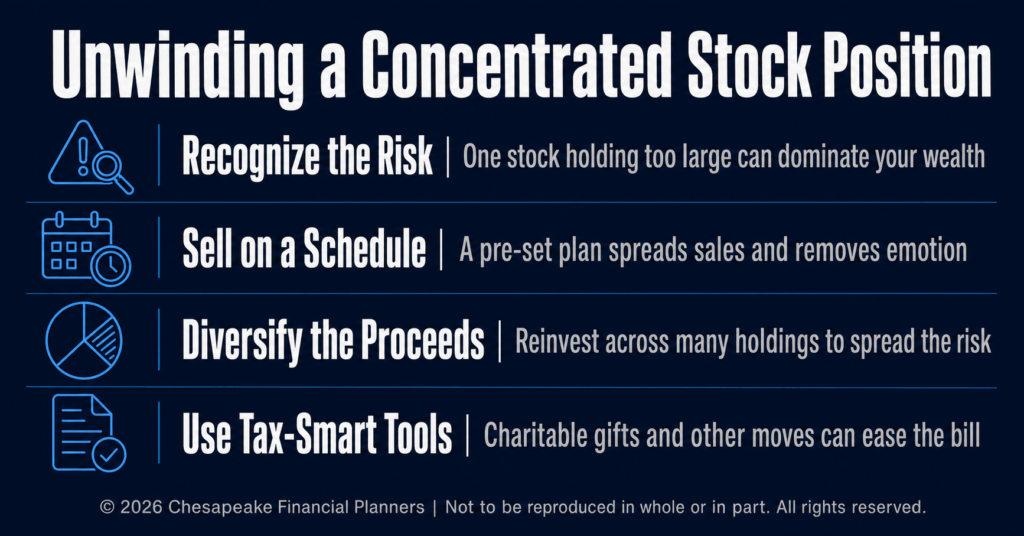
- Which strategies actually work to diversify company stock?
- How does the R.U.D.D.E.R. Method apply when unwinding a concentrated position?
- Related Topics Worth Reading
- Frequently Asked Questions
- What to do next
- Disclosures
Key Takeaways
- A concentrated stock position is typically any single security worth more than 10% of investable assets, and the bigger the position the bigger the planning gap.
- Long-term gains are taxed in 2026 at 0%, 15%, or 20%, with the 20% rate kicking in above $545,500 single or $613,700 MFJ, plus a 3.8% net investment income tax above $200,000 single or $250,000 joint.
- Officers and directors of public companies need a 10b5-1 plan with a 90-day cooling-off period before any sales can begin.
- Founders and early employees of qualifying C-corps can now exclude up to $15 million of gain under post-OBBBA Section 1202 rules.
- Exchange funds, direct indexing, donor-advised funds, and NUA each fit a different situation, and the right answer depends on cash flow, time horizon, and charitable intent.
About the Author: Jeff Judge, CFP®, AEP®, ChFC®, CLU® is Managing Partner of Chesapeake Financial Planners in Forest Hill, Maryland. He has been helping families and business owners in Harford County and the Baltimore metro area work through concentrated stock and equity compensation decisions since earning his CFP® certification in 2013, by using Chesapeake Financial Planners’ signature process, the R.U.D.D.E.R. method™. Jeff puts it bluntly to clients: "Your job already paid for the stock once. Don't let it cost you twice when you finally sell."
What counts as a concentrated stock position, and why does it matter?
A concentrated stock position is generally any single security that makes up more than 10% of your investable net worth. Some advisors draw the line at 20% or 25%. Below 10% the position behaves like a stock pick. Above 10% it starts to set the temperature of your whole financial life.
The problem isn't the company. The problem is that one ticker is driving three things at the same time: your salary, your bonus, and your portfolio. If you're a Tech and SaaS employee with RSUs, options, and an ESPP loaded into the same employer stock, you may be carrying that ticker in five places without noticing. Jeff Judge has watched a single bad earnings call cut a client's net worth by 30% in three days because nobody had stress-tested how much company stock was actually sitting in the household balance sheet.
The Securities and Exchange Commission's Investor Bulletin on diversification flags the same risk in plainer language: a single-security blowup is one of the most common ways a long-savings strategy gets undone. Single-stock returns are far more skewed than the index. Most stocks underperform Treasuries over their lifetime; a small number of names provide most of the market's excess return. You don't know in advance whether you're holding the future winner or one of the long tails. Diversifying isn't an admission that the company is bad; it's an admission that nobody, including the CEO, can predict ten-year outcomes for one ticker.
There's also a behavioral piece worth naming. Loyalty distorts the math. Employees who built the company often feel selling is a vote against the team they work with every day. The right reframe: you're not voting on the company, you're refusing to bet the rest of your life on it.
What does selling concentrated company stock actually cost in taxes?
The first thing to model is the gap between your cost basis and the current market price. On long-term gains (held over a year), the federal rate is 0%, 15%, or 20% depending on income. For 2026, the 20% rate applies above $545,500 of taxable income for single filers and $613,700 for joint filers. Above $200,000 single or $250,000 married filing jointly, you also pay the 3.8% net investment income tax. That combination puts most concentrated-position sellers at an effective federal rate of 23.8% on the gain, before state tax.
Short-term gains, on stock held a year or less, get taxed as ordinary income. For a high earner in the 37% bracket, that means giving back closer to 40 cents on every dollar of gain after the NIIT surcharge. Almost every concentrated-position plan starts by extending the calendar so sales move from short-term to long-term territory.
Then there is the state layer. Maryland, California, New York, New Jersey and several other states tax capital gains as ordinary income, which can push the all-in marginal rate above 30%. Jeff often reminds clients that the AMT, ordinary, NIIT, state, and locality calculations all interact, and the order of sales in a calendar year materially changes how much of each layer applies. Run the math both ways before you click "sell."
The other variable is cost basis. Stock acquired through an ESPP has one basis, RSUs have a different basis (taxed at vest), and ISOs and NSOs each have their own. Mixing share lots without specifying which ones you're selling can pull short-term gains forward and ruin a long-term plan. Most brokers let you specify lots, and a concentrated-position seller should always specify.
Which strategies actually work to diversify company stock?
There is no single right answer. The right answer is usually a mix, sequenced over several years. Here are the levers that move the needle most often.
Want to go deeper? Our Tax Strategy Readiness Quiz walks through this step by step.
10b5-1 plans. If you're an officer, director, or 10% owner of a public company, you can only sell through a pre-arranged Rule 10b5-1 trading plan. Since the SEC's 2022 amendments, the cooling-off period is the later of 90 days after plan adoption or two business days after the next quarterly disclosure, capped at 120 days. The point of a 10b5-1 plan is twofold: it lets you sell through blackout windows, and it removes the emotional decision from each individual trade. You set the price ladder once, then the broker executes.
Exchange funds. An exchange fund lets you contribute appreciated company stock in return for an interest in a diversified pool of other investors' stock, deferring the gain until you redeem. Most exchange funds require a seven-year holding period and a minimum contribution of $500,000 to $1 million. They work best for executives with $5 million or more of stock and no urgent need for the cash. They do not eliminate the gain, they delay it, and they limit your liquidity for years.
Direct indexing. Direct indexing builds a custom portfolio of individual stocks that tracks an index, then harvests losses each year to offset gains from selling the concentrated position. Used patiently, a direct-indexing strategy can release a few hundred thousand dollars of gains a year without a federal tax bill, depending on harvested losses. Morningstar's research on tax-loss harvesting notes the strategy works best when there's a steady supply of new dollars to keep refreshing the underlying lots.
Donor-advised funds and QCDs. Giving appreciated stock to a donor-advised fund removes the gain from your tax return entirely. You get a deduction for the fair market value (capped at 30% of AGI for stock contributions), the DAF sells the stock with no tax, and the money gets granted out to charities on your timeline. For clients already planning to give, this is usually the cheapest way to unwind a chunk of concentrated stock.
Net Unrealized Appreciation (NUA). If your concentrated position lives inside a 401(k), the NUA election lets you distribute the stock in-kind, pay ordinary income tax on the cost basis only, and then pay long-term capital gains on the appreciation later when you sell. It's a one-time, all-or-nothing election. The math depends on the ratio of basis to gain and your current bracket versus your retirement bracket. Done well, it can be the most efficient single trade in a concentrated-position plan. Done casually, it destroys six figures of value. Jeff Judge notes: "The NUA election is one of the most powerful moves in a concentrated-position plan, but it's all-or-nothing and you only get one shot, so the ratio of basis to current value has to pencil out before you pull that trigger."
Section 1202 QSBS. Founders and very early employees of qualifying C-corporations may be able to exclude up to $15 million of gain under the post-OBBBA expansion of Section 1202. Pre-OBBBA stock keeps the prior $10 million per-issuer cap; stock acquired after July 4, 2025 sits under the new $15 million cap and 50/75/100% tiered exclusion based on 3, 4, or 5-year holding periods. QSBS rules are unforgiving on documentation, so verify status with a tax attorney before you sell anything.
| Strategy | Best for | Holding period or commitment | Tax treatment |
|---|---|---|---|
| 10b5-1 plan | Public company insiders | 90-day cooling-off; ongoing | Locks in sale terms; gains still taxed |
| Exchange fund | $5M+ positions, long horizon | 7-year minimum | Gain deferred, not eliminated |
| Direct indexing | High income, ongoing harvest | Multi-year ramp | Offsets gains with harvested losses |
| Donor-advised fund | Already charitable | Funded today, granted over years | Gain removed; FMV deduction |
| NUA from 401(k) | Highly appreciated stock in 401(k) | One-time election at distribution | Ordinary tax on basis, LTCG on gain |
| Section 1202 (QSBS) | C-corp founders, early employees | 5 years (or 3/4 post-OBBBA) | Up to $15M of gain excluded |
How does the R.U.D.D.E.R. Method™ apply when unwinding a concentrated position?
The R.U.D.D.E.R. Method™ is Chesapeake Financial Planners' six-step planning process: Review and Recognize, Uncover and Understand, Design and Develop, Discuss and Decide, Execute and Empower, and Reassess and Refine. Concentrated stock is one of the situations where running through the framework saves people the most money, because the right answer changes year by year.
In the Review and Uncover phase, the work isn't picking a strategy. It's quantifying exposure: total dollar value across RSUs, options, ESPP, 401(k) match, brokerage shares, and any vested stock the household doesn't think of as part of the position. Many clients are surprised when they see the spreadsheet. Jeff has had executives walk in convinced they had a 25% concentration and walk out understanding they were closer to 60%.
Design and Develop is where the multi-year ladder is built. A typical plan sells a set percentage each year (often 15 to 25% of the position) using a blend of the strategies above, sequenced to fill the 0% and 15% LTCG brackets each year, harvest losses elsewhere, and front-load charitable giving in the highest-income year.
Execute is the boring part where the 10b5-1 plan goes in, the exchange fund subscription gets filed, the DAF gets funded, and the direct-indexing account starts harvesting. Reassess and Refine is annual: vesting schedules, tax law (OBBBA didn't sit still, and neither will the next bill), and personal circumstances all change. The five-year plan you build today is a hypothesis. It needs an annual check.

Related Topics Worth Reading
Concentrated stock decisions don't live in isolation. Each related topic below sits in the Tech and Equity Compensation cluster and informs the broader plan.
- How Do I Avoid Surprise Tax Bills When My RSUs Vest?. Restricted stock units add to the same concentration problem. Most employees pay tax at vest and then forget to sell the shares, compounding exposure year after year.
- How Do I Avoid Paying Too Much Tax on My ESPP?. Employee stock purchase plans look like a discount but stack another layer of company stock in the same ticker. The qualifying-disposition math is rarely worth the lockup.
- What Is the Difference Between ISO and NSO Stock Options?. Incentive and non-qualified options each carry their own tax timing. ISOs trigger AMT exposure on exercise and are often the easiest line on a concentrated executive's return to mishandle.
- How Do Donor-Advised Funds Work for Tax Savings?. DAFs become a structural part of the plan for clients with appreciated stock and recurring charitable intent.
- What is a 10b5-1 plan, and how does it let me sell company stock safely?. A deeper walk-through of plan adoption, modification, and termination rules for insiders.
Frequently Asked Questions
How much company stock is too much to hold?
A concentrated stock position generally starts at 10% of investable assets in a single security, though some advisors draw the line at 20 to 25%. The right number depends on your time horizon, liquidity needs, and how much of your other income already depends on the same company. Two clients with identical positions can have very different right answers based on what else they own and how soon they need the money.
Can I just hold the stock forever and avoid the tax problem?
Holding indefinitely doesn't avoid the tax problem; it transfers it to your heirs and your future self. The step-up in basis at death eliminates the gain for inheritors, but you still carry single-stock risk every year you hold. Most clients who plan to hold forever eventually need the cash for retirement, healthcare, or a major purchase, and that's usually the worst time to sell into a forced calendar.
What's the difference between an exchange fund and direct indexing for diversifying company stock?
An exchange fund swaps your concentrated position for an interest in a diversified pool and locks you up for at least seven years; the gain is deferred, not eliminated. Direct indexing keeps your portfolio liquid, builds a custom index account, and uses harvested losses to offset gains as you sell the concentrated position over multiple years. Exchange funds suit very large positions with no near-term liquidity need; direct indexing suits ongoing, multi-year unwinds.
How do 10b5-1 plans work for diversifying a concentrated stock position?
A 10b5-1 plan is a pre-arranged trading schedule that lets corporate insiders sell stock at preset prices or dates without violating insider-trading rules. Officers and directors face a cooling-off period of the later of 90 days after plan adoption or two business days after the next quarterly disclosure, capped at 120 days. Once active, the plan executes automatically, removing each sale decision from the insider's discretion.
Does the Section 1202 QSBS exclusion still apply to my company stock?
The QSBS exclusion under Section 1202 applies only to stock in qualifying C-corporations meeting strict tests, including a gross-assets cap (raised to $75 million by OBBBA for newer issuances) and an active-business requirement. Stock acquired before July 4, 2025 keeps the prior $10 million per-issuer cap and 5-year holding period; stock acquired after sits under the new $15 million cap and tiered 3, 4, or 5-year holding rules. Verify QSBS status with a tax attorney before relying on it.
What's the worst mistake people make when unwinding a concentrated position?
The most common mistake is waiting for a better price to start selling. Jeff sees this constantly: a client says they'll begin diversifying once the stock recovers, the stock drops further, and a year later they own the same concentration at a lower price with a smaller window to act. The second-most-common mistake is selling everything in a single year and pushing the entire gain into the 20% bracket plus the 3.8% NIIT, instead of laddering across calendar years.
What to do next
If you're holding a concentrated stock position in your employer, the first decision isn't which strategy to use; it's whether to start. The diversify-company-stock playbook works best when it's executed over three to five years using a mix of 10b5-1 sales, an exchange fund or direct-indexing account, and a charitable component sized to your AGI. If you found this helpful, our equity compensation planning resources cover RSU and ISO tax timing in depth alongside concentrated-position strategies. Visit chesapeakefp.com to learn more.
———
Disclosures
The information provided is for educational purposes only and should not be construed as investment advice. Investment strategies should be tailored to individual circumstances, risk tolerance, and goals. Past performance doesn't guarantee future results. Consult with qualified financial professionals regarding your specific situation.
This information is not intended to be a substitute for specific individualized tax, investment or legal advice. We suggest that you discuss your specific situation with a qualified tax, legal or financial advisor.
Advisors associated with Chesapeake Financial Planners may be either (1) LPL Financial Registered Representatives offering securities through LPL Financial, Member FINRA and SIPC, and investment advisor representatives offering investment advice through Great Valley Advisor Group; or (2) solely investment advisor representatives offering investment advice through Great Valley Advisor Group and not affiliated with LPL Financial. Great Valley Advisor Group, and Chesapeake Financial Planners are separate entities from LPL Financial.


