

Last reviewed: July 2026
The ISO post-termination exercise window is the short stretch of time, usually 90 days after you leave a company, in which you can still exercise your vested incentive stock options before they disappear. Miss it, and options you already earned can expire worthless or convert to a costlier tax treatment. Leaving a job, whether you quit, get laid off, or get pushed out, starts a countdown that almost nobody explains, and doing nothing is the default outcome that quietly costs people the most.
Key Takeaways
- The ISO post-termination exercise window is typically 90 days; after it closes, vested options usually expire or lose their favorable tax status.
- Federal law requires an ISO to be exercised within three months of leaving to keep incentive stock option treatment.
- Exercising ISOs can trigger AMT on the paper spread; the 2026 AMT exemption is $90,100 for single filers and $140,200 for joint filers.
- A Maryland exercise-and-sell can stack the state's new 2026 rates and 2% capital gains surtax on top of federal tax, so local filers should model the full bill.
About the Author: Jeff Judge, CFP®, AEP®, ChFC®, CLU® is Managing Partner of Chesapeake Financial Planners in Forest Hill, Maryland. He has been helping families and business owners in Harford County and the Baltimore metro area navigate equity compensation and stock option decisions since earning his CFP® certification in 2013, by using Chesapeake's signature process, the R.U.D.D.E.R. Method™. "The most expensive equity mistake I see is not a bad trade," Jeff says. "It is a good employee losing options they already earned because nobody told them a 90-day clock had started."
What Is the ISO Post-Termination Exercise Window, and When Does the Clock Start?
Once you leave a company, your vested but unexercised incentive stock options do not stay available forever. Most grants carry a post-termination exercise window, and in the majority of plans I review, that window is 90 days from your last day. After it closes, unexercised options are usually gone. Some plans let them expire outright; others convert them to non-qualified stock options, which lose the preferential tax treatment ISOs offer.
There is a hard legal reason the number is so often 90 days. The federal tax code requires an ISO to be exercised within three months of the date employment ends to keep its incentive stock option status. Miss that mark and, even if the company technically lets you exercise later, the option no longer qualifies for ISO treatment. Employers cannot extend the tax clock past three months; they can only offer a longer window with NSO treatment instead.
Does the clock start the day I give notice or my last day? It starts on your termination date, meaning your actual last day of employment, not the day you gave notice or accepted a new offer. I have had this conversation with people three weeks after their last day, already deep into interviews, who had no idea the exercise clock had been running since they walked out. Some found out from a form email buried in an inbox. Some never found out until the options had already expired.

The specifics vary by plan, which is exactly why this trips people up. Here is what happens at the end of the window:
| At the end of the window | What it means for you |
|---|---|
| Options expire outright | The vested options simply vanish, and the earned value is gone with nothing to show for it. |
| Options convert to NSOs | You may still exercise, but the spread is taxed as ordinary income and the ISO tax advantage is lost. |
The only way to know which version applies is to read the actual plan document and grant notice, not to assume it works like your last company.
Why Does the Exercise Window Collide With the Worst Possible Timing?
The window never waits for a convenient moment, and that is the problem. A layoff lands with no warning. A founder gets pushed out during a rough funding round. Someone quits after months of burnout and just wants distance. In every one of those situations, a 90-day countdown on a spreadsheet of option grants from four vesting dates is the last thing on anyone's mind.
Exercising usually means writing a real check, not making a paper entry. If a former employee holds 40,000 vested options with a strike price of $8, exercising all of them costs $320,000 in cash before a single tax consideration. Most people do not have that sitting in a checking account, least of all in the month they lost a paycheck. So the clock runs out, not because anyone made a bad decision, but because nobody made any decision at all.
It is often worse for people who leave voluntarily. A layoff at least comes with severance conversations where equity sometimes surfaces; someone who resigns for a new job rarely has anyone prompting that conversation while a clock on their old equity runs in the background.
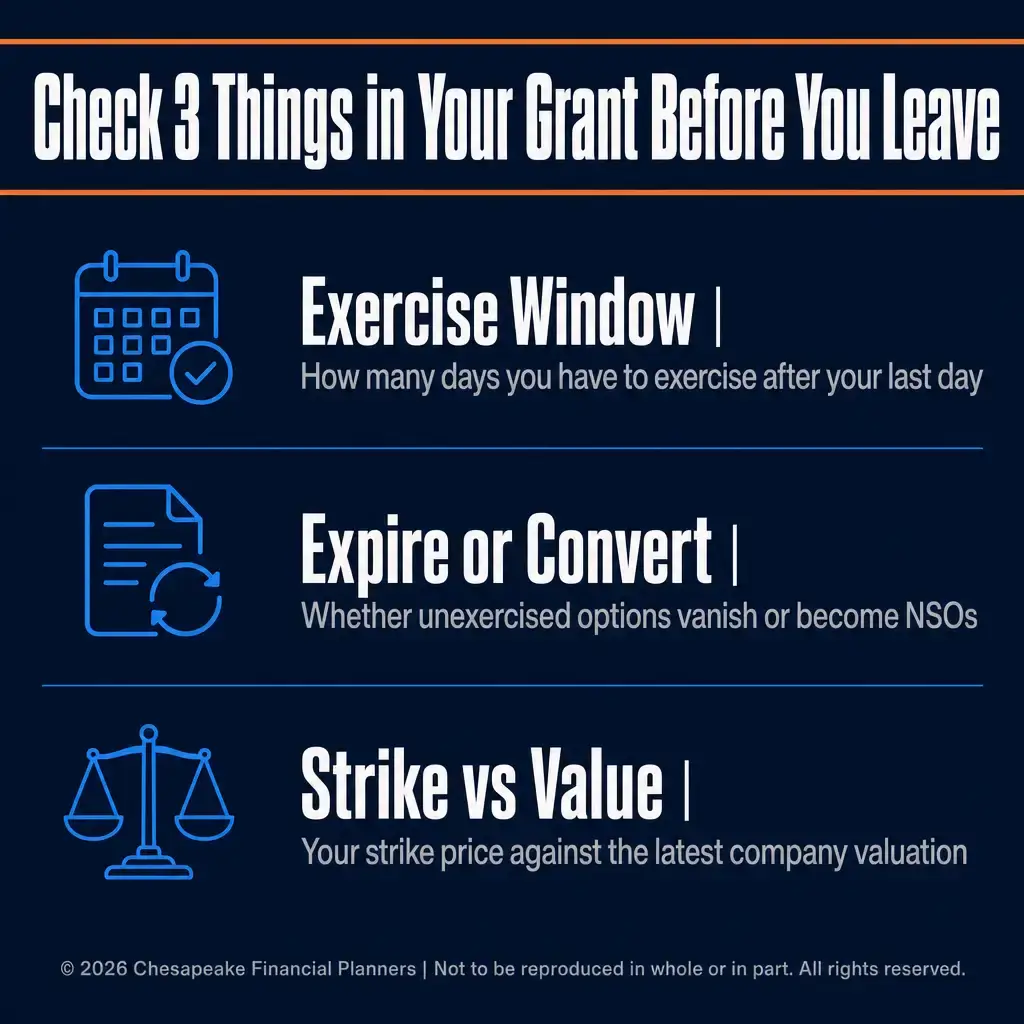
Before you give notice, pull your grant agreement and check three things:
- The length of the post-termination exercise period, stated in days.
- Whether unexercised vested options expire or convert to NSOs at the end of that period.
- The strike price on each tranche compared with the most recent valuation, so you know roughly what exercising would cost.
Most people have never looked at any of these until the day they need the answer, which is exactly the wrong day to start. If you are not sure whether your grant is an ISO or an NSO in the first place, our guide on ISO vs NSO exercise strategy walks through the distinction.
The cash is only half of it. The tax layer is where the window gets genuinely dangerous.
"People assume that because they have not sold a share, they do not owe a dollar. That single assumption is what turns a 90-day window into a five-figure tax surprise," says Jeff Judge, CFP®.
How Does the AMT Turn a 90-Day Deadline Into a Tax Problem?
Exercising incentive stock options inside the window is not only a cash decision. It is a tax decision, and the two get tangled together. Exercising ISOs and holding the shares can trigger the alternative minimum tax on the spread between your strike price and the current fair market value, even though you sold nothing and no cash came in. I have watched people write a check to exercise, then get a tax bill the following April tied to a private-company position they still hold and cannot easily sell.
Run a realistic case. Say the strike price on a tranche is $2 and the most recent 409A valuation puts fair market value at $22 a share on 10,000 shares. The spread is $200,000. That spread does not count as income for regular tax purposes, but it does count for AMT, and depending on the rest of your income that year it can generate a five or six figure tax bill on paper gains. For 2026, the AMT exemption is $90,100 for single filers and $140,200 for married couples filing jointly, and it begins to phase out at higher income. The phaseout now starts at $500,000 for single filers and $1 million for joint filers and claws the exemption back at 50 cents on the dollar, which pulls more option exercisers into AMT than it did a few years ago.
Can I recover the AMT I pay on an exercise? Often, yes. AMT paid on an ISO exercise generally becomes a minimum tax credit you can apply against regular tax in later years. It takes deliberate tracking, and plenty of people leave that credit unclaimed because no one followed it after the exercise year. The mechanics are worth understanding before you exercise, not after; our walkthrough on recovering the AMT credit covers how it unwinds over time.
What Does the ISO Exercise Window Cost a Maryland Filer?
For equity holders around Baltimore, the state tax layer changes the math, and most national option content ignores it entirely. Maryland has a growing base of tech and biotech employees, from Johns Hopkins spinouts to companies along the Baltimore-Washington corridor, and many of them hold ISOs without ever having read the state consequences of exercising.
Here is why it matters. If you do an exercise-and-sell, which is a disqualifying disposition, the spread is taxed as ordinary income, and Maryland taxes that income on top of the federal bill. For 2026, Maryland added new top brackets of 6.25% and 6.5% and a 2% surtax on capital gains for filers with high income. Layer on the Harford County local income tax of 3.06%, and a large exercise in the same year you change jobs can push a Baltimore-area filer into a materially higher combined rate than the federal numbers alone suggest.
This is exactly the kind of interaction we map for clients here in Forest Hill and across Harford County. A tech employee in Bel Air weighing a six-figure exercise is not just answering a federal AMT question; they are answering a Maryland question about brackets, the capital gains surtax, and local tax, often in a year their income is already unusually high from severance or a new salary. The right move is rarely obvious until the full picture, federal and state, sits on one page.
What Should You Do Before the Clock Starts?
The best version of this conversation happens before someone leaves, not after. If a departure is even loosely planned, get a clear picture of the exercise window and the cash required well ahead of the last day. Some plans do offer more than 90 days, particularly older or more employee-friendly grants. Read the actual plan document; do not rely on memory or what a coworker mentioned once.
Can I ask my employer to extend the window? Sometimes, and it is worth asking directly. When a layoff happens without warning, the exercise window becomes a negotiation point, not just a deadline. I have seen former employees ask HR in writing whether the company would extend the window from 90 days to a year and get a yes, especially at companies trying to preserve goodwill with departing staff. It rarely gets extended automatically. It gets extended when someone asks, and the ask should happen before the last day, while there is still a relationship to negotiate from.
Cash constraints have real solutions too. Exercising a portion of your vested options rather than all of them lowers both the cash outlay and the AMT exposure while preserving some position, and running the math at two or three exercise levels often reveals a partial exercise that captures most of the upside at a fraction of the risk. A handful of specialty lenders will front the cash to exercise in exchange for a share of the proceeds, though those arrangements carry real cost and fine print. And sometimes, walking away from options with a strike price close to current value is the rational choice, not a failure.
This is where a repeatable process earns its keep. We run equity decisions through the R.U.D.D.E.R. Method™, Chesapeake's six-step planning process: Review and Recognize, Uncover and Understand, Design and Develop, Discuss and Decide, Execute and Empower, and Reassess and Refine. One client, a product manager leaving for a competitor, called the week she gave notice rather than the week after her last day. We mapped what she held, what exercising would cost, and her AMT exposure at three levels. She exercised about 60% of her vested shares before her last day and let the rest lapse because the math did not clear her risk tolerance. Same grant type and the same 90-day structure as the engineer who lost a fortune to a deadline he never knew existed, but the clock was on her radar before it started running. For the wider picture of what shifts when you change jobs, see our guide on what happens to your stock options when you leave a job.
Frequently Asked Questions
How long is the ISO post-termination exercise window?
For most plans it is 90 days from your last day of employment, though some grants allow longer. Federal tax law caps the incentive stock option treatment at three months after termination regardless of what the plan permits, so even a company window longer than three months converts the options to non-qualified treatment past that point.
What happens to my vested options if I miss the window?
They usually expire worthless or convert to non-qualified stock options, depending on the plan. Expired options are simply gone, with no value recovered. Converted options can still be exercised, but the spread is taxed as ordinary income rather than qualifying for the more favorable incentive stock option treatment.
Does exercising ISOs after I leave trigger the AMT?
It can. Exercising and holding ISOs creates a paper spread between your strike price and the fair market value, and that spread is an AMT preference item. You can owe alternative minimum tax even though you sold no shares and received no cash, which is why modeling the AMT before you exercise matters so much.
Can I negotiate a longer exercise window?
Often yes, if you ask before your last day. Some employers extend the window on request, particularly during larger layoffs or when they want to preserve goodwill. Put the request in writing and make it early, because the window rarely gets extended automatically and almost never after it has already closed.
How does leaving a job affect my options if I live in Maryland?
A Maryland exercise-and-sell is taxed as ordinary income at the state level, and 2026 brought new high-income brackets plus a 2% surtax on capital gains for higher earners. Add local county income tax, and the combined Maryland bill can be a meaningful share of the spread, so run the state math alongside the federal AMT before you act.
If you have left a job in the last few months, or you are thinking about it, find your option grant agreement today and read the clause that sets your ISO post-termination exercise window. That single clause deserves more attention than almost anything else in the document, and it is the one thing that does not wait for you to get around to it. If you want a second set of eyes on the numbers before the clock runs, schedule a fit call with Chesapeake Financial Planners and we will map your window, your cash, and your tax exposure together.
A version of this article was originally published on Jeff Judge's LinkedIn.
Disclosures
The information provided is for educational purposes only and should not be construed as investment advice. Investment strategies should be tailored to individual circumstances, risk tolerance, and goals. Past performance doesn't guarantee future results. Consult with qualified financial professionals regarding your specific situation.
This information is not intended to be a substitute for specific individualized tax advice. We suggest that you discuss your specific tax issues with a qualified tax advisor.
Advisors associated with Chesapeake Financial Planners may be either (1) LPL Financial Registered Representatives offering securities through LPL Financial, Member FINRA and SIPC, and investment advisor representatives offering investment advice through Great Valley Advisor Group; or (2) solely investment advisor representatives offering investment advice through Great Valley Advisor Group and not affiliated with LPL Financial. Great Valley Advisor Group, and Chesapeake Financial Planners are separate entities from LPL Financial.
Chesapeake Financial Planners | 2402 Scotlon Ct, Forest Hill, MD 21050 | (410) 652-7868 | www.chesapeakefp.com
© 2026 Chesapeake Financial Planners | Not to be reproduced in whole or in part. All rights reserved.


