

How can a qualified charitable distribution lower my RMD and taxes?
Last reviewed: July 2026
A qualified charitable distribution lets anyone age 70½ or older move money directly from an IRA to a qualified charity, up to $111,000 per individual in 2026. The transfer counts toward your required minimum distribution if you owe one, and the donated amount never lands on your tax return as income. For pre-retirees and retirees who give regularly, it's often the most tax-efficient way to donate IRA money to charity.
Key Takeaways
- The 2026 QCD annual limit is $111,000 per individual, and married couples each get their own ceiling.
- You can make a QCD starting at age 70½, even though required minimum distributions don't begin until age 73.
- A QCD lowers your adjusted gross income directly, which can also reduce IRMAA Medicare surcharges and Social Security taxation.
- QCDs work from traditional IRAs and inherited IRAs, but not from active 401(k)s, 403(b)s, or active SEP/SIMPLEs.
- Donor-advised funds, private foundations, and supporting organizations are not eligible QCD recipients.
About the Author: Jeff Judge, CFP®, AEP®, ChFC®, CLU® is Managing Partner of Chesapeake Financial Planners in Forest Hill, Maryland. He has been helping families and business owners in Harford County and the Baltimore metro area navigate charitable giving strategies since earning his CFP® certification in 2013, by using Chesapeake Financial Planners’ signature process, the R.U.D.D.E.R. Method™. Jeff often says that most clients in their seventies are already writing the same checks to the same handful of organizations every year, and routing those gifts through the IRA instead of the checkbook is the single highest-ROI tax move he sees go undone.
What is a qualified charitable distribution?
A qualified charitable distribution (QCD) is a direct transfer of funds from your IRA custodian to a qualified 501(c)(3) public charity. The money never passes through your hands, which is what keeps it out of your taxable income. For 2026, the IRS caps the annual QCD amount at $111,000 per individual, indexed for inflation each year.
A QCD differs from a normal IRA withdrawal in one important way: the distribution is excluded from your adjusted gross income. A normal IRA withdrawal hits your 1040 as ordinary income. A QCD doesn't show up there at all. That AGI difference is where most of the planning leverage lives, because AGI drives Medicare IRMAA surcharges, the taxable portion of Social Security, and the deductibility of medical expenses.
The IRS also allows a one-time election of up to $55,000 from a QCD to fund a charitable gift annuity, a charitable remainder unitrust, or a charitable remainder annuity trust. Most retirees never use this provision, but it exists for people who want a stream of income back in exchange for a charitable gift and a partial income exclusion.
The R.U.D.D.E.R. Method™ is Chesapeake Financial Planners' six-step planning process: Review and Recognize, Uncover and Understand, Design and Develop, Discuss and Decide, Execute and Empower, and Reassess and Refine. Within that framework, a QCD usually surfaces during "Discuss and Decide" each fall. The question is rarely whether to give. It's how to route the gift so the IRS, the charity, and the donor all come out ahead.
Who qualifies for a QCD in 2026?
You qualify if you are at least 70½ years old on the date the distribution leaves your IRA. The half-year detail matters. A 70-year-old who turns 70½ in November can make a QCD in December but not in October. The custodian's date stamp is what counts, not the calendar age you'll reach by year-end.
The 70½ threshold is a holdover from the pre-SECURE Act rules. Congress raised the RMD age to 73, and eventually 75, but left the QCD age alone. That gap creates a useful planning window: from 70½ to 72, you can give from your IRA without an RMD to satisfy, which lets you draw down a large IRA balance for charity at low or zero tax cost before RMDs start. Pre-retirees who plan ahead can shrink their future RMD base meaningfully during that two-and-a-half-year window.
Eligible accounts include traditional IRAs, inherited IRAs, and inactive SEP-IRAs or SIMPLE IRAs. Active SEPs and SIMPLEs, meaning ones still receiving employer contributions, are not eligible. Neither are 401(k)s, 403(b)s, or 457(b)s. If your money is in a 401(k) and you want to use QCDs, you must roll it to an IRA first.
The recipient also has to qualify. Public 501(c)(3) charities work. Donor-advised funds, private foundations, and supporting organizations do not, by statute. Faith communities, hospitals, universities, food banks, and most local nonprofits are eligible. Verify the recipient before initiating the wire.
Jeff Judge often sees clients try to route a QCD through their family's donor-advised fund without realizing it's not allowed. The IRS treats that distribution as fully taxable to the IRA owner, with no charitable offset. It's a fix-it-later headache that gets caught at tax time, usually by the CPA.
What are the rules and strategies for required minimum distributions?
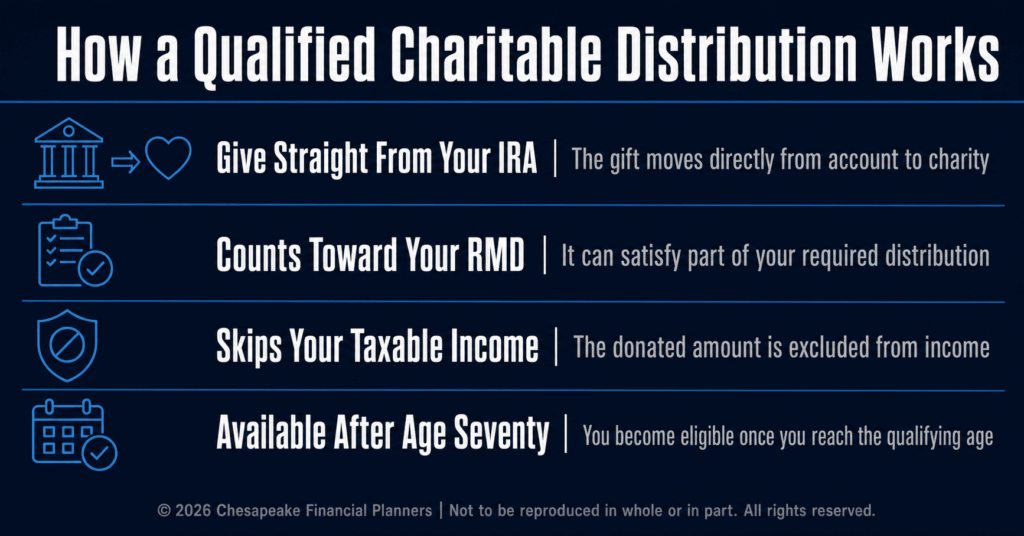
How does a QCD lower your RMD and taxable income?
A QCD lowers your tax bill through two mechanisms that operate independently.
First, it satisfies your RMD. The IRS counts QCD dollars toward your required distribution for the year, dollar for dollar, up to the QCD limit. If your 2026 RMD is $50,000 and you direct $50,000 of it to charity as a QCD, you've satisfied the RMD with money that never touches your taxable income. The result: your RMD obligation is met, and your AGI doesn't budge.
Second, even if the QCD exceeds your RMD or you make a QCD before RMDs start (between age 70½ and 73), the QCD amount is still excluded from gross income. You don't get a charitable deduction for it because you can't double-dip, but the income exclusion is usually worth more than the deduction would have been.
Here's where the math gets interesting. The 2026 standard deduction for married couples filing jointly is $32,200, plus $1,650 each for taxpayers age 65 or older. A married couple where both spouses are 65+ starts with a $35,500 standard deduction floor before any itemized deductions are even considered. Under the One Big Beautiful Bill Act, charitable contributions for itemizers in 2026 only count above a new 0.5% AGI floor, so the first portion of any direct cash gift gets absorbed before any deduction. A QCD sidesteps that floor entirely because it isn't claimed as a deduction. Jeff Judge notes: "With the new 0.5% AGI floor on charitable deductions under OBBBA, a direct cash gift to your favorite charity is now less efficient than it used to be, and for most retirees over 70½ a QCD is simply the better tool."
For retirees with $250,000 in AGI, $80,000 of itemized deductions, and $25,000 in annual charitable giving, the QCD route avoids the 0.5% AGI floor ($1,250) and pulls the entire $25,000 out of AGI. That's a real tax reduction at the marginal rate plus a possible IRMAA tier drop. At $218,000 of MAGI for married joint filers, the first Medicare Part B surcharge kicks in. Pulling $25,000 out of AGI on the right side of that threshold can save thousands per year in Medicare premiums for both spouses.
What is IRMAA, and how does income raise my Medicare premium?
How does a QCD compare to a donor-advised fund?
For retirees with both an IRA and a donor-advised fund (DAF), the smart question is which vehicle serves this dollar best, given the year's tax picture.
| Dimension | QCD | Donor-Advised Fund |
|---|---|---|
| Eligibility age | 70½+ | Any age |
| Annual limit (2026) | $111,000 per individual | No statutory limit |
| Income exclusion | Yes, dollar-for-dollar | No (deduction only if itemizing) |
| Satisfies RMD | Yes | No |
| Counts toward charitable deduction | No (cannot also deduct) | Yes (subject to AGI limits) |
| Funding source | Traditional IRA, inherited IRA | Cash, appreciated securities, business interest |
| Timing of charity payout | Immediate | Donor controls (can be deferred) |
| Acceptable recipients | Public 501(c)(3) only | Most 501(c)(3)s including private foundations |
A QCD wins when the donor takes the standard deduction (most retirees), is over 70½, and gives less than the QCD annual limit per year. A DAF wins when the donor wants to bunch multiple years of giving into one tax year for a bigger itemized deduction, gives appreciated stock to avoid capital gains, or wants to control the timing of payouts to chosen charities.
The two tools also stack. A client can use a QCD to satisfy the RMD and exclude that amount from AGI, then separately fund a DAF with appreciated stock for the AGI level where the deduction has the most value. Jeff Judge tells pre-retirees who are still working and high earners to favor the DAF route through age 70½, then shift the recurring giving to QCDs once they cross the age threshold. The DAF account doesn't go away. It just stops being the first dollar that goes out the door each year.

What mistakes can disqualify your QCD?
The most common QCD failures are mechanical, not strategic.
The biggest is routing the money through your own checking account. A QCD has to be a direct transfer from the IRA custodian to the charity. If the check is made out to you and you endorse it to the charity, the distribution is taxable. Custodians offer two acceptable formats: a check made payable to the charity and mailed to you for forwarding (acceptable because the payee is the charity, not you), or a direct wire to the charity's account.
The second is missing the RMD ordering rule. RMDs operate on a first-dollars-out basis. If you take a regular IRA distribution in February and try to make a QCD in November to "use up" the year's RMD, the February withdrawal already counted as your RMD and is fully taxable. Make the QCD before any other distributions in the year, or at minimum match the order to the intent.
The third is giving to an ineligible recipient. Donor-advised funds, private foundations, and supporting organizations are out, no matter how charitable the destination feels. Public 501(c)(3) charities work. Verify the recipient's status on the IRS Tax Exempt Organization Search before the transfer.
The fourth is incorrect 1099-R reporting. Custodians report the gross distribution on Form 1099-R. They don't know it was a QCD. You, or your tax preparer, have to enter "QCD" on the Form 1040 line for IRA distributions and reduce the taxable amount accordingly. A 1099-R that shows $40,000 distributed will land on the IRS's desk and on the tax software's screen as $40,000 of income unless someone makes the manual adjustment.
Jeff Judge has watched clients catch the third and fourth mistakes only because their CPA noticed the disconnect during tax prep. As Jeff often puts it, "A QCD is the rare tax move where the IRS, the charity, and the donor all win in the same transaction. The only way to ruin it is to get the paperwork wrong."
What should Maryland retirees know about QCDs?
Maryland adds a layer that national QCD coverage skips, and it makes the exclusion worth more here than in most states.
The state's income tax calculation begins with your federal adjusted gross income. Income a QCD keeps off the federal return therefore never reaches the Maryland return either, so the same gift does its work twice. On top of the state rate, Harford County levies a local income tax of 3.06% for 2026, which means a Bel Air or Forest Hill retiree is avoiding federal, state, and county tax on the identical dollars.
The sharper point is what Maryland does not offer. The state's pension exclusion, worth up to $40,600 for residents 65 and older, applies only to income from an employee retirement system: qualified defined benefit and defined contribution plans, 401(a), 401(k), 403(b), and 457(b) plans. The Comptroller of Maryland is explicit that "a traditional IRA, a Roth IRA, a simplified employee plan (SEP), a Keogh Plan or an ineligible deferred compensation plan does not qualify." IRA income is fully exposed at the state and county level with no exclusion available to shelter it. That is exactly why routing IRA dollars out of AGI matters more for a Maryland retiree than for someone in a state that shelters retirement income broadly.
Does a QCD change your Roth conversion plan? The two belong in the same conversation rather than separate ones. Converting traditional IRA balances to Roth before RMD age shrinks future required distributions permanently, and it does that by adding taxable income now. A QCD strategy started at 70½ can offset some of that near-term income while the conversion work is underway. Roth conversions in the pre-RMD gap years covers the conversion side of the same calendar.
One coordination failure shows up repeatedly: IRAs spread across two or three custodians, each calculating its own required distribution for the accounts it holds, with nobody looking at the total across all of them or connecting the giving plan to any of it. Each piece looks reasonable in isolation. The combined picture is where the inefficiency lives, and getting a single view of it, even when consolidating the accounts is not the right move, is usually the first step.
Related Topics Worth Reading
QCDs sit at the intersection of three planning topics, and most clients benefit from understanding the others.
- What are the rules and strategies for required minimum distributions? covers when your distributions actually start, what they cost, and which accounts are subject to them. A QCD only counts toward an RMD you actually owe, so the RMD calculation rules matter.
- How do you use the years between retirement and RMDs to reduce lifetime taxes? looks at the years between retirement and age 73, the same window where QCDs first become available. Roth conversions, IRMAA management, and QCDs all share that planning calendar.
- What is the most tax-efficient charitable giving for high-net-worth donors? explains how QCDs, DAFs, appreciated stock, and bunched gifts fit together. For most clients who have both income and assets to give, the right answer involves using more than one tool.
Frequently Asked Questions
What is the QCD limit for 2026?
The QCD limit for 2026 is $111,000 per individual, up from $108,000 the prior year, and it is indexed for inflation annually under SECURE 2.0. The ceiling applies per person rather than per household, so a married couple who both qualify can exclude up to $222,000 combined, provided each gift comes from that spouse's own IRA.
Can both spouses make QCDs in the same year?
Yes. The QCD 2026 annual limit of $111,000 applies per individual, not per couple, so a married couple where both spouses are at least 70½ can collectively transfer up to $222,000 from their respective IRAs in a single year. Each spouse's QCD must come from their own IRA. You cannot combine ceilings across one spouse's account or another's.
Does a QCD count toward your RMD if you take it later in the year?
Yes, but timing matters within the year. The IRS uses a first-dollars-out rule, meaning regular IRA distributions taken earlier in the year are treated as satisfying your RMD before any later QCD is applied. To use a QCD to satisfy your RMD in full, make the QCD before any other IRA distributions in the calendar year.
Can you make a QCD from an inherited IRA?
Yes, if the beneficiary is at least 70½ years old on the distribution date. Inherited IRAs follow the same QCD eligibility rules as the original owner's IRA. This is a frequently overlooked planning lever for adult children who inherited a parent's IRA in their seventies and don't need the income for current living expenses.
Are donor-advised funds eligible to receive QCDs?
No. The IRS explicitly excludes donor-advised funds, private foundations, and supporting organizations as eligible QCD recipients. Distributions to these entities lose their QCD status and are treated as fully taxable to the IRA owner, even though the receiving organization is otherwise a recognized 501(c)(3). Verify the recipient before initiating the transfer.
Is there a deadline to make a QCD for the current tax year?
The QCD must be completed by December 31 to count for that tax year. Completed means the distribution has actually left your IRA, not that you've initiated paperwork. Custodian processing times can run two to three weeks at year-end, so coordinate any December QCD by the first week of the month at the latest if you want it credited to the current year.
Can you deduct a QCD as a charitable contribution on Schedule A?
No. The income exclusion and the charitable deduction are mutually exclusive for the same dollar. Because the QCD never appears in your gross income, you have nothing to deduct. For most retirees who take the standard deduction, the income exclusion is more valuable than the charitable deduction would have been anyway.
A qualified charitable distribution is the most efficient way to donate IRA money to charity in your seventies, and also the most under-used. If you'd like a clearer picture of how QCDs, RMDs, Roth conversions, and IRMAA tiers all interact in a single retirement income plan, our retirement income planning guide walks through the decision sequence. Download it at chesapeakefp.com.
Want to go deeper? Our Tax-Smart Charitable Giving Playbook walks through this step by step.
Disclosures
The information provided is for educational purposes only and should not be construed as investment advice. Investment strategies should be tailored to individual circumstances, risk tolerance, and goals. Past performance doesn't guarantee future results. Consult with qualified financial professionals regarding your specific situation.
Contributions to a traditional IRA may be tax deductible in the contribution year, with current income tax due at withdrawal. Withdrawals prior to age 59 ½ may result in a 10% IRS penalty tax in addition to current income tax.
Advisors associated with Chesapeake Financial Planners may be either (1) LPL Financial Registered Representatives offering securities through LPL Financial, Member FINRA and SIPC, and investment advisor representatives offering investment advice through Great Valley Advisor Group; or (2) solely investment advisor representatives offering investment advice through Great Valley Advisor Group and not affiliated with LPL Financial. Great Valley Advisor Group, and Chesapeake Financial Planners are separate entities from LPL Financial.


