

Should I Take the Standard Deduction or Itemize?
Last reviewed: July 2026
For most people, the standard deduction wins. It is simpler, it requires no receipts, and after the 2017 tax law roughly doubled it, fewer than 10% of taxpayers still itemize. The choice between the standard vs itemized deduction comes down to one number: whichever method gives you the larger total deduction is the one you take. You add up your itemizable expenses, compare that sum to the standard deduction amount for your filing status, and pick the bigger number.
Key Takeaways
- The standard deduction for 2026 is $16,100 for single filers and $32,200 for married couples filing jointly, per IRS inflation adjustments.
- You itemize only when your deductible expenses exceed your standard deduction amount.
- Roughly 90% of taxpayers now claim the standard deduction, according to IRS filing data.
- Itemizing usually pays off when you have a mortgage, high state taxes, or large charitable gifts.
About the Author: Jeff Judge, CFP®, AEP®, ChFC®, CLU® is Managing Partner of Chesapeake Financial Planners in Forest Hill, Maryland. He has been helping families and business owners in Harford County and the Baltimore metro area navigate income tax decisions since earning his CFP® certification in 2013, by using Chesapeake Financial Planners’ signature process, the R.U.D.D.E.R. method™. Jeff often reminds clients that the deduction question is not about which method feels more sophisticated. It is purely arithmetic, and the IRS lets you run the numbers both ways before you commit.
What Is the Difference Between the Standard Deduction and Itemizing?
The standard deduction is a flat dollar amount the IRS lets you subtract from your income with no questions asked. Itemizing means listing out specific deductible expenses one by one on Schedule A and adding them up. You pick one method or the other. You cannot do both in the same year.
The standard deduction is set by Congress and adjusted for inflation each year. For 2026, the IRS set it at $16,100 for single filers, $32,200 for married couples filing jointly, and $24,150 for heads of household. Taxpayers who are 65 or older or blind get an additional standard deduction amount on top.
Itemized deductions are a defined list. The big four are home mortgage interest, state and local taxes (capped at $40,400 under current law), charitable contributions, and certain medical expenses above 7.5% of your adjusted gross income. If those add up to more than your standard deduction, itemizing lowers your tax bill. If they do not, the standard deduction does.
How Do I Know Which One Saves Me Money?
Run both calculations and take the larger deduction. That is the entire decision. Add up your itemizable expenses for the year, compare the total against your standard deduction amount, and choose whichever number is bigger.
Most tax software does this automatically. It tallies your Schedule A entries, weighs them against the standard deduction, and flags the better option. But you should still understand the math, because it tells you whether any year-end moves are worth making.
Here is a quick comparison of when each method tends to win:
| Situation | Standard Deduction | Itemizing |
|---|---|---|
| Renter with no large charitable gifts | Usually better | Rarely better |
| Homeowner with a large mortgage | Sometimes better | Often better |
| High state income or property taxes | Depends on the $40.4K SALT cap | Can help, but capped |
| Large charitable giving year | Less likely to win | Often better |
| Big medical expense year | Less likely to win | Can win if costs exceed 7.5% of AGI |
Jeff has watched clients assume they should itemize because they own a home, then discover their mortgage interest plus capped state taxes still fall short of the married standard deduction. Owning property does not automatically push you into itemizing anymore. The doubled standard deduction raised the bar.
When Does Itemizing Actually Make Sense?
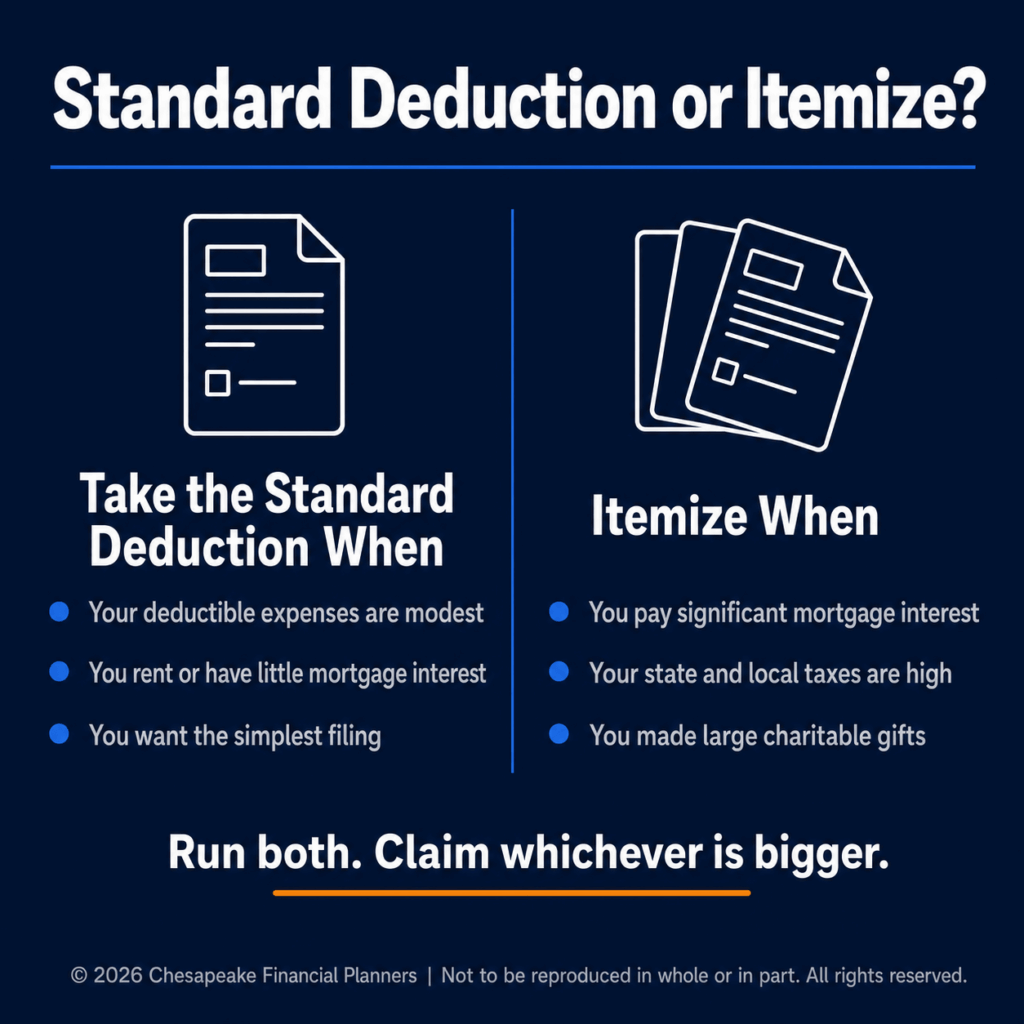
Itemizing makes sense when your deductible expenses clear your standard deduction amount, which usually requires some combination of a mortgage, high state taxes, and meaningful charitable giving. A single homeowner in a high-tax state with a sizable mortgage can cross the threshold on housing costs alone. A married couple needs to clear $32,200 in 2026, which is a higher hurdle.
The state and local tax deduction is capped at $40,400 under current law, which limits how much high earners in expensive states can deduct. That cap is one reason more people have started to itemize than before when it was $10,000. Before the cap increase, a homeowner paying $20,000 in property and income taxes stopped at $10,000. Now they can deduct the full amount.
Charitable giving is where planning gets interesting. If you give to charity every year but fall just short of itemizing, you might "bunch" two or three years of giving into a single tax year. A donor-advised fund lets you front-load several years of contributions, itemize in the bunching year, then take the standard deduction in the off years. This timing strategy is one piece of broader What is a year-round tax planning calendar for retirees and pre-retirees? work.
This is exactly the kind of question we run through the What Is the Difference Between Marginal and Effective Tax Rate? lens, because the value of a deduction depends on your marginal bracket. A $1,000 deduction saves a 12% bracket taxpayer $120 and a 32% bracket taxpayer $320.
Frequently Asked Questions
What is the standard deduction for 2026?
The 2026 standard deduction is $16,100 for single filers, $32,200 for married couples filing jointly, and $24,150 for heads of household, according to IRS inflation adjustments. Taxpayers age 65 or older or who are blind qualify for an additional standard deduction amount stacked on top of these base figures.
Can I itemize and take the standard deduction in the same year?
No, you cannot use both methods in the same tax year. You choose one or the other for your entire return. If you are married filing separately and your spouse itemizes, you generally must itemize too, even if the standard deduction would have saved you more money on your individual return.
Do I lose money if I take the standard deduction with a mortgage?
Not necessarily. Owning a home does not automatically make itemizing the better choice anymore. Since the standard deduction nearly doubled in 2018, many homeowners find their mortgage interest plus capped state taxes still fall below the standard deduction amount. Run both numbers before assuming your mortgage makes itemizing worthwhile.
What can I deduct if I itemize?
If you itemize on Schedule A, you can deduct home mortgage interest, state and local taxes up to a $40,400 cap, charitable contributions, and qualifying medical expenses that exceed 7.5% of your adjusted gross income. Other smaller deductions exist, but these four categories drive most people's itemizing decisions in any given year.
Does itemizing increase my audit risk?
Itemizing does not automatically trigger an audit, but it does require documentation. The IRS expects you to keep records for the deductions you claim. Keep receipts, mortgage statements, property tax bills, and charitable acknowledgment letters. As long as your deductions are legitimate and supported, claiming them is your right, not a red flag.
Don't Guess on the Bigger Tax Picture
The deduction choice is simple math, but it sits inside a larger set of decisions about timing income, managing brackets, and planning charitable gifts. If you want a clearer view of how the standard vs itemized deduction fits your full tax picture, our guide on tax-smart planning walks through the moves that matter most. Download it at chesapeakefp.com and start with the question that saves the most money.
Disclosures
The information provided is for educational purposes only and should not be construed as investment advice. Investment strategies should be tailored to individual circumstances, risk tolerance, and goals. Past performance doesn't guarantee future results. Consult with qualified financial professionals regarding your specific situation.
Advisors associated with Chesapeake Financial Planners may be either (1) LPL Financial Registered Representatives offering securities through LPL Financial, Member FINRA and SIPC, and investment advisor representatives offering investment advice through Great Valley Advisor Group; or (2) solely investment advisor representatives offering investment advice through Great Valley Advisor Group and not affiliated with LPL Financial. Great Valley Advisor Group, and Chesapeake Financial Planners are separate entities from LPL Financial.


