

How Does Bunching Charitable Donations Help You Clear the Standard Deduction?
Last reviewed: July 2026
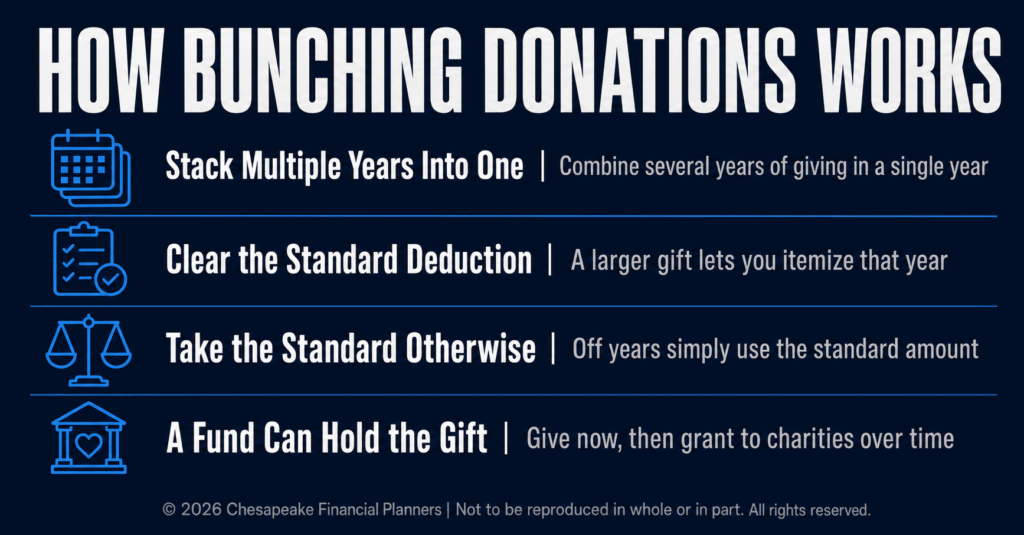
Bunching donations means concentrating two, three, or sometimes four years of charitable giving into a single tax year so the total clears the standard deduction and lets you itemize that year. For 2026, the standard deduction sits at $32,200 for married filing jointly and $16,100 for single filers, meaning a typical donor's annual giving falls well short of the threshold. Bunching solves that math problem by stacking gifts in one year and taking the standard deduction in the off years. It isn't a loophole, and it isn't aggressive planning. It's a calendar decision that recognizes one inconvenient fact: the standard deduction climbed so high under the Tax Cuts and Jobs Act, and then climbed further under the One Big Beautiful Bill Act (OBBBA), that itemizing every year stopped working for most generous families. The deduction lives in the math of when you give, not how much.
Key Takeaways
- Bunching donations stacks two or more years of charitable giving into one tax year so the total clears the standard deduction threshold.
- The 2026 standard deduction is $32,200 for married filing jointly and $16,100 for single filers per the IRS.
- A donor-advised fund lets you bunch the deduction now and pay out grants to charities over multiple years.
- The new 0.5% AGI floor under OBBBA means itemizers in 2026 lose deductions on the first slice of giving.
- Qualified charitable distributions from an IRA at age 70½ skip the deduction question entirely for those eligible.
About the Author: Jeff Judge, CFP®, AEP®, ChFC®, CLU® is Managing Partner of Chesapeake Financial Planners in Forest Hill, Maryland. He has been helping families and business owners in Harford County and the Baltimore metro area navigate charitable giving and tax planning since earning his CFP® certification in 2013, by using Chesapeake Financial Planners’ signature process, the R.U.D.D.E.R. method™. Jeff has watched the standard deduction climb high enough that most generous households now sit just under the itemizing line every single year, leaving thousands in deductions on the table when those gifts could have been bunched.
What Is Bunching Donations and Why Does It Work in 2026?
Bunching donations is a timing tool: instead of giving $10,000 every year, a household gives $30,000 in year one, skips year two, and gives $30,000 again in year three. The deduction works because the IRS lets you take whichever is larger, the standard deduction or your itemized deductions. If your annual itemizable amount, state and local taxes, mortgage interest, and charitable gifts, doesn't clear the standard deduction, the charitable piece adds nothing to your tax bill that year. IRS Topic 506 lays out the basic rules for what counts.
For 2026, the IRS set the standard deduction at $32,200 for married couples filing jointly, $16,100 for single filers, and $24,150 for head of household. Add the SALT cap (still relevant under the rebuilt limits in OBBBA) and mortgage interest, and a typical Maryland household with $10,000 in property taxes and $8,000 in mortgage interest is already at $18,000 of itemizable deductions. To clear the $32,200 MFJ standard deduction, that household needs another $14,200 in charitable gifts. A family giving $5,000 per year falls short every year. Stack three years together, give $15,000 once, and the math flips.
Charitable bunching strategy works best when three conditions line up:
- Your annual charitable giving sits in a band that's meaningful but doesn't clear the standard deduction on its own.
- You have flexibility on the timing of when gifts hit the charity (a donor-advised fund handles this cleanly).
- You don't need every year's deduction to feel even. The IRS doesn't care, and neither does the charity if you use a DAF.
The donation timing piece is what most generous households miss. They write checks every December because that's the rhythm. The math of bunching asks a different question: would a single concentrated year, followed by one or two off years, save you a real tax bill? For most clients we work with in Harford County who give $5,000 to $20,000 a year, the answer is yes.
How Do You Calculate If Bunching Is Worth It?
Run three numbers: your standard deduction, your annual itemizable amount, and the difference between them. The gap tells you how much you'd need to stack to make bunching pay.
Take a Forest Hill couple, married filing jointly, with $10,000 in SALT (the cap), $6,000 in mortgage interest, and $4,500 in annual charitable gifts. Their annual itemized amount is $20,500. The 2026 MFJ standard deduction is $32,200. The gap is $11,700. They don't itemize. Their $4,500 of giving generates a $0 federal tax benefit each year. Stretch that out over five years and they've given $22,500, deducted nothing extra, and paid full freight on the standard deduction line.
Now run the bunching version. They stack three years of giving into one year: $13,500 in 2026, skip 2027 and 2028. In 2026, itemized deductions are $29,500 (the $20,500 base plus the extra $9,000 of pulled-forward giving). That's still under the $32,200 standard deduction, so a three-year bunch doesn't quite work for them. They need to stack a fourth year, or boost annual giving above $4,500, or add appreciated stock to get over the line.
That's where the actual planning question lives, and it's where the R.U.D.D.E.R. Method™ shows up in practice. The R.U.D.D.E.R. Method™ is Chesapeake Financial Planners' six-step planning process: Review and Recognize, Uncover and Understand, Design and Develop, Discuss and Decide, Execute and Empower, and Reassess and Refine. The Review and Recognize step is the one that catches the lost deduction on bunching candidates. Most people don't recognize they're losing a deduction every year until someone runs the numbers across multiple tax years rather than just looking at the current year.
A quick decision table:
| Annual giving | Bunch 2 years | Bunch 3 years | Bunch 4 years |
|---|---|---|---|
| $5,000 MFJ | Probably no | Maybe | Likely yes |
| $10,000 MFJ | Maybe | Likely yes | Yes |
| $15,000+ MFJ | Likely yes | Yes | Yes |
| $5,000 Single | Maybe | Likely yes | Yes |
| $10,000+ Single | Likely yes | Yes | Yes |
Single-filer math works at lower giving levels because the standard deduction is half as much. A single professional giving $8,000 a year, with SALT and mortgage interest at $14,000, is already at $22,000 itemized against a $16,100 standard. They itemize every year. Bunching helps less.
How Does a Donor-Advised Fund Make Bunching Easier?
A donor-advised fund (DAF) is the cleanest mechanical answer to the bunching problem. You contribute a multi-year lump sum to the DAF in the bunch year, take the full deduction in that year, and then recommend grants to your favorite charities over the next two to five years on whatever schedule you want.
The DAF separates the deduction from the actual gift to charity. Without a DAF, bunching forces you to send a $15,000 check to your church in December, which most clergy will tell you is great for the budget but disorienting for the donor relationship. With a DAF, your church still receives $5,000 a year in March and September on your normal schedule. The IRS has already let you deduct the full $15,000 in the bunch year.
Jeff Judge has worked with several Harford County families who use a DAF to bunch three years of giving into one year, then sleep on it. The most common pattern: a year with a large taxable event, a Roth conversion, a business sale, vested RSUs, becomes the bunch year. The deduction lands when income is highest, when the marginal rate is most painful, and when the deduction is worth the most. That alignment is the real lever, not the bunching itself.
Jeff puts it this way: "The bunching question isn't whether you give. It's whether the IRS gives you any credit for what you've already decided to give. For most generous families, the answer for the last few years has been no, and that's the fix."
Three things to verify when choosing a DAF sponsor:
- The minimum grant size (some sponsors require minimums per grant, which matters if you give to many small charities).
- The investment options inside the DAF (you want growth options for the years between contribution and grant payout).
- Administrative fees (most national sponsors charge 0.6% to 1.0% of assets annually).
The DAF deduction respects the same 60% AGI limit on cash gifts to public charities that any direct cash gift would, per IRS Pub. 526. Excess contributions carry forward up to five years. For appreciated stock contributed to the DAF, the 30% AGI limit applies (lower because you also avoid the capital gains tax on the appreciation).
When Should You Use a Qualified Charitable Distribution Instead?
A qualified charitable distribution (QCD) is a transfer of money directly from your traditional IRA to a qualifying 501(c)(3), and it sidesteps the standard deduction question entirely. The QCD never hits your income, so it never has to clear anything to count as a tax benefit.
For 2026, the QCD limit is $111,000 per individual per year per IRS Pub. 590-B. Each spouse with their own IRA can make QCDs up to the individual limit, so a married couple can move up to $222,000 directly from their IRAs to charity in a single year without any of it showing up as taxable income.
The eligibility rules are tighter than bunching:
- You must be at least 70½ on the date of distribution, not the year of distribution. This is earlier than the RMD age (73 for most current retirees, eventually 75). Many people in their early 70s qualify for QCDs but don't yet have required RMDs.
- The transfer must go directly from your IRA custodian to the charity. If you take the money first and then write a check, it isn't a QCD; it's a regular taxable distribution.
- QCDs can't go to donor-advised funds, private foundations, or supporting organizations. They go straight to operating public charities.
- The QCD counts toward your RMD for the year if you have one.
For donors over 70½ who give annually anyway, the QCD beats bunching almost every time. The reason: the QCD reduces your AGI, which has knock-on benefits for What is IRMAA, and how does income raise my Medicare premium?, the taxation of Social Security, the new 0.5% AGI charitable floor, and the qualified business income deduction phase-outs. A bunching strategy that itemizes more never reduces AGI. The QCD does.
Jeff often points out to clients still working past 70½ that the QCD plus a bunching plan for the years before 70½ stacks naturally. Give modestly while working, bunch a DAF contribution in the year you retire when income is still high, then switch to QCDs at 70½. Three planning techniques, one continuous strategy.
How Does the New 0.5% AGI Floor Change Bunching Math in 2026?
OBBBA added a 0.5% AGI floor on charitable contributions for itemizers starting in 2026. Only the slice of giving that exceeds 0.5% of your adjusted gross income is deductible. The portion below the floor is gone, and it does not carry forward.
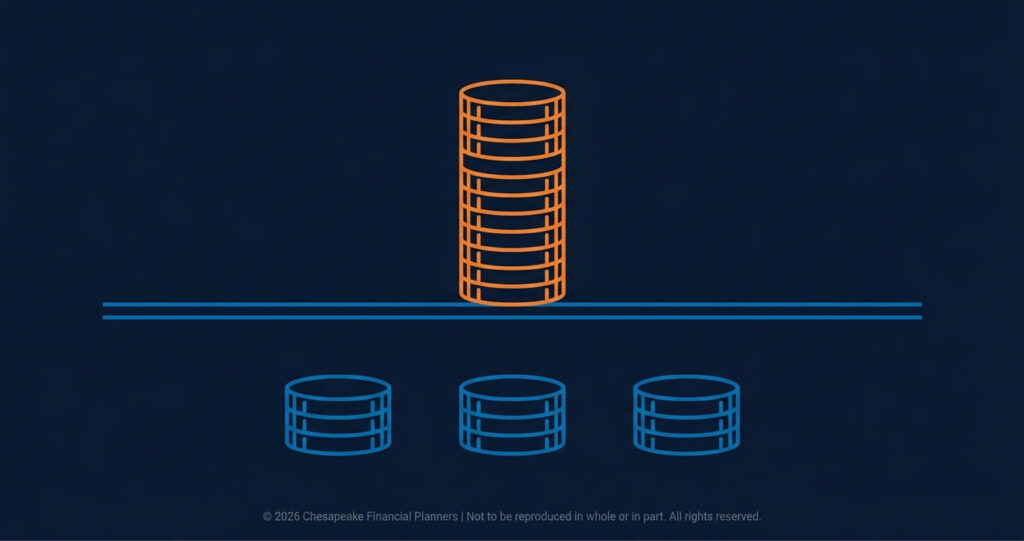
For a couple with $400,000 of AGI, the floor is $2,000. If they give $10,000, only $8,000 is deductible. If they give $15,000 in a bunch year, only $13,000 is deductible. The floor applies once per year, not once per gift. So bunching actually improves the floor math: stacking three years of giving into one year means the floor cuts off your first $2,000, which is the same amount it would have cut off in any single year. You're losing one year's worth of floor rather than three.
The math, simplified:
| Strategy | 3-year giving | Floor lost over 3 years | Deductible over 3 years |
|---|---|---|---|
| Give $5,000 annually | $15,000 | $6,000 ($2,000 × 3) | $9,000 |
| Bunch $15,000 in one year | $15,000 | $2,000 (one year) | $13,000 |
| Bunch with DAF for grant flexibility | $15,000 | $2,000 (one year) | $13,000 |
Bunching keeps an extra $4,000 of deduction alive in this example. The new floor isn't a reason to stop giving. It's another reason the timing of the deduction matters more than it used to.
Two more wrinkles worth knowing:
- OBBBA also caps the benefit rate on itemized charitable deductions at 35% for taxpayers in the top 37% bracket. The cap doesn't change the deduction itself, just the rate at which the deduction reduces tax. Most middle-income bunchers won't feel this, but high earners might want to bunch in a year their bracket sits below 37%.
- Non-itemizers got a small consolation prize in OBBBA: an above-the-line deduction of up to $1,000 (single) or $2,000 (MFJ) for cash gifts to qualifying 501(c)(3) organizations. This is a fixed amount that doesn't grow with inflation. For households giving more than $2,000 per year, bunching to itemize still wins.
Related Topics Worth Reading
If charitable bunching is on your radar, these adjacent topics often come up in the same conversation:
- Donor-Advised Funds vs Private Foundations vs QCDs. A side-by-side look at when each charitable vehicle fits, and the relative tax impact of each. Donor-advised fund, private foundation, or QCD: which giving strategy fits me?
- Donor-Advised Funds: The Flexible Way to Give and Save on Taxes. A deeper look at the DAF mechanics, sponsor options, and how to think about investment options inside the fund. What Is a Donor-Advised Fund, and How Does It Save on Taxes?
- Qualified Charitable Distributions: Give From Your IRA and Lower Your RMD. The full QCD playbook for donors over 70½ who want the cleanest tax outcome on annual giving. How can a qualified charitable distribution lower my RMD and taxes?
- Donating Appreciated Stock Instead of Cash. A separate deduction tool that pairs well with bunching, especially for households with concentrated single-stock positions. Should I donate appreciated stock instead of cash?
- What Order Should You Withdraw From Your Accounts in Retirement? Charitable strategy intersects withdrawal sequencing for retirees with RMDs and DAF balances. What is the right retirement withdrawal order for your accounts?
Frequently Asked Questions
Can I bunch donations every other year, or do I need to wait three years?
You can bunch on whatever calendar makes the math work. Two-year and three-year stretches are most common, but four- and five-year bunches show up in real plans too. The cadence depends on your annual giving level relative to the standard deduction gap. A household giving $20,000 a year usually only needs a two-year bunch to clear the line; a household giving $5,000 a year may need four years stacked.
Do I have to use a donor-advised fund to bunch donations?
No. Direct gifts to your favorite charities in the bunch year work just as well from a tax standpoint. The donor-advised fund is a convenience tool that separates the deduction year from the actual cash flow to the charity, which is what most donors actually want. If you're comfortable writing a $30,000 check to one organization in December and skipping the next two years, you don't need a DAF at all.
Does bunching donations affect my charitable carryforward?
Bunching can interact with charitable carryforward rules if your bunch-year contributions exceed the 60% AGI limit for cash gifts or the 30% AGI limit for appreciated property. Amounts above those limits carry forward up to five years. The new 0.5% AGI floor under OBBBA does not carry forward; any deduction lost to the floor in a given year is permanently lost. That is a strong argument for fewer, larger bunch years over many smaller ones.
Can I bunch donations and use a QCD in the same year?
Yes. The QCD comes out of your IRA and never enters your AGI, so it has no interaction with your itemized deductions or the bunching math. A donor over 70½ who has a particularly high-income year can use the QCD to handle their normal annual giving directly from the IRA, then separately make a bunched DAF contribution from taxable assets to capture an itemized deduction on top.
What's the deadline to make a bunched contribution count for this tax year?
Cash and check gifts must be delivered or postmarked by December 31, and electronic donations to a DAF must complete the transfer by the same date. Stock gifts require more lead time: most brokers ask for at least 5 to 10 business days, and DAF sponsors usually need contributions in hand by mid-December for the security to be liquidated and credited in time. Start the paperwork by early December if a stock gift is part of the plan.
Bunching donations is the rare planning move where running the numbers takes 20 minutes and the savings show up immediately on your tax return. If this is the year you'd like to figure out whether bunching fits your situation, our free 2026 Charitable Giving Decision Guide walks through the standard deduction math, DAF setup options, and the QCD checklist for donors over 70½. Download it at chesapeakefp.com.
Want to go deeper? Our Tax-Smart Charitable Giving Playbook walks through this step by step.
Disclosures
The information provided is for educational purposes only and should not be construed as investment advice. Investment strategies should be tailored to individual circumstances, risk tolerance, and goals. Past performance doesn't guarantee future results. Consult with qualified financial professionals regarding your specific situation.
This information is not intended to be a substitute for specific individualized tax, investment or legal advice. We suggest that you discuss your specific situation with a qualified tax, legal or financial advisor.
Advisors associated with Chesapeake Financial Planners may be either (1) LPL Financial Registered Representatives offering securities through LPL Financial, Member FINRA and SIPC, and investment advisor representatives offering investment advice through Great Valley Advisor Group; or (2) solely investment advisor representatives offering investment advice through Great Valley Advisor Group and not affiliated with LPL Financial. Great Valley Advisor Group, and Chesapeake Financial Planners are separate entities from LPL Financial.


