
How Can Bunching Charitable Deductions Save Me on Taxes?
Last reviewed: July 2026
Bunching charitable deductions saves you on taxes by concentrating several years of giving into a single tax year, so your itemized deductions clear the standard deduction threshold in that year. You itemize once, take the standard deduction in the off years, and capture a tax benefit you would otherwise lose entirely. The same total giving produces real tax savings instead of zero. For many generous households, bunching charitable deductions is the difference between writing checks that count and writing checks the IRS ignores.
Key Takeaways
- Bunching concentrates multiple years of giving into one year so itemized deductions exceed the 2026 standard deduction of $32,200 for married couples.
- A donor-advised fund lets you claim a large deduction now while granting to charities annually for years afterward.
- The SALT deduction cap makes itemizing harder, which is exactly why bunching matters more now than it did a decade ago.
- Donating appreciated stock instead of cash inside a bunched year avoids capital gains tax and increases your deduction.
About the Author: Jeff Judge, CFP®, AEP®, ChFC®, CLU® is Managing Partner of Chesapeake Financial Planners in Forest Hill, Maryland. He has been helping families and business owners in Harford County and the Baltimore metro area navigate charitable and tax planning since earning his CFP® certification in 2013, by using Chesapeake Financial Planners’ signature process, the R.U.D.D.E.R. method™. Jeff has watched generous clients give away tens of thousands of dollars a year and get nothing back at tax time, simply because nobody told them how the standard deduction math actually works.
What Is Bunching Charitable Deductions?
Bunching charitable deductions is the strategy of grouping multiple years of charitable gifts into one tax year to push your total itemized deductions above the standard deduction, then taking the standard deduction in the off years. You give the same amount over time. You just change the timing.
Here is the problem it solves. The standard deduction is large. According to the IRS, the 2026 standard deduction is $32,200 for married couples filing jointly, $16,100 for single filers, and $24,150 for head of household. If your annual giving plus your other itemized deductions falls below that number, your charitable gifts produce no tax benefit at all. You take the standard deduction either way.
Bunching fixes the timing. In year one, you give three to five years of contributions at once, creating a large itemized deduction that clears the threshold. In the following years, you give little or nothing and take the standard deduction. Over the full cycle you have given the same total, but you have actually used your charitable deductions instead of leaving them stranded.
How can I potentially optimize my taxes as my income grows?

Why the Standard Deduction Makes Bunching Necessary
The 2017 tax law nearly doubled the standard deduction. That simplified filing for most households, but it quietly erased the charitable tax benefit for millions of givers who now take the standard deduction automatically.
The state and local tax cap makes it worse. Through the 2026 tax year, taxpayers can deduct a capped amount of state and local taxes, which limits one of the largest line items most itemizers used to rely on. With SALT capped and the standard deduction high, ordinary charitable giving often falls short of the threshold.
Walk through the math. You are married, you donate $20,000 a year, you pay $10,000 in state and local taxes, and you have $5,000 in mortgage interest. Your itemized deductions total $35,000. That beats the $32,200 standard deduction by only $2,800. So your entire $20,000 gift generated a tax benefit on just $2,800 of it. The rest did nothing for your return.
In Jeff's experience, this is the most common charitable planning miss he sees with new clients. They assume that because they give generously, they must be getting a deduction. They are often getting almost nothing. Running the Schwab or Fidelity Charitable calculators against their actual numbers tends to be a genuine surprise.
How can I potentially optimize my taxes as my income grows?
How a Donor-Advised Fund Makes Bunching Practical
Bunching has one obvious drawback. Most people do not want to dump five years of giving into their favorite charity in a single year, then disappear for four years. Nonprofits depend on steady support, and donors want to keep giving annually.
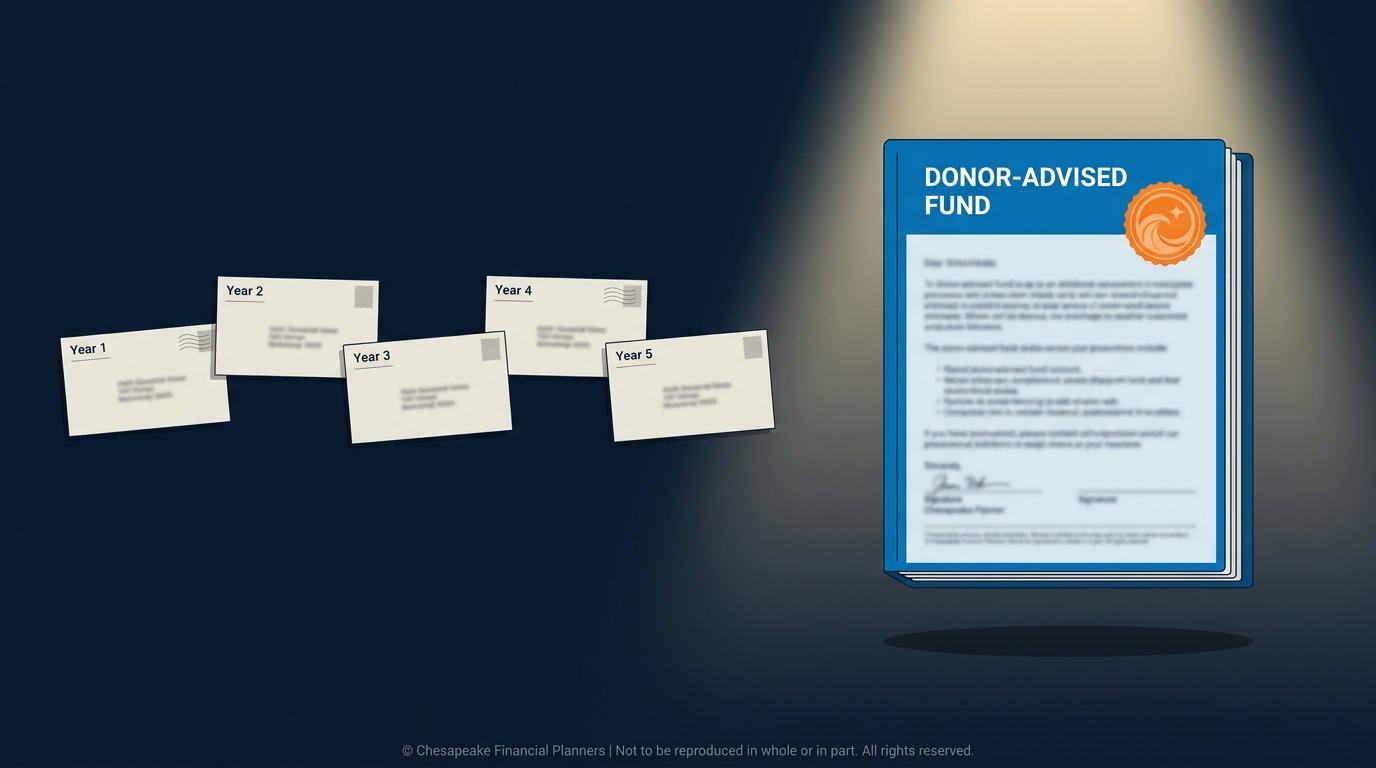
A donor-advised fund solves that tension. A donor-advised fund is a charitable account you fund with a large lump sum, claim the full deduction for in the year you fund it, then grant out to charities on your own schedule over the following years.
Here is how the cycle works. In year one you contribute a large sum, say $100,000, to the fund and claim the full $100,000 charitable deduction that year. Over the next five years you recommend $20,000 in grants annually to the charities you support. The charities see steady annual gifts. The IRS sees one large deduction in year one. You see the tax benefit you were missing. Jeff Judge notes: "With a donor-advised fund, the IRS sees one large deduction while your favorite charities see the same steady annual support they have always relied on, and that separation of tax timing from giving timing is exactly what makes bunching work in practice."
According to the National Philanthropic Trust, donor-advised funds have grown into one of the most widely used charitable vehicles in the country, in large part because they pair cleanly with a bunching strategy. The fund handles the recordkeeping, and you separate the tax timing from the giving timing.
How does a donor-advised fund work and who should consider using one?
How do donor-advised funds work for charitable giving and taxes?
Bunching Versus Annual Giving: A Side-by-Side Look
The clearest way to see the value is to compare the same giver over a five-year window. The household below is married, gives $20,000 a year, and pays $10,000 in state and local taxes.
| Approach | Year 1 itemized | Years 2-5 | Five-year deduction used |
|---|---|---|---|
| Annual giving ($20,000/yr) | $30,000 (below standard) | $30,000/yr (below standard) | Roughly $0 of charitable benefit |
| Bunching via DAF ($100,000 once) | $110,000 (itemize) | Standard deduction each year | Full charitable benefit on the excess |
Without bunching, the giver donates $100,000 over five years and captures almost no charitable tax benefit, because every single year falls below the $32,200 standard deduction. With bunching through a donor-advised fund, year one produces a large itemized deduction well above the threshold, and the standard deduction covers the remaining four years. Same generosity, very different tax outcome.
One layer makes this even stronger: fund the bunch with appreciated stock instead of cash. When you donate appreciated stock held more than a year, you generally deduct the full fair market value and avoid the capital gains tax you would owe on a sale. That is a second tax win stacked on top of the deduction.
How do qualified charitable distributions work and who benefits most?
Where Bunching Fits in a Full Plan
Bunching is a timing decision, and timing decisions work best inside a structured process. At Chesapeake Financial Planners we use the R.U.D.D.E.R. Method™, a six-step planning process: Review and Recognize, Uncover and Understand, Design and Develop, Discuss and Decide, Execute and Empower, and Reassess and Refine. Charitable timing slots into the Design and Develop step, where we coordinate giving with income spikes, Roth conversions, and the sale of a business or appreciated asset.
The best bunching years are often high-income years. A large bonus, a business sale, or a Roth conversion can push you into a higher bracket, and that is the year a big deduction is worth the most. Jeff often coordinates a client's bunched gift with the same year they realize a large taxable event, so the deduction offsets income taxed at the top rate.
How Do High Earners Open a Backdoor Roth IRA in 2026?
Frequently Asked Questions
What does bunching charitable deductions mean?
Bunching charitable deductions means grouping several years of charitable gifts into one tax year so your itemized deductions exceed the standard deduction that year. You itemize in the bunching year, then take the standard deduction in the off years. You give the same total amount, but you change the timing to capture a tax benefit you would otherwise lose.
How does a donor-advised fund help with bunching?
A donor-advised fund lets you contribute a large lump sum in one year and claim the full charitable deduction immediately, then grant money to charities on your own schedule over several years. This separates the tax timing from the giving timing, so charities still receive steady annual support while you concentrate your deduction into a single high-value year.
How many years should I bunch at once?
Most givers bunch three to five years of contributions into one year, though the right number depends on your annual giving, your other itemized deductions, and your tax bracket. The goal is to clear the standard deduction comfortably in the bunching year while keeping enough years in the off-cycle to take the standard deduction. A financial planner can model the exact number for your situation.
Can I donate appreciated stock when I bunch?
Yes, and donating appreciated stock held longer than one year is often the smartest way to fund a bunched gift. You generally deduct the full fair market value of the stock and avoid the capital gains tax you would owe if you sold it first. Pairing appreciated stock with a donor-advised fund stacks two tax advantages in a single year.
Who benefits most from bunching charitable deductions?
Generous households whose annual itemized deductions normally fall just below the standard deduction benefit most. That often includes people who give consistently but pay capped state and local taxes and carry little or no mortgage interest. High-income earners with a bonus, business sale, or Roth conversion year are especially strong candidates, since the deduction offsets income taxed at the highest rates.
Ready to Make Your Giving Count?
If you give generously every year and suspect you are getting nothing back at tax time, you are probably right, and you can fix it. Our guide to smarter charitable giving walks through bunching, donor-advised funds, and appreciated stock in plain language. Download it at chesapeakefp.com and see how much of your giving you have been leaving on the table.
Want to go deeper? Our Tax-Smart Charitable Giving Playbook walks through this step by step.
Disclosures
The information provided is for educational purposes only and should not be construed as investment advice. Investment strategies should be tailored to individual circumstances, risk tolerance, and goals. Past performance doesn't guarantee future results. Consult with qualified financial professionals regarding your specific situation.
This information is not intended to be a substitute for specific individualized tax, investment or legal advice. We suggest that you discuss your specific situation with a qualified tax, legal or financial advisor.
Advisors associated with Chesapeake Financial Planners may be either (1) LPL Financial Registered Representatives offering securities through LPL Financial, Member FINRA and SIPC, and investment advisor representatives offering investment advice through Great Valley Advisor Group; or (2) solely investment advisor representatives offering investment advice through Great Valley Advisor Group and not affiliated with LPL Financial. Great Valley Advisor Group, and Chesapeake Financial Planners are separate entities from LPL Financial.


