


Published: | Last reviewed:
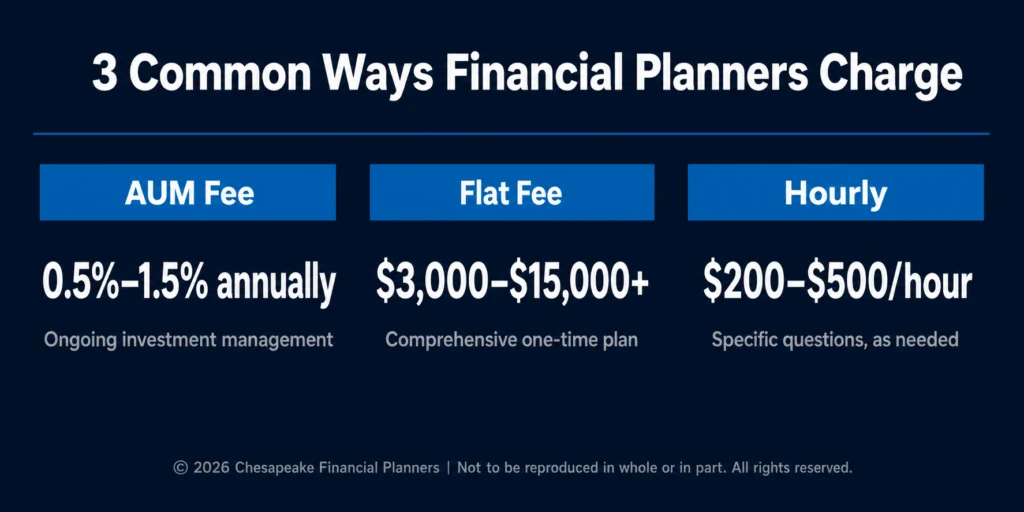
Comprehensive financial planning typically costs between 0.50% and 1.50% of assets under management per year, or a flat fee of roughly $2,000 to $15,000 annually, depending on how the advisor structures their pricing and how complex your situation is. Hourly planners generally charge $200 to $500 per hour.
Key Takeaways
- Most assets-under-management advisors charge 0.50% to 1.50% per year, often on a tiered schedule that lowers the rate as your balance grows.
- Flat-fee and retainer planning commonly runs $2,000 to $15,000 annually and does not scale with portfolio size.
- The median financial advisory fee on a $1 million portfolio is roughly 1.0%, or about $10,000 per year.
- Fee-only advisors accept no product commissions; fee-based advisors may also earn commissions on certain products, which can create conflicts of interest that should be disclosed.
Key fee figures for comprehensive financial planning, by pricing model:
| Figure | Amount or rate | Applies to |
|---|---|---|
| Assets-under-management (AUM) fee | 0.50% to 1.50% of assets | Per year, often tiered |
| Flat fee or retainer | $2,000 to $15,000 | Per year |
| Hourly planner | $200 to $500 | Per hour |
| Median advisory fee on a $1 million portfolio | About 1.0%, or about $10,000 | Per year |
About the Author: Jeff Judge, CFP®, AEP®, ChFC®, CLU® is Managing Partner of Chesapeake Financial Planners in Forest Hill, Maryland. He has been helping families and business owners in Harford County and the Baltimore metro area navigate fee structures and planning decisions since earning his CFP® certification in 2013, by using Chesapeake Financial Planners’ signature process, the R.U.D.D.E.R. method™. Jeff often tells clients the fee question is the easy part. The harder, more valuable question is what a planner does to earn it.
About Jeff Judge, CFP®: meet Jeff and the Chesapeake Financial Planners team.
What are the common financial advisor fees and how do they work?
Financial advisor fees come in five main structures, and each one suits a different type of client. Understanding the structure tells you more than the number, because two advisors charging the same headline fee can deliver very different value.
The most common arrangement is assets under management (AUM). Advisors charge a percentage of the money they manage, generally 0.50% to 1.50% per year, deducted quarterly from your accounts. According to research compiled by Kitces.com, the typical all-in AUM fee on a $1 million portfolio sits near 1.0%, or about $10,000 annually. Most firms tier the schedule. A planner might charge 1.00% on the first $1 million, 0.75% on the next $2 million, and 0.50% above $3 million. The fee covers planning, investment management, and ongoing personal financial management reviews.
Flat-fee or retainer planning has grown fast. These advisors charge a set annual or monthly amount, commonly $2,000 to $15,000 per year, regardless of how much money you have. This model works well if you have a large portfolio but a relatively simple plan, because you stop paying more just because your account grew.
Hourly advisors charge $200 to $500 per hour, which fits people who need occasional advice rather than ongoing management. A one-time written plan often runs $2,000 to $5,000, depending on complexity. That suits a narrow decision, like weighing a pension against a lump sum, but it fits ongoing planning less well, since real situations keep changing.
Jeff has watched clients fixate on the percentage and miss the bigger picture. A 1.0% fee that includes tax coordination, retirement projections, and estate planning is often cheaper in real dollars than a 0.50% fee that only buys investment management.
What is the difference between fee-based, fee-only, and commission-based financial planners?
A fee-only financial planner is paid solely by you, the client, and earns no commissions. A fee-based planner, such as Chesapeake Financial Planners, charges planning or advisory fees and may also earn commissions on certain products such as insurance or annuities. A commission-based advisor earns money primarily from selling insurance, annuities, or mutual funds. The model determines where the incentives sit, which matters as much as the price tag.
Commission-based compensation can make the upfront cost look lower, but the cost sits inside the product you buy, so ask for the product's full cost and how the advisor is paid on it. A fee-based firm should disclose any commission it earns.
Advisors acting as a fiduciary are legally required to act in your best interest in the advice they give. The Certified Financial Planner Board of Standards holds CFP® professionals to a fiduciary standard whenever they provide financial advice. That means the recommendation has to be right for you, not profitable for the advisor.
The table below compares the two models on the dimensions that matter most.
| Dimension | Fee-Only Planner | Fee-Based Planner | Commission-Based Advisor |
|---|---|---|---|
| Who pays the advisor | You, directly | You, plus product companies on some products | Product companies, via commissions |
| Conflicts of interest | No commission conflict | Possible on commission products; must be disclosed | Built into product sales; must be disclosed |
| Range of solutions | Advisory services | Advisory services plus, where appropriate, insurance and annuity solutions through one adviser | Product-based solutions |
| Standard of care | Fiduciary when giving advice | Fiduciary in advisory relationships; a different standard for commission products | Best-interest standard for recommendations |
| Best fit | Ongoing planning with no commissions | Ongoing planning plus occasional product needs, or needs that change over time | One-time product purchase |
Jeff tells clients to ask every advisor one question: how are you paid, and what does that pay you to recommend? A fee-based firm that discloses its commissions and acts as a fiduciary in its advisory work can serve you well, and so can a fee-only firm. Chesapeake Financial Planners is fee-based, not fee-only: we act as fiduciaries in our advisory relationships through our registered investment adviser, and we may also earn commissions on insurance or annuity products when those genuinely fit a plan, with custody through LPL Financial.
What does financial planning cost at Chesapeake Financial Planners?
Chesapeake Financial Planners, based in Forest Hill and serving Harford County and the Baltimore metro, prices planning and investment management as two separate services. Planning fees run roughly $3,000 to $10,000 per year depending on complexity. Investment management fees range from 0.35% to 1.30% of assets, with the rate declining as the portfolio grows. The firm puts its full fee schedule in its Form ADV before any engagement begins.
Jeff Judge, CFP® is direct about the fee conversation. "I want clients to know exactly what they're paying and why before we start," he says. "The planning fee covers the ongoing oversight, the tax planning, the retirement income modeling, the estate coordination. The investment fee covers the portfolio. They're two separate services, and we price them that way."
In Jeff's experience, the people who feel best about their fees are the ones who understood the structure on day one. The ones who feel burned almost always discovered a layer of cost they were never walked through.
What questions should I ask when interviewing a fee-based financial advisor in Maryland?
What does comprehensive financial planning actually include?
Comprehensive financial planning covers far more than picking investments. A full engagement coordinates every major financial decision in your life so they work together instead of pulling against each other. That coordination is what you are really paying for.
A typical comprehensive relationship includes investment management, retirement income projections, tax planning across multiple years, estate plan coordination, insurance and risk review, cash flow analysis, education funding, and behavioral coaching during volatile markets. For business owners, it also includes succession and exit planning, which often becomes the single largest financial event of their lives.
At Chesapeake Financial Planners, this work runs through a defined process. The R.U.D.D.E.R. Method™ is Chesapeake Financial Planners' six-step planning process: Review and Recognize, Uncover and Understand, Design and Develop, Discuss and Decide, Execute and Empower, and Reassess and Refine. The point of a repeatable process is that nothing important falls through the cracks between the investment account and the tax return. Jeff Judge notes: "A repeatable planning process matters because financial decisions don't live in isolation, and without a structured framework it's easy for a tax move to go unexamined by the estate attorney, or an insurance gap to go unnoticed until a claim makes it painfully obvious."
The value compounds because the pieces interact. A Roth conversion decision affects your tax bracket, your Medicare premiums, and your heirs' inheritance. Investment-only management ignores those connections. Comprehensive planning catches them.
Why Does a Financial Planning Process Matter More Than Investment Selection?
How do I know if comprehensive financial planning is worth the cost?
Comprehensive financial planning is worth the cost when the advisor's work either grows your wealth or prevents costly mistakes by more than you pay them. For most people with meaningful complexity, that threshold is cleared in tax savings and avoided errors alone.
Consider what a single avoided mistake is worth. Claiming Social Security at the wrong age can cost a married couple tens of thousands of dollars over a retirement. A poorly sequenced retirement withdrawal can push you into a higher tax bracket and trigger surcharges on your Medicare premiums. A good planner catches these before they happen.
Jeff puts it plainly. Most people optimize the wrong thing. They obsess over shaving a few basis points off an investment fee while leaving real money on the table in unnecessary taxes and missed planning opportunities. The fee you pay a planner is visible. The cost of going without one usually is not, which is exactly why it gets ignored.
If you already have investments and are weighing whether ongoing advice earns its keep, the answer depends on your complexity, not your balance.
A few questions clarify value when you compare advisors:
- What services are included? Investment management only, or comprehensive planning across tax, retirement, insurance, and estate?
- How often do we meet? Quarterly, annually, or only when you reach out?
- Who does the work? The CFP® professional directly, or mostly junior staff?
- What do you cover proactively? Responsive advisors react when asked. Proactive ones bring you opportunities you didn't know to ask about.
Watch for vague fee answers and for "all investment, no planning," where a portfolio gets managed but tax strategy, income planning, and estate coordination never enter the conversation. Registered investment advisors must disclose all fees and conflicts in Form ADV Part 2, so if you cannot get a clear answer about how an advisor is paid, ask for the document before signing anything.
What should I look for in a financial advisor in Maryland?
Is financial planning worth it if I already have investments?
Should I update my financial plan after a big life event?
For the full guide, see How Much Do I Need to Retire? A Practical Guide.
Related service: planning for an inheritance or estate
Serving your area: financial planning in Harford County, MD
More in this guide:
Frequently Asked Questions
How much does a financial advisor cost per year?
A financial advisor typically costs 0.50% to 1.50% of managed assets per year, which is about $5,000 to $15,000 annually on a $1 million portfolio. Flat-fee planners commonly charge $2,000 to $15,000 per year regardless of portfolio size. Hourly advisors charge $200 to $500 per hour for occasional advice rather than ongoing management.
What is a reasonable AUM fee for financial planning?
A reasonable AUM fee for comprehensive financial planning is around 1.0% per year on portfolios near $1 million, scaling down as the balance grows. According to Kitces.com research, 1.0% is the median all-in fee at that asset level. Larger portfolios often pay tiered rates that drop to 0.50% or lower on higher balances.
Is a fee-based or fee-only financial planner cheaper than a commission-based advisor?
It depends on the products, how long you hold them, and the advice you need. Fee-only and fee-based advisory fees are stated upfront in dollars or percentages. Commissions are built into products, so they are less visible; ask for the full cost in writing. Fee-based firms can offer both advisory services and commission-based solutions, so you can compare the two for a given need.
Does the cost of a CFP professional include tax and estate planning?
The cost of working with a CFP professional usually includes tax planning and estate plan coordination as part of a comprehensive engagement. CFP® professionals coordinate with your CPA and estate attorney rather than replacing them. This coordination across investments, taxes, and estate strategy is a core part of what comprehensive financial planning services deliver beyond pure investment management.
Are financial planning fees worth it for someone in their 30s or 40s?
Financial planning fees are often worth it in your 30s and 40s because early decisions about saving, tax-advantaged accounts, and debt compound over decades. The dollar value of avoiding a costly mistake early is enormous because there is so much time for it to compound. Hourly or flat-fee planning can be a cost-effective entry point at this stage.
How do I avoid hidden financial advisor fees?
Avoid hidden financial advisor fees by asking every advisor, whether fee-only or fee-based, to state their compensation clearly and disclose any product commissions. Ask any advisor to put their full fee in writing, including fund expense ratios and any third-party costs. If an advisor cannot explain exactly how they get paid in one or two sentences, that is a warning sign worth taking seriously.
Is there a minimum to work with a financial planner?
Many full-service practices set investment minimums, often in the $250,000 to $500,000 range, while others offer flat-fee or hourly services with no minimum at all. Ask directly whether a minimum applies and whether there is a fee structure that fits your situation before assuming you are priced out.
Can I deduct financial advisor fees on my taxes?
No, not as an individual. Investment advisory fees used to be a miscellaneous itemized deduction, which the 2017 tax law suspended for 2018 through 2025. The 2025 One Big Beautiful Bill Act made that elimination permanent, so the deduction does not return in 2026. Fees paid inside certain business structures may be treated differently, so confirm with your CPA.
How do I confirm what a financial planner actually charges?
Ask for the planner's Form ADV Part 2 brochure, which every registered investment advisor must provide. According to the SEC, this document spells out all fees, compensation, and conflicts of interest. Reading it before you sign is the clearest way to confirm what you will pay.
If you want to dig deeper into whether ongoing advice fits your situation, our free guide walks through how to evaluate a planning relationship and what questions to ask before you sign. Download it at chesapeakefp.com.
Is it worth hiring a financial advisor in my 30s and 40s?
Sources
- Certified Financial Planner Board of Standards (cfp.net)
- Form ADV (adviserinfo.sec.gov)
- Form ADV Part 2 (sec.gov)
Disclosures
The information provided is for educational purposes only and should not be construed as investment advice. Investment strategies should be tailored to individual circumstances, risk tolerance, and goals. Past performance doesn't guarantee future results. Consult with qualified financial professionals regarding your specific situation.


