
Why Does a Financial Planning Process Matter More Than Investment Selection?
Last reviewed: July 2026
A financial planning process matters more than investment selection because the decisions made around taxes, retirement timing, withdrawal sequencing, and estate coordination move your long-term outcome far more than picking a fund that beats its benchmark. The debate over financial planning process vs investment performance usually ends the same way: process wins. Fund selection earns a fraction of a percent of edge, if any. A coordinated plan, executed consistently, produces something worth multiples of that.
Key Takeaways
- A structured planning process drives better outcomes than fund selection, because tax, timing, and coordination decisions compound over decades.
- The IRS set the 2026 401(k) employee contribution limit at $24,500, a planning lever fund picking cannot replicate.
- Morningstar research attributes meaningful added value to advisor decisions like tax-efficient withdrawals, not to security selection.
- The R.U.D.D.E.R. Method™ gives those decisions a repeatable structure so good choices get made on time, not too late.
About the Author: Jeff Judge, CFP®, AEP®, ChFC®, CLU® is Managing Partner of Chesapeake Financial Planners in Forest Hill, Maryland. He has been helping families and business owners in Harford County and the Baltimore metro area navigate the tradeoff between process and performance since earning his CFP® certification in 2013, by using Chesapeake Financial Planners’ signature process, the R.U.D.D.E.R. method™. Jeff will tell you the clients who arrive obsessed with returns almost always leave that first meeting caring about something else entirely.
Is Investment Selection Really the Wrong Thing to Optimize?
Most people evaluate financial advice with one question: will this person get me better returns? It feels like the obvious question. It's also the wrong one.
Investment selection is one of the smaller variables in long-term financial outcomes. Picking the "right" fund earns maybe a quarter percent of edge over a broad index, and often less once costs are accounted for. Building a coordinated plan, executing it, and keeping it current produces something considerably more valuable. The contrast at the heart of financial planning process vs investment performance isn't close once you look at where the dollars actually come from.
Morningstar's research on advisor-added value has long pointed to the same conclusion: the gains come from tax-efficient decisions, behavioral consistency, and structured withdrawal strategies, not from finding a security that outperforms its benchmark. That is the entire premise behind structured financial planning.
Jeff Judge is direct about it: "Clients who come in focused on investment selection usually leave that first conversation with a different view of what matters. We address allocation, of course. But the decisions around taxes, retirement timing, insurance, and estate planning are where we actually move the needle for most people."

What Does a Real Planning Process Provide That a Portfolio Doesn't?
A planning process provides coordination across every area where money decisions carry consequences, and that coordination is invisible on a performance summary. Tax decisions. Behavioral consistency. The sequencing of withdrawals in retirement. The timing of Social Security claims. Insurance that matches current risk. Estate documents that reflect current intentions.
Consider one concrete lever. The IRS set the 2026 employee 401(k) deferral limit at $24,500, with an additional catch-up for those 50 and older. Deciding how to fund that, whether to route dollars to Roth or pre-tax, and how it interacts with a future conversion strategy is a planning decision. No fund pick comes near it. This is the value of financial planning that account statements never show.
At Chesapeake Financial Planners, structured financial planning runs through the R.U.D.D.E.R. Method™. The R.U.D.D.E.R. Method™ is Chesapeake Financial Planners' six-step planning process: Review and Recognize, Uncover and Understand, Design and Develop, Discuss and Decide, Execute and Empower, and Reassess and Refine. The sequence matters. You can't design effective strategies before understanding the full picture, and you can't implement well without knowing why each piece is in place. Jeff Judge notes: "You genuinely cannot design a smart Roth conversion strategy before you understand someone's pension income, Social Security timing, and estate intentions — which is exactly why the R.U.D.D.E.R. process runs in sequence rather than letting you jump straight to implementation."
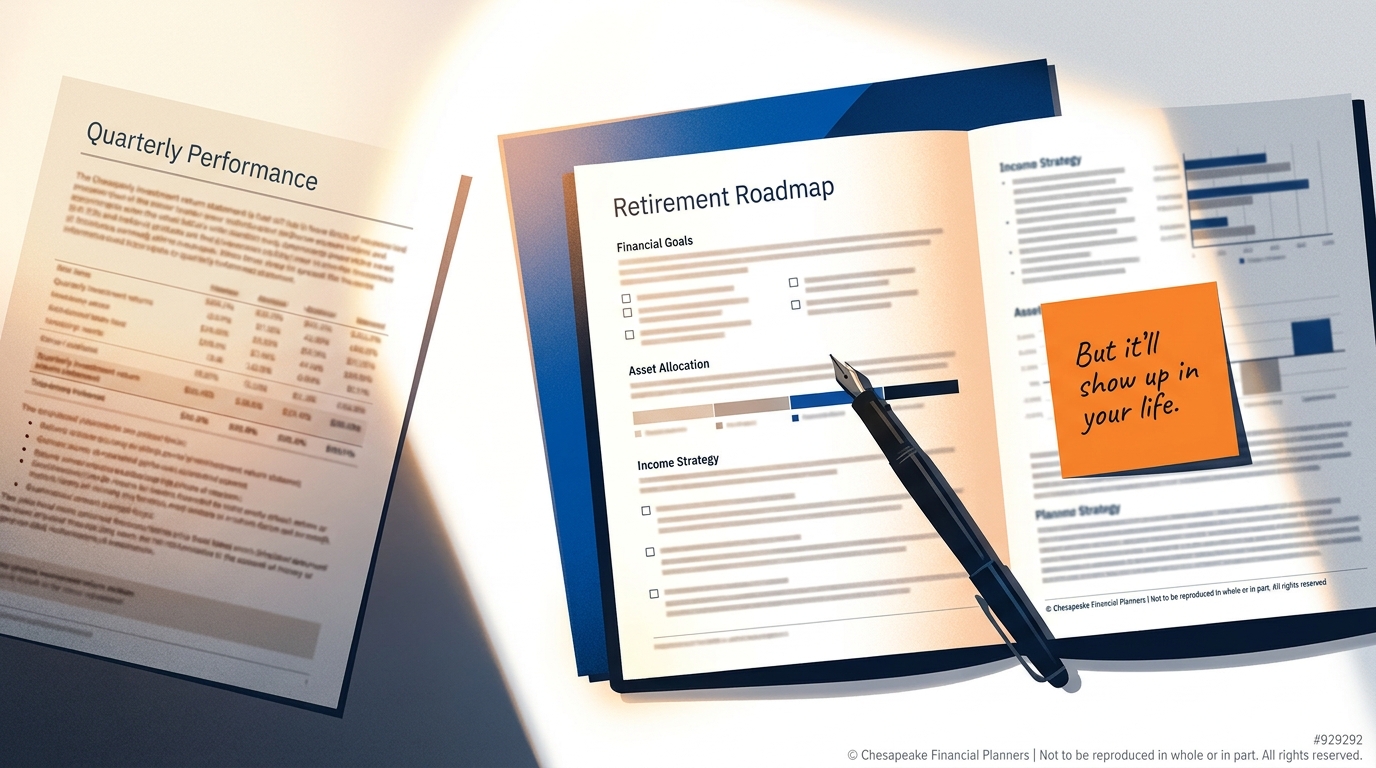
In Jeff's experience with pre-retirees, the most valuable work often produces no visible change at all. "The Roth conversion that reduces lifetime tax exposure by $40,000 won't show up in your portfolio return. But it'll show up in your life." That gap, between what's visible and what's valuable, is exactly why so many people optimize the wrong thing.
Why Does Everyone Fixate on Returns Anyway?
People fixate on returns because returns are measurable and immediate, while the most valuable planning decisions are invisible. Your account balance changes and you can watch it move. The tax avoided on a Roth conversion done three years ago is invisible. The estate dispute avoided because beneficiary designations were updated never happens, so it never registers.
This is the trap that separates financial advisor vs self-directed outcomes. A self-directed investor can track a fund's return to the basis point. What they often can't see is the missed Roth conversion window, the Social Security claim made by default, or the withdrawal order that quietly raised their lifetime tax bill. The CFP Board consistently finds that consumers following a structured planning process with a CFP professional report higher confidence about being on track for retirement than those without structured guidance.
That confidence isn't a feeling for its own sake. It's the byproduct of decisions getting made on schedule rather than reactively.


Frequently Asked Questions
What is the difference between a financial planning process and investment management?
A financial planning process coordinates decisions across taxes, retirement income, insurance, and estate planning, while investment management handles only how your assets are allocated. Investment management is a subset of planning, not a replacement for it. The process tells you whether you're on track toward your goals; the portfolio only tells you how your holdings performed against a benchmark.
Does a financial planning process matter if my account is under $1 million?
Yes, a financial planning process matters regardless of account size because the stakes are measured against what you have, not against some threshold. Someone who built a $600,000 retirement account over thirty years faces high-stakes decisions around taxes, Social Security timing, healthcare, and estate coordination. Those decisions carry the same weight, and getting them right protects a meaningful share of the total.
Is financial planning worth it if I already pick my own investments?
Financial planning is worth it even for confident self-directed investors because the value comes from coordination, not stock picking. You may choose excellent funds and still leave money on the table through missed conversion windows, suboptimal withdrawal sequencing, or default Social Security claims. A structured process catches the decisions that don't appear on a performance report but quietly shape your long-term result.
How is a planning process different from an annual portfolio review?
A planning process evaluates whether you're on track toward your specific goals and what has changed, while an annual portfolio review only measures investment performance against a benchmark. The review answers "how did my holdings do." The process answers "am I still heading where I want to go, and what adjustments make sense now." Portfolio review lives inside planning, not the other way around.
What does ongoing financial planning maintenance actually involve?
Ongoing maintenance means reviewing the plan at least annually and after any major life or market event, then updating recommendations when circumstances change. In the R.U.D.D.E.R. Method™, this is the Reassess and Refine step. It keeps the plan aligned with your life today rather than the situation you were in when it was first built, which is where most stale plans quietly fail.
What does it cost to skip a structured planning process?
Skipping a structured process costs you slowly and invisibly, which is why it goes unnoticed until the total is large. Disconnected accounts, outdated beneficiary designations, missed Roth conversion windows, and Social Security claims made by default are rarely catastrophic alone. Compounded over decades, they add up to real money and real risk that a coordinated process would have caught early.
The Long View on Planning Value
There's no line item on a financial statement for quality of decisions made. But decisions compound the same way returns do. Good decisions made consistently across taxes, income planning, insurance, and estate coordination accumulate into far better outcomes than reactive decisions made in isolation. That's the real answer in the financial planning process vs investment performance question, and it's why structured financial planning beats chasing the next outperforming fund.
A process provides the structure that makes good decisions possible and timely. The R.U.D.D.E.R. Method™ process starts with a complete picture, works through the decisions that matter, carries them into implementation, and stays current as life changes. Will financial planning actually help you reach your goals faster? It does, by removing the costly delays and gaps that self-directed investors rarely see until it's too late.
If you want to understand what a structured planning process looks like for your specific situation, our guide on evaluating financial advice walks through it in depth. Download it at chesapeakefp.com, or explore how the process connects to Is financial planning worth it if I already have investments? and How Does a Financial Plan Actually Get Built?. You can also see how it ties into Should I update my financial plan after a big life event? and What is the best order to withdraw from my 401k, Roth IRA, and taxable accounts in retirement?.
Want to go deeper? Our Retirement Income Blueprint Workbook walks through this step by step.
Disclosures
The information provided is for educational purposes only and should not be construed as investment advice. Investment strategies should be tailored to individual circumstances, risk tolerance, and goals. Past performance doesn't guarantee future results. Consult with qualified financial professionals regarding your specific situation.
All performance referenced is historical and is no guarantee of future results. All indices are unmanaged and may not be invested into directly.
R-squared indicates what percentage of a manager's movement in performance is explained by movement in performance in its benchmark. R-squared ranges from 0 to 100 and a score of 100 suggests that all movements of a manager's performance are completely explained by movements in the index.
This information is not intended to be a substitute for specific individualized tax, investment or legal advice. We suggest that you discuss your specific situation with a qualified tax, legal or financial advisor.
Advisors associated with Chesapeake Financial Planners may be either (1) LPL Financial Registered Representatives offering securities through LPL Financial, Member FINRA and SIPC, and investment advisor representatives offering investment advice through Great Valley Advisor Group; or (2) solely investment advisor representatives offering investment advice through Great Valley Advisor Group and not affiliated with LPL Financial. Great Valley Advisor Group, and Chesapeake Financial Planners are separate entities from LPL Financial.


