

What should I look for in a financial advisor in Maryland?
Last reviewed: July 2026
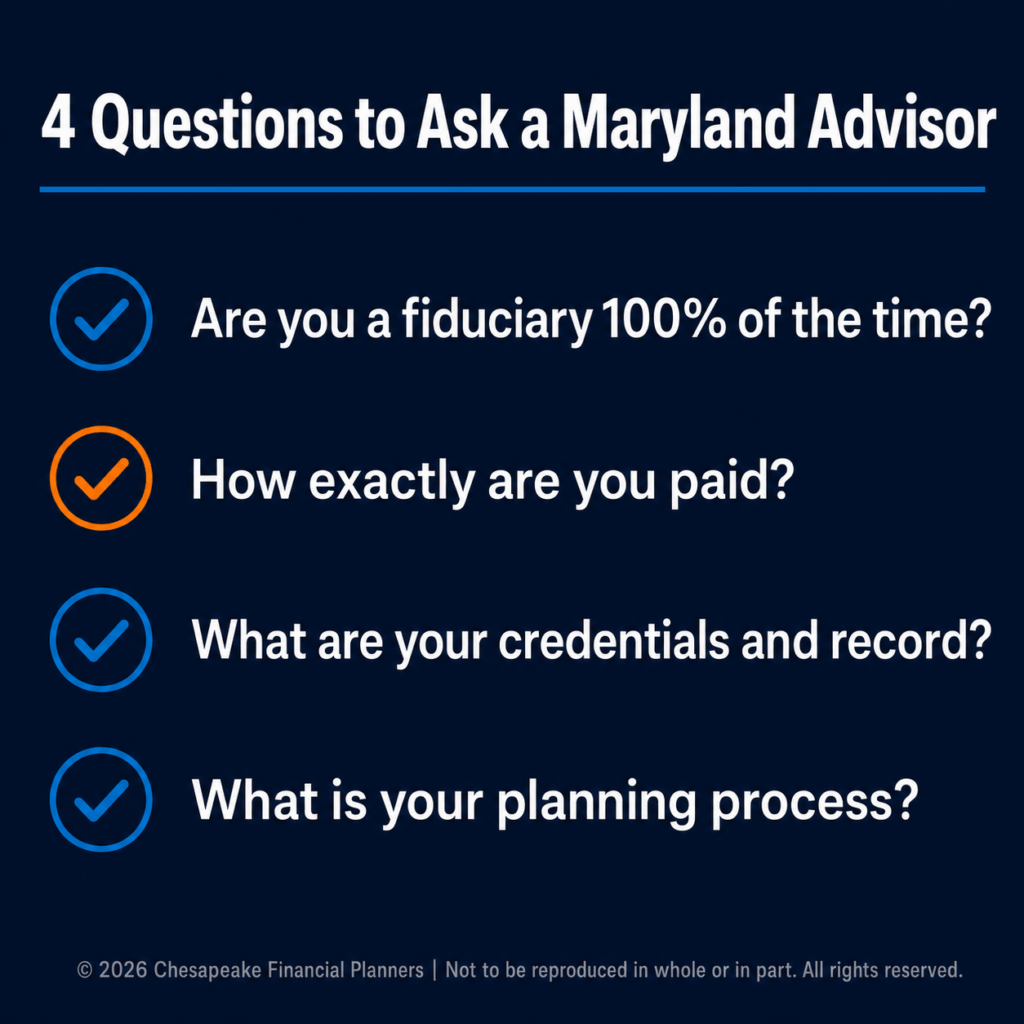
To choose a financial advisor in Maryland, confirm the advisor is a fiduciary, understand exactly how they get paid, verify their credentials and disciplinary record, and ask how they build a plan around your specific goals. The right advisor will answer all four questions plainly. If any answer is vague or rushed, that tells you something. This guide walks through how to choose a financial advisor in Maryland step by step, with the exact questions to ask before you sign anything.
Key Takeaways
- Confirm your advisor is a fiduciary, legally required to put your interests ahead of their own commission.
- Maryland advisors registered with the SEC manage at least $110 million in assets.
- Always verify an advisor's record for free using FINRA BrokerCheck before your first meeting.
- Ask how the advisor is paid before discussing your portfolio, because fee structure shapes every recommendation.
About the Author: Jeff Judge, CFP®, AEP®, ChFC®, CLU® is Managing Partner of Chesapeake Financial Planners in Forest Hill, Maryland. He has been helping families and business owners in Harford County and the Baltimore metro area choose the right advisory relationship since earning his CFP® certification in 2013, by using Chesapeake Financial Planners’ signature process, the R.U.D.D.E.R. method™. Jeff has watched plenty of people pick an advisor based on a referral and a good lunch, then discover two years later they never asked how the person actually got paid.
Step 1: Confirm the Advisor Is a Fiduciary in Maryland
Start here, because it decides everything else. A fiduciary advisor is legally bound to put your interests ahead of their own compensation. That sounds obvious. It isn't the standard everyone in the industry follows.
Not every person who calls themselves a "financial advisor" works under a fiduciary obligation all the time. Some operate under a lower "suitability" bar, where a recommendation only has to be appropriate, not the best available to you. The difference shows up in your statement years later, usually in the fees you didn't notice.
Ask directly: "Are you a fiduciary 100% of the time, in writing?" A fee-only Certified Financial Planner working as an investment adviser representative answers yes without hesitation. According to the CFP Board, CFP® professionals are required to act as fiduciaries when providing financial advice. For families across Harford County, that single written commitment removes most of the guesswork. Jeff often tells clients the fiduciary question is the cheapest insurance they'll ever buy, because it costs nothing to ask and reframes the entire relationship.
Step 2: Understand How the Advisor Gets Paid
You cannot evaluate advice until you know who funds it. In Maryland, advisors are generally paid one of three ways: fee-only, fee-based, or commission.
Here is how those compare:
| Payment Model | How They Earn | What to Watch For |
|---|---|---|
| Fee-only | You pay directly, by flat fee, hourly, or a percentage of assets | No product commissions, fewest built-in conflicts |
| Fee-based | A mix of client fees plus some commissions | Ask which recommendations carry a commission |
| Commission | Paid by the products they sell you | Every recommendation has a sales incentive attached |
None of these is automatically wrong, but each shapes the advice differently. A fee-only advisor has no commission riding on whether you buy an annuity. A commission-based advisor might. The point isn't to assume bad intent; it's to know where the incentive sits so you can read the recommendation clearly. Ask for the fee structure in plain dollars, not percentages alone, so you can see the real annual cost.
Step 3: Verify Credentials and Disciplinary History in Maryland
Anyone can print "financial advisor" on a business card. Credentials and a clean record are what separate a professional from a salesperson.
Look for letters that require real training and ongoing ethics standards: CFP® (Certified Financial Planner), CFA, ChFC®, or CPA for tax work. The CFP Board maintains coursework, exam, experience, and ethics requirements for the CFP® mark. Then verify the person, not just the firm.
Run two free checks before you ever sit down:
- Search the advisor on FINRA BrokerCheck for licensing and any disclosures.
- Search the firm and its representatives on the SEC Investment Adviser Public Disclosure database.
Both are free, both take five minutes, and both surface complaints, regulatory actions, and employment history. Maryland-based advisers who manage smaller asset bases register with the state, while larger firms register with the SEC. Either way, the public record is searchable. In Jeff's experience working with clients near Bel Air and Forest Hill, the people who skip these checks are almost always the ones who later wish they hadn't.
Step 4: Ask How the Advisor Builds Your Plan
A good advisor in Maryland sells you a process, not a product. Before you commit, ask what their planning process actually looks like and who you'll work with day to day.
At Chesapeake Financial Planners, we use the R.U.D.D.E.R. Method™, our six-step planning process: Review and Recognize, Uncover and Understand, Design and Develop, Discuss and Decide, Execute and Empower, and Reassess and Refine. A defined process matters because it means your plan isn't improvised in a single meeting. It gets built, pressure-tested, and revisited as your life changes.
Ask these process questions:
- "What does your first 90 days with a new client look like?"
- "How often will we meet, and who else is on my team?"
- "How do you handle taxes, estate planning, and insurance, or do you refer those out?"
- "What happens to my plan if you retire or leave?"
The answers tell you whether you're buying a relationship or a transaction.
How does a Maryland financial advisor's local knowledge help me?
A Maryland advisor who knows the area understands state-specific details that a national call-center advisor may miss, including Maryland's estate tax threshold, local property considerations in Harford County, and how state income tax interacts with retirement income. That context shows up in the recommendations you receive. According to the Comptroller of Maryland, Maryland levies its own estate tax in addition to any federal estate tax, which makes local planning genuinely different from advice built for a no-estate-tax state.
This is also where working with a firm rooted in your community matters. Chesapeake Financial Planners sits at 2402 Scotlon Ct in Forest Hill, and we serve families and business owners across Harford County and the broader Baltimore metro. When your advisor lives where you live, the local pieces of your plan get handled by someone who actually deals with them.
For a deeper look at the difference, see What does a fiduciary financial advisor in Harford County do that a broker doesn't?, and if cost is your next question, How much does a CFP cost in Maryland? breaks it down.
Step 5: Trust the Fit, Not Just the Resume
The first four steps screen for competence and honesty. This last one is about whether you'll actually use the advisor you hire.
You'll share details about your money, your fears, and your family with this person for years. If they talk over you, dodge straight questions, or make you feel small for not knowing something, that's the relationship you're signing up for. A good advisor explains things clearly and treats your questions as the point, not an interruption. Sit down for a no-pressure conversation before you decide. If you're weighing virtual options, Who Is a Virtual Financial Advisor in Maryland Actually Right For? covers what changes and what doesn't.
If you'd rather start from the location side, How do I find a CFP near Forest Hill, MD? is a good next read, and What questions should I ask when interviewing a fee-only financial advisor in Maryland? gives you a printable checklist.
Frequently Asked Questions
Is a financial advisor in Maryland required to be a fiduciary?
Not all of them are. Investment adviser representatives in Maryland owe a fiduciary duty, but some advisors operate under a lower suitability standard for certain products. Always ask the advisor to confirm, in writing, that they act as a fiduciary 100% of the time before you hire them.
How do I check a financial advisor's background in Maryland for free?
Want to go deeper? Our When and How to Hire a Financial Planner walks through this step by step.
Use two free public tools. Search the advisor on FINRA BrokerCheck for licensing and disclosures, and search the firm on the SEC's Investment Adviser Public Disclosure site. Both reveal complaints, regulatory actions, and employment history in about five minutes, with no account required.
What is the difference between fee-only and fee-based advisors in Maryland?
A fee-only advisor is paid solely by you, through a flat fee, hourly rate, or percentage of assets, with no product commissions. A fee-based advisor earns client fees plus some commissions on products. Fee-only carries the fewest built-in conflicts, so ask exactly how any advisor is compensated before you proceed.
How much does a financial advisor cost in Harford County, Maryland?
Costs vary by model. Many advisors charge roughly 1% of assets under management annually, while others use flat planning fees or hourly rates. The honest answer depends on the advisor's structure and your situation, so ask for the total annual cost in dollars, not just a percentage, during your first conversation.
What questions should I ask a financial advisor before hiring them in Maryland?
Ask whether they are a fiduciary 100% of the time, how they are paid, what credentials they hold, and what their planning process looks like. Then ask who is on your team and what happens to your plan if the advisor leaves. Clear answers signal a professional worth hiring.
Ready to Find the Right Fit?
Choosing a financial advisor in Maryland comes down to four honest answers: fiduciary status, fee structure, verified credentials, and a real planning process. Get those, and the decision gets much simpler. Jeff Judge and the Chesapeake team serve families and business owners across Harford County and the Baltimore metro from our office in Forest Hill. Schedule a free, no-obligation fit call at chesapeakefp.com and bring every question on this list.
Disclosures
The information provided is for educational purposes only and should not be construed as investment advice. Investment strategies should be tailored to individual circumstances, risk tolerance, and goals. Past performance doesn't guarantee future results. Consult with qualified financial professionals regarding your specific situation.
Advisors associated with Chesapeake Financial Planners may be either (1) LPL Financial Registered Representatives offering securities through LPL Financial, Member FINRA and SIPC, and investment advisor representatives offering investment advice through Great Valley Advisor Group; or (2) solely investment advisor representatives offering investment advice through Great Valley Advisor Group and not affiliated with LPL Financial. Great Valley Advisor Group, and Chesapeake Financial Planners are separate entities from LPL Financial.


