

How Much Money Do I Actually Need to Retire Comfortably?
Last reviewed: July 2026
How much to retire is the question we hear more than any other at Chesapeake Financial Planners, and the honest answer is that your number is personal. There is no universal figure that works for every household in Forest Hill, Harford County, or anywhere else. Your number depends on how you want to live, when you claim Social Security, what health care costs you face, and how taxes treat the accounts you draw from. This retirement planning guide walks you through a practical, step-by-step way to estimate your own number using current 2026 figures.
On This Page
- Key Takeaways
- Why Is There No Single Number for How Much to Retire?
- How Do You Estimate Your Annual Retirement Spending?
- What Role Will Social Security Play in Your Retirement Income?
- How Much Should You Save, and Does the 4% Rule Still Work?
- How Do Health Care and Taxes Reshape Your Retirement Number?
- What Steps Can You Take Today to Hit Your Number?
- Frequently Asked Questions
- Putting Your Retirement Number to Work
- Disclosures
Key Takeaways
- Your retirement number is driven by annual spending, not a one-size-fits-all dollar amount; most households need to replace 70 to 85 percent of pre-retirement income.
- Social Security carries a meaningful share of the load, with the average retired worker receiving $2,071 per month in 2026.
- A widely cited starting withdrawal rate is roughly 3.9 percent for 2026, lower than the old 4 percent rule of thumb.
- Health care is a major line item; Fidelity estimates a single 65-year-old may need about $172,500 for medical costs in retirement.
- Maxing tax-advantaged accounts matters: the 2026 401(k) employee contribution limit is $24,500, with an $8,000 catch-up at age 50.
About the Author: Jeff Judge, CFP®, AEP®, ChFC®, CLU® is Managing Partner of Chesapeake Financial Planners in Forest Hill, Maryland. He has been helping families and business owners in Harford County and the Baltimore metro area plan for retirement income since earning his CFP® certification in 2013, by using Chesapeake Financial Planners’ signature process, the R.U.D.D.E.R. method™. Jeff's view: the households who feel most confident in retirement are rarely the ones with the biggest balance, they are the ones who pressure-tested their spending before they stopped working.
Why Is There No Single Number for How Much to Retire?
Retirement calculators love to produce a single, confident figure. Real life does not work that way. Two couples who both spent $90,000 a year before retiring can need very different portfolios, because one plans to travel and carry a mortgage while the other has paid off their home and wants a quieter life. Your number is a reflection of your choices, not a fixed law of nature.
The most useful way to think about it is replacement income: the share of your pre-retirement paycheck you will need to recreate once the paychecks stop. Many planners use 70 to 85 percent as a starting band, because some costs fall in retirement, such as commuting, payroll taxes, and the money you currently set aside for retirement itself. Others rise, especially travel, hobbies, and eventually health care. Where you land in that band depends on your lifestyle and your debts.
A paid-off mortgage is the single biggest swing factor we see. A household that retires debt-free can often live well on 70 percent of their old income, while one still carrying a mortgage and a car payment may need closer to 90 percent for the first decade. That is a difference of hundreds of thousands of dollars in the portfolio you need to build, driven by one line on your balance sheet.
Longevity is the other quiet driver. A plan that has to last 35 years needs a noticeably larger cushion than one built for 25, and most people underestimate how long retirement runs. A 65-year-old couple today has a strong chance that at least one spouse reaches 90, so planning to a comfortable old age rather than an average life expectancy is the safer default. The cost of being wrong is asymmetric: overshoot your number and you leave a larger estate, undershoot it and you risk running short in your eighties when going back to work is not realistic.
Is the same retirement number right for everyone?
No. A reasonable retirement number for a debt-free couple in Bel Air who plan a modest lifestyle might be a fraction of what a couple with a vacation home and an ongoing mortgage requires. Start from your own spending, not an average, and adjust for the life you actually plan to live. how to build a retirement budget
How Do You Estimate Your Annual Retirement Spending?
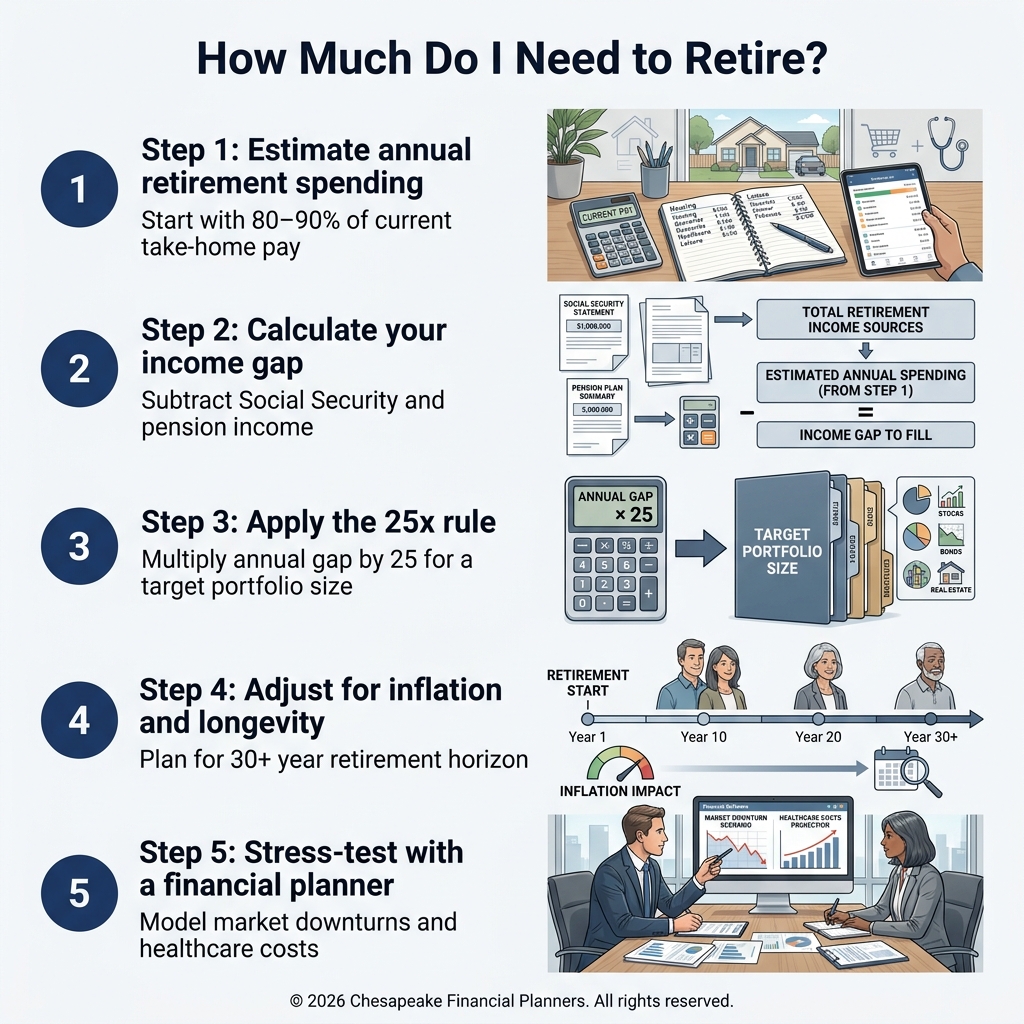
Your annual spending is the engine of the whole calculation, so it deserves the most attention. Start with what you spend now. Pull twelve months of bank and credit card statements and sort the outflows into essential costs, such as housing, food, insurance, utilities, and transportation, and discretionary costs, such as travel, dining, gifts, and hobbies. This gives you a real baseline instead of a guess. A free retirement savings calculator can turn that annual spending figure into a rough target in about five minutes, which is a good gut check before you do the detailed work.
Then adjust for retirement. Subtract expenses that will disappear, such as commuting, the portion of income you currently save, and, for many, a mortgage that will be paid off. Add expenses that will grow, especially health care and travel in the active early years. The result is your target annual retirement spending in today's dollars.
Here is the simple math that turns spending into a number. If you expect to spend $90,000 a year and Social Security plus any pension will cover $40,000 of it, your portfolio needs to produce the remaining $50,000 a year. At a conservative starting withdrawal rate, that gap implies the size of the portfolio you are working toward, which the savings section below covers in detail.
One mistake worth avoiding: do not assume your spending stays flat for thirty years. It rarely does. Most retirements move through phases, and planning for a single average number tends to overstate the late years and understate the early ones.
How do I calculate my retirement spending if my expenses keep changing?
Build three scenarios. Go-go years are active, with higher travel and discretionary spending in your sixties. Slow-go years come as you settle into a routine and travel less. No-go years bring lower activity but often higher health care and support costs. Planning in phases is far more realistic than assuming flat spending across a three-decade retirement. What Is the Best Retirement Spending Strategy for Me?

What Role Will Social Security Play in Your Retirement Income?
For most retirees, Social Security is the foundation of guaranteed lifetime income, and it sits at the center of any honest retirement income planning conversation. As of 2026, the average retired worker receives $2,071 per month, and the maximum benefit for someone retiring at full retirement age is $4,152 per month. Benefits rose with a 2.8 percent cost-of-living adjustment for 2026, which helps your income keep pace with inflation in a way almost no private asset does.
When you claim matters enormously. Claiming early at 62 permanently reduces your benefit to roughly 70 percent of your full amount, while waiting increases it. If you were born in 1960 or later, delaying to age 70 raises your monthly benefit to 124 percent of your full retirement amount. Here is how the three main claiming ages compare:
| Claiming age | Benefit vs. your full retirement amount |
|---|---|
| 62 (earliest) | About 70 percent, permanently reduced |
| Full retirement age (66 to 67) | 100 percent |
| 70 (latest) | 124 percent for those born in 1960 or later |
If you are still working before full retirement age, the 2026 earnings test withholds $1 in benefits for every $2 you earn above $24,480, so claiming while you have a paycheck often makes little sense. For a healthy person with other assets to bridge the gap, delaying can be one of the most valuable decisions available anywhere in a financial plan.
Married couples have an extra lever: coordinating two benefits instead of optimizing each one alone. When the higher earner delays to 70, it also raises the survivor benefit the other spouse may eventually collect, which turns the delay into longevity insurance for the household rather than a bet on one person's lifespan. For many couples we work with, that single coordination move adds more lifetime income than any change to their investment mix.
Jeff Judge puts it plainly: "Social Security is the only inflation-adjusted, guaranteed income most clients will ever own. Treating the claiming decision as a throwaway is one of the most expensive mistakes I see."
Should I count on Social Security being there?
Yes, with a planning adjustment. Even under the trustees' more cautious projections, the program is expected to pay the large majority of scheduled benefits, funded by ongoing payroll taxes. We typically model full benefits and then stress-test a reduction so your plan holds up either way. Building flexibility in now beats hoping the question never comes up. Should I Take Social Security at 62 or Wait Until 70?
How Much Should You Save, and Does the 4% Rule Still Work?
The 4 percent rule was a useful rule of thumb: withdraw 4 percent of your portfolio in year one, adjust that dollar amount for inflation each year, and historically the money lasted about thirty years. It is a starting point, not a guarantee. Recent research on the 4% rule retirement question suggests being a bit more conservative today. Morningstar's 2026 analysis put a safe starting withdrawal rate closer to 3.9 percent for a balanced portfolio.
To translate that into a savings target, divide the annual income you need from your portfolio by your withdrawal rate. The rate you pick changes the target more than most people expect:
| Starting withdrawal rate | First-year income from $1 million | Portfolio needed for $50,000 a year |
|---|---|---|
| 4.0 percent (traditional rule) | $40,000 | $1.25 million |
| 3.9 percent (Morningstar 2026) | $39,000 | About $1.28 million |
| 3.5 percent (conservative) | $35,000 | About $1.43 million |
Using the earlier example, a $50,000 annual gap divided by 0.039 implies a portfolio of roughly $1.28 million. Divide by 4 percent instead and you get $1.25 million. The exact figure shifts with your assumptions, which is why the rate you choose matters as much as the balance you accumulate.
Getting there is mostly about consistently funding tax-advantaged accounts. For 2026, you can contribute up to $24,500 to a 401(k), plus an $8,000 catch-up if you are 50 or older, and a larger $11,250 catch-up if you are between ages 60 and 63. IRA contributions are capped at $7,500. Automating these contributions is how the number quietly gets built, year after year, without depending on willpower.
Is the 4% rule still safe in 2026?
It is a reasonable guardrail, not a promise. Lower starting rates, flexible spending, and a willingness to trim withdrawals in down markets all improve the odds your money lasts a full retirement. Treat the rate as a dial you can adjust, not a fixed setting you lock in on day one. What Is the 4% Rule and Does It Still Work in Retirement?
How Do Health Care and Taxes Reshape Your Retirement Number?
Health care is the expense most people underestimate. Fidelity estimates that a single 65-year-old retiring in 2025 may need about $172,500 to cover medical costs over the course of retirement. Medicare helps, but it is not free: the standard Part B premium is $202.90 per month in 2026 with a $283 annual deductible, and that does not include supplemental coverage, dental, vision, or long-term care.
If you are still working and have a high-deductible health plan, a health savings account is one of the most powerful retirement tools available, because contributions, growth, and qualified withdrawals are all tax-free. For 2026 you can contribute up to $4,400 for self-only coverage and $8,750 for family coverage. Many of our clients treat the HSA as a dedicated retirement health care fund and pay current medical bills out of pocket so the account can grow untouched. How do I use an HSA for retirement?
Taxes quietly change how much you actually need. A dollar in a traditional 401(k) is worth less than a dollar in a Roth account, because you owe ordinary income tax when you withdraw it. Building a mix of pre-tax, Roth, and taxable accounts gives you control over your taxable income in retirement, which can lower your Medicare premiums and reduce how much of your Social Security is taxed. That control is worth real money, sometimes tens of thousands over a full retirement. tax diversification in retirement Jeff Judge notes: "When we model two clients with the same account balance, the one with Roth flexibility consistently keeps more money in their pocket because we can dial taxable income down in ways that also protect their Medicare premiums and Social Security tax treatment."
The lever most people miss sits in the years between retirement and age 73, when required minimum distributions begin. With no paycheck and RMDs not yet started, your taxable income often dips, which can open a window to convert traditional dollars to Roth at a lower rate. Done deliberately across several years, that can shrink the tax bill on a lifetime of withdrawals and keep you under the income thresholds that quietly raise Medicare premiums later.
How much should I budget for health care in retirement?
As a planning anchor, budget six figures per person across retirement and revisit it every year. Couples should roughly double the single estimate. Anyone retiring before 65 needs a separate plan to bridge coverage until Medicare begins, since marketplace premiums in those gap years can rival a mortgage payment. How do I get health insurance between early retirement and Medicare?
What Steps Can You Take Today to Hit Your Number?
Knowing your number is only useful if it changes what you do this year. At Chesapeake Financial Planners we work through this with a repeatable framework. The R.U.D.D.E.R. Method™ is Chesapeake Financial Planners' six-step planning process: Review and Recognize, Uncover and Understand, Design and Develop, Discuss and Decide, Execute and Empower, and Reassess and Refine. Applied to your retirement number, it turns a vague worry into a concrete plan you revisit every year.
The order of operations matters more than the heroics. These four moves cover most of the distance:
- Calculate your real annual spending using twelve months of statements, then build your three-phase retirement budget.
- Estimate your Social Security at ssa.gov and decide on a claiming age you can defend, not just the earliest one available.
- Max your tax-advantaged accounts in the right order: capture the full employer match, fund an HSA if eligible, then add Roth and taxable savings.
- Stress-test your plan against a lower 3.9 percent withdrawal rate, higher health care costs, and a market downturn early in retirement.
In Jeff Judge's experience, the clients who hit their number are rarely the ones chasing the highest return. They are the ones who automated their savings, kept their fixed costs low, and revisited the plan every year as life changed. One pattern shows up again and again: the couple who runs their numbers five years before retiring almost always retires on schedule, while the couple who waits until the year before often works two or three years longer than they wanted to. The plan is a living document, not a one-time calculation. What Does a Real Financial Review Actually Cover?
What is the first step to figuring out how much to retire on?
Start with your spending. Until you know what your life costs, every other number is a guess. Once you have a realistic annual figure, the savings target and the claiming decisions fall into place around it. schedule a retirement planning session
Frequently Asked Questions
How much do I need to retire at 65?
There is no universal figure, but a common planning method multiplies the annual income you need from your portfolio by 25, which reflects a 4 percent withdrawal rate. If you need $50,000 a year from savings beyond Social Security, that points to roughly $1.25 million, then adjusted up or down for your own spending, health, and goals. Your real number depends on your debts and lifestyle.
Is $1 million enough to retire?
For some households yes, for others no. One million dollars supports roughly $40,000 of inflation-adjusted annual withdrawals at a 4 percent rate, on top of Social Security. Whether that is enough depends entirely on your spending, your debts, your health care needs, and how long you expect your retirement to last. A debt-free couple may thrive on it while another household finds it tight.
How does Social Security factor into my retirement number?
Social Security reduces how much your portfolio has to produce. In 2026 the average retired worker receives $2,071 a month, about $24,852 a year, which directly offsets your spending. The more guaranteed income you have from Social Security and any pension, the smaller the portfolio you need to cover everything else. This is why the claiming decision is worth real planning attention.
What is a safe withdrawal rate in 2026?
Recent research points to a starting withdrawal rate near 3.9 percent for a balanced portfolio, slightly more conservative than the traditional 4 percent rule. The right rate depends on your asset mix, your flexibility to cut spending in down markets, and how long your retirement is likely to be. Lower starting rates meaningfully increase the odds your money lasts a full retirement.
How much should I budget for health care in retirement?
Plan for a major expense. Fidelity estimates a single 65-year-old may need about $172,500 for medical costs across retirement, and couples should roughly double that figure. Medicare's standard Part B premium is $202.90 a month in 2026, and that excludes supplemental coverage, dental, vision, and any long-term care you may eventually need. Budget six figures per person and revisit it yearly.
How much money to retire do I need if I want to retire early at 55?
Retiring at 55 raises your number because you fund more years and bridge a decade before Medicare and Social Security begin. Plan for roughly 35 to 40 years of withdrawals, a lower starting withdrawal rate near 3.5 percent, and a separate budget for private health insurance until 65. Many early retirees need 25 to 30 times their annual spending rather than 25.
Does where I live affect how much I need to retire?
Yes, significantly. State income taxes, housing costs, and property taxes vary widely, so the same lifestyle can cost far more in one state than another. Maryland, for example, taxes some retirement income that other states fully exempt, which is worth modeling before you assume your current budget carries over. Where you choose to retire can move your number by six figures over a full retirement.
When should I start planning how much to retire on?
Now, regardless of your age. The earlier you estimate your number, the more time compounding and tax-advantaged savings have to work in your favor. Even if retirement is decades away, a rough number tells you whether your current savings rate is on track or needs to change today. A small adjustment at 40 beats a large one at 60.
Putting Your Retirement Number to Work
Figuring out how much to retire comes down to four moving parts: your annual spending, your guaranteed income from Social Security, a sustainable withdrawal rate, and a plan for health care and taxes. Get those right and the number stops being intimidating and starts being a target you can manage. At Chesapeake Financial Planners, we work through how much you need to retire with clients every week. If you're weighing this decision, a second opinion costs you nothing. Visit chesapeakefp.com to learn more.
Want to go deeper? Our Retirement Income Blueprint Workbook walks through this step by step.
Disclosures
The information provided is for educational purposes only and should not be construed as investment advice. Investment strategies should be tailored to individual circumstances, risk tolerance, and goals. Past performance doesn't guarantee future results. Consult with qualified financial professionals regarding your specific situation.
Advisors associated with Chesapeake Financial Planners may be either (1) LPL Financial Registered Representatives offering securities through LPL Financial, Member FINRA and SIPC, and investment advisor representatives offering investment advice through Great Valley Advisor Group; or (2) solely investment advisor representatives offering investment advice through Great Valley Advisor Group and not affiliated with LPL Financial. Great Valley Advisor Group, and Chesapeake Financial Planners are separate entities from LPL Financial.


