

Is it worth hiring a financial advisor in my 30s and 40s?
Last reviewed: July 2026
Whether it is worth paying for financial advice in your 30s and 40s comes down to a simple test: the fee should be less than the dollars you get back in tax savings, retirement account optimization, insurance right-sizing, and avoided mistakes. Hiring a financial advisor in your 30s is worth it when that math works. For most households earning over $150,000, or those dealing with equity compensation, kids, a small business, or a recent windfall, the math works in your favor. For a single W-2 earner with no dependents and a fully funded 401(k), a one-time advice-only consultation usually beats an ongoing relationship.
On This Page
- Key Takeaways
- What does a financial advisor in your 30s actually do?
- How much does a financial advisor in your 30s and 40s cost?
- When is hiring a financial advisor in your 30s worth it?
- What are the alternatives if a full-service advisor isn't worth it yet?
- How do you find a good financial advisor in your 30s or 40s?
- Related topics worth reading
- Frequently Asked Questions
- Where to go from here
- Disclosures
Key Takeaways
- A financial advisor in your 30s and 40s pays off when the year holds equity comp, a home purchase, or a new business.
- The 2026 401(k) employee contribution limit is $24,500 and the IRA limit is $7,500, and most under-40 households fund neither without a plan.
- The 1% AUM model is one option among many. Advice-only and flat-fee planners now serve under-40 clients without an asset minimum.
- The CFP® credential plus a written fiduciary commitment is the floor, not a feature. Verify both before signing anything.
- "Free" advice from a broker is usually advice on a product that pays the broker, not advice on your plan.
About the Author: Jeff Judge, CFP®, AEP®, ChFC®, CLU® is Managing Partner of Chesapeake Financial Planners in Forest Hill, Maryland. He has been helping families and business owners in Harford County and the Baltimore metro area navigate the early-career planning years since earning his CFP® certification in 2013, by using Chesapeake Financial Planners’ signature process, the R.U.D.D.E.R. method™. Jeff often tells clients in their 30s that the best decisions of the next decade are the ones running quietly in the background: account selection, savings rate, and the order you tap accounts when life shifts.
What does a financial advisor in your 30s actually do?
A financial advisor in your 30s typically handles three things over and over: cash flow and savings rate, tax-advantaged account selection, and insurance and protection. The work is less about picking individual stocks and more about coordinating decisions across paychecks, employer benefits, and life events. A good planner in this stage is part decision-maker, part tax coordinator, and part traffic cop for everything else competing for the same dollar.
For most under-40 clients the planning conversations land on the same handful of questions. Should the 401(k) deferral be pre-tax, Roth, or split? Does a backdoor Roth IRA fit on top of the workplace plan? Is the HSA the most tax-advantaged account in the entire stack, and is it being used like a long-term retirement vehicle or a short-term medical account? Is term life sized correctly, and is disability coverage actually in place? Each question alone is small. Stacked across a decade, they decide whether the family hits financial independence at 55 or 65.
This is also where the R.U.D.D.E.R. Method™ comes in. The R.U.D.D.E.R. Method™ is Chesapeake Financial Planners' six-step planning process: Review and Recognize, Uncover and Understand, Design and Develop, Discuss and Decide, Execute and Empower, and Reassess and Refine. In the 30s and 40s, most of the value sits in the first three steps. By the time a client is in their 50s, the same framework runs the other direction, with Execute and Reassess carrying the weight.
Jeff Judge tells younger clients that the early-career years are the ones where small decisions compound the most, not the ones where they matter least. A 1% savings rate change at 32 is worth more in retirement than a perfect Roth conversion at 62. That is the case for financial planning younger, before the picture gets more complicated.
What an advisor will not do for you in this stage
A planner in your 30s or 40s is not going to time the market, pick the next winning stock, or make your investment statement look exciting. The strategies that move the needle in this stage are mechanical: maximizing the employer match, choosing the right account type, getting the beneficiary forms updated, and making sure income protection is in place before kids arrive. The work is less glamorous than what most people expect, and that is a feature, not a bug.
How much does a financial advisor in your 30s and 40s cost?
Financial advisor fees in your 30s and 40s break into four common models. The right one depends on what you actually need: ongoing management of investable assets, one-time planning, project work on a specific decision, or hourly help with a narrow question.
| Fee model | Typical cost | Who it suits |
|---|---|---|
| Assets under management (AUM) | 0.75% to 1.25% of investable assets annually | Households with $250,000+ already invested and a preference for ongoing oversight |
| Flat annual retainer | $3,000 to $10,000 per year | Households with complex tax or income situations regardless of account size |
| Hourly | $200 to $400 per hour | A single question or short engagement, like a Roth conversion check |
| Advice-only or project fee | $1,500 to $5,000 per engagement | One-time decisions: equity comp planning, mortgage timing, business start-up |
A household with $300,000 in a 401(k) paying 1% AUM is writing a $3,000 check each year. A household earning $250,000 with $50,000 invested is in a different spot, where a flat retainer or project fee almost always beats an AUM relationship. Compounded over 10 years, the fee choice itself is one of the biggest planning decisions a younger client will make.
The fee model also signals what the advisor will spend time on. AUM advisors focus on the portfolio because that is what generates the fee. Flat-fee and advice-only planners focus on planning because that is what is being paid for. Neither model is inherently better. The match between fee structure and the work that actually moves your situation is what matters.
When is hiring a financial advisor in your 30s worth it?
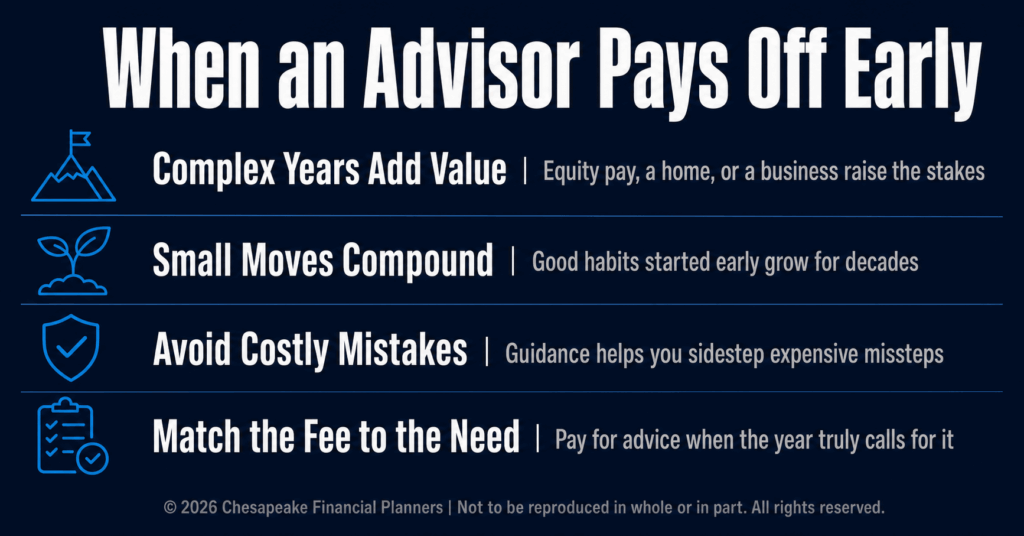
The decision is rarely about age and almost always about the year. A 36-year-old with a stable job, no equity comp, and a fully funded 401(k) does not need ongoing planning. A 36-year-old who just received an RSU grant, bought a house, and is expecting a first child probably does. The trigger is the complexity of the year, not the number on the driver's license.
Real triggers worth paying for advice on include: household income above $150,000 with tax planning gaps, equity compensation in any form (RSUs, ISOs, NQSOs, ESPP), marriage or divorce, a first child, buying a first home, an inheritance, a business sale or start-up, a job change with an old 401(k) sitting at a former employer, and any year where the federal marginal rate jumps. A single one of these in a given tax year is usually enough to justify a project fee or annual retainer.
The numbers underline why. The 2026 401(k) employee contribution limit is $24,500 according to the IRS, the 2026 IRA contribution limit is $7,500, and the 2026 family HSA contribution limit is $8,750 per IRS Revenue Procedure 2025-19. A married household maxing all three is moving $40,750 of income off the current-year tax return before any backdoor Roth or Mega Backdoor Roth move. That is the kind of number that disappears quietly if no one is tracking it.
The Roth picture matters too. The 2026 Roth IRA phase-out range for married filing jointly is $242,000 to $252,000 per IRS Notice 2025-67. Households crossing into that range need a backdoor Roth strategy or they lose the ability to fund a Roth IRA directly. Households whose income is climbing rapidly need to make the move before the door closes, not after. Households that step back to one income for a few years (parental leave, sabbatical, business launch) have a window to do Roth conversions at lower brackets. Each scenario is a decision, and decisions made without numbers tend to default to whatever costs the most in tax.
What's the dollar value of advice in a complex year?
A planning engagement that catches a single missed Backdoor Roth (worth roughly $7,500 of tax-advantaged space in 2026), avoids a wash sale on an exercised ISO position, or shifts the 401(k) deferral mix in a way that locks in $4,000 of long-term tax savings has already paid for itself several times over. The hardest fees to justify are the ones spent on planning in a quiet year. The easiest fees to justify are the ones spent in a year that holds two or more of the triggers above.
What are the alternatives if a full-service advisor isn't worth it yet?
Not every 30-something needs a planner on retainer. The honest answer for many under-35 clients is that a robo-advisor and an annual planning checkup beat a full AUM relationship. The cost is lower, the discipline is higher, and the planning gets done in the year it is needed instead of every year by default.
The serious alternatives in 2026 break into three buckets. Robo-advisors like Vanguard Digital Advisor, Schwab Intelligent Portfolios, and Fidelity Go handle portfolio construction and rebalancing for a fraction of the AUM cost. Target-date funds inside a workplace 401(k) do the same job, often with even lower expense ratios. Advice-only and flat-fee networks (NAPFA, XY Planning Network, the Advice-Only Network) connect clients with fiduciary planners who charge by the project or hour with no minimum.
A pattern many high-earning under-40 clients use: a robo-advisor for the taxable account, target-date funds inside the 401(k), and an annual or biennial planning project with an advice-only CFP® professional. The combined cost is often well under what an AUM advisor would charge on the same dollars, and the planning still gets the attention it deserves. The trade-off is that there is no one calling you in February asking about the W-2 you just received. Some clients want that. Others find it unnecessary.

Employer-provided financial wellness benefits are the third bucket. Many employers now offer free or subsidized access to a planner through providers like Northstar, Origin, and Brightplan. The quality varies. The price is often zero. Used well, this can replace a hired planner entirely for households with a relatively simple picture. Used poorly, it is a series of generic webinars that nobody attends.
Jeff often tells DIY clients that the right tool is whatever closes the gap between intention and execution. A spreadsheet that gets opened beats a planner who gets ignored.
How do you find a good financial advisor in your 30s or 40s?
The search starts with credentials and fiduciary commitment, not with returns or testimonials. The CFP® credential is the meaningful baseline for personal planning. It signals that the advisor has passed a comprehensive exam, completed continuing education, and agreed to a code of ethics enforced by the CFP Board. Other credentials add depth in specific areas (ChFC®, CLU®, AEP® for advanced topics; CFA for investment specialists), but the CFP® is the planning baseline.
Two regulatory checks belong at the top of the list. FINRA BrokerCheck shows registration history and any customer complaints or regulatory actions for anyone selling securities. The SEC's Investor.gov lets you verify investment advisor registration and pull Form ADV, which discloses the firm's services, fees, disciplinary history, and conflicts of interest in plain language. Both are free, both take less than ten minutes, and both flag the small percentage of advisors who should not be working with you before the first conversation happens.
Fiduciary commitment is the next step. Ask the question directly and ask for it in writing: "Will you act as a fiduciary on every recommendation you make to me, in writing?" A fiduciary is legally required to put your interests first. A non-fiduciary working under a suitability standard is allowed to recommend products that pay them more even when a comparable option costs you less. The two operate by different rules. Most CFP® professionals practicing in a fee-based or fee-only structure work as fiduciaries on planning engagements, but the fiduciary commitment should be explicit, not implied.
Fee transparency is the last filter. A real advisor will tell you the fee in dollars before you sign anything. If the conversation keeps pivoting back to the portfolio's "outlook" instead of "this is what the engagement costs and this is what you get for it," that is a tell. A clear answer in the first meeting predicts a clear relationship later.
Related topics worth reading
The decision to hire a financial advisor in your 30s and 40s sits inside a larger set of planning questions. These cluster posts go deeper on individual pieces of the picture and are worth bookmarking before or after this one.
- How do you choose the right financial advisor and what should you look for? walks through credentials, fee structures, and red flags in detail. Read this before any first meeting.
- How much does it cost to hire a financial planner in 2026? runs the math on AUM, flat fee, hourly, and advice-only pricing, with realistic case examples.
- What is the difference between a fee-based and fee-only financial advisor? explains the structural difference in compensation models and where conflicts of interest can hide.
- How should a high earner who is not rich yet build wealth? covers the planning playbook for households earning $250,000+ that feel like they are not yet building wealth.
- What does a financial planner actually do, and do I need one? breaks down the day-to-day work of planning, separated from the brochure version.
- mega backdoor roth strategy for the high earners whose 401(k) plan allows after-tax contributions and in-plan Roth conversions.
Frequently Asked Questions
Is it worth paying for a financial advisor in your 30s if you only have $50,000 invested?
Yes, when the advice is project-based or advice-only rather than AUM. A flat-fee planner running a one-time engagement at $2,000 to $4,000 can pay back many times that in account selection, savings rate, and tax planning. The same $50,000 paying a 1% AUM fee is only generating $500 a year of revenue, which is rarely enough to fund the kind of attention that justifies the hire. Match the fee model to the situation, not the asset balance.
Can a robo-advisor replace a financial advisor in your 30s and 40s?
A robo-advisor can replace the portfolio piece, but not the planning piece. Robos handle asset allocation, rebalancing, and tax-loss harvesting at low cost, which solves the investment side of the picture. They do not coordinate the 401(k) deferral split, run the Roth conversion math, evaluate insurance coverage, or unpack equity comp. For under-40 households with a simple W-2, a robo plus an occasional planning project is often the right stack.
How much should a financial advisor cost relative to your income?
A reasonable rule is that planning fees in your 30s and 40s should land between 0.3% and 1% of household income for the value of the work received. For a household earning $250,000, that puts a flat retainer in the $2,500 to $5,000 range and a one-time project in the $1,500 to $3,500 range. Anything that crosses 2% of household income is a high bar and should come with a clear, written explanation of what the engagement covers.
What questions should you ask a financial advisor in your 30s before signing?
Ask four questions in the first meeting: Are you a fiduciary on every recommendation, in writing? What is your total annual fee for me, in dollars? How are you compensated, including any third-party commissions or revenue-sharing? And what does the first year of work look like, month by month? A planner who answers all four cleanly is worth the second conversation. A planner who deflects on any of them is not.
Do you really need a CFP® specifically, or is any financial advisor okay?
The CFP® designation is the personal financial planning baseline. It is not the only credential that matters, but it is the only one that signals comprehensive planning education and an enforceable code of ethics specific to financial planning. Other certifications (ChFC®, CFA, AEP®) layer specialization on top. For an advisor whose primary role is planning rather than insurance sales or investment management, the CFP® is the credential to verify first.
What if your employer offers free financial planning. Is that enough?
It depends on the program. Employer-provided benefits through Northstar, Origin, Brightplan, and similar providers can replace a hired planner for a household with a relatively simple picture: W-2 income, a 401(k), maybe an HSA, and standard insurance needs. Households with equity compensation, business income, rental properties, or major upcoming decisions usually need the deeper engagement that a dedicated CFP® professional can provide. Start with what is free, add on where the gaps appear.
Can paying for a financial advisor in your 30s actually lose you money?
It can, if the fee model and the work do not match. The clearest failure pattern is a 1% AUM relationship with an advisor who treats the year like a portfolio review. If the planning is shallow and the assets are large, the AUM fee outruns the value being delivered. The reverse pattern, paying a small project fee for advice on a single complex decision, almost always returns more than it costs.
Where to go from here
If this is the year you are evaluating whether a financial advisor in your 30s or 40s is worth the cost, the next step is not picking a planner. The next step is mapping the decisions sitting in front of you over the next 12 to 24 months. The list of triggers earlier in this post is a good starting point. If you found this helpful, the Pre-Planning Checklist for Under-40 Households covers what to gather before any first meeting in detail. Download it at chesapeakefp.com.
Want to go deeper? Our Cost vs. Value walks through this step by step.
This material is for educational purposes only and should not be considered tax or legal advice. Please consult with your tax advisor or attorney regarding your specific situation.
CFP Board owns the marks CFP®, CERTIFIED FINANCIAL PLANNER®, and CFP® (with plaque design) in the U.S.
The opinions voiced in this material are for general information only and are not intended to provide specific advice or recommendations for any individual.
All investing involves risk including loss of principal. No strategy assures success or protects against loss.
This information is not intended to be a substitute for specific individualized tax, investment or legal advice. We suggest that you discuss your specific situation with a qualified tax, legal or financial advisor.
A Roth IRA offers tax deferral on any earnings in the account. Qualified withdrawals of earnings from the account are tax-free. Withdrawals of earnings prior to age 59½ or prior to the account being opened for 5 years, whichever is later, may result in a 10% IRS penalty tax. Limitations and restrictions may apply.
Contributions to a traditional IRA may be tax deductible in the contribution year, with current income tax due at withdrawal. Withdrawals prior to age 59½ may result in a 10% IRS penalty tax in addition to current income tax.
Disclosures
The information provided is for educational purposes only and should not be construed as investment advice. Investment strategies should be tailored to individual circumstances, risk tolerance, and goals. Past performance doesn't guarantee future results. Consult with qualified financial professionals regarding your specific situation.
Advisors associated with Chesapeake Financial Planners may be either (1) LPL Financial Registered Representatives offering securities through LPL Financial, Member FINRA and SIPC, and investment advisor representatives offering investment advice through Great Valley Advisor Group; or (2) solely investment advisor representatives offering investment advice through Great Valley Advisor Group and not affiliated with LPL Financial. Great Valley Advisor Group, and Chesapeake Financial Planners are separate entities from LPL Financial.


