

How can I catch up on retirement savings in my 50s?
Last reviewed: July 2026
You catch up on retirement savings in your 50s by maximizing catch-up contributions, cutting fixed expenses to free up real cash flow, delaying Social Security, and stretching your working years. Your 50s are not the decade to panic. For most people, they are peak earning years with fewer dependents and the highest contribution limits the IRS allows, which makes catch-up retirement savings more achievable now than at any earlier point.
Key Takeaways
- Savers age 50 and older can contribute an extra $8,000 to a 401(k) in 2026, on top of the $24,500 standard limit.
- Ages 60 to 63 get an enhanced 401(k) catch-up of $11,250 under SECURE 2.0, for a $35,750 total.
- Delaying Social Security from age 62 to 70 can raise your monthly benefit by roughly 77%.
- Working two or three extra years lets accounts grow while shortening how long your savings must last.
About the Author: Jeff Judge, CFP®, AEP®, ChFC®, CLU® is Managing Partner of Chesapeake Financial Planners in Forest Hill, Maryland. He has been helping families and business owners in Harford County and the Baltimore metro area navigate retirement savings strategies since earning his CFP® certification in 2013, by using Chesapeake Financial Planners’ signature process, the R.U.D.D.E.R. method™. Jeff often reminds clients that the people who feel "behind" in their 50s usually have more levers to pull than they realize, because their income and expense picture is clearer than it has ever been.
Why Are Your 50s a Turning Point for Retirement Savings?
Your 50s are a turning point because three forces line up at once: higher income, lower expenses, and bigger contribution limits. For many people, the 50s are peak earning years. You have negotiating power, your skills command more pay, and the salary you earn now is often the highest you will ever see.
At the same time, expenses tend to fall. If your children are financially independent and your mortgage is winding down, you suddenly have cash flow you can redirect. Jeff Judge has watched clients free up $1,500 to $3,000 a month simply because a kid graduated and a car loan got paid off. That money has to go somewhere. The question is whether it goes to lifestyle creep or to retirement savings.
The third force is the contribution rules. Starting at age 50, the IRS lets you put away significantly more in tax-advantaged accounts than younger workers can. So the answer to "is it too late?" is no. The real question is how quickly and deliberately you act. This is also where a structured planning process matters, and at Chesapeake Financial Planners we run clients through the R.U.D.D.E.R. Method™, our six-step planning process: Review and Recognize, Uncover and Understand, Design and Develop, Discuss and Decide, Execute and Empower, and Reassess and Refine.
How Do I Know If I'm On Track for Retirement?
How Much Can You Save With 401(k) Catch-Up Contributions?
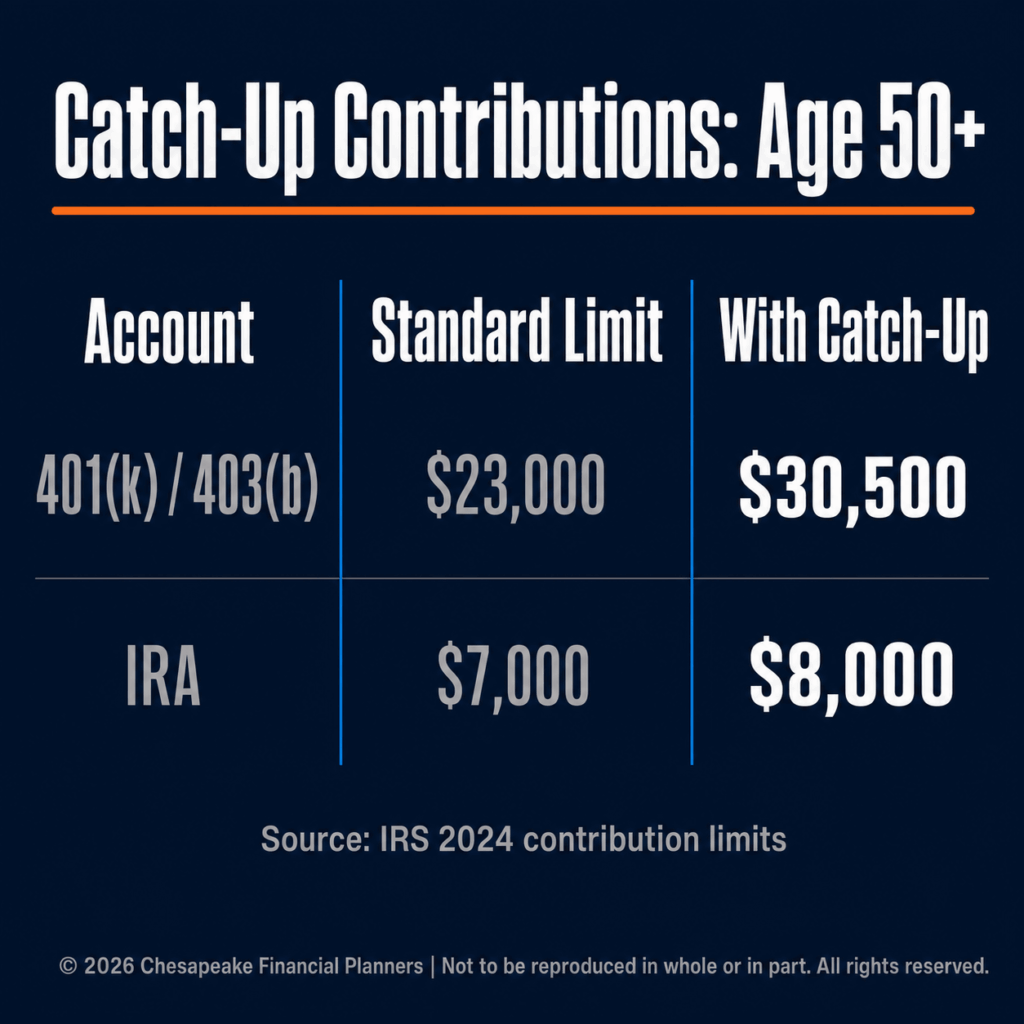
The single most powerful tool you have is the catch-up contribution. Once you turn 50, you can save well beyond the standard limits, and the numbers are meaningful.
| Account | Standard limit (2026) | Catch-up amount | Total you can contribute |
|---|---|---|---|
| 401(k)/403(b), ages 50-59 and 64+ | $24,500 | +$8,000 | $32,500 |
| 401(k)/403(b), ages 60-63 (SECURE 2.0) | $24,500 | +$11,250 | $35,750 |
| Traditional or Roth IRA, age 50+ | $7,500 | +$1,100 | $8,600 |
According to the IRS, 401(k) catch-up contributions begin the year you turn 50. SECURE 2.0 layers on an enhanced catch-up for ages 60 through 63, which is one of the most overlooked windows in retirement planning. If you max both a 401(k) and an IRA at age 50, you are setting aside $41,000 a year in tax-advantaged accounts. Do that for a decade with reasonable returns and you can build real savings even from a thin starting base.
If you cannot max out right away, raise your contribution percentage every time you get a raise. You will not feel it in your paycheck, but your balance will notice. These 401(k) catch-up contributions are the backbone of most realistic catch up retirement savings plans.
How can I close the retirement savings gap as a woman?
Where Should You Cut Spending to Free Up Cash?
When retirement is 10 to 15 years out, every dollar of fixed spending you cut is retirement security you buy. Skip the latte-shaming. Go after the big line items instead.
Housing is the largest. Downsizing now, rather than waiting until you retire, can free up equity you redirect straight into savings, and it lowers taxes, insurance, and upkeep at the same time. Vehicles are next. Many people drive more car than they need; trading down can save hundreds a month across payment, insurance, and maintenance. Then there is the slow leak of subscriptions and memberships that accumulate quietly and add up to thousands a year.
The hardest line item is often adult children. Jeff has had this conversation many times: you cannot borrow for retirement, but your kids can borrow for almost everything else. Supporting capable adult children at the expense of your own security is one of the most common and costly mistakes he sees. The goal is not deprivation. It is prioritization.
How do I know if I'm saving enough for retirement?
How Does Delaying Social Security Boost Your Income?
Delaying Social Security is one of the most effective ways to raise guaranteed, inflation-adjusted retirement income. Every year you wait past 62 increases your benefit, and the increases stop at age 70.
According to the Social Security Administration, if your full retirement age is 67, claiming at 62 permanently reduces your benefit by about 30%, while claiming at 70 increases it by 24% through delayed retirement credits. That spread between 62 and 70 is roughly 77%. For a woman planning retirement, this matters even more, because women tend to live longer and a larger lifetime benefit compounds over a longer retirement. Jeff Judge notes: "That 77-percentage-point spread between claiming at 62 versus 70 is one of the most consequential numbers in a retirement plan, and for women especially, who statistically face the longest retirements, choosing the smaller check early can mean real financial strain in their late 80s."
If you need to bridge the years between retiring and claiming, spend down other savings first and let the Social Security benefit grow. A bigger inflation-adjusted check for life is hard to beat. This is one of the core retirement savings strategies we model for clients, especially women, before they pull the trigger on a claiming date.
Should I Take Social Security at 62 or Wait Until 70?
Does Working a Few Extra Years Really Make a Difference?
Working even two or three extra years has an outsized effect, for three reasons that stack on top of each other. First, you are not withdrawing, so your accounts keep compounding. Second, you keep contributing, and those late contributions land at peak balances. Third, you shorten the retirement you have to fund. Retiring at 67 instead of 62 means your savings might need to last 20 years instead of 25.
You do not have to grind full-time to capture this. Many people shift to part-time work or consulting in their early 60s, earning enough to cover living costs while their retirement accounts keep growing untouched. That bridge income is part of building durable retirement income.
How do I create sustainable retirement income streams?
Frequently Asked Questions
How much can I put in my 401(k) at age 50 in 2026?
In 2026, you can contribute $24,500 to a 401(k) plus an $8,000 catch-up contribution if you are 50 or older, for a total of $32,500. If you are between 60 and 63, SECURE 2.0 allows an enhanced catch-up of $11,250, raising your total to $35,750. These limits apply per the IRS.
Is it too late to start saving for retirement in my 50s?
No, it is not too late to start saving in your 50s. This decade often combines peak earnings, falling expenses, and the highest contribution limits the IRS allows. By maxing catch-up contributions, trimming fixed costs, delaying Social Security, and working a few extra years, you can build meaningful retirement savings even from a low starting point.
How much does delaying Social Security increase my benefit?
Delaying Social Security raises your benefit by about 8% per year between full retirement age and age 70. If your full retirement age is 67, claiming at 62 cuts your benefit by roughly 30%, while waiting until 70 increases it by 24%. The difference between claiming at 62 and 70 is roughly 77% more monthly income.
Should I prioritize paying off debt or saving for retirement in my 50s?
Capture your full employer 401(k) match first, since that is an immediate guaranteed return you cannot replicate elsewhere. After the match, attack high-interest debt above roughly 6% before adding extra savings, because eliminating that interest is a guaranteed return. Lower-rate debt can run alongside aggressive retirement contributions.
What is the best way for women to catch up on retirement savings?
The best approach for women combines maxing catch-up contributions, delaying Social Security, and planning for a longer life expectancy. Because women tend to live longer and may have had career pauses, front-loading savings in peak earning years and maximizing a guaranteed, inflation-adjusted Social Security benefit are especially powerful retirement planning strategies.
Where to Go From Here
Catching up on retirement savings in your 50s is rarely about one heroic move. It is about pulling several levers at once: catch-up contributions, leaner fixed costs, a smarter Social Security claiming date, and a flexible work timeline.
Ready to See Your Own Levers?
Our Wealth Growth Roadmap for Women in Their 50s walks through catch-up contributions, spending, and claiming strategy together, so you can see how they interact instead of guessing.
Want to go deeper? Take the Wealth Growth Roadmap for Women in Their 50s to see where you stand.
Disclosures
The information provided is for educational purposes only and should not be construed as investment advice. Investment strategies should be tailored to individual circumstances, risk tolerance, and goals. Past performance doesn't guarantee future results. Consult with qualified financial professionals regarding your specific situation.
Advisors associated with Chesapeake Financial Planners may be either (1) LPL Financial Registered Representatives offering securities through LPL Financial, Member FINRA and SIPC, and investment advisor representatives offering investment advice through Great Valley Advisor Group; or (2) solely investment advisor representatives offering investment advice through Great Valley Advisor Group and not affiliated with LPL Financial. Great Valley Advisor Group, and Chesapeake Financial Planners are separate entities from LPL Financial.


