

What is a 403(b), and how is it different from a 401(k)?
Last reviewed: July 2026
A 403(b) is an employer-sponsored retirement plan for employees of public schools, hospitals, churches, and tax-exempt nonprofits. It works almost exactly like a 401(k): you contribute pre-tax or Roth dollars from your paycheck, your money grows tax-deferred, and many employers match part of what you save. The biggest difference is who offers it. A 401(k) comes from for-profit companies, while a 403(b) comes from the nonprofit and public-sector world.
If you work at a Baltimore hospital, a Harford County school district, or a local charity, your retirement plan is almost certainly a 403(b). The mechanics feel identical to a 401(k) on the surface, but a few rules underneath are different, and those differences can cost or save you real money.
Key Takeaways
- A 403(b) is the nonprofit and public-sector version of a 401(k), with nearly identical tax treatment and contribution mechanics.
- The 2026 employee contribution limit for a 403(b) is $24,500, the same as a 401(k).
- Workers age 50 and older can add an $8,000 catch-up contribution in 2026, and ages 60 to 63 can add $11,250.
- 403(b) plans offer a unique 15-year service catch-up that 401(k) plans do not have.
About the Author: Jeff Judge, CFP®, AEP®, ChFC®, CLU® is Managing Partner of Chesapeake Financial Planners in Forest Hill, Maryland. He has been helping families and business owners in Harford County and the Baltimore metro area navigate retirement plan decisions since earning his CFP® certification in 2013, by using Chesapeake Financial Planners’ signature process, the R.U.D.D.E.R. method™. Jeff sees a recurring pattern with hospital and nonprofit employees: they assume their 403(b) is somehow second-rate compared to a corporate 401(k), and they leave employer matching dollars on the table because of it.
What is a 403(b) plan and who can have one?
A 403(b) is a tax-advantaged retirement account available only to employees of specific types of organizations. The IRS limits these plans to public schools and universities, hospitals and healthcare systems, churches and religious organizations, and 501(c)(3) tax-exempt nonprofits. If your employer is a for-profit business, you cannot have a 403(b); you would have a 401(k) instead.
The plan is sometimes called a tax-sheltered annuity, or TSA, because the earliest versions were funded entirely with annuity contracts. That history matters. Many older 403(b) plans still default participants into high-cost annuity products instead of low-cost mutual funds. If you teach in a public school or work at a hospital, check what your plan actually holds. The label on the account tells you less than the investments inside it.
You contribute through payroll deduction, just like a 401(k). You choose a percentage of your salary, it comes out before you ever see it, and most plans let you pick between a traditional (pre-tax) and a Roth (after-tax) option. Your employer may match a portion of your contributions, though nonprofit matches tend to be smaller than what large corporations offer.
How is a 403(b) different from a 401(k)?
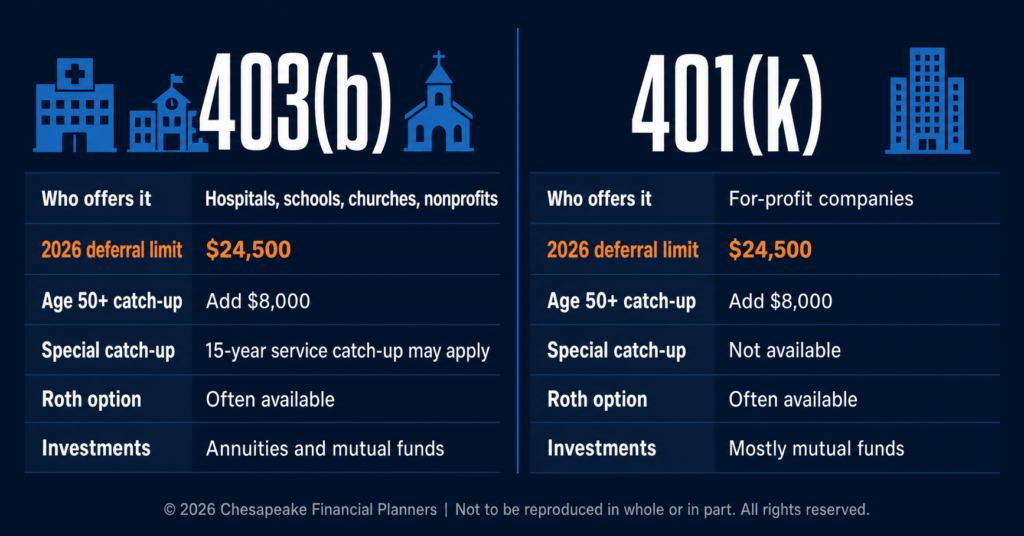
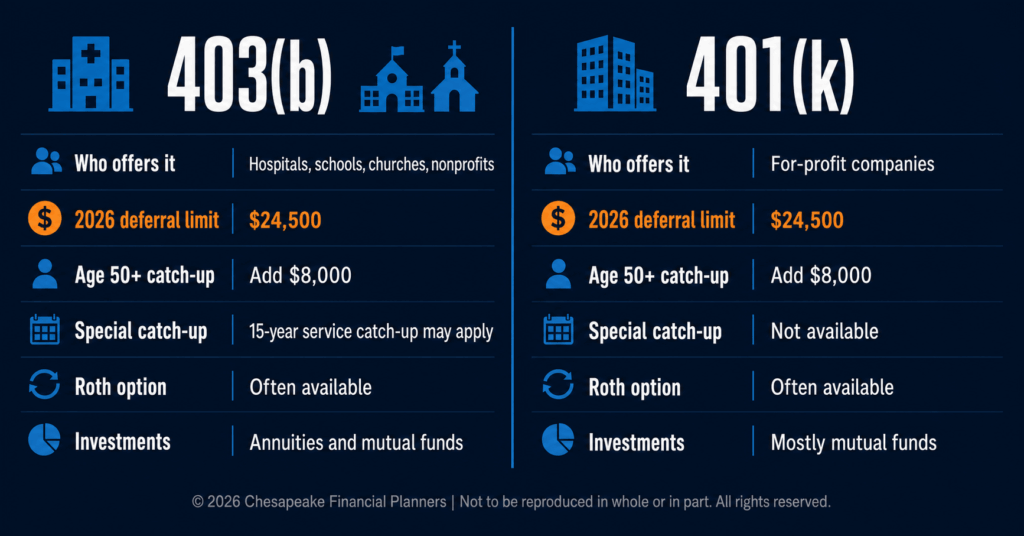
A 403(b) and a 401(k) share the same contribution limits, the same tax treatment, and the same early-withdrawal penalty rules. The differences come down to who sponsors the plan, what you can invest in, and a handful of special catch-up provisions. Here is a direct comparison.
| Feature | 403(b) | 401(k) |
|---|---|---|
| Who offers it | Nonprofits, hospitals, schools, churches | For-profit companies |
| 2026 employee limit | $24,500 | $24,500 |
| Age 50+ catch-up (2026) | $8,000 | $8,000 |
| Investment options | Often annuities and mutual funds | Usually mutual funds and ETFs |
| 15-year service catch-up | Available at qualifying employers | Not available |
| ERISA protection | Sometimes exempt (governmental, church plans) | Almost always covered |
Want to go deeper? Our Retirement Income Blueprint Workbook walks through this step by step.
According to the IRS, 403(b) plans sponsored by government or church employers may be exempt from ERISA, the federal law that sets fiduciary and reporting standards for retirement plans. That exemption is a double-edged sword. It can mean fewer protections and looser oversight of plan fees, which is one reason annuity costs in some 403(b) plans run high. Jeff Judge often tells clients who work at hospitals or school districts to request the plan's fee disclosure in writing before assuming the default investment is a good deal.
The other meaningful difference is investment selection. Because 403(b) plans grew out of the annuity world, many still steer participants toward insurance products with surrender charges and annual fees well above what a comparable index fund costs. A 401(k) at a large employer usually offers a cleaner menu of low-cost funds. If you have a choice between investment providers inside your 403(b), the lowest-fee option almost always wins over a 30-year horizon.
What are the 403(b) contribution limits and rules for 2026?
The 2026 employee contribution limit for a 403(b) is $24,500, matching the 401(k) limit set by the IRS. If you are age 50 or older, you can add a catch-up contribution of $8,000, bringing your personal maximum to $32,500. Under the SECURE 2.0 rules, workers ages 60 through 63 get an even larger catch-up of $11,250 in 2026, which raises their ceiling to $35,750.
Then there is the rule that makes 403(b) plans genuinely different. Employees with 15 or more years of service at the same qualifying organization may be eligible for an additional catch-up of up to $3,000 per year, capped at $15,000 over a lifetime. This 15-year service catch-up does not exist in the 401(k) world at all. It rewards long-tenured teachers, nurses, and nonprofit staff who tend to stay at one employer for decades. Not every plan offers it, and the math is technical, so confirm eligibility with your benefits office. Jeff Judge notes: "The 15-year service catch-up is one of the most overlooked provisions in the retirement savings code, and it was written specifically for the teachers and hospital employees who spend a career at one institution, so if you have been somewhere that long it is absolutely worth confirming whether your plan allows it."
Total contributions from you and your employer combined cannot exceed $72,000 in 2026, or 100 percent of your compensation, whichever is less. For most 403(b) participants, the employee deferral limit is the binding number, not the combined cap. The practical takeaway: capture every dollar of employer match first, then push your own contribution as high as your budget allows.
These figures are accurate as of 2026 and are adjusted by the IRS for inflation each year, so check the current limit before you set your payroll deduction for a new year.
Should you choose a Roth or traditional 403(b)?
Most 403(b) plans now offer both a traditional and a Roth option, and the choice comes down to when you want to pay taxes. A traditional 403(b) gives you a deduction today and taxes your withdrawals in retirement. A Roth 403(b) takes after-tax dollars now, but your withdrawals in retirement come out completely tax-free.
The general rule of thumb is straightforward. If you expect to be in a higher tax bracket in retirement than you are today, the Roth usually wins. If you expect a lower bracket later, traditional usually wins. Younger nurses, teachers, and nonprofit workers early in their careers often benefit from Roth contributions because their current bracket is relatively low and they have decades of tax-free growth ahead.
This is not a permanent decision. You can split your contributions between both buckets, and many of Jeff's clients do exactly that to hedge against uncertainty about future tax rates. For a deeper breakdown of how this trade-off works, see Should I Choose a Roth 401k or Traditional 401k?, which applies the same logic to 403(b) accounts.

What happens to your 403(b) when you leave the job?
When you leave a nonprofit or hospital employer, your 403(b) does not disappear, and you have four basic options. You can leave the money in the old plan, roll it into your new employer's plan, roll it into an IRA, or cash it out. Cashing out before age 59½ triggers ordinary income tax plus a 10 percent early-withdrawal penalty, so that option is rarely smart.
For most people changing jobs, a rollover to an IRA opens up a far wider menu of low-cost investments than a legacy 403(b) typically offers, especially if the old plan was annuity-heavy. That said, rolling into a new employer plan can make sense if the new plan has strong, cheap funds and you value the simplicity of one account. The right move depends on the fees and the funds, not on a generic rule. If you are weighing this decision, our guides on What should I do with my 401(k) when I change jobs? and Can I roll my old 401(k) into an IRA instead? walk through the same considerations that apply to a 403(b).
Frequently Asked Questions
Is a 403(b) better than a 401(k)?
Neither plan is inherently better, because both offer the same 2026 contribution limit of $24,500 and the same tax treatment. A 403(b) can be worse in practice if it defaults you into high-cost annuities, and better if it offers the 15-year service catch-up. The quality depends on the specific investments and fees inside your plan, not the plan type.
Can I have both a 403(b) and a 401(k)?
Yes, you can hold both a 403(b) and a 401(k) if you work two jobs that each offer one. However, your combined employee contributions across both plans cannot exceed the annual limit of $24,500 in 2026, plus any catch-up you qualify for. The IRS treats the deferral limit as a single shared ceiling across both account types.
How much can I contribute to a 403(b) in 2026?
You can contribute up to $24,500 to a 403(b) in 2026 as an employee. If you are age 50 or older, you can add an $8,000 catch-up for a total of $32,500, and workers ages 60 to 63 can add $11,250. Long-tenured employees may qualify for an additional 15-year service catch-up of up to $3,000 per year.
Are 403(b) withdrawals taxed?
Traditional 403(b) withdrawals are taxed as ordinary income when you take the money out in retirement. Roth 403(b) withdrawals are completely tax-free if you are at least 59½ and have held the account for five years. Withdrawals before age 59½ generally trigger ordinary income tax plus a 10 percent early-withdrawal penalty, with limited exceptions.
Do 403(b) plans have required minimum distributions?
Yes, traditional 403(b) plans require you to begin taking required minimum distributions, or RMDs, once you reach the IRS starting age, currently 73 for most people. Roth 403(b) accounts no longer require RMDs during the owner's lifetime under SECURE 2.0. Coordinating these withdrawals with your other income sources matters for keeping your tax bill manageable.
Bottom Line
A 403(b) is the nonprofit world's version of a 401(k), and for the teachers, nurses, and charity staff across Harford County and the Baltimore metro, it is the primary tool for building retirement security. The plan mechanics are nearly identical, but the fees, investment menu, and special catch-up rules are where the real decisions live. Get those right and a 403(b) is every bit as powerful as a corporate 401(k).
If you want to dig deeper into how your retirement savings fit into a full income plan, download our free retirement planning guide at chesapeakefp.com. It covers how to coordinate accounts like your 403(b) with Social Security and pension income so you keep more of what you have saved.
Disclosures
The information provided is for educational purposes only and should not be construed as investment advice. Investment strategies should be tailored to individual circumstances, risk tolerance, and goals. Past performance doesn't guarantee future results. Consult with qualified financial professionals regarding your specific situation.
CFP Board owns the marks CFP®, CERTIFIED FINANCIAL PLANNER®, and CFP® (with plaque design) in the U.S.
Certified Financial Planner Board of Standards Center for Financial Planning, Inc. owns and licenses the certification marks CFP®, CERTIFIED FINANCIAL PLANNER®, and CFP® (with plaque design) in the United States to Certified Financial Planner Board of Standards, Inc., which authorizes individuals who successfully complete the organization’s initial and ongoing certification requirements to use the certification marks.
A Roth IRA offers tax deferral on any earnings in the account. Qualified withdrawals of earnings from the account are tax-free. Withdrawals of earnings prior to age 59 ½ or prior to the account being opened for 5 years, whichever is later, may result in a 10% IRS penalty tax. Limitations and restrictions may apply.
Advisors associated with Chesapeake Financial Planners may be either (1) LPL Financial Registered Representatives offering securities through LPL Financial, Member FINRA and SIPC, and investment advisor representatives offering investment advice through Great Valley Advisor Group; or (2) solely investment advisor representatives offering investment advice through Great Valley Advisor Group and not affiliated with LPL Financial. Great Valley Advisor Group, and Chesapeake Financial Planners are separate entities from LPL Financial.


