
What Is a 457(b) Plan?
Last reviewed: July 2026
A 457(b) plan is a tax-advantaged retirement savings account offered to employees of state and local governments and certain tax-exempt organizations. You contribute pre-tax dollars from your paycheck, the money grows tax-deferred, and you pay ordinary income tax when you withdraw it in retirement. The biggest advantage that sets a 457(b) apart from a 401(k) or 403(b): there is no early withdrawal penalty once you separate from your employer, no matter your age.
Key Takeaways
- A 457(b) plan lets government and certain nonprofit employees defer income for retirement with pre-tax contributions and tax-deferred growth.
- The 2026 contribution limit is $24,500, with extra catch-up room for those age 50 and older.
- Unlike a 401(k), a 457(b) carries no 10% early withdrawal penalty once you leave your employer, regardless of age.
- A special "final three years" catch-up provision can let some savers nearly double their annual contributions before retirement.
About the Author: Jeff Judge, CFP®, AEP®, ChFC®, CLU® is Managing Partner of Chesapeake Financial Planners in Forest Hill, Maryland. He has been helping families and business owners in Harford County and the Baltimore metro area navigate retirement plan decisions since earning his CFP® certification in 2013, by using Chesapeake Financial Planners’ signature process, the R.U.D.D.E.R. method™. Jeff often finds that government employees overlook the 457(b)'s no-penalty withdrawal rule, which can be one of the most valuable early-retirement tools available to anyone.
How Does a 457(b) Plan Actually Work?
A 457(b) is a type of deferred compensation plan. You agree to set aside part of your salary before it ever hits your paycheck, and that money goes into an investment account you control. Because the contribution comes out pre-tax, it lowers your taxable income for the year. The balance grows without annual taxes on gains or dividends. You only owe tax when you take the money out.
The plan name comes from Section 457 of the Internal Revenue Code. There are two flavors. The "b" version is the one most public employees use, and it follows clear federal rules about contribution limits and withdrawals. The 457(b) is governmental when it covers state and local workers; a separate non-governmental version exists for some nonprofit executives, and that one comes with more restrictions.
Most plans give you a menu of mutual funds or target-date funds to choose from. You decide how aggressive or conservative to be based on your timeline and risk tolerance. The investment choices function much like a 401(k) lineup.
Who Can Contribute to a 457 Plan?
Eligibility for a governmental 457(b) is straightforward: you work for a state or local government entity that sponsors the plan. That includes teachers, firefighters, police officers, public university staff, city and county employees, and many transit and utility workers. According to the Bureau of Labor Statistics, a large share of state and local government workers have access to employer-sponsored retirement plans, and the 457(b) is a common offering.
Here is where it gets interesting. A 457(b) does not count against the contribution limit on a 401(k) or 403(b). If your employer offers both a 457(b) and a 403(b), which many school districts and public universities do, you can max out both plans in the same year. That effectively doubles how much you can shelter from taxes annually. Jeff Judge has watched public-sector clients leave this on the table for years simply because no one explained that the two limits stack.
What Are the 457(b) Contribution Limits for 2026?
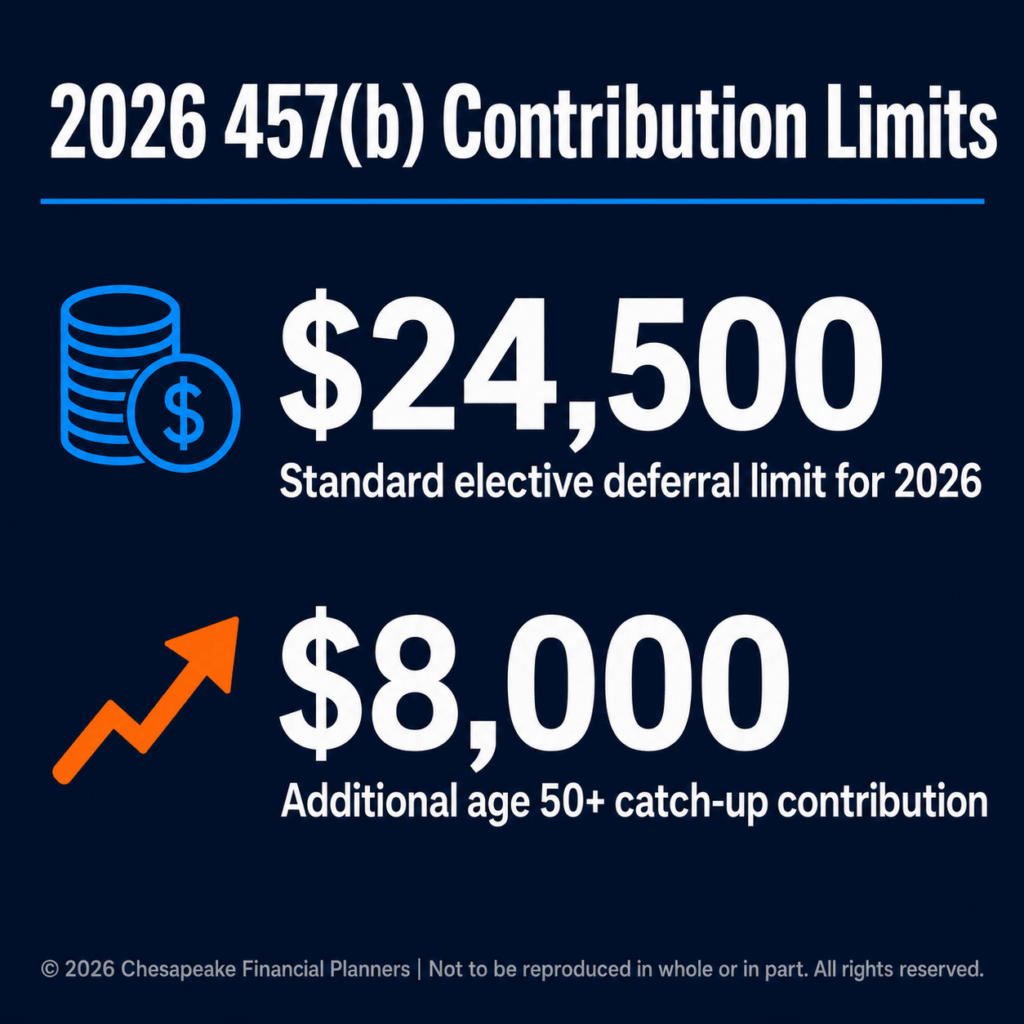
The standard contribution limit for a 457(b) in 2026 is $24,500, according to the IRS. If you are age 50 or older, you can add a catch-up contribution on top of that base amount, raising your total ceiling for the year.
The 457(b) has a second catch-up provision that no other plan offers, and it is genuinely powerful. In the three years before your plan's normal retirement age, you may be able to use a "special" catch-up that lets you contribute up to twice the annual limit, provided you have unused contribution room from prior years. You cannot use the age-50 catch-up and the special three-year catch-up in the same year; you take whichever produces the larger contribution.
| Feature | 457(b) | 401(k) |
|---|---|---|
| 2026 base limit | $24,500 | $24,500 |
| Age 50+ catch-up | Yes | Yes |
| Special 3-year catch-up | Yes | No |
| Early withdrawal penalty after separation | None | 10% before 59½ |
| Stacks with 403(b) limit | Yes | N/A |
The numbers above for the 457(b) are as of 2026. The standout column is the special three-year catch-up, which a 401(k) cannot match.
When Can You Withdraw From a 457(b) Plan?
You can withdraw from a governmental 457(b) without the 10% early withdrawal penalty as soon as you separate from your employer, regardless of your age. This is the feature that makes the plan so valuable for anyone considering early retirement. A 401(k) generally penalizes withdrawals before age 59½, but a 457(b) does not.
You still owe ordinary income tax on whatever you withdraw, because you never paid tax on the contributions going in. The penalty waiver is about avoiding the extra 10% hit, not about avoiding income tax altogether. If you retire at 55, you can begin drawing from a 457(b) right away without that penalty. For a firefighter or police officer who retires after 25 years of service in their early 50s, this can bridge the gap until other accounts become accessible. A thoughtful retirement income drawdown strategy accounts for exactly this kind of penalty-free access window.

How Does a 457(b) Compare to a 401(k) or 403(b)?
The mechanics are similar across all three: pre-tax contributions, tax-deferred growth, taxes due at withdrawal. The differences live in the details. A 457(b) skips the early withdrawal penalty after separation. It also offers the special three-year catch-up. The trade-off is that 457(b) plans historically offered fewer Roth options and sometimes narrower investment menus, though many plans have added a Roth 457(b) feature in recent years.
If you are a public employee weighing how to prioritize accounts, Jeff Judge uses Chesapeake Financial Planners' R.U.D.D.E.R. Method™, the firm's six-step planning process of Review and Recognize, Uncover and Understand, Design and Develop, Discuss and Decide, Execute and Empower, and Reassess and Refine, to map contributions against your tax bracket today versus your expected bracket in retirement. For some clients, filling the 457(b) first makes sense because of the penalty-free flexibility. For others, a Roth versus traditional decision drives the answer.
What Happens to Your 457(b) When You Change Jobs?
When you leave a job, you have several options for a governmental 457(b). You can leave the money where it is, roll it into a new employer's eligible plan, or roll it into an IRA. Be careful with one detail: rolling a 457(b) into an IRA can erase the no-penalty withdrawal advantage, because IRA distributions before 59½ generally trigger the 10% penalty. The FINRA guidance on retirement accounts is worth reviewing before you move any balances.
If early access matters to your plan, keeping the money in the 457(b) may be the smarter move even if an IRA offers more investment choices. This is exactly the kind of trade-off where a job change retirement decision deserves a careful second look before you act.
Frequently Asked Questions
What is a 457(b) plan in simple terms?
A 457(b) plan is a retirement savings account for government and some nonprofit employees that lets you set aside pre-tax money from your paycheck. The balance grows tax-deferred, and you pay ordinary income tax only when you withdraw the funds, typically in retirement.
Can you withdraw from a 457(b) before age 59½ without penalty?
Yes. A governmental 457(b) lets you withdraw funds without the 10% early withdrawal penalty once you separate from your employer, regardless of age. You still owe ordinary income tax on the distribution, but you avoid the penalty that applies to most 401(k) withdrawals before age 59½.
Can you contribute to both a 457(b) and a 403(b) in the same year?
Yes. The 457(b) contribution limit is separate from the 403(b) and 401(k) limits, so you can max out both plans in the same year if your employer offers them. For 2026, that means you could contribute the full $24,500 to each plan, sheltering far more income from taxes.
What is the special three-year catch-up for a 457(b)?
The special three-year catch-up lets you contribute up to twice the annual limit in the three years before your plan's normal retirement age, if you have unused contribution room from earlier years. You cannot combine it with the standard age-50 catch-up; you use whichever produces the larger contribution that year.
Is a 457(b) better than a 401(k)?
Neither is universally better; it depends on your situation. A 457(b) wins on penalty-free withdrawals after separation and the special three-year catch-up. A 401(k) often offers broader investment menus and more consistent Roth options. Many public employees benefit most by coordinating both kinds of accounts with a tax-aware plan.
What happens to a 457(b) if I roll it into an IRA?
Rolling a governmental 457(b) into an IRA usually erases the penalty-free withdrawal advantage, because IRA distributions before age 59½ generally trigger the 10% early withdrawal penalty. If early access matters to your retirement plan, keeping the money inside the 457(b) may be the smarter choice despite an IRA's wider investment options.
If you found this helpful and want a clearer picture of how a 457(b) fits alongside your pension, Social Security, and other savings, our retirement planning guides walk through the full picture. Download our free retirement readiness resources at chesapeakefp.com to see how a public-sector retirement strategy comes together for what is a 457b saver like you.
Want to go deeper? Our 10 Signs You're Ready for a Certified Financial Planner walks through this step by step.
Disclosures
The information provided is for educational purposes only and should not be construed as investment advice. Investment strategies should be tailored to individual circumstances, risk tolerance, and goals. Past performance doesn't guarantee future results. Consult with qualified financial professionals regarding your specific situation.
This information is not intended to be a substitute for specific individualized tax, investment or legal advice. We suggest that you discuss your specific situation with a qualified tax, legal or financial advisor.
Advisors associated with Chesapeake Financial Planners may be either (1) LPL Financial Registered Representatives offering securities through LPL Financial, Member FINRA and SIPC, and investment advisor representatives offering investment advice through Great Valley Advisor Group; or (2) solely investment advisor representatives offering investment advice through Great Valley Advisor Group and not affiliated with LPL Financial. Great Valley Advisor Group, and Chesapeake Financial Planners are separate entities from LPL Financial.


