

How Does Social Security Work for Retirement Benefits?
Last reviewed: July 2026
To understand how Social Security works, start here: Social Security pays a monthly retirement benefit based on your 35 highest-earning years, indexed for wage growth. You can claim as early as age 62, but each year you delay between 62 and 70 raises your monthly check, and the choice you make is largely permanent. For a worker with the maximum earnings history retiring at 70 in 2026, the maximum monthly Social Security benefit is $5,181. The same worker claiming at 62 would receive $2,969. That gap, roughly $2,200 per month for life, is why getting the social security claiming age right matters more than most people realize.
Key Takeaways
- The average Social Security retirement benefit in 2026 is $2,071 per month after the 2.8% cost-of-living adjustment.
- Your full retirement age is 67 for anyone born in 1960 or later, and between 66 and 66 and 10 months if earlier.
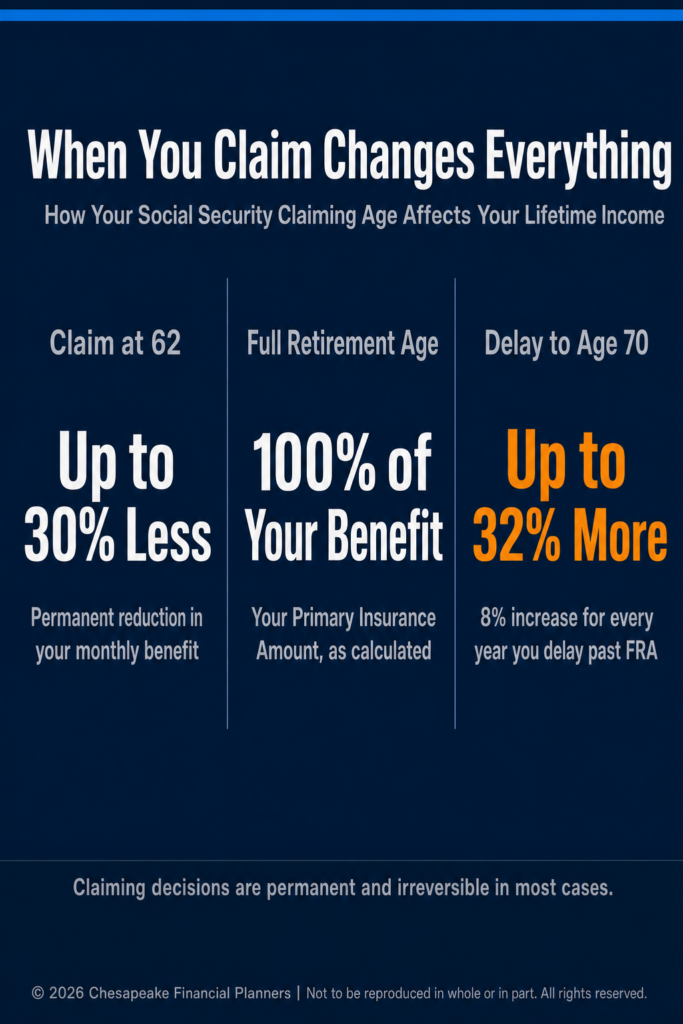
- Claiming at 62 reduces your benefit up to 30%; delaying past FRA adds 8% per year up to age 70.
- Up to 85% of your Social Security benefits can be subject to federal income tax, depending on your combined income.
About the Author: Jeff Judge, CFP®, AEP®, ChFC®, CLU® is Managing Partner of Chesapeake Financial Planners in Forest Hill, Maryland. He has been helping families and business owners in Harford County and the Baltimore metro area work through Social Security claiming decisions since earning his CFP® certification in 2013, by using Chesapeake Financial Planners’ signature process, the R.U.D.D.E.R. method™. Jeff sees this decision get rushed more often than any other in his practice; the age 62 check feels like a reward for decades of FICA contributions, but for a healthy worker still earning income, claiming early can mean leaving six figures on the table over a long retirement.
How Social Security Works: A Quick Overview
Social Security is a federal insurance program funded through Federal Insurance Contributions Act (FICA) payroll taxes. Workers pay 6.2% of wages up to the 2026 Social Security wage base of $184,500, and employers match that contribution. Self-employed workers pay both halves on Social Security earnings.
To qualify for retirement benefits, you need 40 work credits, which most workers earn in 10 years. The benefit you eventually receive is based on your 35 highest-earning years. Fewer than 35 years of covered earnings means missing years count as zero, lowering your benefit. Social Security also pays disability and survivor benefits, but this post focuses on the retirement portion.
How Are Social Security Benefits Calculated?
Your benefit calculation starts with your earnings history. The Social Security Administration indexes each year of your wages for wage growth, producing your Average Indexed Monthly Earnings (AIME). The AIME then runs through a progressive formula that yields your Primary Insurance Amount (PIA), the benefit you would receive if you claim at full retirement age.
Lower lifetime earners receive a higher replacement rate than higher earners under the PIA formula. For someone retiring at FRA in 2026, the maximum monthly benefit is $4,152, per SSA.
Once you have your PIA, the amount you actually receive depends on the age you claim. Claim before FRA, and the benefit is permanently reduced. Claim after, and it grows. SSA applies a 2.8% cost-of-living adjustment for 2026, which carries forward each year.
When Should You Claim Social Security Benefits?
You can claim as early as age 62 or as late as 70. The earlier you claim, the smaller each monthly check; the longer you wait, the larger each check. Here is how the 2026 numbers compare for a worker with the maximum earnings history:
| Claiming Age | 2026 Maximum Monthly Benefit | Change vs. FRA |
|---|---|---|
| 62 | $2,969 | About 28% less |
| 67 (FRA, born 1960+) | $4,152 | Baseline (100% of PIA) |
| 70 | $5,181 | About 25% more |
The right Social Security claiming age depends on health, family longevity, marital status, other retirement income, and whether you plan to keep working. If you claim before FRA and continue earning, Social Security withholds $1 in benefits for every $2 you earn above the 2026 earnings limit of $24,480, with a higher limit the year you reach FRA. After FRA there is no earnings test, and withheld benefits are recredited to your record.
In Jeff's experience, clients who get this right model two scenarios side by side: claim at FRA versus delay to 70, each projected through age 90. The break-even point usually lands in the late 70s or early 80s, so if you expect to live past then and can fund the gap from other accounts, delaying often comes out ahead. For couples, the higher earner's claiming age also sets the survivor benefit. See How do I coordinate all my retirement income sources to minimize taxes and maximize income? for a framework.
How Do Spousal and Survivor Social Security Benefits Work?
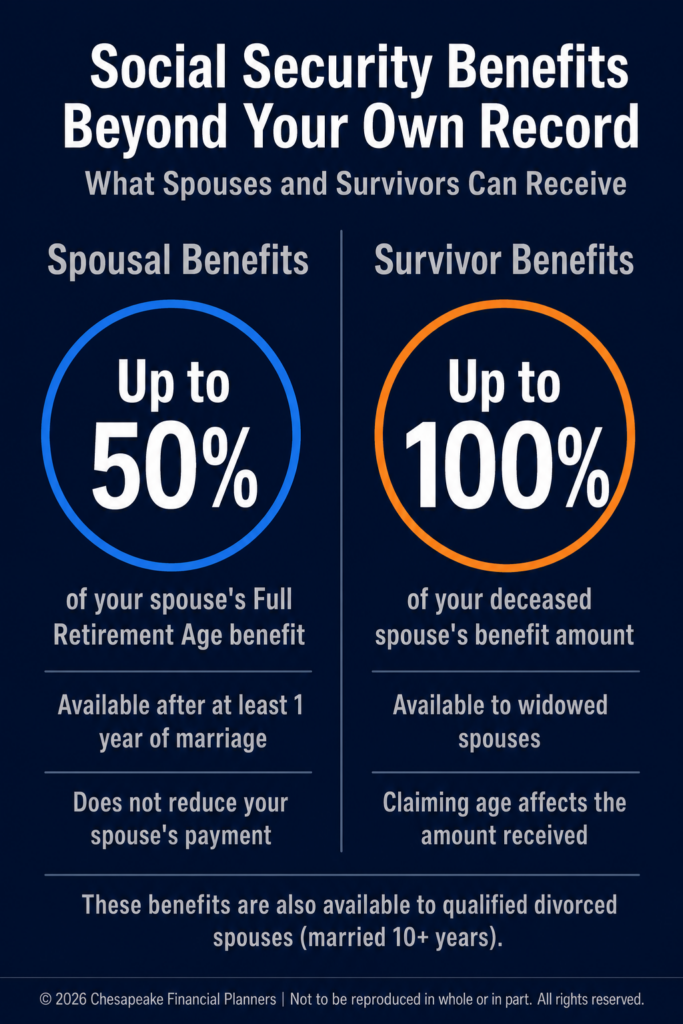
Social Security pays benefits beyond your own earnings record. A spouse may receive up to 50% of the higher earner's Primary Insurance Amount at FRA, even with little or no earnings history of their own. Claiming before FRA reduces spousal social security benefits, the same way early claiming reduces the worker's own benefit. The spousal payment does not reduce what the higher earner receives.
If your spouse passes away, survivor benefits can replace up to 100% of the deceased spouse's benefit amount, including any delayed retirement credits earned by claiming late. A surviving spouse can claim as early as age 60 (50 if disabled), with reductions for early claiming. Couples planning together often have the higher earner delay to age 70 partly to lock in a larger survivor benefit for whichever spouse lives longer.
Divorced spouses can qualify on an ex-spouse's record if the marriage lasted at least 10 years and both are at least 62. The ex-spouse does not need to be currently collecting, and the ex-spouse's own benefit is not affected.
How Are Social Security Benefits Taxed in Retirement?
Many retirees are surprised that Social Security taxes don't end when paychecks do; federal income tax can still apply to a portion of their benefits. Whether you owe tax depends on your combined income, defined as adjusted gross income (AGI) plus nontaxable interest plus half of your Social Security benefits.
If combined income falls between $25,000 and $34,000 (single) or $32,000 and $44,000 (married filing jointly), up to 50% of your benefits may be taxable. Above those upper thresholds, up to 85% can be subject to federal income tax. These thresholds have not been indexed for inflation since they were set in 1983 and 1993, so more retirees cross them each year. The IRS guidance on taxation of Social Security benefits walks through the calculation worksheet.
State treatment varies. Maryland exempts Social Security benefits from state income tax, which helps Forest Hill and Harford County retirees keep more of each check. Coordinating withdrawals from tax-deferred accounts, running Roth conversions before claiming, and timing capital gains can keep combined income below the higher threshold and reduce the share of benefits subject to federal tax. See Should I Do Roth Conversions Before I Retire? for a deeper look. Jeff Judge notes: "Because Maryland exempts Social Security from state tax, our clients in Harford County have a real opportunity to use Roth conversions strategically in the years before claiming so they never push their combined income above the 85 percent federal threshold."
Frequently Asked Questions
At what age can I start collecting Social Security?
You can start collecting Social Security retirement benefits as early as age 62, but claiming before your full retirement age reduces your monthly benefit by up to 30% for anyone born in 1960 or later. Full benefits begin at FRA (age 67 for that cohort), and benefits grow 8% per year for each year you delay past FRA up to age 70. The early claim is permanently reduced; the late claim is permanently larger.
How much does Social Security pay on average in 2026?
The average Social Security retirement benefit in January 2026 is $2,071 per month, reflecting the 2.8% cost-of-living adjustment. The maximum benefit at full retirement age in 2026 is $4,152 per month, and the maximum at age 70 is $5,181. Your actual benefit depends on your 35 highest-earning years and the age at which you claim. Social Security replaces about 40% of pre-retirement income for the average worker.
Is it better to claim Social Security at 62 or 67?
Claiming at 67, the full retirement age for anyone born in 1960 or later, almost always produces more lifetime income than claiming at 62 if you live past the break-even point in your late 70s. Early claiming reduces the maximum monthly benefit from $4,152 to $2,969 in 2026, and the reduction is permanent. Early claiming may make sense if you have shortened life expectancy, immediate income need, or no other resources to bridge the gap.
Can I work while collecting Social Security?
Yes, you can work while collecting Social Security, but if you claim before full retirement age and earn more than $24,480 in 2026, Social Security withholds $1 in benefits for every $2 you earn above the limit. A higher limit applies the year you reach FRA, and once you reach FRA there is no earnings test. Withheld benefits are recredited to your record after FRA, raising your monthly check.
Are Social Security benefits taxed?
Yes, Social Security benefits can be subject to federal income tax depending on your combined income, which is adjusted gross income plus nontaxable interest plus half of your benefits. Up to 50% of benefits become taxable when combined income exceeds $25,000 (single) or $32,000 (joint); up to 85% becomes taxable above $34,000 (single) or $44,000 (joint). Maryland does not tax Social Security at the state level.
Your Next Step
How Social Security works is one piece of a larger retirement income picture, and the claiming decision is often the largest dollar trade-off a household will make. If you want to see how different claiming ages affect your specific situation, the Chesapeake team can model break-even points, survivor benefits, and tax interactions for your household. Visit chesapeakefp.com to start the conversation. See also: What is the best retirement income planning strategy? and How Can Maryland Retirees Reduce Their State Tax Burden?.
Want to go deeper? Our Medicare and Social Security Guide walks through this step by step.
This material is for educational purposes only and should not be considered tax or legal advice. Please consult with your tax advisor or attorney regarding your specific situation.
Social Security regulations and benefit calculations are subject to change. For the most current information, visit SSA.gov or consult with a qualified financial advisor.
Disclosures
The information provided is for educational purposes only and should not be construed as investment advice. Investment strategies should be tailored to individual circumstances, risk tolerance, and goals. Past performance doesn't guarantee future results. Consult with qualified financial professionals regarding your specific situation.
Advisors associated with Chesapeake Financial Planners may be either (1) LPL Financial Registered Representatives offering securities through LPL Financial, Member FINRA and SIPC, and investment advisor representatives offering investment advice through Great Valley Advisor Group; or (2) solely investment advisor representatives offering investment advice through Great Valley Advisor Group and not affiliated with LPL Financial. Great Valley Advisor Group, and Chesapeake Financial Planners are separate entities from LPL Financial.


