

Published: | Last reviewed: November 2026 by Jeff Judge, CFP®
Part of our guide: How Are Financial Advisory Practices Valued for Sale?
What makes a financial advisory practice more valuable to a buyer comes down to how durable the revenue is. Planning-led client relationships, recurring advisory fees, and a healthy client age mix raise financial advisory practice value. Heavy concentration and a messy regulatory history lower it.
Key Takeaways
- Schwab Advisor Services, citing DeVoe & Company, reports more than 300 RIA deals closed in 2025, so buyers compare practices closely.
- Schwab's 2025 RIA Benchmarking Study found 41% of firms pursued M&A or other inorganic growth in 2024, so buyers are active.
- The FPA Journal notes that recurring revenue is worth much more than commission revenue from one-time transactions.
- Commonwealth lists revenue concentration, older clients, and regulatory matters among the factors buyers weigh.
About the Author: Jeff Judge, CFP®, AEP®, ChFC®, CLU® is Managing Partner of Chesapeake Financial Planners in Forest Hill, Maryland. He has been helping families and business owners in Harford County and the Baltimore metro area navigate business transitions and exit planning since earning his CFP® certification in 2013, by using Chesapeake's signature process, the R.U.D.D.E.R. Method™. "A buyer is not paying for your past year. A buyer is paying for how many of those relationships will still be there next year."
This post is buyer-neutral. Chesapeake Financial Planners acquires advisory practices, but the factors below are general market themes, not the firm's own criteria.
What Makes a Financial Advisory Practice More Valuable at the Relationship Level?
Every advisory practice buyer is pricing durability, and buyers pay for relationships that will outlast the founder. A planning-led relationship, meaning ongoing financial planning rather than investment-only service, gives a client several reasons to stay: a written plan, regular reviews, and an advisor who knows the household. Commonwealth lists the depth of client-advisor relationships among the determinants of advisory practice valuation, and it describes full financial planning as an opportunity in practices where clients have not yet experienced it.
Retention and tenure supply the evidence. Commonwealth points to retention rates and the average duration of client relationships as signals of a loyal client base, so keep those numbers on hand.
A repeatable process helps a buyer see that the relationship is not only the founder. Chesapeake Financial Planners' own process for clients shows what that looks like. The R.U.D.D.E.R. Method™ is Chesapeake Financial Planners' six-step planning process: Review and Recognize, Uncover and Understand, Design and Develop, Discuss and Decide, Execute and Empower, and Reassess and Refine. Jeff Judge often tells advisors that a buyer can tell within an hour whether a practice runs on a process or on one person's memory.
The FPA Journal also lists key person dependency among the value drivers that specialists adjust for, so documented service models, meeting notes, and a team that clients already know matter.
Does Recurring Advisory Fee Revenue Beat Commission Revenue?
Usually, yes, because it renews on its own. The FPA Journal states that "the value of recurring revenue is much higher compared to that of commission revenue from one-time transactions." Recurring advisory fees keep arriving without a new sale each year, so a buyer can plan around them. Commission income has to be earned again.
Does a commission-heavy practice sell for less?
Often it does, because a buyer has to underwrite income that restarts each year. Commonwealth notes that moving a practice from commission-based to fee-based can lay the groundwork for stronger long-term revenue streams. If you plan to sell, the mix of recurring advisory fees and transaction income is one of the first things a buyer will check.
| Factor | Why a buyer cares | What a seller can document |
|---|---|---|
| Planning-led relationships | Clients have reasons to stay | Written plans, review cadence, notes |
| Recurring advisory fees | Revenue renews without a new sale | Fee schedules and revenue by type |
| Client age mix | Shows attrition risk and future growth | Client age bands and household data |
| Concentration | One departure can change the numbers | Revenue and assets by client |
| Regulatory history | Signals risk and operating discipline | Form ADV and exam history |

How Do Client Age and Next-Generation Engagement Affect Value?
An aging client base is both a risk and an opportunity. Commonwealth says the age spread of clients can point to future asset growth or to attrition risk, especially as clients near retirement. A practice whose clients are mostly near or past retirement faces withdrawals and, eventually, estate transfers.
Next-generation engagement is the counterweight. When an advisor already knows the adult children and has a plan for the family's wealth transfer, a buyer sees assets that may stay in the practice after the parents. In Jeff's experience, advisors undervalue the small step of inviting heirs to a review meeting years before a sale. The invitation costs little, and it gives a buyer evidence that the relationship extends past one generation.
What Drags a Practice's Value Down?
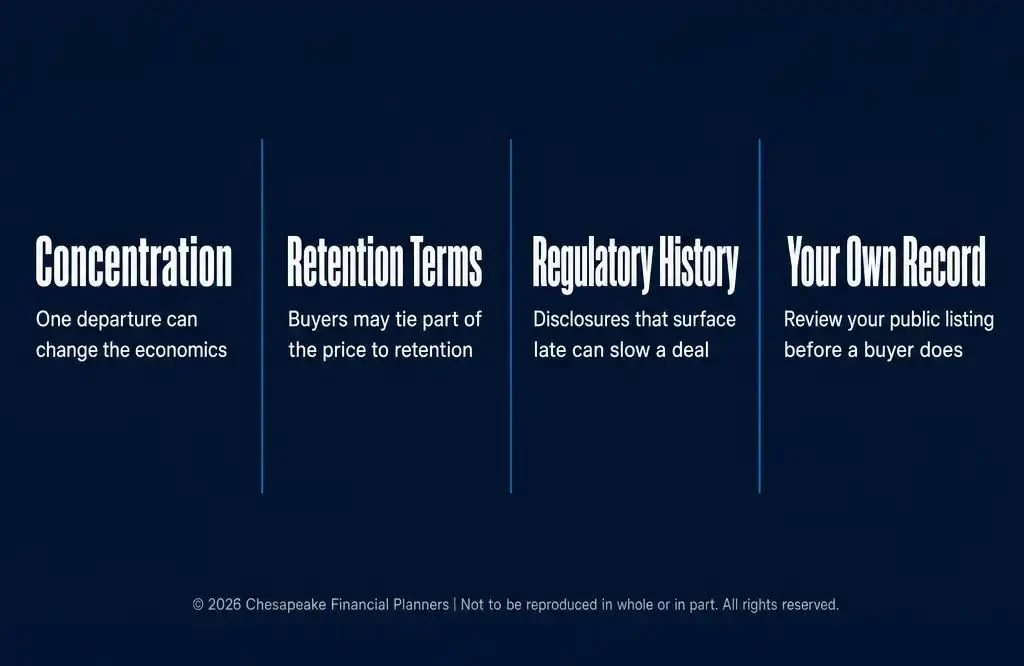
Two issues recur: concentration and compliance history. Commonwealth lists high concentration in assets or revenue streams among its deal breakers. If a few households produce a large share of revenue, one departure changes the economics, and a buyer will often ask for terms tied to retention, as our post on how practice sales are structured explains.
Regulatory history works the same way. Commonwealth lists compliance with regulatory requirements and any legal matters or risks among its determinants. A buyer will review the firm's records, and disclosures that surface late can slow a deal.
Where can a buyer check an adviser's regulatory history?
On the SEC's Investment Adviser Public Disclosure site. The SEC says Form ADV contains disclosure about certain disciplinary events involving the adviser and its key personnel, and that you can search a firm or individual representative and view that record. Review your own listing before a buyer does.
What Should a Seller Do Before Going to Market?
Treat your own practice the way a buyer will. Walk through these steps well before a sale:
- Split revenue into recurring advisory fees and transaction income.
- List revenue and assets by household to see concentration.
- Chart client ages and note which heirs you already know.
- Gather planning documents, review notes, and service models that show the relationship does not rest on you alone.
- Read your Form ADV and IAPD record as a buyer would.
Schwab's figures show an active market, with more than 300 deals in 2025 and 41% of firms pursuing M&A or other inorganic growth in 2024. Sellers who document these factors give buyers less to discount. Knowing what makes a financial advisory practice more valuable lets you fix gaps while you still have time, and a documented practice is easier for any buyer to price. For how to value a financial advisory practice, including RIA valuation methods, see How Are Financial Advisory Practices Valued for Sale? When you reach deal terms, read about payment structures and how the sale is taxed.
If you are weighing a sale, start with the valuation guide above, then read How Does Chesapeake Financial Planners Evaluate a Book of Business? for one buyer's published approach. Visit chesapeakefp.com to learn more.
Frequently Asked Questions
What makes a financial advisory practice more valuable to a buyer?
Durable revenue. Buyers pay more for planning-led client relationships, recurring advisory fees, and a client base that skews younger or includes engaged heirs. They pay less when revenue is concentrated in a few households or when regulatory history raises questions. Documentation lets a seller prove each factor.
Why do buyers prefer recurring advisory fees to commissions?
Recurring fees renew without a new sale, so a buyer can forecast them. The FPA Journal says recurring revenue is worth much more than commission revenue from one-time transactions. Commission income has to be earned again, which makes it harder for a buyer to underwrite.
Does client age affect the value of an advisory practice?
Yes. The age spread of clients signals attrition risk as clients near retirement and growth potential when younger clients or heirs are engaged. Buyers look at the age mix and at how well the advisor knows the next generation, so documenting those relationships supports value.
How does client concentration lower a practice's value?
Concentration makes revenue depend on a few relationships. If one large household leaves, the practice loses a meaningful share of income, so buyers discount for the risk or tie part of the price to retention. Spreading revenue across more households makes the practice easier to price.
Do buyers check an advisor's compliance history?
Yes. Form ADV discloses certain disciplinary events involving an adviser and its key personnel, and the SEC makes that information searchable on its IAPD site. Buyers also review the firm's records during diligence, so a seller should review and explain any disclosure before going to market.
Disclosures
The information provided is for educational purposes only and should not be construed as investment advice. Investment strategies should be tailored to individual circumstances, risk tolerance, and goals. Past performance doesn't guarantee future results. Consult with qualified financial professionals regarding your specific situation.
This information is not intended to be a substitute for specific individualized tax, investment or legal advice. We suggest that you discuss your specific situation with a qualified tax, legal or financial advisor.
Advisors associated with Chesapeake Financial Planners may be either (1) LPL Financial Registered Representatives offering securities through LPL Financial, Member FINRA and SIPC, and investment advisor representatives offering investment advice through Great Valley Advisor Group; or (2) solely investment advisor representatives offering investment advice through Great Valley Advisor Group and not affiliated with LPL Financial. Great Valley Advisor Group, and Chesapeake Financial Planners are separate entities from LPL Financial.
Chesapeake Financial Planners | 2402 Scotlon Ct, Forest Hill, MD 21050 | (410) 652-7868 | www.chesapeakefp.com
© 2026 Chesapeake Financial Planners | Not to be reproduced in whole or in part. All rights reserved.


