

How Does Chesapeake Financial Planners Evaluate a Book of Business?
Last reviewed: July 2026
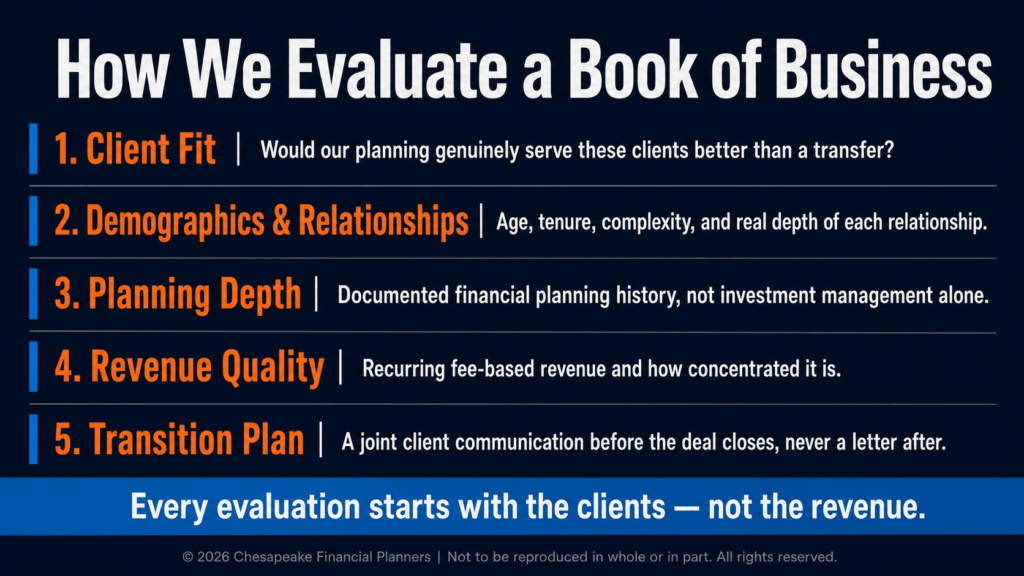
Chesapeake Financial Planners evaluates a book of business by starting with the clients, not the revenue. The firm asks one question before any financial number enters the conversation: would our planning approach actually serve these clients well? Only when the answer is yes does the review move to demographics, planning depth, revenue quality, operational readiness, and the transition plan. For a retiring advisor in Maryland weighing who should inherit a lifetime of client relationships, that order matters more than the multiple.
Not every book of business is worth buying. That sounds obvious, but deal flow for advisory practices has climbed to record levels, and the pressure to grow through acquisition pushes buyers toward deals that look clean on a spreadsheet yet fall apart in practice. Filtering carefully is the entire job.
On This Page
- Key Takeaways
- Why Chesapeake Evaluates Client Fit Before Revenue
- How Does Chesapeake Assess Client Demographics and Relationship Quality?
- How Does Chesapeake Evaluate Planning Depth and Philosophy Alignment?
- How Does Chesapeake Review Revenue Quality and Fee Structure?
- How Does Chesapeake Assess Operational Readiness for Integration?
- How Does the Transition Communication Plan Work?
- What This Means If You Are a Retiring Advisor in Maryland
- Frequently Asked Questions
- Considering a Transition for Your Own Book?
- Disclosures
Key Takeaways
- Chesapeake evaluates a book of business by client fit first, then planning depth, revenue quality, operations, and the transition plan.
- According to the SEC, registered investment advisers managed roughly $144.6 trillion in assets as of 2024 reporting.
- Roughly 37% of financial advisors are expected to retire over the next decade, controlling a large share of industry assets.
- Fee-based recurring revenue transfers more reliably than commission or one-time revenue, which shapes how a practice is valued.
- The strongest transitions in Harford County start with a joint client communication before the deal closes, not a letter after.
About the Author: Jeff Judge, CFP®, AEP®, ChFC®, CLU® is Managing Partner of Chesapeake Financial Planners in Forest Hill, Maryland. He has been helping families and business owners in Harford County and the Baltimore metro area navigate practice transitions and acquisitions since earning his CFP® certification in 2013, by using Chesapeake Financial Planners’ signature process, the R.U.D.D.E.R. method™. Jeff will tell you the deals he passes on teach him more than the ones he closes, because most books that come to market fail the very first test: the clients were never given real planning to begin with.
Why Chesapeake Evaluates Client Fit Before Revenue
To buy a book of business in financial planning in Maryland the right way, you have to be willing to walk away from most of them. Chesapeake Financial Planners leads every acquisition review with client fit because a transferred client who feels abandoned does not stay, and a client who does not stay was never an asset in the first place. The revenue on the offering memorandum is only as durable as the relationships underneath it.
The market context makes the discipline necessary. According to the SEC's Investment Adviser statistics, registered investment advisers in the United States collectively managed roughly $144.6 trillion in assets as of 2024 reporting, across more than 15,000 firms. That is an enormous, active, and competitive market, and competitive markets overprice the wrong things. Practices with thin planning and high advisor-dependent loyalty often carry the same headline multiple as practices with documented, durable client relationships. They should not.
What does "client fit" actually mean in an acquisition?
Client fit means the people in the book would be measurably better served by Chesapeake's planning process than by a generic account transfer. Jeff Judge puts it plainly: "We don't acquire books of business because they're available. We do it when we find an advisor whose clients deserve the kind of continuity and care that we can actually deliver. That's a much shorter list than you might think." A clean fit means the firm can step in and improve the client experience on day one. A poor fit means the firm would be inheriting a service gap it cannot close fast enough to keep people from leaving.
This is also where the R.U.D.D.E.R. Method™ enters the picture. The R.U.D.D.E.R. Method™ is Chesapeake Financial Planners' six-step planning process: Review and Recognize, Uncover and Understand, Design and Develop, Discuss and Decide, Execute and Empower, and Reassess and Refine. An acquisition only works when the acquired clients can be folded into that process without feeling like they have been handed off to strangers. If you want the broader context on why this matters to clients, see What Is a Succession Plan for a Financial Advisor?.
How Does Chesapeake Assess Client Demographics and Relationship Quality?
Chesapeake assesses client demographics by looking at age, planning complexity, tenure, and the depth of the existing advisory relationship, because those four factors predict whether clients will stay and whether they can be served well. A book is not a number of accounts. It is a collection of human relationships with very different levels of trust and very different planning needs.
An 80-client book where 60 clients have been with the advisor for more than 15 years tells a completely different story than a 200-client book with average tenure under three years. Long-tenured clients are usually more loyal and more complex at the same time. They have estate documents, business interests, and family dynamics that a three-year client rarely has. They require genuine continuity of service, not a welcome email and a new account number.
Why does client age matter in a practice acquisition?
Client age matters because it predicts the planning work ahead and the revenue runway behind it. A book concentrated in clients aged 75 and older is in the distribution and estate-settlement phase, which means meaningful planning work but a shrinking asset base over time. A book weighted toward clients in their 50s and early 60s is approaching the most planning-intensive years of their lives, which is exactly where Chesapeake adds the most value. The advisor population itself skews older, which is why so many books are coming to market at all. McKinsey research estimates that roughly 37% of financial advisors are expected to retire within the next decade. That wave is the supply side of the entire acquisition market.
Relationship quality is the hardest factor to fake. Jeff has watched advisors present books where the headline revenue looked strong, but a closer look showed clients who had not had a substantive planning meeting in years. Those clients are not loyal. They are inert, and inert clients leave the moment a competitor calls. Chesapeake separates genuine relationship depth from the appearance of it before it considers a single dollar of revenue. For the local context of who these clients tend to be, many Harford County books are weighted toward business owners, which connects directly to How do business owners plan for retirement differently?.
How Does Chesapeake Evaluate Planning Depth and Philosophy Alignment?
Chesapeake evaluates planning depth by determining whether the book's clients have received real, documented financial planning or whether they have only been investment-managed with a portfolio and little else. This is the dividing line that shapes the entire integration, because the two groups require completely different onboarding once they become Chesapeake clients.
This is not about software or shared terminology. Two advisors can use the same planning platform and deliver wildly different depth. The question is whether the clients arrive with a multi-year planning history that Chesapeake can build on, or whether they arrive having never had a real plan beyond their statement balance. Both groups can be served well. They cannot be served the same way.
What happens when a book has shallow planning history?
When a book has shallow planning history, Chesapeake treats every transferred client as a brand-new planning engagement rather than a continuation. That is more work, and it changes the deal economics, but it is not a disqualifier on its own. In fact, a book of purely investment-managed clients can be a genuine opportunity, because the planning gap is exactly what Chesapeake fills. The risk is mispricing it. Paying a planning-practice multiple for an investment-only book overpays for value that does not exist yet. The firm prices the planning gap honestly rather than pretending it is not there.
Philosophy alignment is the softer half of this test, and it is where Jeff's experience does the heavy lifting. An advisor who built a practice around chasing product commissions has trained clients to expect a certain kind of relationship, and unwinding that expectation takes patience. An advisor who built around comprehensive planning has done much of Chesapeake's work in advance. The closer the selling advisor's philosophy sits to Chesapeake's planning-first approach, the smoother the transition and the higher the client retention. For sellers thinking through these tradeoffs from their own side, How Are Financial Advisory Practices Valued for Sale? covers the valuation mechanics in depth.
How Does Chesapeake Review Revenue Quality and Fee Structure?
Chesapeake reviews revenue quality by examining how the revenue is generated, how concentrated it is, and how reliably it recurs, because not all revenue transfers at the same rate. The financial review follows the relationship review for a reason: a high revenue number attached to fragile relationships is worth less than a modest revenue number attached to durable ones.
The firm looks at three things specifically, and the differences between them are large enough to swing a valuation by a wide margin.
| Revenue Factor | What Chesapeake Looks For | Why It Matters |
|---|---|---|
| Fee structure | Share of revenue that is fee-based versus commission-based | Fee-based revenue transfers more reliably and recurs predictably |
| Revenue concentration | Share of revenue from the top 10 clients | High concentration is a risk if loyalty was tied to the individual advisor |
| Revenue type | Recurring advisory and planning fees versus one-time engagements | Recurring AUM and planning fees are far more predictable than one-time commissions |
Why does recurring revenue command a higher value?
Recurring revenue commands a higher value because it survives the transition. Ongoing advisory fees and planning retainers keep arriving month after month regardless of whether a new product is sold, which makes the future cash flow predictable and the practice financeable. One-time planning engagements and insurance commissions, by contrast, evaporate once the original sale is complete. A book that looks identical to another in total revenue can be worth substantially more or less depending entirely on how much of that revenue recurs.
Revenue concentration is the quiet risk that catches inexperienced buyers. If 60% of a practice's revenue comes from its top 10 clients, and those clients chose the practice because they trusted one specific advisor who is now leaving, the buyer is exposed. Lose two of those relationships and the economics of the deal collapse. Jeff weighs concentration heavily, because concentration plus advisor-dependent loyalty is the single most common way a promising acquisition turns into a loss. For business owners on the other side of a sale who want to understand how their own proceeds get deployed, How do I invest the proceeds from selling my business? walks through the reinvestment side of the same coin.
How Does Chesapeake Assess Operational Readiness for Integration?
Chesapeake assesses operational readiness by reviewing the practice's client records, compliance history, technology, and staffing before any deal closes, because a book of business never arrives clean. It arrives with documentation of varying quality, a compliance trail, and sometimes employees whose futures are part of the transaction.
The operational review is where a deal that passed the relationship and revenue tests can still fall apart. A practice with strong client relationships but chaotic, incomplete records forces months of reconstruction work, and during that work clients feel the friction. Friction during a transition is how attrition starts.
What does Chesapeake check during operational due diligence?
During operational due diligence, Chesapeake checks four areas in detail:
- CRM and client documentation. Are client records thorough, current, and portable to Chesapeake's technology environment? Sparse records mean the firm is rebuilding client knowledge from scratch, which slows everything and raises the risk that something important gets missed.
- Compliance history. BrokerCheck records are reviewed for both the selling advisor and the practice. FINRA operates BrokerCheck as a free public tool, and a clean disclosure history is non-negotiable. Disclosure events do not automatically end a conversation, but they require explanation and they shape the structure.
- Technology compatibility. How easily does the practice's existing technology map to Chesapeake's stack? Incompatible systems create migration cost and data-loss risk.
- Staff considerations. If the practice has administrative staff or associate advisors, what is the expectation around employment continuity? Good staff can be a meaningful asset in a transition; uncertainty about their future can destabilize it.
Jeff treats documentation quality as a proxy for how the selling advisor actually ran the practice. An advisor whose records are meticulous usually ran a meticulous planning relationship, and that consistency tends to predict client loyalty. An advisor whose records are thin often ran thin relationships, no matter how the revenue looks. The records tell the truth the pitch deck does not. Sellers preparing their own practice for this kind of scrutiny will recognize the parallels in When should I start valuing my business for a future sale?.

How Does the Transition Communication Plan Work?
Chesapeake builds the transition communication plan before the deal closes, not after, because how clients first hear about the change is the single largest driver of whether they stay. The firm requires, where possible, a joint communication to clients from both the selling advisor and Chesapeake before the transaction is final, so that clients hear about the change from someone they already trust, with context that explains why Chesapeake was chosen and what continuity looks like.
This is the step that separates an acquisition built around clients from one built around the seller's payday. A letter sent after the fact tells clients a decision was made about them without them. That approach benefits the seller, who has already been paid, and harms everyone else, because it produces exactly the attrition that destroys the value the buyer just purchased.
Why does the communication sequence matter so much?
The communication sequence matters because trust transfers through people, not paperwork. When a long-trusted advisor sits beside the new advisor and says, in effect, "I chose these people to take care of you, and here is why," the client's trust travels across the introduction. When clients instead discover the change through a form letter, the trust does not transfer; it evaporates. Chesapeake structures the overlap period specifically so these introductions can happen in person or by call, client by client where the relationships warrant it.
Advisors who plan to notify clients by letter after closing are not practices Chesapeake pursues. That is not a judgment about the advisor's character. It is a practical recognition that the deal will not perform. Jeff has seen books lose a quarter of their clients inside a year purely because the handoff was handled as a transaction instead of a relationship. The communication plan is cheap insurance against the most expensive mistake in the entire process. For business owners thinking about how to communicate a transition to their own employees and stakeholders, the same principles appear in Should I tell my employees I'm selling the business?.
What This Means If You Are a Retiring Advisor in Maryland
If you are an advisor approaching retirement in Maryland and you are thinking about what your clients deserve in a transition, the most useful thing to know about Chesapeake Financial Planners is that the conversation starts with your clients, not with your deal. Based in Forest Hill and serving Harford County, Bel Air, and the broader Baltimore metro area, Chesapeake has built its acquisition approach around a single belief: a book of business is a set of obligations to real people, and those obligations should be honored, not just transferred.
Chesapeake is not the right home for every book. The firm passes on more practices than it pursues, and it does so on purpose. But for advisors whose clients have received genuine planning and who want continuity that protects those relationships, the firm offers a transition built around care rather than speed. The local connection is part of that. Clients in Harford County tend to value an advisor they can actually sit across from, and Chesapeake's physical presence in Forest Hill means those relationships stay grounded in the community where they began. Jeff Judge notes: "We pass on acquisitions where the fit isn't right because taking on a book out of opportunity rather than genuine alignment is exactly the kind of move that ultimately lets those clients down, and that's not a trade we're willing to make."
Jeff's view, after years of these conversations, is simple. The advisors who do this well are the ones who started thinking about their clients' next chapter long before they thought about their own exit. If that describes you, the planning is worth starting now rather than later. For a broader look at how exits get structured, What are my options for exiting my business besides selling outright? lays out the alternatives, and When Should I Start Planning My Business Exit Strategy? shows why early planning consistently produces better outcomes.

Frequently Asked Questions
What size books of business does Chesapeake Financial Planners consider?
Chesapeake evaluates practices across a range of sizes, with primary interest in books where planning depth and client relationship quality meet a defined threshold rather than a revenue minimum. A smaller book of well-planned, loyal clients often fits better than a large book of advisor-dependent accounts. Revenue size alone never determines fit at the firm.
How long does the Chesapeake acquisition process take?
The Chesapeake acquisition process typically takes three to six months from the initial conversation to close. Transitions where the selling advisor wants a longer overlap or a more structured handoff can extend beyond that window. The firm prioritizes a clean, client-protective transition over speed, so the timeline flexes to fit the relationships involved rather than a fixed deadline.
Does the selling advisor have to stay on during the transition in Maryland?
Chesapeake prefers a defined overlap period, typically six to twelve months, where the selling advisor remains available for client introductions and relationship context. This overlap is built into the deal structure for most Maryland transitions because it is the mechanism that transfers client trust. A full clean break is possible but generally produces higher attrition, so the firm structures around continuity wherever the relationships allow.
What happens to clients who do not want to transfer to Chesapeake?
Clients always retain the right to move their accounts elsewhere, and clients who choose not to transfer to Chesapeake are free to do so without obstacle. The firm's goal is a high-quality, voluntary transition rather than a forced one. A transition that has to be coerced was never going to last, so Chesapeake measures success by the clients who choose to stay, not the ones it can hold.
How does Chesapeake value a book of business in Harford County?
Chesapeake values a book of business by weighing recurring fee-based revenue, client relationship quality, planning depth, revenue concentration, and operational readiness together rather than applying a single multiple. A Harford County practice with durable, well-documented relationships and predictable recurring revenue earns a stronger value than a larger practice with fragile, advisor-dependent loyalty. The relationships drive the number more than the headline revenue does.
Is buying a book of business in financial planning common in Maryland?
Buying a book of business in financial planning is increasingly common in Maryland and nationally, driven by an aging advisor population. McKinsey estimates roughly 37% of financial advisors will retire over the next decade, which is creating a steady supply of practices seeking succession. That demographic wave makes disciplined evaluation more important, because rising deal volume tends to pull less-prepared buyers toward overpriced or poor-fit acquisitions.
What is the first thing Chesapeake reviews in a potential acquisition?
The first thing Chesapeake reviews is client fit: whether the firm's planning approach would genuinely serve the book's clients better than a simple account transfer would. Only after that question is answered does the review move to demographics, planning depth, revenue, operations, and the transition plan. Starting with the clients keeps the firm from overpaying for revenue that the underlying relationships cannot actually support.
Considering a Transition for Your Own Book?
If you found this helpful, Chesapeake Financial Planners has built a planning library for advisors and business owners thinking through succession, valuation, and exit. Our guide on practice transitions covers what a client-first handoff actually looks like and how to prepare your book years before you need to. Download it at chesapeakefp.com to start mapping your own next chapter.
Jeff Judge is the only advisor with Chesapeake Financial Planners who holds the CFP® designation.
Want to go deeper? Our 10 Signs You're Ready for a Certified Financial Planner walks through this step by step.
Disclosures
The information provided is for educational purposes only and should not be construed as investment advice. Investment strategies should be tailored to individual circumstances, risk tolerance, and goals. Past performance doesn't guarantee future results. Consult with qualified financial professionals regarding your specific situation.
Advisors associated with Chesapeake Financial Planners may be either (1) LPL Financial Registered Representatives offering securities through LPL Financial, Member FINRA and SIPC, and investment advisor representatives offering investment advice through Great Valley Advisor Group; or (2) solely investment advisor representatives offering investment advice through Great Valley Advisor Group and not affiliated with LPL Financial. Great Valley Advisor Group, and Chesapeake Financial Planners are separate entities from LPL Financial.


