
How do I protect my financial independence long-term as a woman?
Last reviewed: July 2026
To protect financial independence for women over the long term, build multiple income streams, keep retirement accounts funded through career interruptions, maintain a 6-to-12-month emergency fund in your own name, and understand exactly how Social Security treats your earnings history. The goal is simple: enough resources and knowledge to stay secure no matter what life delivers. Women face longer retirements, more career breaks, and a higher likelihood of managing money alone, so the margin for guessing is thin.
Key Takeaways
- Women retiring at 65 in 2026 can expect to live to roughly 86.6 years, funding retirements that often span three decades.
- The 2026 401(k) contribution limit lets you fund retirement aggressively during peak earning years to offset future gaps.
- Keep 6 to 12 months of expenses in accessible savings, not stocks, so a market drop never forces a fire sale.
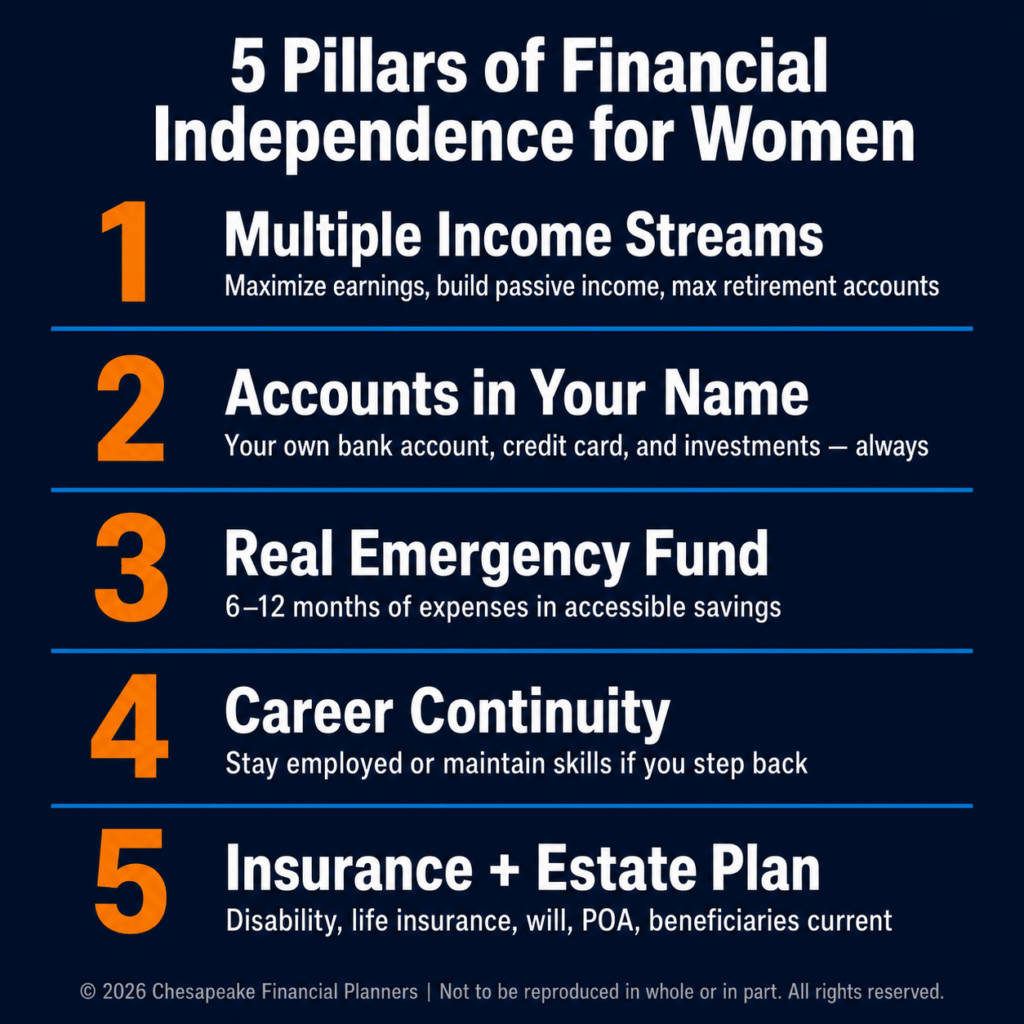
- Maintain accounts and credit in your own name to guarantee immediate access if a partner dies or a marriage ends.
About the Author: Jeff Judge, CFP®, AEP®, ChFC®, CLU® is Managing Partner of Chesapeake Financial Planners in Forest Hill, Maryland. He has been helping families and business owners in Harford County and the Baltimore metro area navigate retirement income and financial independence planning since earning his CFP® certification in 2013, by using Chesapeake Financial Planners’ signature process, the R.U.D.D.E.R. method™. Jeff has watched too many capable women end up at a financial disadvantage not because they earned too little, but because they handed off the knowledge of how their own money worked.
Why Financial Independence Looks Different for Women
Financial independence for women carries higher stakes because the structural realities make financial vulnerability both more likely and more expensive. Three forces drive the gap, and each one compounds the others.
Longer life expectancy is the first. According to the Social Security Administration, a woman reaching 65 in 2026 can expect to live to roughly 86.6 years, meaning retirement savings may need to stretch across 25 to 30 years. A retirement shortfall that looks manageable over 15 years becomes a serious problem when it has to last twice as long.
Career interruptions are the second. Time away from paid work to raise children or care for aging parents reduces the 35 highest-earning years that Social Security uses to calculate your benefit. It also stops retirement contributions during the exact years compound growth does the most work. The U.S. Census Bureau has documented how caregiving responsibilities fall disproportionately on women, with measurable effects on lifetime earnings.
The pay gap is the third. The U.S. Bureau of Labor Statistics reports women working full time earned about 83.6% of men's median weekly earnings in recent data, with wider gaps for women of color. Less income means less room to save aggressively and a thinner cushion when something breaks.
Jeff Judge often tells clients that financial independence is not about refusing partnership or never needing help. It is about having the resources and the knowledge to stay secure regardless of what arrives, planned or not.

How to Build Income Streams That Survive a Career Break
Real financial independence for women rarely comes from one paycheck. Diversifying how money flows in builds resilience for the years when one source stops, and at least one source usually does.
Start by treating your career as the engine. Negotiate compensation deliberately, pursue raises and promotions, and move strategically when pay stalls. Your earning years fund everything downstream, so protecting earning power is foundational, not selfish.
Build retirement accounts as aggressively as your cash flow allows. The IRS set the 2026 employee 401(k) contribution limit at $24,500, with an additional catch-up contribution for those age 50 and older. If you are self-employed, a SEP-IRA or solo 401(k) allows far higher limits. These accounts are how you pay yourself when active earning ends.
Add passive or semi-passive income where it fits. Dividend-paying investments, rental income, or revenue from a business that does not demand your constant presence all create stability when you cannot or do not want to work full time. For a fuller treatment of layering these together, see our guide on How Do I Create Multiple Income Streams for Retirement?.
Finally, invest in skills that stay valuable. Certifications, education, and a maintained professional network protect your ability to re-enter the workforce after a break. The longer you are out, the harder and lower-paid re-entry becomes, so keeping a foot in the door matters more than most people expect.
How to Keep Financial Autonomy Inside a Partnership
Financial independence for women does not require staying single or splitting every account. It requires specific habits that protect your long-term security even inside a strong marriage.
Maintain full visibility into household finances. Even if your partner handles bills or investments, you should understand income, balances, debts, insurance, and the estate plan. Never outsource financial knowledge so completely that you would be lost if suddenly solely responsible. This matters because the American Bar Association and household-finance research consistently show that the partner left out of decisions is the one most exposed when a relationship ends.
Keep some money and credit in your own name. A bank account, a credit card, and some investments under your name establish independent credit and provide immediate access to cash. If a partner dies, assets can be tied up for weeks during probate, and you do not want to wait.
Protect your Social Security position. Career breaks lower your future benefit, and the rules around spousal and survivor benefits are easy to misread. Before sacrificing your own earnings, understand the long-term Social Security impact. Our overview of When Should Single People Claim Social Security Benefits? walks through the mechanics when you are managing benefits on your own.
Jeff Judge has seen this pattern play out repeatedly: a capable woman who let her spouse "handle the money" finds herself, after a divorce or a death, inheriting an advisor relationship she never chose and a portfolio she does not understand. The fix is participation now, while it is easy. Major decisions, insurance choices, and estate planning should involve both partners fully. If you feel sidelined or talked down to in a meeting, that is a signal about the advisor, the partner, or both.
How Much Emergency Savings Actually Protects You
Financial independence requires a cash cushion that buys breathing room when income stops or an unexpected expense lands. For women, the standard advice often falls short.
Aim for 6 to 12 months of expenses in accessible savings rather than the traditional 3 to 6. The shorter range assumes stable employment and fast re-hiring. Women face longer average gaps, more caregiving emergencies, and a greater need for career flexibility, so a deeper reserve does more real work.
Keep the fund truly liquid. Hold it in a high-yield savings account or money market fund, not in stocks where a downturn could force you to sell at a loss, and not in CDs where early-withdrawal penalties erode the value. The point of an emergency fund is that it is there, in full, the moment you need it.
Replenish it as your first priority after any use. Once a crisis stabilizes, rebuilding the reserve should top your financial list. The R.U.D.D.E.R. Method™ is Chesapeake Financial Planners' six-step planning process: Review and Recognize, Uncover and Understand, Design and Develop, Discuss and Decide, Execute and Empower, and Reassess and Refine. The final step, Reassess and Refine, is exactly where you check that your emergency fund and income plan still fit your life after a major event. If you want to pressure-test whether your overall plan can absorb a shock, our piece on Will My Money Last If the Market Crashes During Retirement? is a good next read.
Frequently Asked Questions
How much money do women need to be financially independent?
There is no single number, because financial independence depends on your expenses, not a fixed target. A practical benchmark is enough invested assets to cover your annual spending sustainably, plus 6 to 12 months of liquid emergency savings. Because women often fund longer retirements, plan for spending to last 25 to 30 years.
Why is financial independence more important for women than men?
Financial independence matters more for women because of three compounding realities: longer life expectancy, more frequent career interruptions for caregiving, and a persistent pay gap. The Bureau of Labor Statistics shows women earn roughly 83.6% of men's median weekly earnings, leaving less room to save and a thinner cushion when emergencies arrive.
Should I keep separate finances from my spouse?
You do not need fully separate finances, but you should keep some money and credit in your own name. Maintaining an individual bank account, a credit card, and some investments protects your independent credit history and guarantees immediate access to cash if your spouse dies and assets are tied up in probate for weeks.
How does taking time off for caregiving affect my retirement?
Taking time off for caregiving reduces retirement security in two ways. It lowers your 35 highest-earning years used to calculate Social Security, and it pauses retirement contributions during prime compounding years. Even a few years out can permanently reduce both your benefit and your account balances, so plan to offset the gap when earning resumes.
How much should women keep in an emergency fund?
Women should aim for 6 to 12 months of expenses in accessible savings, rather than the traditional 3 to 6 months. The larger reserve accounts for longer average unemployment periods, more caregiving emergencies, and a greater need for career flexibility. Keep the fund in a high-yield savings or money market account, never invested in stocks.
Can I rebuild financial independence after a divorce or job loss?
Yes, you can rebuild financial independence after a divorce or job loss, and most women do. Start by stabilizing cash flow, then rebuild your emergency fund, then resume retirement contributions. Reconnect with your professional network to restore earning power. A structured planning process helps you sequence these steps so progress feels manageable rather than overwhelming.
Where to Go From Here
Protecting your financial independence is not a one-time achievement; it is a set of decisions you revisit as life changes. The women who stay secure are not the ones who earned the most. They are the ones who stayed informed, kept resources in their own name, and planned for a long retirement on purpose. At Chesapeake Financial Planners, we work through these exact questions with women every week. If you are weighing how to protect your independence for the long term, a second opinion costs you nothing. Visit chesapeakefp.com to learn more.
Disclosures
The information provided is for educational purposes only and should not be construed as investment advice. Investment strategies should be tailored to individual circumstances, risk tolerance, and goals. Past performance doesn't guarantee future results. Consult with qualified financial professionals regarding your specific situation.
Advisors associated with Chesapeake Financial Planners may be either (1) LPL Financial Registered Representatives offering securities through LPL Financial, Member FINRA and SIPC, and investment advisor representatives offering investment advice through Great Valley Advisor Group; or (2) solely investment advisor representatives offering investment advice through Great Valley Advisor Group and not affiliated with LPL Financial. Great Valley Advisor Group, and Chesapeake Financial Planners are separate entities from LPL Financial.


