

How Will Divorce Affect My Retirement Plan and Savings?
Last reviewed: July 2026
Divorce affects your retirement plan by dividing the accounts you built during the marriage, cutting your future contribution capacity, and changing how you claim Social Security. Retirement assets earned during the marriage are usually split as marital property, your single-income household contributes less going forward, and you may gain access to benefits on your ex-spouse's work record. The decisions you make during the divorce shape your retirement security for decades.
Key Takeaways
- Retirement accounts built during marriage are usually marital property and divided through a court order called a QDRO.
- Women's household income falls about 41% after divorce, while men's falls roughly 23%.
- You can claim Social Security on an ex-spouse's record if the marriage lasted at least 10 years.
- Failing to file the QDRO after the divorce is final can cost you your entire share of an account.
About the Author: Jeff Judge, CFP®, AEP®, ChFC®, CLU® is Managing Partner of Chesapeake Financial Planners in Forest Hill, Maryland. He has been helping families and business owners in Harford County and the Baltimore metro area navigate divorce and retirement decisions since earning his CFP® certification in 2013, by using Chesapeake Financial Planners’ signature process, the R.U.D.D.E.R. method™. Jeff sees the same pattern again and again: the spouse who understands how their accounts get divided walks out of mediation in far better shape than the one who waited for a lawyer to explain it.
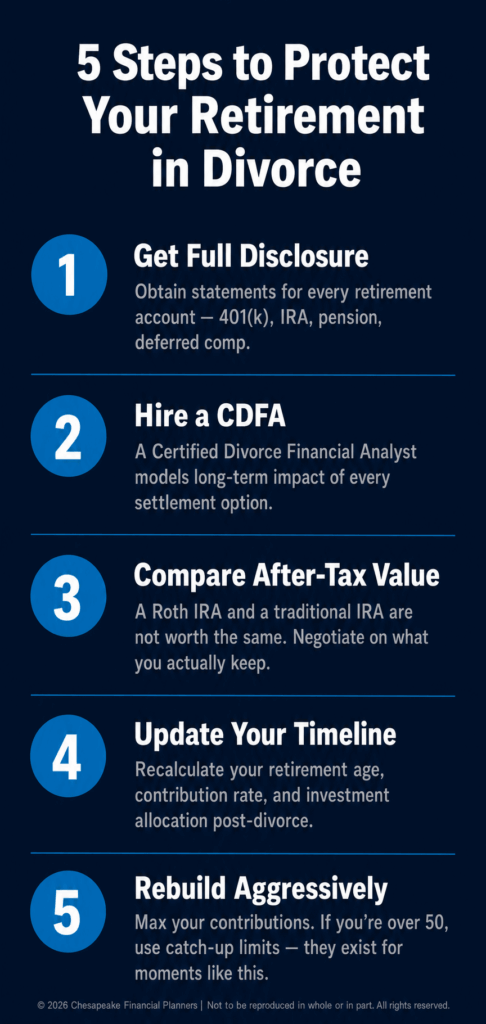
Divorce reshapes nearly every part of your financial life, and few areas take a harder hit than retirement. Income drops, accounts split, and the timeline you built your whole plan around shifts. The good news is that most of the damage is manageable if you understand the moving parts before the settlement is final.
How Are Retirement Accounts Divided in Divorce?
Retirement accounts accumulated during the marriage are generally treated as marital property and subject to division. That includes 401(k) and 403(b) plans, traditional and Roth IRAs, pensions, 457 plans for government workers, annuities, and deferred compensation. Accounts you owned before the marriage or inherited during it are usually separate property, though mixing those funds with marital money can blur the line.
How the split happens depends on your state. Community property states (Arizona, California, Idaho, Louisiana, Nevada, New Mexico, Texas, Washington, and Wisconsin) generally divide marital assets 50/50. Every other state uses equitable distribution, dividing assets fairly but not always equally. Courts weigh the length of the marriage, each spouse's income and earning capacity, non-financial contributions like raising children, and the standard of living during the marriage.
This is where Chesapeake's planning process matters. The R.U.D.D.E.R. Method™ is Chesapeake Financial Planners' six-step planning process: Review and Recognize, Uncover and Understand, Design and Develop, Discuss and Decide, Execute and Empower, and Reassess and Refine. The Uncover step is where most people discover assets they forgot they had, like an old pension or a deferred comp plan from a job two employers ago.
How can I close the retirement savings gap as a woman?
What Is a QDRO and Why Does It Matter?
A Qualified Domestic Relations Order (QDRO) is a court order that lets retirement plan assets move from one spouse to the other without triggering early withdrawal penalties or income taxes. You need one for employer-sponsored plans like 401(k)s and pensions. You do not need one for IRAs, which can be transferred under the divorce decree itself.
The most expensive mistake Jeff Judge sees in divorce cases is a QDRO that never gets filed. The settlement says you are entitled to half the 401(k), everyone signs, and then nobody completes the order. Until the plan administrator processes the QDRO, the account stays in the original owner's name. If that person dies, remarries, or drains the account first, your share can vanish. Treat the QDRO as a separate task with its own deadline, not an afterthought.
Should I take my pension as a lump sum or monthly payments?
What Are the Hidden Retirement Costs of Divorce?
The visible cost is the asset split. The hidden costs do more long-term damage, and they compound quietly for years.
The first is lost compound growth. Splitting a $200,000 account into two $100,000 accounts does not just halve today's balance. Each person also loses the growth the full amount would have generated. At a 7% annual return over 20 years, $200,000 grows to roughly $774,000, while each $100,000 half grows to about $387,000. The total is the same, but you are now solely responsible for funding and managing yours.
The second is reduced future contributions. Running a household on one income usually means less cash for retirement savings. Research from the Center for Retirement Research at Boston College shows divorced women in their fifties hold retirement balances far below those of married women. The income gap reported by the U.S. Government Accountability Office, a roughly 41% drop for women and 23% for men, is the engine behind that savings gap.
The third is the temptation to tap accounts early. Financial stress after a divorce pushes people to withdraw from retirement accounts before age 59½, which triggers a 10% early withdrawal penalty plus ordinary income tax. That permanently shrinks the nest egg you just fought to divide. The 2026 contribution limit for 401(k) plans gives you room to rebuild, but only if you stop the bleeding first.
How do I create sustainable retirement income streams?
How Does Divorce Affect My Social Security?
Here is the bright spot. You may qualify for Social Security benefits based on your ex-spouse's work record, even if they have remarried. You can claim on their record if your marriage lasted at least 10 years, you are currently unmarried, you are at least age 62, and your ex is eligible for Social Security (they do not have to be collecting yet). Your benefit on their record also has to exceed your own.
You can receive up to 50% of your ex-spouse's full retirement age benefit if you wait until your own full retirement age to claim, which is 67 for anyone born in 1960 or later, according to the Social Security Administration. Claim earlier and the benefit is permanently reduced. Your ex never finds out you are collecting, and your claim does not reduce their benefit or their current spouse's benefit.
If your ex-spouse dies, you may qualify for survivor benefits worth up to 100% of their benefit amount, provided you reached full retirement age and the marriage lasted at least 10 years. Remarrying before age 60 generally ends your eligibility for divorced survivor benefits, while remarrying after 60 preserves it.
Should I Take Social Security at 62 or Wait Until 70?
Frequently Asked Questions
How long do you have to be married to get your spouse's Social Security after divorce?
You must have been married for at least 10 years to claim Social Security on an ex-spouse's record. You also need to be unmarried, at least age 62, and your ex must be eligible for benefits. The benefit on their record must be higher than your own for it to matter. The marriage length is measured from the wedding date to the date the divorce was finalized.
Is a 401(k) split 50/50 in a divorce?
A 401(k) is not automatically split 50/50. In the nine community property states, marital assets are generally divided equally, so the portion earned during the marriage is split in half. In equitable distribution states, courts divide assets fairly based on factors like marriage length and earning capacity, which can produce an uneven split. Only the portion accumulated during the marriage is typically subject to division.
What is a QDRO and do I need one?
A QDRO, or Qualified Domestic Relations Order, is a court order that divides employer retirement plans like 401(k)s and pensions without triggering taxes or early withdrawal penalties. You need one for any employer-sponsored plan. You do not need a QDRO to split an IRA, since the divorce decree itself authorizes that transfer. Filing the QDRO promptly after the divorce protects your share.
Can I withdraw from my 401(k) penalty-free during a divorce?
Yes, a divorce-related QDRO allows a one-time penalty-free distribution from a 401(k) to the receiving spouse, though ordinary income tax still applies if you take cash instead of rolling it over. This is the only point in the process where you can access 401(k) money before 59½ without the 10% penalty. Most people roll the funds into an IRA to preserve tax deferral and avoid the tax bill.
Will divorce delay my retirement?
Divorce often pushes back retirement because you lose roughly half your retirement assets, your income drops sharply, and your contribution capacity shrinks. The Government Accountability Office found household income falls about 41% for women and 23% for men after divorce. Rebuilding takes time, so many people work several extra years, increase savings rates, and adjust their retirement age to close the gap.
What to Do Next
Divorce will affect your retirement plan, but the size of that effect depends on the choices you make during the settlement, not after. Knowing how accounts are divided, filing the QDRO on time, and understanding your divorced spousal Social Security options can recover years of lost ground. If you want a clear-eyed look at where you stand, download our guide on protecting retirement savings through major life transitions at chesapeakefp.com.
How do I protect my financial independence long-term as a woman?
Want to go deeper? Our 10 Signs You're Ready for a Certified Financial Planner walks through this step by step.
Prefer a different starting point? Our Transition Readiness Questionnaire is worth a look.
Disclosures
The information provided is for educational purposes only and should not be construed as investment advice. Investment strategies should be tailored to individual circumstances, risk tolerance, and goals. Past performance doesn't guarantee future results. Consult with qualified financial professionals regarding your specific situation.
Advisors associated with Chesapeake Financial Planners may be either (1) LPL Financial Registered Representatives offering securities through LPL Financial, Member FINRA and SIPC, and investment advisor representatives offering investment advice through Great Valley Advisor Group; or (2) solely investment advisor representatives offering investment advice through Great Valley Advisor Group and not affiliated with LPL Financial. Great Valley Advisor Group, and Chesapeake Financial Planners are separate entities from LPL Financial.


