

How Do I Create Sustainable Retirement Income Streams?
Last reviewed: July 2026
To create sustainable retirement income streams, you build a layered system of income sources that work together: guaranteed income from Social Security and pensions covers your essentials, while investment withdrawals provide flexibility and growth. The goal is to match reliable income against fixed expenses, then draw from your portfolio in a tax-efficient sequence so your money lasts as long as you do. There is no single product that solves this. It's a coordination problem, not a purchase decision.
Key Takeaways
- Sustainable retirement income comes from layering guaranteed sources against essential expenses, then drawing from investments for the rest.
- Delaying Social Security from 62 to 70 can raise your monthly benefit by roughly 77%, per the SSA.
- Withdrawal sequencing across taxable, traditional, and Roth accounts can meaningfully reduce lifetime taxes.
- A 65-year-old today has a real chance of a 30-year retirement, so plans must survive longevity risk.
About the Author: Jeff Judge, CFP®, AEP®, ChFC®, CLU® is Managing Partner of Chesapeake Financial Planners in Forest Hill, Maryland. He has been helping families and business owners in Harford County and the Baltimore metro area navigate retirement income planning since earning his CFP® certification in 2013, by using Chesapeake Financial Planners’ signature process, the R.U.D.D.E.R. method™. Jeff's observation after years of this work: most people obsess over their investment returns and underspend the one lever that actually moves the needle, which is the order they pull money from their accounts.
What Makes Retirement Income Sustainable?
Sustainable retirement income means your income sources can support your spending for your entire life without running dry, even through market downturns and decades of rising prices. A plan is sustainable when it answers three risks at once: longevity, inflation, and market timing.
Longevity is the big one. According to the Social Security Administration, a man who reaches 65 today can expect to live, on average, into his mid-80s, and a woman into her late-80s. Averages hide the tail: a meaningful share of 65-year-olds will see 90 or beyond. That's a 25 to 30 year planning window.
Here's the core move. Match your guaranteed income (Social Security, any pension, an income annuity if you own one) against your non-negotiable expenses: housing, food, insurance, healthcare. When the essentials are covered by income that can't be outlived, your investment portfolio becomes the flexible layer that funds travel, gifts, and the good years. Jeff Judge often tells clients that this single framing removes most of the panic. You stop watching the market to decide whether you can buy groceries.
This is also where the R.U.D.D.E.R. Method™ fits naturally. The R.U.D.D.E.R. Method™ is Chesapeake Financial Planners' six-step planning process: Review and Recognize, Uncover and Understand, Design and Develop, Discuss and Decide, Execute and Empower, and Reassess and Refine. Income planning lives in the Design and Develop and Reassess and Refine steps, because a withdrawal plan that worked at 65 needs adjusting at 72 when required minimum distributions begin.
What Are the Main Sources of Retirement Income?
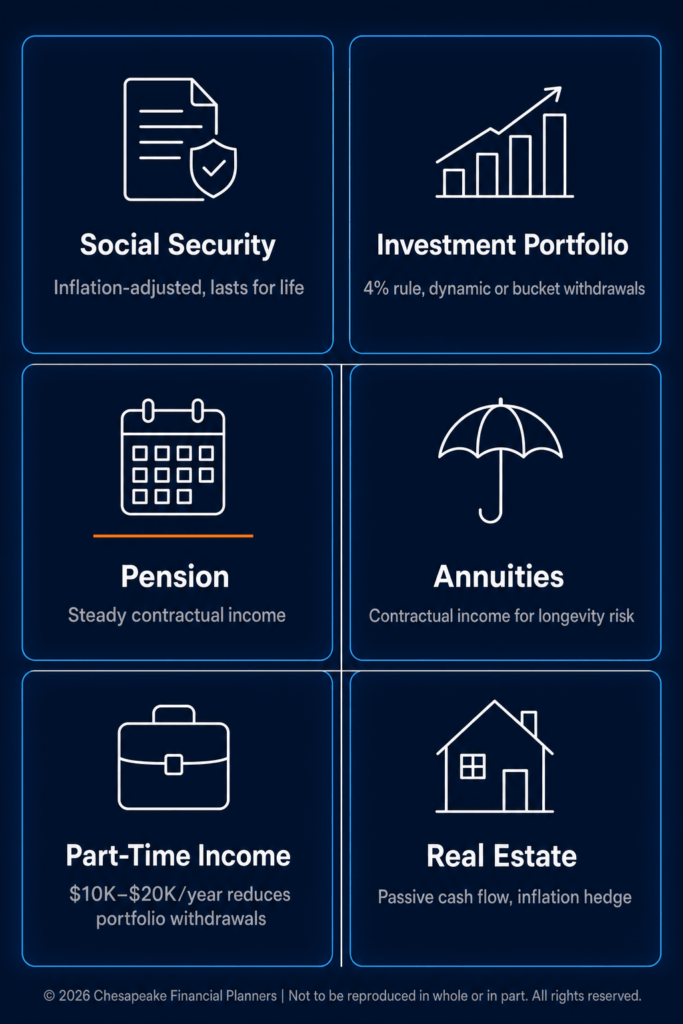
Most durable retirement income plans pull from several distinct sources, each playing a different role. The point of diversifying income, not just investments, is that no single source carries the full weight.
| Income Source | Role in the Plan | Key Tradeoff |
|---|---|---|
| Social Security | Inflation-adjusted, lifetime floor | Claiming age is largely permanent |
| Pension | Steady paycheck replacement | Lump sum vs. annuity is usually irreversible |
| Portfolio withdrawals | Flexible, growth-oriented | Vulnerable to market timing |
| Income annuity | Longevity insurance, income floor | Reduced liquidity, fees vary |
| Part-time work | Bridge income, purpose | Not permanent, energy-dependent |
Social Security is the bedrock for most retirees. It replaces roughly 40% of pre-retirement income for an average earner, according to the SSA. The claiming decision is one of the highest-stakes choices in retirement. Delaying from 62 to 70 can increase your monthly benefit by approximately 77%, because delayed retirement credits add 8% per year past full retirement age. For a married couple, coordinating two claiming ages is a real planning exercise, not a coin flip.
Pensions, if you have one, behave like Social Security: contractual income you can lean on. The hard part is the lump sum versus monthly payment decision, which is typically permanent. We model both paths against your health, your other income, and your legacy goals before anyone signs.
Portfolio withdrawals from your 401(k), IRA, and brokerage accounts fund the rest. For 2026, the IRS sets the 401(k) employee deferral limit at $24,500, with an additional catch-up for those 50 and older, so workers nearing retirement can still build the base they'll draw from. How you withdraw matters as much as how much.
Income annuities can convert a slice of savings into a lifetime paycheck, useful for covering essentials when Social Security and a pension don't fully cover them. They trade liquidity for certainty. Used as one layer, not the whole plan, they earn their place.
How Much Can I Safely Withdraw Each Year?
A safe withdrawal rate is the percentage of your portfolio you can take in your first year, adjusted upward for inflation each year after, with a high probability your money lasts 30 years. The long-standing benchmark is the 4% guideline, which suggests withdrawing 4% of your starting balance in year one. On a $1 million portfolio, that's $40,000 the first year.
The 4% guideline is a starting point, not a law. Three approaches show up most in real plans:
- Fixed percentage (the 4% guideline): Simple and predictable, but it ignores what the market is doing.
- Dynamic withdrawals (guardrails): You spend a little more in strong years and trim in weak ones, which protects the portfolio during downturns.
- The bucket strategy: You segment assets by time horizon, holding one to two years of cash for near-term needs, bonds for the middle years, and stocks for long-term growth, so you're never forced to sell stocks in a crash.
Jeff Judge has watched the bucket approach do its real work in the emotional dimension, not just the spreadsheet. When clients know their next two years of spending is sitting in cash, they don't sell in a panic when the headlines turn ugly. That discipline is often worth more than the optimal withdrawal math.

Which Accounts Should I Withdraw From First?
Withdraw in a tax-efficient sequence: generally tap taxable accounts first, then tax-deferred accounts like traditional IRAs, and let Roth accounts grow longest. The order you pull money from your accounts can change your lifetime tax bill by tens of thousands of dollars, and it's the lever most retirees underuse.
Different accounts carry different tax treatment:
- Taxable brokerage accounts: Gains are taxed at long-term capital gains rates, which are usually lower than ordinary income rates.
- Traditional IRAs and 401(k)s: Every dollar is taxed as ordinary income when withdrawn, and required minimum distributions force withdrawals starting at age 73 under current IRS rules.
- Roth IRAs: Qualified withdrawals come out tax-free, and there are no lifetime RMDs on the original owner.
A common sequence draws from taxable accounts first to capture lower capital gains rates, then traditional accounts to fill up lower tax brackets, while preserving Roth dollars for late retirement or heirs. But the smartest plans do partial Roth conversions in the low-income gap years between retirement and the start of RMDs, smoothing out the tax cliff that hits many retirees at 73. There's no template here. The right sequence depends on your bracket, your balances, and your timeline.
Frequently Asked Questions
How do I create sustainable retirement income streams?
You create sustainable retirement income by layering guaranteed sources against your essential expenses, then drawing from investments for discretionary spending. Cover housing, food, insurance, and healthcare with Social Security and any pension, then use portfolio withdrawals for flexibility. Coordinate withdrawal timing and account types to control taxes and stretch your savings across a 25 to 30 year retirement.
What is the safest retirement income strategy?
The safest strategy combines guaranteed lifetime income with a diversified, tax-aware withdrawal plan rather than relying on any single source. Pair Social Security and any pension with a cash buffer of one to two years of spending, so you're never forced to sell investments during a downturn. Diversification across income sources, not just assets, is what protects you.
How does Social Security fit into a retirement income plan?
Social Security is the inflation-adjusted, lifetime foundation of most retirement income plans, replacing roughly 40% of pre-retirement income for an average earner. Because delaying from 62 to 70 can raise your monthly benefit by about 77%, your claiming age is one of the highest-value decisions you'll make. Coordinate it with your other income sources rather than claiming by default.
What is the 4% rule for retirement withdrawals?
The 4% rule suggests withdrawing 4% of your portfolio in your first year of retirement, then adjusting that dollar amount for inflation each year afterward, with a strong chance your money lasts 30 years. On a $1 million portfolio, that's $40,000 the first year. Treat it as a starting benchmark, not a rigid rule, and adjust based on market conditions.
Which retirement accounts should I withdraw from first?
Most tax-efficient plans draw from taxable accounts first to capture lower capital gains rates, then tap traditional IRAs to fill lower tax brackets, while preserving Roth accounts longest. This sequencing, combined with partial Roth conversions in low-income years before required minimum distributions begin at 73, can reduce your lifetime tax bill by tens of thousands of dollars.
Do I need an annuity for a sustainable retirement income?
You don't need an annuity, but one can help if Social Security and a pension don't fully cover your essential expenses. An income annuity converts a portion of savings into guaranteed lifetime income, which addresses longevity risk and provides an income floor. Used as one layer of a diversified plan rather than a wholesale replacement for your portfolio, it can add real stability.
Building a retirement income plan you can actually live on starts with knowing how your pieces fit together. If this was helpful, our guide on turning savings into reliable income walks through the same framework step by step. Download it at chesapeakefp.com to see how a coordinated plan handles retirement income streams in your own numbers.
For related reading, see How Do I Create Multiple Income Streams for Retirement?, Should I Take Social Security at 62 or Wait Until 70?, and Should I take my pension as a lump sum or monthly payments? to go deeper on the building blocks above.
Want to go deeper? Our Retirement Income Blueprint Workbook walks through this step by step.
Disclosures
The information provided is for educational purposes only and should not be construed as investment advice. Investment strategies should be tailored to individual circumstances, risk tolerance, and goals. Past performance doesn't guarantee future results. Consult with qualified financial professionals regarding your specific situation.
This information is not intended to be a substitute for specific individualized tax, investment or legal advice. We suggest that you discuss your specific situation with a qualified tax, legal or financial advisor.
Advisors associated with Chesapeake Financial Planners may be either (1) LPL Financial Registered Representatives offering securities through LPL Financial, Member FINRA and SIPC, and investment advisor representatives offering investment advice through Great Valley Advisor Group; or (2) solely investment advisor representatives offering investment advice through Great Valley Advisor Group and not affiliated with LPL Financial. Great Valley Advisor Group, and Chesapeake Financial Planners are separate entities from LPL Financial.


