

Published: | Last reviewed: October 2026 by Jeff Judge, CFP®
Part of our guide: Should I Get a Trust or Is a Will Enough?
Yes. Executor liability can reach you personally when estate funds go out to heirs or lower-priority creditors and the estate then cannot cover its taxes and other priority claims. Federal law makes a representative who pays other debts ahead of a government claim liable for the amount paid, and Maryland adds its own creditor deadlines for the personal representative.
Key Takeaways
- A representative who pays other debts before a federal claim is liable to the extent of the payment for unpaid government claims.
- Maryland bars a creditor claim not presented within six months of death or two months after written notice, whichever is earlier.
- In 2026 an estate can owe Maryland estate tax above a $5,000,000 exemption even when it stays under the $15,000,000 federal exclusion.
- Holding a documented reserve until taxes and claims clear, with monthly written updates, keeps the executor and the family working from the same facts.
About the Author: Jeff Judge, CFP®, AEP®, ChFC®, CLU® is Managing Partner of Chesapeake Financial Planners in Forest Hill, Maryland. He has been helping families and business owners in Harford County and the Baltimore metro area work through estate settlement since earning his CFP® certification in 2013, by using Chesapeake's signature process, the R.U.D.D.E.R. Method™. "Slowing an estate down is often the kindest thing an executor can do for a family, even when month three feels like the wrong time to hear it," Jeff says.
What is executor liability, and when does it reach a personal representative?
Executor liability is the personal financial responsibility a taxing authority or creditor can place on an executor, called a personal representative in Maryland, for obligations the estate left unpaid. It is the same idea as executor personal liability, and it turns on what the executor paid out and in what order.
According to IRS Publication 559, a personal representative collects the decedent's assets, pays the decedent's creditors, and then distributes what remains.
The federal claims-priority statute is blunt about what happens when the order slips. A representative "paying any part of a debt of the person or estate before paying a claim of the Government is liable to the extent of the payment for unpaid claims of the Government," according to 31 U.S.C. 3713(b). For an estate that cannot cover everything, the IRS adds a knowledge test: the representative is personally responsible when he or she had notice of the tax obligations, or failed to use due care in determining whether they existed, before distributing the estate's assets.
Here is a composite example, not a real client. Three months after a mother's death, her son, the executor, wires each of his two sisters a share of her brokerage account. Months later a final income tax bill for her last year arrives, along with a medical provider's claim nobody knew about, and the estate account is nearly empty. The person left answering for those bills is the executor.
Does an executor pay the estate's taxes out of pocket?
No, not as a starting point. The estate pays its taxes from estate assets. Personal exposure appears when those assets have already gone out the door and nothing remains to cover a federal claim, which is why the order of payment and a held-back reserve matter. Whether any exposure exists in a particular estate is a question for an estate attorney in the state where the estate is being administered.
In what order should an executor pay the estate before the heirs?
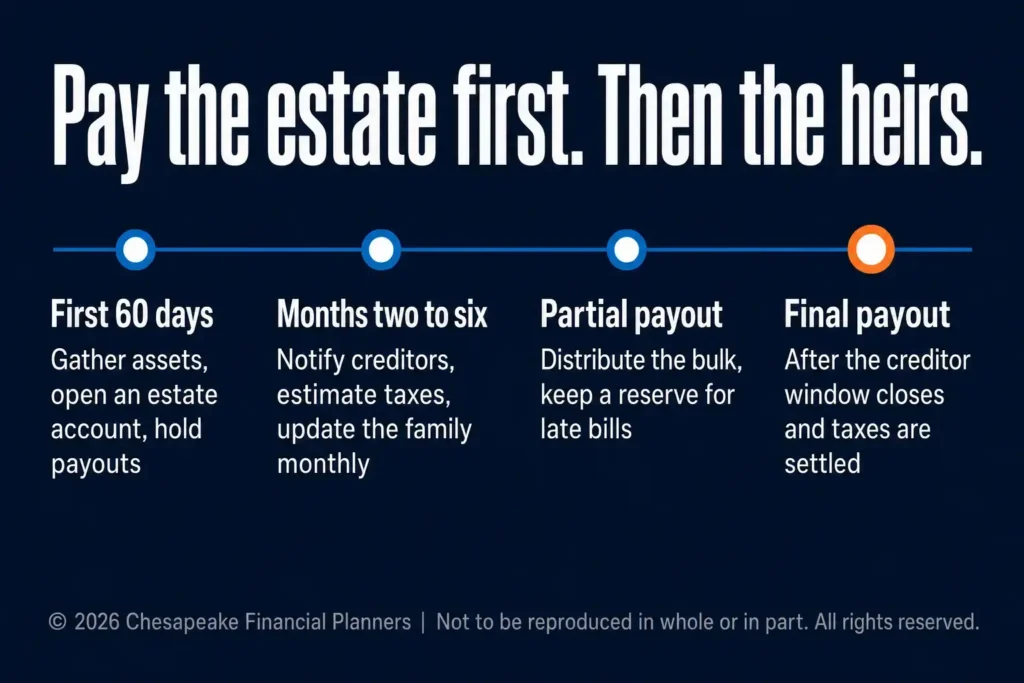
Debts, taxes, and expenses come first, and heirs come last. A workable estate administration timeline has four stages, and the first three exist so the fourth does not hurt anyone.
- First 60 days: gather assets, open an estate account, hold payouts. Order death certificates, locate the will, obtain an employer identification number for the estate, and notify the IRS in writing of your fiduciary role on Form 56, as Publication 559 directs. Inventory everything, including retirement accounts and life insurance that pass outside the will by beneficiary designation. Make no distributions yet.
- Months two through six: notify creditors, estimate taxes, update the family monthly. Identify debts and give notice to creditors as Maryland requires. Ask a CPA to estimate the final income tax bill and any estate-level taxes. Keep a running ledger of every dollar in and out.
- Partial payout: distribute the bulk, keep a reserve for late bills. Once the tax picture is clear, a partial estate distribution can relieve family pressure while a reserve stays in the estate account for taxes, expenses, and claims still possible under state law.
- Final payout: after the creditor window closes and taxes are settled. Make the last distribution, close the estate account, and file the closing documents your state requires.
Two IRS forms are worth raising with the CPA early. An executor can file Form 5495 to request a discharge from personal liability for the decedent's income, gift, and estate taxes, and Publication 559 also describes Form 4810, a request for prompt assessment of the decedent's taxes.
Pressure to pay early is real. Siblings ask when their share is coming, a surviving parent may need funds, and an adult child under financial strain can push hard, while the executor is often grieving too. Waiting can look like hoarding to relatives who already distrust one another. A monthly update is the answer: two short paragraphs covering what came in, what went out, what is pending, and what happens next. The reserve is not the executor holding the family's money. It is the executor making sure no one, the executor included, gets a surprise bill later.
"The fastest way to start a sibling fight is to pay everyone out and then have to ask for some of it back." – Jeff Judge, CFP®
For more on why these conversations turn tense, see our look at what drives inheritance family conflict after a loss.
Which bills arrive late, and what does Maryland add to the list?
The late arrivals are rarely exotic. They are ordinary obligations on slow timelines, and a distribution made in month three has no way of knowing about a bill that surfaces in month eleven.
| Item | When it tends to surface | Who often helps |
|---|---|---|
| Final individual income tax return | After the year of death ends | CPA |
| Estate income tax return, when assets earn investment income during administration | During and after the first year of administration | CPA |
| Federal or Maryland estate tax filings, depending on estate size | Maryland payment is due nine months after death | Estate attorney and CPA |
| Maryland inheritance tax | Collected by the Register of Wills | Estate attorney |
| Final medical bills and credit card balances | Over the first several months | Executor, with the attorney |
| Property taxes, utilities, and coverage on a vacant house | Monthly until the house is sold | Executor |
How long do creditors have to file a claim in Maryland?
A creditor claim against a Maryland estate is barred unless presented within the earlier of six months after the date of death or two months after the personal representative mails written notice, under Estates and Trusts section 8-103. Claims of the United States and the State are treated separately by statute, which is why a federal tax claim can outlast the creditor claims period. Paying heirs before that window closes can leave the personal representative exposed if a valid claim appears later.
Maryland also adds its own taxes to the federal system. Its estate tax exemption is $5,000,000 per person, against a $15,000,000 federal basic exclusion in 2026, so a Maryland family with a paid-off home, retirement accounts, and life insurance can owe state tax with no federal tax due. The Comptroller states that payment is due nine months after death and that the credit behind the tax cannot exceed 16% of the taxable estate above the exemption. The separate inheritance tax is 10% on property passing to individuals outside the exempt classes, which include a spouse, children and other lineal descendants, a child's spouse, parents, grandparents, stepchildren, stepparents, and siblings. Nieces, nephews, and friends fall outside that list. Our guides to Maryland's estate and inheritance tax and to who pays the 10% inheritance tax show how the two interact.
For the families I work with in Forest Hill, Bel Air, and across Harford County, this local layer is what surprises people. A national checklist says to wait for the tax picture. Maryland adds a six-month creditor window and a nine-month estate taxA federal (and sometimes state) tax on the transfer of assets to heirs at death, assessed on the total estate value above the applicable exemption. The federal exemption is $15 million per person in 2026: the 2025 law known as the One Big Beautiful Bill Act set it at that level, indexed for inflation after 2026, with no scheduled sunset. payment date, and each is a reason to hold a reserve longer than the family would like.
How large a reserve should an executor hold before a partial distribution?
There is no universal percentage, and I would be skeptical of anyone who offers one without looking at the estate. The reserve is built from the bills that are likely, plus a cushion for the one nobody saw coming.
Here is a hypothetical, for illustration only and not a recommendation. An estate holds an $800,000 brokerage account and a house awaiting sale.
| Reserve component | Illustrative amount |
|---|---|
| Final income tax balance, per the CPA's estimate | $22,000 |
| Estate-level income tax during administration | $4,000 |
| Attorney and accounting fees | $18,000 |
| House carrying costs, $1,400 a month for eight months | $11,200 |
| Total of the known items | $55,200 |
With known items near $55,000, an executor might hold $70,000 to $85,000 to leave room for an unexpected claim, then make a partial distribution of the rest once the tax estimate is firm. The reserve looks minor beside an $800,000 account. It looks substantial the day a bill arrives that the account can no longer cover.
Jeff Judge tends to open the reserve conversation with the CPA's tax estimate on the table, because a number from a third party lands better with siblings than a number the executor picked alone.

How can an executor who is also an heir keep the family on the same page?
When the executor is one of the children, every decision gets read two ways. Selling the house quickly looks efficient to one sibling and self-serving to another. Holding it for a better price looks careful to one and controlling to another. An executor's fee, which state law often allows, can feel like a betrayal to a sibling who assumed the work would be free.
Disclosure is the fix. Tell your siblings what you plan to do before you do it, and share the ledger. If you plan to take a fee, say so early and explain what it covers. If you plan to buy an asset from the estate, such as a parent's car or a share of the house, get an independent valuation and put the terms in writing.
Heirs have a part to play as well:
- Ask for a written timeline and a simple accounting instead of asking when your money arrives. The first request invites openness. The second invites defensiveness.
- Raise concerns early and ask to see the documents, rather than relying on what another relative heard.
- If you receive a partial distribution, pause before spending it. A short wait gives you room to plan around your own taxes, especially if you also inherited a retirement account with its own distribution rules.
If you have been named executor and feel over your head, that is a normal reaction. Few people serve more than once or twice, and the job arrives in the middle of grief with the family watching. Estate assets can often cover reasonable fees for the attorney and CPA who guide you, subject to what the estate attorney confirms for your situation.
The R.U.D.D.E.R. Method™ is Chesapeake Financial Planners' six-step planning process: Review and Recognize, Uncover and Understand, Design and Develop, Discuss and Decide, Execute and Empower, and Reassess and Refine. In an estate, I use it to keep the tax picture, family communication, and timeline pointed the same way while the attorney and CPA do their work. It does not replace either of them.
Frequently Asked Questions
Can an executor be personally liable for estate debts?
Yes, an executor can be personally liable when an estate that cannot cover all of its debts pays others ahead of federal claims, and the executor had notice of the obligation or failed to use due care. The exposure is measured by what was paid out. An estate attorney can say how it applies to a specific situation.
How long should an executor wait before paying heirs?
An executor should wait until the estate's debts, expenses, and taxes are identified and covered, which often means several months. In Maryland the creditor claims period runs up to six months after death, so many executors keep a reserve past that date and make a partial distribution once the tax picture is clear.
What happens if an executor pays heirs before creditors?
If the estate later cannot pay a valid claim, the executor may be asked to cover it personally, and the heirs may be asked to return money, which is where family conflict often begins. Federal tax claims receive priority, so paying others first can create personal exposure for the executor up to the amount paid.
Should an executor keep a reserve for taxes and late bills?
Yes, a reserve is the standard way to cover obligations that surface after the first distribution, including the final income tax return, estate-level income tax, administration costs, and carrying costs on a house. The right size depends on the estate, so ask the CPA for a written estimate of the tax items before choosing a number.
Do assets with a beneficiary designation go through the estate?
No, retirement accounts and life insurance with a named beneficiary pass by that designation rather than through the will, so they often reach the beneficiary sooner than estate assets do. They still belong in the executor's inventory, because they affect the estate's tax picture and the family's expectations about timing.
If you are the executor now, start with one question: do you know what the estate owes before you decide what it can give? Executor liability is easiest to manage before the first check is written, and a short conversation with your attorney, your CPA, and a planner who coordinates with both can set the order of payment. Schedule a Fit Call and we will talk through your timeline.
A version of this article was originally published on Chesapeake Financial Planners' LinkedIn.
Disclosures
The information provided is for educational purposes only and should not be construed as investment advice. Investment strategies should be tailored to individual circumstances, risk tolerance, and goals. Past performance doesn't guarantee future results. Consult with qualified financial professionals regarding your specific situation.
This information is not intended to be a substitute for specific individualized tax, investment or legal advice. We suggest that you discuss your specific situation with a qualified tax, legal or financial advisor.
Certified Financial Planner Board of Standards Center for Financial Planning, Inc. owns and licenses the certification marks CFP®, CERTIFIED FINANCIAL PLANNER®, and CFP® (with plaque design) in the United States to Certified Financial Planner Board of Standards, Inc., which authorizes individuals who successfully complete the organization's initial and ongoing certification requirements to use the certification marks.
The ChFC® is the property of The American College of Financial Services, which reserves sole rights to its use, and is used by permission.
The CLU® is the property of The American College of Financial Services, which reserves sole rights to its use, and is used by permission.
This material is for educational purposes only. Insurance products contain exclusions, limitations, and terms for keeping them in force. Please contact a qualified insurance professional for costs and complete details.
Advisors associated with Chesapeake Financial Planners may be either (1) LPL Financial Registered Representatives offering securities through LPL Financial, Member FINRA and SIPC, and investment advisor representatives offering investment advice through Great Valley Advisor Group; or (2) solely investment advisor representatives offering investment advice through Great Valley Advisor Group and not affiliated with LPL Financial. Great Valley Advisor Group, and Chesapeake Financial Planners are separate entities from LPL Financial.
Chesapeake Financial Planners | 2402 Scotlon Ct, Forest Hill, MD 21050 | (410) 652-7868 | www.chesapeakefp.com
© 2026 Chesapeake Financial Planners | Not to be reproduced in whole or in part. All rights reserved.


