

Estate Planning Guide: Wills, Trusts, and Legacy Strategies
Last reviewed: July 2026
A complete estate plan answers two questions: what happens to your assets when you die, and who steps in if you cannot make decisions while you are alive. This estate planning guide walks through the documents, the tax rules, and the framework Jeff Judge uses with families in Maryland and across the country to translate good intentions into instructions that hold up in court, at the bank, and at the hospital.
On This Page
- Key Takeaways
- Why is estate planning the most-skipped financial planning step?
- What does a complete estate planning guide actually include?
- Should I use a will, a revocable living trust, or both?
- How does Maryland's two-tax system work for residents?
- Why do beneficiary designations override the will?
- How does the R.U.D.D.E.R. Method keep an estate plan alive?
- Frequently Asked Questions
- Talk through your plan with a CFP®
- Disclosures
Key Takeaways
- The 2026 federal estate tax exemption sits at $15 million per person under the One Big Beautiful Bill Act, but the Maryland threshold is $5 million and has not been indexed for inflation since 2019.
- A will alone does not avoid probate; a revocable living trust paired with proper funding does, while still working alongside the will as a safety net.
- Beneficiary designations on retirement accounts and life insurance override your will entirely, which is the single most common planning failure Jeff sees.
- Maryland is one of only two states that levies both an estate tax and a separate inheritance tax, and the rules for each are different.
- A durable financial power of attorney and an advance medical directive matter as much as the will, because incapacity planning is what protects you while you are still alive.
About the Author: Jeff Judge, CFP®, AEP®, ChFC®, CLU® is Managing Partner of Chesapeake Financial Planners in Forest Hill, Maryland. He has been helping families and business owners in Harford County and the Baltimore metro area navigate estate planning and intergenerational wealth transfer since earning his CFP® certification in 2013, by using Chesapeake Financial Planners’ signature process, the R.U.D.D.E.R. method™. In Jeff's practice, the estate plan that actually works is the one a family revisits every few years, not the one signed at the lawyer's office in 2009 and left to gather dust.
Why is estate planning the most-skipped financial planning step?
Who actually has a will in 2026?
A 2025 Caring.com survey reports that only 32% of American adults have any kind of estate planning document in place, not a complete plan, just a single will or trust. That figure has barely moved in a decade. The reason is not cost or complexity. It is that estate planning forces a conversation about death and dependency that most people would rather defer. The result is predictable: when something happens, the state's default rules decide who gets what, who raises the children, and who manages the money during incapacity.
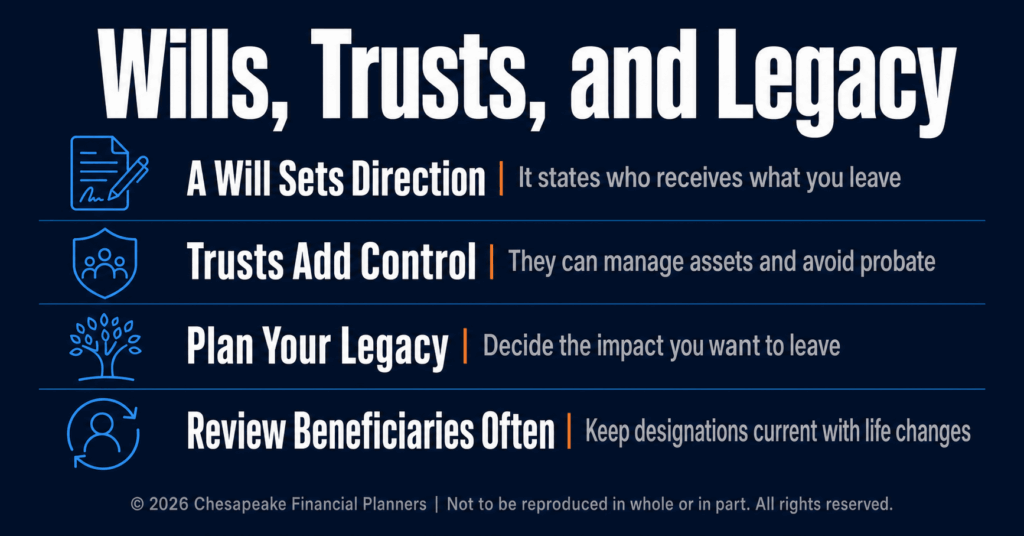
The cost of skipping this step is not only emotional. Probate in Maryland routinely takes 9 to 18 months and consumes 3% to 7% of an estate's gross value in fees, taxes, and lost time. For a $1.2 million estate, that translates to $36,000 to $84,000 that never reaches the heirs. Most of that cost is preventable with documents that take a small fraction of that to draft.
Estate planning is also incapacity planning. The Centers for Disease Control reports that one in nine Americans aged 65 and older has Alzheimer's, and roughly one-third will experience some form of cognitive decline before death. A durable financial power of attorney and an advance medical directive prevent a court-appointed guardian from making decisions a family member should be making. In Jeff's practice, the calls about estate documents almost always come after an incapacity event, not a death, which is why he frames the conversation around the living, not the will. See What Is the Difference Between Financial and Healthcare Power of Attorney? for the incapacity layer of planning.
What does a complete estate planning guide actually include?
The five documents every adult should have
A complete estate plan is not a single document. It is a coordinated set of five documents that together cover asset transfer, incapacity, health care, and minor children:
- Last Will and Testament. Names an executor (called a "personal representative" in Maryland), designates guardians for minor children, and directs how probate assets pass.
- Revocable Living Trust. A separate legal entity you create during life that holds title to assets so they pass outside probate. Revocable means you can change it; living means it operates while you are alive.
- Durable Financial Power of Attorney. Authorizes a named agent to manage your finances if you become incapacitated. "Durable" means the authority survives incapacity. A regular power of attorney does not.
- Advance Medical Directive. Combines a health care power of attorney (who decides) with a living will (what you want). Maryland publishes a state-specific form at no cost through the Attorney General.
- HIPAA Authorization. Allows named individuals to access your medical records. Without it, your adult children, even ones flying in to help, can be turned away at the hospital desk.

For families with more than approximately $2 million in assets, with a small business, with a special-needs dependent, or with a blended family, this list expands. Common additions include an irrevocable life insurance trust, an What is a special needs trust, and how does it protect my child's benefits?, a buy-sell agreement for the business, and a Revocable vs Irrevocable Trust: What's the Difference?. The framework stays the same: who decides, who receives, and what is in place to protect against the long tail of things that can go wrong.
The number Jeff cites most often with clients is not a tax threshold. It is the cost of guardianship litigation, which a 2023 AARP Public Policy Institute analysis found averages between $5,000 and $35,000 in attorney fees and court costs in contested cases. A correctly drafted durable power of attorney costs a fraction of that and prevents the dispute entirely. As Jeff often tells clients: "The estate plan that actually works is the one a family revisits every two to three years, not the one signed in 2009 and left in a binder."
Should I use a will, a revocable living trust, or both?
Which one do you actually need?
The most persistent estate planning question Jeff hears is this: "Do I need a trust, or is a will enough?" The honest answer is that almost every adult needs a will, and many adults also benefit from a trust. They do different jobs.
| Feature | Last Will and Testament | Revocable Living Trust |
|---|---|---|
| Avoids probate | No | Yes (for assets titled in the trust) |
| Public record on death | Yes | No |
| Effective during incapacity | No | Yes (successor trustee steps in) |
| Names guardian for minor children | Yes | No (use a will for this) |
| Cost to draft (typical) | $500 to $2,000 | $2,500 to $6,000 |
| Requires funding or retitling | No | Yes, and this step is what most families skip |
| Modifiable during life | Yes (via codicil) | Yes (via amendment) |
The point that gets missed: a trust only avoids probate for assets that have been retitled into the trust's name. A trust signed but never funded is a trust that does nothing at death. Jeff routinely meets families in Harford County and the Baltimore area with a well-drafted trust from 2014 that holds zero assets, because no one ever moved the brokerage account, the deed, or the bank accounts into it. The original attorney handed over the binder and the conversation ended. That gap is the single most expensive estate planning failure he sees in real client files.
Trusts deliver real value in three situations. First, families with real estate in multiple states use a trust to avoid ancillary probate proceedings in each one. Second, families who value privacy benefit because probate records are public while trust administration is not. Third, families anticipating incapacity gain a meaningful advantage because a successor trustee can act immediately without court involvement. Outside those situations, a well-drafted will paired with a strong power of attorney often does the same work for less money. The right answer depends on your assets, your state, and your timeline. See Revocable vs Irrevocable Trust: What's the Difference? for the next layer of trust-type analysis.
How does Maryland's two-tax system work for residents?
The estate tax and the inheritance tax are not the same thing
Maryland is one of only two states (the other is New Jersey) that imposes both an estate tax and a separate inheritance tax. The combination catches families who assumed that being well under the federal exemption meant being safe from estate taxation entirely. They are different taxes, paid by different parties, calculated differently.

The Maryland estate tax kicks in at a $5 million exemption per person, frozen at that level since 2019 with no inflation adjustment. The top rate is 16%. A Forest Hill family with a $7 million estate (the combined value of a paid-off home, retirement accounts, life insurance proceeds, and a small business interest) owes Maryland estate tax on the $2 million above the threshold, even though they are nowhere near the federal $15 million exemption. The portability that exists at the federal level for surviving spouses does not exist at the Maryland level, which is a planning issue every couple in the state should know about.
The Maryland inheritance tax is separate. It applies to property passing to beneficiaries who are not lineal descendants, ancestors, or spouses. Siblings, nieces, nephews, cousins, friends, and non-relatives generally pay 10% on what they inherit. A widow with no children who leaves her estate to her niece and nephew owes Maryland inheritance tax on most of what passes, regardless of estate size.
Jeff's standing observation with Maryland couples: the estate tax exemption gap, federal $15 million versus Maryland $5 million, is the single largest planning miss he sees in Harford County client files. A bypass trust, a credit shelter strategy, or strategic lifetime gifting can address it, but only if the documents are drafted while both spouses are alive. After the first death, the planning options narrow sharply. See How do Maryland's estate tax and inheritance tax work together, and how do you plan around both? and Who owes Maryland's 10% inheritance tax and what planning options protect non-lineal heirs? for the deeper mechanics, and Estate tax planning for high-net-worth individuals
Why do beneficiary designations override the will?
The most important estate planning forms are not at the lawyer's office
Retirement accounts, life insurance policies, annuities, transfer-on-death brokerage accounts, and payable-on-death bank accounts pass according to their beneficiary designation forms, not according to the will. This is the rule that surprises families more than any other.
If a 401(k) names an ex-spouse as primary beneficiary and a new spouse has been listed in the will for fifteen years, the ex-spouse receives the 401(k). The Supreme Court confirmed this principle in 2013 in Hillman v. Maretta, and federal courts have applied it consistently since. The will does not control these assets. The beneficiary form does. Period.
Jeff's practice observation: in roughly four out of every ten new-client reviews, at least one beneficiary designation is wrong, blank, or outdated. The common pattern is an account opened ten years ago that named a parent who has since died, a 401(k) from a former employer never updated after divorce, or a life insurance policy with a primary beneficiary listed but no contingent. Each of these is a document that overrides the will, and that nobody is going to find until it is too late to fix.
The fix is straightforward but not automatic. Every retirement account, every life insurance policy, and every transfer-on-death registration should be reviewed at four trigger points: marriage, divorce, birth or adoption, and the death of a named beneficiary. See Do I need to update my beneficiary designations after a divorce or major life change? for the divorce-specific checklist that Jeff walks every newly-separated client through, and How do I include digital assets and passwords in my estate plan? for the parallel issue with passwords, cryptocurrency, and online accounts.
How does the R.U.D.D.E.R. Method™ keep an estate plan alive?
Why most plans fail not at drafting but at maintenance
The R.U.D.D.E.R. Method™ is the six-stage framework Jeff uses with clients, Review, Understand, Develop, Document, Execute, and Refine, to convert one-time planning conversations into a living plan that keeps pace with a client's life. In an estate planning context, every stage matters, but Refine is where most plans break.
An estate plan signed in 2014 does not reflect the 2017 Tax Cuts and Jobs Act, the 2020 SECURE Act elimination of the stretch IRA for most non-spouse beneficiaries, the 2022 SECURE 2.0 distribution rules, the 2025 One Big Beautiful Bill Act exemption changes, the Maryland inheritance tax adjustments, your daughter's divorce, the small business you sold, or the grandchildren who arrived since. Each of those events changes the answer. None of them automatically updates the documents.
Jeff's standing recommendation: a five-question check-in every two years. Has anyone in the plan died, divorced, married, or been born? Have your assets crossed the federal or Maryland exemption thresholds? Have your guardian or trustee choices aged out of the role? Has any beneficiary designation been changed by the custodian without your knowledge? Are the executor and trustee still willing and able? If any answer is yes, the plan needs an attorney visit, not just an internal update. See Estate Planning for Couples for the longer version of this check-in, and How Does the Annual Gift Tax Exclusion Work? for one of the simplest ways to put the federal exemption to work during life.
Frequently Asked Questions
Do I need an estate plan if I do not own much?
Yes. Estate planning is not only about wealth transfer. It is also about who makes decisions when you cannot. A durable power of attorney and an advance medical directive protect you during incapacity, regardless of your net worth. Even a single adult with modest assets benefits from naming an executor and avoiding the state's intestacy default. The court-appointed alternative is slower, more expensive, and decided by someone who does not know your family. Jeff regularly sees twenty-something professionals get blindsided by the gap between "I'm fine" and "the hospital will not let my mom in the room."
What is the federal estate tax exemption for 2026?
The federal estate and gift tax exemption is $15 million per individual ($30 million for a married couple) for deaths in 2026, as set by the One Big Beautiful Bill Act signed in 2025. The exemption is indexed for inflation going forward. This figure is permanent under current law, replacing the previously scheduled 2026 sunset of the 2017 Tax Cuts and Jobs Act. Note that this is the federal exemption only; state-level estate taxes apply in 12 states plus the District of Columbia, with thresholds as low as $1 million.
How is a revocable trust different from an irrevocable trust?
A revocable trust can be amended, modified, or revoked by the grantor at any time during life, which makes it flexible but offers no estate tax or creditor protection. An irrevocable trust cannot be changed without beneficiary consent or court approval, which makes it less flexible but allows assets to be excluded from the taxable estate and shielded from creditors. Revocable trusts are the default for probate avoidance and incapacity planning. Irrevocable trusts are the tool for advanced estate tax reduction, asset protection, and Medicaid planning. Most families need a revocable trust first; only some need an irrevocable trust as well.
Does my will cover my retirement accounts?
No. Retirement accounts pass by beneficiary designation, not by will. If your 401(k), IRA, 403(b), or Roth IRA has a named beneficiary on file with the custodian, that beneficiary receives the account regardless of what your will says. The only time the will controls is when no valid beneficiary is on file or when the named beneficiary has predeceased without a contingent beneficiary listed. This is why a real estate planning guide includes a beneficiary review of every retirement and insurance account. The documents at the lawyer's office are only half of the plan.
What is the Maryland estate tax exemption in 2026?
The Maryland estate tax exemption is $5 million per individual, fixed at that level since 2019 with no inflation adjustment, per the Maryland Comptroller. The top rate is 16% on the value above the exemption. Unlike the federal estate tax, the Maryland estate tax does not permit portability between spouses, meaning the deceased spouse's exemption cannot be transferred to the surviving spouse automatically. A credit shelter trust or QTIP trust is the standard planning tool used to preserve the first spouse's exemption at the Maryland level. Maryland is also one of only two states that levies a separate inheritance tax on non-lineal beneficiaries.
How often should I update my estate plan?
Estate plans benefit from a review every two to three years and an update whenever a major life event occurs: marriage, divorce, birth or adoption of a child or grandchild, death of a beneficiary or executor, large asset purchase or sale, business sale, relocation to a new state, or a significant change in net worth. Tax law changes also matter. The 2025 One Big Beautiful Bill Act made the higher federal exemption permanent, but state law and beneficiary rules continue to evolve. Plans drafted before the 2020 SECURE Act often contain stretch-IRA language that no longer applies to most non-spouse beneficiaries and may need to be updated.
Can I create my own will online?
Online will-creation tools can work for simple situations, such as single adults with modest assets, no minor children, no business interests, and no state-specific tax exposure. They become risky as soon as any complication exists: blended families, business ownership, real estate in multiple states, special-needs dependents, Maryland's two-tax exposure, or estates near a state exemption threshold. The cost of an attorney-drafted plan is small relative to the cost of a contested will, an invalid trust funding, or a beneficiary designation that overrides the document. For Maryland residents with more than approximately $2 million in assets, attorney drafting is generally the better answer.
Talk through your plan with a CFP®
If your estate planning guide on the shelf was drafted before 2020, or if it was signed and then left untouched, the documents likely do not reflect the federal exemption changes, the SECURE Act distribution rules, or the Maryland inheritance tax exposure your beneficiaries face today. A short conversation can identify what needs an attorney visit and what is fine to leave alone. Schedule a complimentary call with Jeff Judge to walk through your current documents, beneficiary designations, and Maryland tax position. No obligation, just a working list of what to fix.
Disclosures
The information provided is for educational purposes only and should not be construed as investment advice. Investment strategies should be tailored to individual circumstances, risk tolerance, and goals. Past performance doesn't guarantee future results. Consult with qualified financial professionals regarding your specific situation.
CFP Board owns the marks CFP®, CERTIFIED FINANCIAL PLANNER®, and CFP® (with plaque design) in the U.S.
Certified Financial Planner Board of Standards Center for Financial Planning, Inc. owns and licenses the certification marks CFP®, CERTIFIED FINANCIAL PLANNER®, and CFP® (with plaque design) in the United States to Certified Financial Planner Board of Standards, Inc., which authorizes individuals who successfully complete the organization’s initial and ongoing certification requirements to use the certification marks.
This information is not intended to be a substitute for specific individualized tax, investment or legal advice. We suggest that you discuss your specific situation with a qualified tax, legal or financial advisor.
Advisors associated with Chesapeake Financial Planners may be either (1) LPL Financial Registered Representatives offering securities through LPL Financial, Member FINRA and SIPC, and investment advisor representatives offering investment advice through Great Valley Advisor Group; or (2) solely investment advisor representatives offering investment advice through Great Valley Advisor Group and not affiliated with LPL Financial. Great Valley Advisor Group, and Chesapeake Financial Planners are separate entities from LPL Financial.


