

What Is the Difference Between Financial and Healthcare Power of Attorney?
Last reviewed: July 2026
A power of attorney is a legal document that authorizes someone you choose to act on your behalf if you cannot act for yourself. The difference between the two main types is simple: a financial power of attorney lets your chosen agent manage money, property, and accounts, while a healthcare power of attorney lets a separate agent make medical decisions. Most families need both. Having one without the other leaves a dangerous gap, because money problems and medical problems rarely arrive separately.
Key Takeaways
- A financial power of attorney covers money, property, and accounts; a healthcare power of attorney covers medical and end-of-life decisions.
- Wills only take effect at death, so they offer zero protection during incapacity.
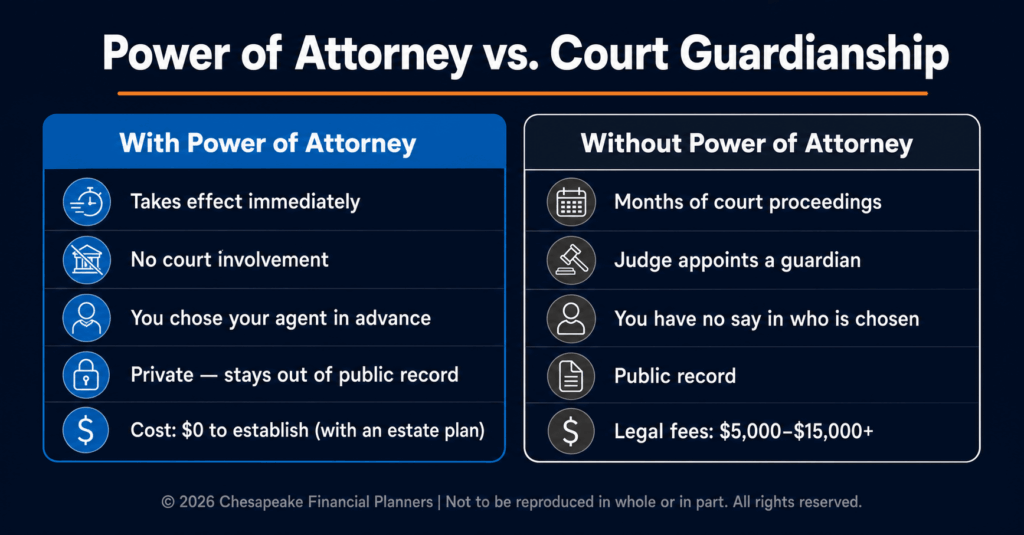
- Without these documents, your family may face court guardianship, which can take months and cost thousands.
- Roughly two-thirds of U.S. adults have no advance directive in place as of 2026.
About the Author: Jeff Judge, CFP®, AEP®, ChFC®, CLU® is Managing Partner of Chesapeake Financial Planners in Forest Hill, Maryland. He has been helping families and business owners in Harford County and the Baltimore metro area navigate estate planning documents since earning his CFP® certification in 2013, by using Chesapeake Financial Planners’ signature process, the R.U.D.D.E.R. method™. Jeff has watched more than one family burn through six figures and the better part of a year fighting for guardianship that two signatures could have prevented.
What Is a Power of Attorney and Why It Matters
A power of attorney is a written authorization that names a trusted person (your "attorney-in-fact" or "agent") to make decisions and take actions for you. The document does not require the agent to be a lawyer. It simply hands them legal standing to act in your place.
Here is the part most people miss. A will is the document everyone talks about, but a will does nothing while you are alive. It only works after death. Powers of attorney are the opposite. They work while you are alive but unable to act, and they expire the moment you die.
You are statistically more likely to face a period of incapacity before death than to die suddenly. A stroke, a serious accident, advancing dementia, or a long illness can leave you alive but unable to sign a check or approve a treatment plan. According to the CDC, someone in the United States has a stroke roughly every 40 seconds. Plenty of those people survive in a state where they cannot manage their own affairs.
Jeff Judge often tells clients that powers of attorney are the most practical estate planning documents they will ever sign. For most families they matter more in real life than the will or the trust, because the odds of needing them are higher and the cost of skipping them is immediate.
What is a will and do I need one for my estate?
Financial Power of Attorney: What It Controls
A financial power of attorney (often called a durable power of attorney) gives your agent authority over your money and property. The word "durable" matters: it means the document stays in effect even after you become incapacitated. A non-durable version ends exactly when you need it most, so durable is almost always the right choice.
Your financial agent can typically:
- Access checking, savings, and investment accounts
- Pay bills, deposit checks, and move money between accounts
- File tax returns and handle IRS matters
- Buy, sell, and manage real estate, including paying the mortgage and property taxes
- Manage brokerage and retirement accounts and exercise stock options
- File insurance claims, pay premiums, and manage policies
- Hire attorneys, enter contracts, and manage business interests
There are limits. Unless your document specifically grants these powers, your agent usually cannot make large gifts, change beneficiary designations on life insurance or retirement accounts, or create and modify trusts. And every shred of authority ends at your death, when your will and your executor take over.
This is where the language of the document does real work. A bare-bones template downloaded online may not authorize the gifting or trust powers that a thoughtful plan needs. Jeff has seen families discover too late that an agent lacked the authority to do basic Medicaid planning because the form skipped a single paragraph. The fix is to draft the document with the actual plan in mind, not to grab the cheapest form available.
Do I need to update my beneficiary designations after a divorce or major life change?
Healthcare Power of Attorney: Medical Decision-Making
A healthcare power of attorney (also called a healthcare proxy or medical power of attorney) authorizes a different kind of decision. This agent steps in when you cannot communicate your own medical wishes. They can authorize or refuse treatment, choose your doctors and facilities, access your medical records, and make end-of-life decisions in line with your stated values.
This document is usually paired with a living will, which spells out your specific wishes about life support, resuscitation, and other end-of-life care. The healthcare power of attorney names the person; the living will gives that person guidance. Together they keep the decision inside your family and out of a courtroom.
Privacy law adds a wrinkle here. Under federal HIPAA rules, hospitals cannot freely share your medical information without authorization. A properly drafted healthcare power of attorney with HIPAA language clears that hurdle so your agent can actually see the information needed to make decisions.
The two documents answer two different questions. Who pays your bills and manages your portfolio if you are incapacitated? That is the financial agent. Who decides whether you have surgery? That is the healthcare agent. They can be the same person or two different people, and many families deliberately split the roles to match each person's strengths.
How Do I Leave Money to a Disabled Child Without Losing Benefits?
Why You Need Both, and Where Powers of Attorney Fit in a Full Plan
Having one document without the other leaves a hole. A financial agent with no healthcare authority can pay the hospital but cannot approve the treatment. A healthcare agent with no financial authority can approve the surgery but cannot access the account to keep the lights on at home. Real crises hit both fronts at once.
Powers of attorney are one piece of a coordinated plan, not the whole plan. At Chesapeake Financial Planners, we work through these documents using the R.U.D.D.E.R. Method™, Chesapeake Financial Planners' six-step planning process: Review and Recognize, Uncover and Understand, Design and Develop, Discuss and Decide, Execute and Empower, and Reassess and Refine. The goal is to make sure your powers of attorney, your will, your beneficiary designations, and your insurance all point in the same direction.
A common mistake Jeff sees is treating these documents as a one-time event. You sign them, file them, and forget them for twenty years. But agents move, relationships change, and laws shift. Powers of attorney should be reviewed when life changes, not left to gather dust in a drawer.
What is an Accredited Estate Planner (AEP)?
Frequently Asked Questions
What happens if you become incapacitated without a power of attorney?
If you become incapacitated without a power of attorney, your family generally cannot access your accounts or make medical decisions for you. They must petition a court to appoint a guardian or conservator, a process that often takes months, costs thousands of dollars, and puts a judge in control of decisions your family could have handled privately.
What is the difference between a durable and a non-durable power of attorney?
A durable power of attorney stays in effect even after you become incapacitated, which is exactly when you need it most. A non-durable power of attorney ends the moment you lose capacity. For incapacity planning, you almost always want the durable version, since the whole point is to keep your agent's authority intact during a crisis.
Can the same person be both my financial and healthcare agent?
Yes, one person can serve as both your financial and healthcare agent, and many families choose this for simplicity. Others deliberately split the roles, naming a financially savvy relative for money decisions and a different person who shares their medical values for healthcare choices. The right answer depends on your family and each person's strengths.
Does a power of attorney override a will?
No, a power of attorney does not override a will, because the two documents never operate at the same time. A power of attorney works only while you are alive and ends at death. A will takes effect only after death. They are sequential tools, not competing ones, which is why most families need both.
Do I need a lawyer to create a power of attorney?
You do not legally need a lawyer to create a power of attorney, since templates exist, but an attorney helps ensure the document includes the specific powers your plan requires. Generic forms often omit gifting authority, trust powers, or HIPAA language, which can leave your agent unable to act when it matters most.
If you want a clear starting point for your own estate planning documents, our free estate planning checklist walks through powers of attorney, wills, and beneficiary designations step by step. Download it at chesapeakefp.com.
Disclosures
The information provided is for educational purposes only and should not be construed as investment advice. Investment strategies should be tailored to individual circumstances, risk tolerance, and goals. Past performance doesn't guarantee future results. Consult with qualified financial professionals regarding your specific situation.
Advisors associated with Chesapeake Financial Planners may be either (1) LPL Financial Registered Representatives offering securities through LPL Financial, Member FINRA and SIPC, and investment advisor representatives offering investment advice through Great Valley Advisor Group; or (2) solely investment advisor representatives offering investment advice through Great Valley Advisor Group and not affiliated with LPL Financial. Great Valley Advisor Group, and Chesapeake Financial Planners are separate entities from LPL Financial.


