

How Does the Annual Gift Tax Exclusion Work?
Last reviewed: July 2026
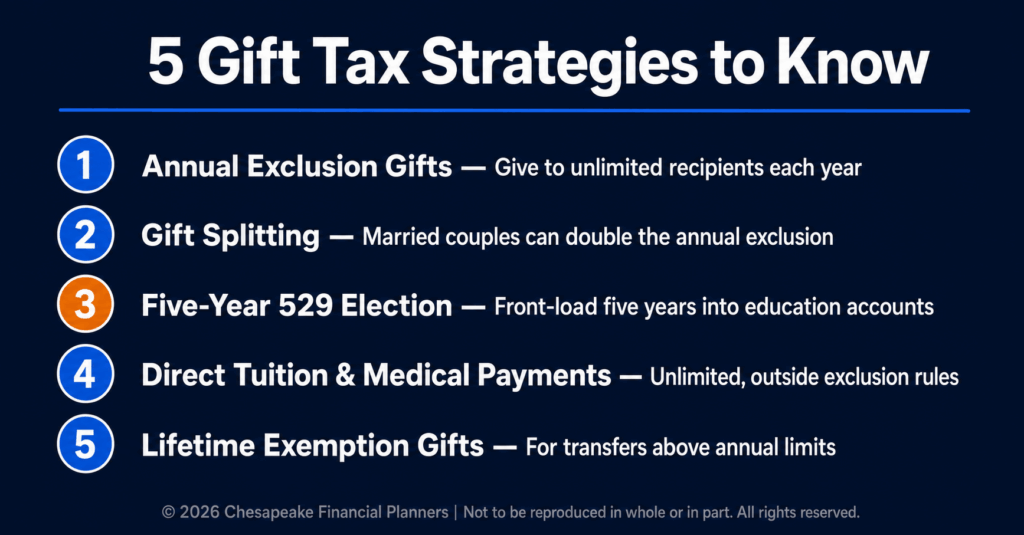
The gift tax exclusion lets you give up to $19,000 per recipient in 2026 without filing a gift tax return or touching your lifetime exemption, according to the IRS. There is no limit on how many people you can gift to. A married couple can combine their exclusions to give $38,000 to the same person every year. Used systematically, this single rule moves serious money out of a taxable estate.
Key Takeaways
- The 2026 annual gift tax exclusion is $19,000 per recipient, with no cap on the number of recipients.
- A married couple can give $38,000 per recipient each year through gift splitting without using lifetime exemption.
- The 2026 lifetime gift and estate tax exemption is $15 million per person under the One Big Beautiful Bill Act.
- Direct payments of tuition and medical bills to the institution are not gifts and do not use any exclusion.
- Gifts to non-citizen spouses qualify for a higher $194,000 annual exclusion in 2026.
About the Author: Jeff Judge, CFP®, AEP®, ChFC®, CLU® is Managing Partner of Chesapeake Financial Planners in Forest Hill, Maryland. He has been helping families and business owners in Harford County and the Baltimore metro area navigate estate and gift tax planning since earning his CFP® certification in 2013, by using Chesapeake Financial Planners’ signature process, the R.U.D.D.E.R. method™. Jeff often tells clients that the biggest gifting mistake he sees isn't giving too much, it's never starting, then watching a decade of tax-free transfer slip away.
What Is the Annual Gift Tax Exclusion?
The annual gift tax exclusion is the amount you can give to any one person in a calendar year without filing a gift tax return or reducing your lifetime exemption. For 2026, the IRS set that figure at $19,000 per recipient.
The power is in the repetition. You can give $19,000 to your son, $19,000 to your daughter, $19,000 to each grandchild, and $19,000 to a friend down the street, all in the same year, with no tax return required. There is no limit on the number of recipients.
Take a couple with three married children and six grandchildren. That's twelve recipients (three children, three children-in-law, six grandchildren). At $19,000 each, one spouse moves $228,000 in a single year. Both spouses gifting doubles it to $456,000 annually. Over ten years, that's $4.56 million out of the estate, plus every dollar of appreciation those gifts earn after they leave your hands. None of it touches the lifetime exemption.
How Does the Lifetime Gift and Estate Tax Exemption Work?
The lifetime exemption is a separate, much larger allowance for gifts that exceed the annual exclusion and for transfers at death. For 2026, that exemption is $15 million per person, or $30 million for a married couple, permanently set by the One Big Beautiful Bill Act signed into law in 2025.
The exemption is unified, meaning lifetime gifts and transfers at death draw from the same pool. Every dollar you gift above the annual exclusion uses a dollar of lifetime exemption. Whatever remains at death shelters your estate from the 40% federal estate tax.
The strategic question is whether to use exemption now through large lifetime gifts or preserve it until death. Lifetime gifts pull future appreciation out of your estate, which can be worth far more than using the same exemption later. The trade-off: assets held until death receive a step-up in cost basis, wiping out capital gains tax on appreciation. The IRS has confirmed that gifts made under earlier higher exemption levels will not be clawed back. Jeff Judge notes: "The step-up in basis at death is real money, so when I'm modeling whether to gift now or hold, I'm comparing the estate tax savings against the capital gains tax your heirs would permanently avoid if you keep the asset."
What Counts as a Present Interest Gift?
To qualify for the annual exclusion, a gift must be a "present interest," meaning the recipient gets immediate use and enjoyment of it. Cash, publicly traded securities, and property transferred outright all qualify cleanly.
Gifts into a trust usually don't qualify unless the trust is built for it. Families solve this with Crummey provisions, which give the beneficiary a short window, often 30 days, to withdraw the contribution. Most beneficiaries never exercise the right, so the money stays in trust, but the withdrawal power makes the gift a present interest that qualifies for the exclusion.
The most generous variation involves 529 education accounts. You can front-load five years of annual exclusions into a single 529 contribution: $95,000 per recipient in 2026, or $190,000 for a married couple, filed on a gift tax return that spreads the election across five years.
How Does Gift Splitting Work for Married Couples?
Gift splitting lets a married couple treat a gift made by one spouse as if each gave half. This lets you use both annual exclusions even when only one spouse writes the check.
Say you give $38,000 to your daughter from your own account. With a gift-splitting election, the IRS treats it as $19,000 from you and $19,000 from your spouse. Both annual exclusions are used and no lifetime exemption is consumed. Without the election, you'd use your full exclusion and dip $19,000 into your lifetime exemption.
The catch is paperwork. Gift splitting requires both spouses to file Form 709, even though no tax is owed. Jeff has seen couples skip the filing because no tax was due, only to create a documentation gap that surfaces years later. The return is the proof the election was made.
What Are the Rules for Gifts to Non-Citizen Spouses?
The unlimited marital deduction that allows tax-free gifts between U.S. citizen spouses does not apply when the recipient spouse is not a U.S. citizen. Instead, gifts to a non-citizen spouse get a higher annual exclusion: $194,000 in 2026, according to the IRS, compared to $19,000 for everyone else.
For larger transfers, a qualified domestic trust (QDOT) preserves the marital deduction while ensuring federal estate tax is eventually paid when the surviving spouse takes distributions or dies. Cross-border couples should run this past an estate attorney before moving significant assets.
Frequently Asked Questions
How much can I give someone in 2026 without paying gift tax?
You can give up to $19,000 per recipient in 2026 without filing a gift tax return or using any lifetime exemption, per the IRS. There is no limit on how many people you can give to, so you can repeat that $19,000 gift across as many recipients as you choose every single year.
Do I have to pay tax on gifts I receive?
No, the recipient of a gift never owes federal gift tax. The gift tax is the responsibility of the person making the gift, and even then it is rarely paid because the lifetime exemption absorbs amounts above the annual exclusion. Recipients generally have no federal filing obligation for gifts they receive.
Does paying someone's tuition count as a taxable gift?
No, tuition and medical expenses paid directly to the school or provider are not considered gifts and use none of your annual exclusion. A grandparent can pay a grandchild's full college tuition straight to the university and still give that grandchild the separate $19,000 annual exclusion gift the same year.
Do I need to file a gift tax return for an $19,000 gift?
No, a gift at or below the $19,000 annual exclusion to a single recipient generally requires no gift tax return. You file IRS Form 709 only when a gift to one person exceeds $19,000, when you elect gift splitting, or when you front-load a 529 plan. No tax is usually owed, but the return is still required.
What happens if I give more than the annual exclusion?
If you give more than $19,000 to one person in 2026, the excess simply reduces your $15 million lifetime exemption and you file Form 709 to report it. You almost never owe actual gift tax until lifetime gifts exceed the full exemption. The return tracks how much exemption you have used over your lifetime.
Can married couples combine their gift tax exclusions?
Yes, a married couple can combine exclusions to give $38,000 per recipient each year through gift splitting. Even if only one spouse funds the gift, they elect to treat it as coming equally from both. This requires both spouses to file Form 709, but no tax is owed and no lifetime exemption is used.
If you found this helpful, our estate planning resources go deeper on coordinating gifts with trusts, charitable strategies, and your full wealth transfer plan. Explore related guidance on How can I potentially optimize my taxes as my income grows?, How do donor-advised funds work for charitable giving and taxes?, and How do you create a family wealth governance structure for long-term success?, then download our estate planning starter guide at chesapeakefp.com.

Want to go deeper? Our 10 Signs You're Ready for a Certified Financial Planner walks through this step by step.
Disclosures
The information provided is for educational purposes only and should not be construed as investment advice. Investment strategies should be tailored to individual circumstances, risk tolerance, and goals. Past performance doesn't guarantee future results. Consult with qualified financial professionals regarding your specific situation.
This information is not intended to be a substitute for specific individualized tax, investment or legal advice. We suggest that you discuss your specific situation with a qualified tax, legal or financial advisor.
Advisors associated with Chesapeake Financial Planners may be either (1) LPL Financial Registered Representatives offering securities through LPL Financial, Member FINRA and SIPC, and investment advisor representatives offering investment advice through Great Valley Advisor Group; or (2) solely investment advisor representatives offering investment advice through Great Valley Advisor Group and not affiliated with LPL Financial. Great Valley Advisor Group, and Chesapeake Financial Planners are separate entities from LPL Financial.


