
How Do I Include Digital Assets and Passwords in My Estate Plan?
Last reviewed: July 2026
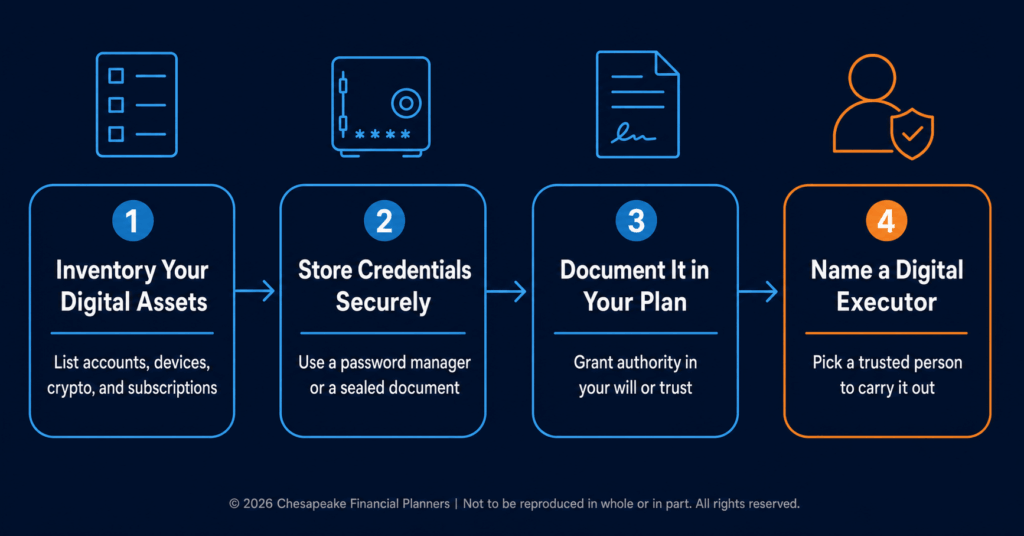
To include digital assets in your estate plan, you need three things: a written inventory of your accounts, legal authority granted to a named fiduciary, and a secure method for passing along access credentials. Digital assets estate planning covers everything from your email and photo libraries to cryptocurrency wallets and online banking. Without explicit legal permission, your executor can be locked out of accounts you spent decades building, and some assets, like crypto held in a self-custody wallet, can vanish forever.
Key Takeaways
- Digital assets estate planning requires a written inventory, fiduciary authority, and a secure way to pass along access credentials.
- All 50 states have now adopted the Revised Uniform Fiduciary Access to Digital Assets Act, giving executors legal access to your digital life.
- Self-custody crypto with no recovery plan is permanently lost at death, with an estimated 3.7 million Bitcoin already unrecoverable.
- Never put passwords directly in your will, which becomes a public court record after probate.
About the Author: Jeff Judge, CFP®, AEP®, ChFC®, CLU® is Managing Partner of Chesapeake Financial Planners in Forest Hill, Maryland. He has been helping families and business owners in Harford County and the Baltimore metro area navigate estate planning since earning his CFP® certification in 2013, by using Chesapeake Financial Planners’ signature process, the R.U.D.D.E.R. method™. Jeff has watched more than one family lose access to a parent's photos, email, and even crypto holdings simply because nobody planned for the password problem.
Most people build a careful estate plan around their house, their retirement accounts, and their life insurance. Then they forget that half their financial life now lives behind a login screen. Your digital assets are real assets. The law has finally caught up to that fact, but only if you do the paperwork to use it.
What Counts as a Digital Asset in Your Estate?
A digital asset is any electronic record in which you hold a right or interest. That definition is deliberately broad, and it matters for your estate plan because each category needs a different handling strategy.
Digital assets generally fall into a few buckets. Financial accounts include online banking, brokerage logins, and PayPal or Venmo balances. Cryptocurrency and NFTs are a category all their own because of how access works. Then there are sentimental and personal assets: email, cloud photo storage, social media accounts, and digital subscriptions. Finally, there are income-producing digital assets like a monetized YouTube channel, a blog, or a domain name portfolio.
The reason this matters for digital assets estate planning is that ownership and access are not the same thing. You may legally own a Coinbase account, but if your executor cannot prove authority and cannot pass the platform's verification, the legal ownership does you no good. According to the Pew Research Center, roughly 96% of American adults now use the internet, which means nearly every estate today contains digital property worth inventorying.
What is a will and do I need one for my estate?

What Law Gives My Executor Access to My Digital Accounts?
The Revised Uniform Fiduciary Access to Digital Assets Act, known as RUFADAA, is the law that grants your named fiduciary legal authority to access your digital accounts after death or incapacity. As of 2026, all 50 states plus the District of Columbia have adopted some version of it, according to the Uniform Law Commission.
Here is the part people miss. RUFADAA sets up a three-tier priority system for who controls access. An online tool offered by the platform itself, like Google's Inactive Account Manager or Facebook's Legacy Contact, ranks first. If you use one of those tools, it overrides everything else. Second in line is your estate planning document, meaning your will, trust, or power of attorney, but only if it specifically grants digital asset authority. Third, and weakest, is the platform's own terms of service agreement, the one you clicked "agree" to without reading.
What this means in practice: if your will is silent on digital assets, your executor falls back to a service agreement that often prohibits account transfers entirely. The FINRA Investor Education Foundation has flagged this gap as a common and avoidable estate planning failure.
What Is a Financial Power of Attorney and Why Do I Need One?
How Do I Make Sure My Family Can Access My Cryptocurrency?
To make sure your family can access your cryptocurrency, you must document where the assets are held and how to reach the private keys or seed phrase, then store that information somewhere both secure and discoverable. Crypto is the highest-risk digital asset in any estate because access is everything.
If you hold crypto on an exchange like Coinbase or Kraken, your executor can work with the platform's estate process, similar to a brokerage account. But if you hold crypto in a self-custody wallet, a hardware device, or a software wallet you control directly, there is no company to call. Whoever holds the seed phrase holds the coins. Lose it, and the assets are gone with no recovery, no customer service, and no court order that can help. Chainalysis estimates that around 3.7 million Bitcoin are already permanently lost, much of it because owners died or lost access without a plan.
Jeff Judge tells crypto-holding clients to treat the seed phrase like the only key to a vault that can never be re-keyed. The practical approach is to store the recovery information in a way that survives you but does not expose it while you are alive: a sealed letter in a fireproof safe, a bank safe deposit box your executor can legally access, or a reputable digital inheritance service. Never email it, never store it in a plain cloud document, and never write it in your will.
How can I potentially optimize my taxes as my income grows?
How Should I Store and Share My Passwords?
The safest way to store and share passwords for estate purposes is a password manager with a designated emergency access feature, paired with written instructions stored separately from the passwords themselves. This solves the central tension of digital assets estate planning: your credentials must be secure today and accessible to the right person later.
A password manager such as 1Password, Bitwarden, or Dashlane lets you store hundreds of logins behind one master password. Most offer an emergency access or legacy contact feature that grants a named person access after a waiting period or after you fail to respond to a request. You set this up once and the system handles the handoff. The Cybersecurity and Infrastructure Security Agency recommends password managers as a core security practice, and the same tool that protects you in life protects your estate in death.
The framework Jeff uses with clients follows the firm's R.U.D.D.E.R. Method™, which is Chesapeake Financial Planners' six-step planning process: Review and Recognize, Uncover and Understand, Design and Develop, Discuss and Decide, Execute and Empower, and Reassess and Refine. Digital assets fit naturally into the "Uncover and Understand" step, because most clients are genuinely surprised by how much of their net worth and personal history now lives online.
Do I need to update my beneficiary designations after a divorce or major life change?
Frequently Asked Questions
Should I put my passwords in my will?
No, you should never put passwords directly in your will. A will becomes a public court record once it enters probate, meaning your private credentials would be exposed to anyone who requests the file. Instead, keep passwords in a password manager or a sealed document referenced by your will but stored separately and securely.
What happens to my online accounts if I die without a plan?
Without a plan, your online accounts default to each platform's terms of service, which usually prohibit transfers and may delete inactive accounts. Your executor may be legally locked out even with a death certificate. RUFADAA can help, but only if your estate documents specifically grant digital asset authority to your named fiduciary.
Can my executor access my email account after I die?
Your executor can access your email only if you granted digital asset authority in your estate documents or set up the provider's own legacy tool, like Google's Inactive Account Manager. Email is critical because it often holds password-reset links for every other account, so it should be a top priority in your digital inventory.
Does a power of attorney cover my digital assets while I am alive?
A power of attorney covers your digital assets during incapacity only if the document explicitly grants digital asset access authority under RUFADAA. A standard, older power of attorney often does not include this language. Review your power of attorney and add specific digital asset provisions if it predates 2018 or is silent on the topic.
How often should I update my digital asset inventory?
Update your digital asset inventory at least once a year and any time you open or close a major account, change a master password, or move cryptocurrency between wallets. Digital life changes fast, and a two-year-old password list is often useless. Treat the review like an annual financial checkup, ideally alongside your full estate plan review.
Are cryptocurrency holdings taxed when I inherit them?
Inherited cryptocurrency generally receives a step-up in cost basis to its fair market value on the date of death, the same as other capital assets. This means heirs may owe little or no capital gains tax if they sell soon after inheriting. Tax rules are nuanced, so confirm the specifics with your tax advisor before selling.
Your Next Step
Digital assets estate planning is no longer optional, because so much of your financial life and personal history now lives behind a login. If you want a clear, organized way to inventory your accounts and pass them along securely, our Estate Document Locator walks you through every digital asset category step by step. Download it at chesapeakefp.com and give your family one less thing to untangle.
Disclosures
The information provided is for educational purposes only and should not be construed as investment advice. Investment strategies should be tailored to individual circumstances, risk tolerance, and goals. Past performance doesn't guarantee future results. Consult with qualified financial professionals regarding your specific situation.
Advisors associated with Chesapeake Financial Planners may be either (1) LPL Financial Registered Representatives offering securities through LPL Financial, Member FINRA and SIPC, and investment advisor representatives offering investment advice through Great Valley Advisor Group; or (2) solely investment advisor representatives offering investment advice through Great Valley Advisor Group and not affiliated with LPL Financial. Great Valley Advisor Group, and Chesapeake Financial Planners are separate entities from LPL Financial.


