

Revocable vs Irrevocable Trust: What's the Difference?
Last reviewed: July 2026
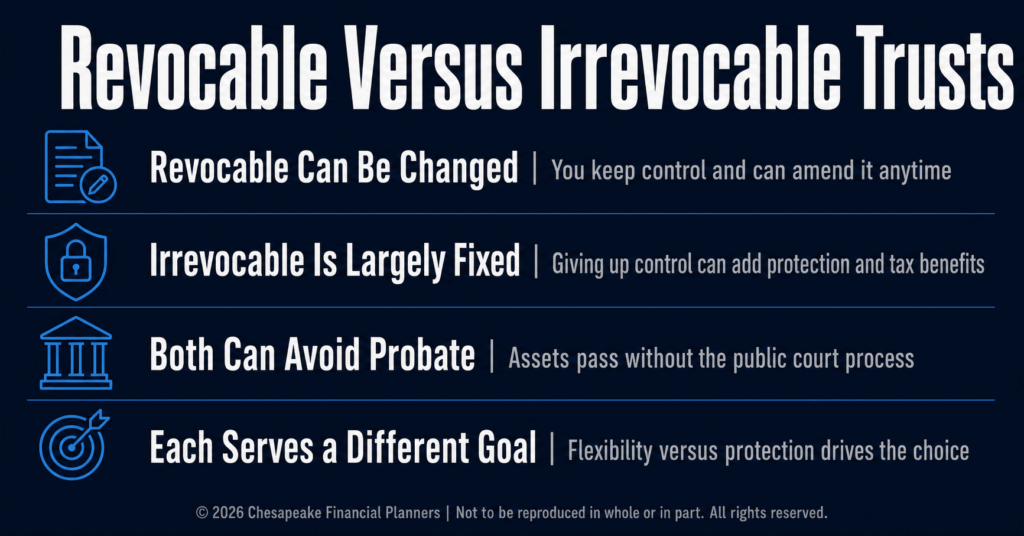
A revocable trust can be changed or canceled anytime during your life, while an irrevocable trust generally cannot. That one difference, control, drives everything else. A revocable trust keeps you fully in charge and helps your estate avoid probate, while an irrevocable trust asks you to give up control in exchange for asset protection and potential tax benefits. The revocable vs irrevocable trust decision ultimately comes down to a single question: do you value flexibility or protection more?
Key Takeaways
- A revocable trust can be amended or revoked during your lifetime; an irrevocable trust generally cannot be changed.
- Both types can avoid probate, but only an irrevocable trust offers meaningful asset protection and estate tax benefits.
- For 2026, the federal estate tax exemption is $15 million per person, so most families use trusts for control, not estate tax.
- In Maryland, the state estate tax exemption is just $5 million, far below the federal level, which changes the math locally.
- A revocable living trust is the common default; irrevocable trusts solve specific protection, tax, or eligibility problems.
About the Author: Jeff Judge, CFP®, AEP®, ChFC®, CLU® is Managing Partner of Chesapeake Financial Planners in Forest Hill, Maryland. He has been helping families and business owners in Harford County and the Baltimore metro area structure their estates since earning his CFP® certification in 2013, by using Chesapeake Financial Planners’ signature process, the R.U.D.D.E.R. method™. Jeff has watched people sign irrevocable trusts they did not need and regret giving up control, and he treats that trade as something you earn a reason for, not a default.
What Is a Revocable Trust?
A revocable trust, often called a revocable living trust, is a legal arrangement you create during your lifetime that you can change, amend, or cancel whenever you want. You typically act as the grantor who creates it, the trustee who manages it, and the beneficiary who benefits from it, all at once. In plain terms, you stay completely in control, and the trust holds your assets while you continue to use them exactly as before.
The main reason people set up a revocable living trust is to avoid probate, the public, court-supervised process of distributing assets after death. Assets titled in the trust pass directly to your beneficiaries without probate, which keeps the transfer private, faster, and usually cheaper. A revocable trust also lets a successor trustee step in smoothly if you become incapacitated, without a court guardianship.
What a revocable trust does not do is protect your assets or save estate taxes while you are alive. Because you keep control, the law still treats the assets as yours: they remain reachable by your creditors and remain part of your taxable estate. The trust becomes irrevocable only when you die, locking in its terms at that point. Jeff Judge often tells clients that a revocable trust is mostly about control and convenience, not protection, and that confusing the two is the single most common trust mistake he sees.
What Is an Irrevocable Trust?
An irrevocable trust is one you generally cannot change, amend, or revoke after you create it. When you move assets into it, you give up ownership and control of those assets to the trust, managed by a trustee for the benefit of others. That loss of control is not a flaw; it is the entire point, because it is what unlocks the benefits a revocable trust cannot offer.
By removing assets from your ownership, an irrevocable trust can shield them from future creditors and lawsuits, depending on state law and how and when the trust is funded. It can also remove those assets, and their future growth, from your taxable estate. That matters most for larger estates. The IRS confirms the federal estate and gift tax exemption rose to $15 million per person for 2026 and is now permanent, so federal estate tax affects very few families. State rules can be far stricter, though. The Comptroller of Maryland sets the Maryland estate tax exemption at just $5 million per person, with a top rate of 16%, which means a Maryland estate can owe state tax while owing nothing federally. Jeff Judge notes: "Maryland clients are often surprised to learn their estate could owe state tax at 16% on assets above $5 million even though they are nowhere near the federal threshold, and that gap is exactly where an irrevocable trust structure earns its keep."
Irrevocable trust uses go well beyond taxes. An irrevocable life insurance trust can keep a policy's death benefit out of your taxable estate. A special needs trust can provide for a disabled beneficiary without disrupting their benefits. Medicaid asset protection trusts, set up well in advance, can help with long-term care planning. The American Bar Association is a useful neutral starting point for understanding these structures before you talk to an attorney.
Revocable vs Irrevocable Trust: How Do They Compare?
Side by side, the trade-off becomes clear. The revocable trust wins on flexibility; the irrevocable trust wins on protection. Neither is better in the abstract, because they are built for different jobs.
| Feature | Revocable Trust | Irrevocable Trust |
|---|---|---|
| Can you change it? | Yes, anytime during life | Generally no, only in limited ways |
| Who controls the assets? | You do | The trustee, not you |
| Avoids probate? | Yes | Yes |
| Protects assets from creditors? | No | Often, depending on state law |
| Removes assets from your taxable estate? | No | Yes |
| Who pays income tax on it? | You do, on your return | The trust or beneficiaries, often |
| Privacy from public records? | Yes | Yes |
| Best suited for | Control and probate avoidance | Asset protection and tax planning |
The pattern is consistent. Anything that gives you ongoing control, the revocable trust offers and the irrevocable trust does not. Anything that requires giving up control, only the irrevocable trust can deliver. There is no structure that does both, which is why so many estate plans use a revocable trust as the everyday backbone and add an irrevocable trust only to solve a specific problem.
When Should You Use Each Type of Trust?
For most families, a revocable living trust is the right default. If your goal is to avoid probate, keep your affairs private, plan for incapacity, and retain full control of your money, the revocable trust does all of that. With the federal exemption at $15 million, the old motivation of dodging federal estate tax simply does not apply to the large majority of households, so flexibility usually wins.
An irrevocable trust earns its place when you have a specific reason to give up control. That includes estates large enough to face estate tax, especially in a state like Maryland with its $5 million threshold, a need to protect assets from creditors or lawsuits, long-term care and Medicaid planning done years ahead, or providing for a beneficiary with special needs. Deciding between them is exactly the kind of question the R.U.D.D.E.R. Method™ is built for, which is Chesapeake Financial Planners' six-step planning process: Review and Recognize, Uncover and Understand, Design and Develop, Discuss and Decide, Execute and Empower, and Reassess and Refine.
Jeff Judge puts it bluntly: "A revocable trust is about control and convenience. An irrevocable trust is about giving up control to get something specific back. If you do not need what the irrevocable trust gives you, do not sign away your flexibility to get it." In his experience, the families who do best are the ones who start with the simpler tool and add complexity only when a real problem calls for it. He points to Maryland couples in particular: with the state's $5 million exemption sitting far below the federal $15 million, a paid-off home, retirement accounts, and life insurance can quietly push a Maryland estate toward the state threshold without anyone realizing it. Whichever route fits, a trust is a legal document with lasting consequences, so it should always be drafted with a qualified estate planning attorney, not from a template.

Related Topics Worth Reading
Trusts are one piece of a complete estate plan. These related guides cover the parts that work alongside them.
- A trust is only as good as the person running it. Our Who should I name as my trustee? guide explains how to choose wisely.
- Trusts handle assets, but not decisions while you are alive. See What Is a Financial Power of Attorney and Why Do I Need One? for the documents that cover incapacity.
- If you have young children, the most important choice is not financial. Our How Do You Name a Guardian for Minor Children? guide walks through it.
- New to all of this? Start with What Are the Basics of Estate Planning for High Net Worth? for the core documents every adult should have.
- For larger estates, our How Can High Net Worth Individuals Reduce Estate Taxes? piece goes deeper on advanced strategies.
Frequently Asked Questions
What is the main difference between a revocable and irrevocable trust?
The main difference is control. A revocable trust can be changed, amended, or canceled by you at any time during your life, so you keep full control of the assets. An irrevocable trust generally cannot be changed once created, and you give up ownership of the assets in exchange for protection and potential estate tax benefits.
Does a revocable trust protect my assets from creditors?
No, a revocable trust does not protect your assets from creditors. Because you keep the power to revoke it and control the assets, the law still treats those assets as yours, so creditors and lawsuits can reach them. For meaningful creditor protection, you generally need an irrevocable trust, where you have given up control of the assets.
Does a revocable trust avoid estate taxes?
No, a revocable trust does not reduce estate taxes. Since the assets remain under your control, they stay part of your taxable estate. A revocable trust avoids probate and provides privacy and incapacity planning, but not estate tax savings. Removing assets from your taxable estate requires an irrevocable trust, where ownership is transferred away from you.
Can an irrevocable trust ever be changed?
Sometimes, but only in limited ways. Although irrevocable trusts are meant to be permanent, some can be modified through court approval, a trust protector, beneficiary agreement, or a process called decanting, where assets are moved into a new trust. These options vary by state and trust terms, so changing an irrevocable trust requires an attorney and is never guaranteed.
Which type of trust avoids probate?
Both revocable and irrevocable trusts avoid probate for the assets they hold. Probate is the public court process of distributing a deceased person's assets, and any asset properly titled in either type of trust passes directly to beneficiaries outside that process. Avoiding probate is a benefit both trusts share, which is why probate avoidance alone does not point to one type.
Do I need a trust if my estate is under $15 million?
Possibly, even though you are under the federal estate tax exemption. Trusts do far more than save estate tax: a revocable trust avoids probate, keeps your affairs private, and plans for incapacity, which benefits estates of any size. In a state like Maryland with a $5 million estate tax threshold, a trust can also matter for state tax planning.
So in the revocable vs irrevocable trust decision, start with what you are trying to accomplish. If you want control, privacy, and a smooth transfer, a revocable living trust likely fits. If you need asset protection or estate tax relief and are willing to give up control to get it, an irrevocable trust may be worth the trade. If you want a simple framework for organizing your estate plan alongside the rest of your finances, our What are the fundamentals of personal financial planning? walks through it step by step. Download it at chesapeakefp.com.
Want to go deeper? Our How to Avoid Common Mistakes With Inherited Wealth walks through this step by step.
This material is for educational purposes only and should not be considered tax or legal advice. Please consult with your tax advisor or attorney regarding your specific situation.
The opinions voiced in this material are for general information only and are not intended to provide specific advice or recommendations for any individual.
All investing involves risk including loss of principal. No strategy assures success or protects against loss.
There is no guarantee that a diversified portfolio will enhance overall returns or outperform a non-diversified portfolio. Diversification does not protect against market risk.
Disclosures
The information provided is for educational purposes only and should not be construed as investment advice. Investment strategies should be tailored to individual circumstances, risk tolerance, and goals. Past performance doesn't guarantee future results. Consult with qualified financial professionals regarding your specific situation.
This information is not intended to be a substitute for specific individualized tax, investment or legal advice. We suggest that you discuss your specific situation with a qualified tax, legal or financial advisor.
Advisors associated with Chesapeake Financial Planners may be either (1) LPL Financial Registered Representatives offering securities through LPL Financial, Member FINRA and SIPC, and investment advisor representatives offering investment advice through Great Valley Advisor Group; or (2) solely investment advisor representatives offering investment advice through Great Valley Advisor Group and not affiliated with LPL Financial. Great Valley Advisor Group, and Chesapeake Financial Planners are separate entities from LPL Financial.


