
Last reviewed: September 2026
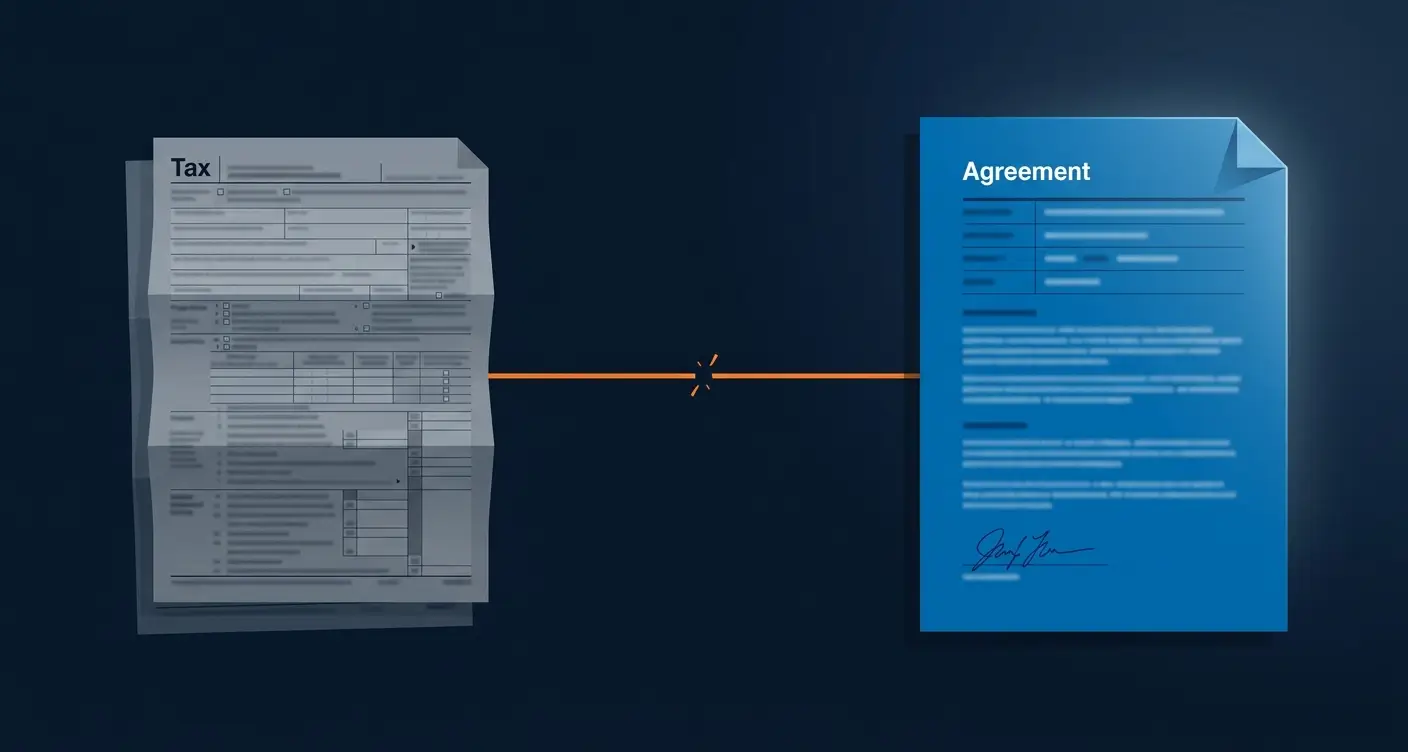
Yes. A sound tax move can quietly break the business valuation formula inside your buy-sell agreement, because many agreements price a departing owner's share off a baseline, often officer compensation or earnings, that the tax move changes. Your CPA's compensation restructuring can cut this year's tax bill exactly as intended while the formula your attorney drafted years earlier starts producing a number nobody signed up for. Neither professional did anything wrong. The gap exists because no one's job included checking whether the two pieces of advice still fit together, and it usually surfaces at the worst possible moment: a death, a disability, or a sale.
Key Takeaways
- A buy-sell business valuation formula tied to officer compensation or earnings can drift out of date the moment compensation is restructured for tax reasons.
- The IRS expects S corporation owners who work in the business to take reasonable compensation, so salary and distribution decisions are routine and frequent.
- Maryland's estate tax exemption is $5,000,000 per person, while the 2026 federal basic exclusion is $15,000,000.
- An annual side-by-side review of the tax plan, the buy-sell agreement, and the estate documents closes a gap that sequential meetings leave open.
About the Author
About the Author: Jeff Judge, CFP®, AEP®, ChFC®, CLU®, is Managing Partner of Chesapeake Financial Planners in Forest Hill, Maryland, where he coordinates tax, legal, and investment planning for business owners across Harford County and the Baltimore metro area. "Most of the damage I see in buy-sell agreements was never a drafting error. It was a good decision made somewhere else that nobody carried back to the agreement."
How Can a Smart Tax Move Change the Business Valuation Formula in Your Buy-Sell Agreement?
Here is the mechanism in its most common form. A CPA recommends adjusting how an owner takes compensation, some mix of salary and distributions, to reduce the overall tax burden. For an S corporation, that conversation happens constantly, because owners who work in the business must be paid reasonable compensation and everything above it can flow out as distributions. On the tax return, the recommendation works exactly as intended.
But a buy-sell agreement often ties its business valuation formula to a multiple of officer compensation, to adjusted earnings that assume a certain compensation structure, or to a book-value calculation that shifts as distributions change retained earnings. Change the compensation structure significantly and the formula can produce a number that no longer reflects what the business is worth, or what the owners intended when they signed.
A business owner we worked with took his CPA's advice on exactly this kind of restructuring. Smart advice, on its own. It also changed the baseline his buy-sell formula relied on, a document his attorney had drafted two years earlier and nobody had looked at since. Neither professional knew the other's work was affected.

Does this mean the CPA or the attorney gave bad advice?
No. The CPA was asked to reduce the tax bill and did, and the attorney drafted a formula that fit the business as it existed at signing. Each was optimizing the piece they were hired to handle. The problem is structural: nobody was asked to check one piece against the other, so a reasonable decision in one lane quietly changed the assumptions in another.
Where Else Does the Same Coordination Gap Show Up?
Compensation and valuation formulas are the clearest version, but we see the same pattern in several other places. In each one, the individual decision was reasonable and the cost shows up in the space between advisors:
1. An estate plan built around an ownership percentage or entity structure that no longer matches reality after a partner buy-in, buyout, or restructuring the estate attorney was never told about.
2. A key person or buy-sell insurance policy sized against an old valuation and never revisited as the business grew, so the coverage no longer matches the cost of replacing that person or funding a buyout at today's value. We cover that gap in depth in our post on key person insurance coverage gaps.
3. A retirement plan contribution strategy that assumes a compensation level the CPA has since lowered for tax reasons, which quietly reduces what the owner can contribute without either professional realizing it.
How does a mismatched estate plan actually play out?
One owner brought on a minority partner through a structured payment plan his CPA handled. The estate attorney who had drafted his will and trust years earlier was never told, so the estate documents still assumed 100% sole ownership passing to his family. We found the mismatch only because we asked to see the estate documents and the current ownership agreement side by side during a routine review, and had something happened to him in that three-year window, the estate would likely have ended up in a dispute with the minority partner over what the documents meant.
| Change made for one reason | What it can do to the buy-sell and estate plan | Who should review it before it takes effect |
|---|---|---|
| Owner compensation restructured for tax savings | Shifts a formula tied to officer compensation or adjusted earnings | CPA, attorney, and financial planner together |
| New partner bought in or ownership percentages changed | Leaves estate documents and buyout terms describing an ownership structure that no longer exists | Estate attorney and business attorney |
| Business grew substantially | Leaves insurance funding and fixed-price clauses far below current value | Financial planner and insurance professional |
| Entity or tax election changed | Can change how the formula measures earnings or book value | CPA and business attorney |
Why Does Maryland Raise the Stakes for a Stale Buy-Sell Formula?
For a Harford County or Baltimore-area owner, a stale formula is not only a partnership problem. It is often an estate tax problem. Maryland's estate tax exemption is $5,000,000 per person, far below the 2026 federal basic exclusion of $15,000,000. A family business that would never trigger a federal estate tax return can easily push a Forest Hill or Bel Air owner over the Maryland line once the home, retirement accounts, and life insurance are added.
That is where the formula matters twice. The buyout price determines what the family actually receives, and the value of the business interest drives the Maryland estate calculation. A buy-sell price does not automatically control the value for tax purposes either: under Internal Revenue Code Section 2703, an agreement's price is respected for estate tax only when the arrangement meets specific tests, including terms comparable to an arm's-length deal. A formula that has drifted far from real value is the kind of arrangement that invites a dispute with the family, with a partner, or with a tax authority. Our guide to Maryland's estate and inheritance taxes covers the state layer in more detail.

Why Do These Gaps Stay Invisible Until They Get Expensive?
This problem persists because nothing breaks right away. The compensation restructuring saves real tax dollars this year. The estate documents still exist and look complete. The insurance policy is still in force. Everything appears to be working.
The gap surfaces later, usually at the worst possible moment. A partner's death or disability triggers the buy-sell formula and the number it produces matches no one's expectation. An estate settles and the ownership structure in the documents does not match reality. A sale process begins and the valuation everyone assumed turns out to rest on assumptions nobody had checked in years. By then it is not a quick fix. It is a renegotiation or a legal dispute, happening when the owner or the family has the least bandwidth to handle it.
Isn't my CPA or my attorney already watching for this?
Usually not, and not through any lack of diligence. Your CPA does not see your buy-sell agreement unless you show it to them, and your attorney does not see this year's tax return unless you bring it up. Each is engaged and evaluated on their own piece, with no explicit charge to check their work against the other two, which is why most owners assume the whole picture is covered when no one has actually been asked to cover it.
What Actually Closes the Gap, and What Should You Check This Week?
"The fix isn't finding a better CPA or a better attorney. Both professionals are likely doing competent work within their own lane. The fix is creating a coordinating conversation that currently doesn't exist, where someone is responsible for checking whether the pieces still fit together." Jeff Judge, CFP®, AEP®, ChFC®, CLU®
That means, at minimum, an annual review where the tax strategy, the legal documents, and the financial plan are looked at side by side, not in three separate meetings months apart. It means the CPA's recommendation gets checked against what the buy-sell agreement assumes before it is implemented, not after. And it means the attorney's documents get revisited whenever there is a material change to compensation, ownership, or value, not on whatever multi-year cycle happens to come up.
This is the coordinating role we take on for business owner clients through the R.U.D.D.E.R. Method™, Chesapeake Financial Planners' six-step planning process: Review and Recognize, Uncover and Understand, Design and Develop, Discuss and Decide, Execute and Empower, and Reassess and Refine. The Reassess and Refine step is where a buy-sell formula gets tested against this year's compensation, ownership, and value. For the owner in the first example, that meant bringing the CPA and the attorney into the same conversation for the first time in the life of that agreement, and updating the formula to reflect the current compensation structure and the owners' actual intent.
A simple way to start this week: pull your buy-sell agreement, your most recent estate documents, and your last two years of tax returns, and put them in front of one person who can read all three at once. The goal is not to find a problem for its own sake. It is to confirm the assumptions in each document still match what is true about the business today. Harford County owners, whether you run a contracting firm in Bel Air, a practice in Towson, or a family manufacturer near Aberdeen, can start that review with us in person in Forest Hill or virtually.
Frequently Asked Questions
What is a business valuation formula in a buy-sell agreement?
It is the method written into the agreement for setting the price one owner, or the company, pays for another owner's share when a trigger event occurs, such as death, disability, retirement, or departure. Common approaches include a fixed agreed price, a multiple of earnings or officer compensation, book value, or an independent appraisal at the time of the trigger.
How often should a buy-sell agreement be reviewed?
At least annually alongside the tax plan, and any time compensation, ownership percentages, entity structure, or business value changes materially. Waiting for a multi-year legal review cycle is how formulas drift years out of date without anyone noticing.
Can an S corporation compensation change affect a buy-sell agreement?
Yes. If the valuation formula is tied to officer compensation or to earnings figures that shift when salary and distributions are rebalanced, a compensation change made for tax reasons can move the buyout price. The tax savings are real, but the effect on the agreement should be checked before the change takes effect.
Does the buy-sell price determine the value of the business for Maryland estate tax?
Not automatically. Under Internal Revenue Code Section 2703, an agreement's price is respected for estate tax purposes only when the arrangement meets specific tests, including terms comparable to an arm's-length deal. A formula that has drifted far from real value is more likely to be challenged, which matters in Maryland because the state exemption is $5,000,000 per person.
Who should coordinate my CPA, attorney, and financial advisor?
Someone whose job is explicitly to look across all three, which is often a financial planner who reviews the tax strategy, legal documents, and investment plan together. That coordinator does not replace your CPA or attorney. They make sure each professional's work is checked against the others before a decision takes effect.
If you are a business owner in Harford County or the Baltimore metro area and your buy-sell agreement, estate documents, and tax strategy have never been reviewed in the same conversation, Chesapeake Financial Planners can help you find out whether the pieces still fit together. Schedule a call and we will walk through what a side-by-side review would look like for your business.
A version of this article was originally published on Chesapeake Financial Planners' LinkedIn.
Disclosures
The information provided is for educational purposes only and should not be construed as investment advice. Investment strategies should be tailored to individual circumstances, risk tolerance, and goals. Past performance doesn't guarantee future results. Consult with qualified financial professionals regarding your specific situation.
This information is not intended to be a substitute for specific individualized tax, investment or legal advice. We suggest that you discuss your specific situation with a qualified tax, legal or financial advisor.
This material is for educational purposes only. Insurance products contain exclusions, limitations, and terms for keeping them in force. Please contact a qualified insurance professional for costs and complete details.
Advisors associated with Chesapeake Financial Planners may be either (1) LPL Financial Registered Representatives offering securities through LPL Financial, Member FINRA and SIPC, and investment advisor representatives offering investment advice through Great Valley Advisor Group; or (2) solely investment advisor representatives offering investment advice through Great Valley Advisor Group and not affiliated with LPL Financial. Great Valley Advisor Group, and Chesapeake Financial Planners are separate entities from LPL Financial.
Chesapeake Financial Planners | 2402 Scotlon Ct, Forest Hill, MD 21050 | (410) 652-7868 | www.chesapeakefp.com
© 2026 Chesapeake Financial Planners | Not to be reproduced in whole or in part. All rights reserved.


