

What does a buy-sell agreement need to cover for a co-owned business?
Last reviewed: July 2026
A buy-sell agreement needs to cover six triggers, a valuation method, a funding source, payment terms, and tax allocation. Most co-owned businesses have a buy sell agreement that covers two of those well, one of them partially, and the rest as boilerplate the lawyer borrowed from a different deal. The result is a document that looks complete on the shelf and falls apart the day someone actually needs it.
On This Page
- Key Takeaways
- What does a buy-sell agreement actually do?
- Which triggers must a buy-sell agreement address?
- How do you fund a buy-sell agreement?
- What disability and death provisions belong in every agreement?
- Related Topics Worth Reading
- Frequently Asked Questions
- Disclosures
Key Takeaways
- A complete buy-sell agreement names six succession triggers (death, disability, divorce, retirement, voluntary exit, involuntary exit) and the price formula for each.
- Disability is the most-often-missing trigger, even though the Social Security Administration says about 1 in 4 of today's 20-year-olds will be disabled before retirement.
- Funding usually combines life insurance, disability buyout insurance, and a sinking fund; an unfunded agreement is the most common reason buy-sells fail in practice.
- With the federal estate exemption now at $15 million per person for 2026, buy-sell terms drive estate values rather than the other way around.
- Most buy-sell agreements last 10 to 30 years; a 3-to-5-year review cycle is the difference between a working document and a costly misunderstanding.
About the Author: Jeff Judge, CFP®, AEP®, ChFC®, CLU® is Managing Partner of Chesapeake Financial Planners in Forest Hill, Maryland. He has been helping families and business owners in Harford County and the Baltimore metro area work through buy-sell agreements and business succession since earning his CFP® certification in 2013, by using Chesapeake Financial Planners’ signature process, the R.U.D.D.E.R. method™. In Jeff's practice, more co-owned businesses are tripped up by a missing or stale disability trigger than by any other single gap in their succession paperwork. As Jeff puts it: "Every co-owner I work with has thought about what happens if a partner dies, but almost none of them have sat down and defined in writing what disability means in the context of their specific agreement — and that undefined gap is almost always the one that turns into a crisis."
What does a buy-sell agreement actually do?
A buy-sell agreement is a binding contract between co-owners that says, in advance, who can buy an owner's share, when, at what price, and on what terms when a specific event happens. Without it, the surviving owners are negotiating with a grieving spouse, a disability insurer, a divorce attorney, or a creditor; with one, they are following instructions everyone already agreed to.
The contract has three jobs. First, it controls who ends up with equity in the business. Second, it sets the price formula or valuation method so the family of a departing owner gets fair value without litigating it. Third, it identifies the funding source that actually pays the exit price, because a promise to pay $4 million for a partner's interest is not the same as $4 million sitting in a policy when it is needed.
Most owners think of a buy-sell as estate or insurance paperwork. It is closer to an operating constitution. If your business partner dies on a Tuesday, the agreement is what tells you exactly what happens Wednesday morning, who controls the votes, who signs the checks, and how the buyout will be funded. That is a planning instrument, not a binder on a shelf.
The buy-sell sits at the center of a broader succession plan. The operating agreement points to it for transfer restrictions, the estate plan assumes its valuation, and the company's banking covenants often require it to exist. The U.S. Small Business Administration lists a written buy-sell as foundational for any multi-owner business preparing for a future ownership change. Treating it as one piece of the How Do I Create a Business Succession Plan? picture, rather than a standalone form, is how owners avoid finding three documents that contradict each other.
Which triggers must a buy-sell agreement address?
The six triggers every co-owned business needs to address are death, disability, divorce, retirement, voluntary exit, and involuntary exit. Most agreements cover death well, address retirement vaguely, mention disability without defining it, and treat the other three as someone else's problem. That gap is where partnerships break.
Each trigger answers a different question. Death: what happens to a partner's heirs and their stake. Disability: at what point of long-term inability does the company have the right or obligation to buy out the disabled owner. Divorce: what happens if a co-owner's spouse becomes entitled to part of the business through a property settlement. Retirement: how an owner gives notice, the price that applies, and the payment terms. Voluntary and involuntary exit cover walking away by choice and termination for cause, bankruptcy, license loss, or conviction.
Disability deserves separate attention because the numbers are not what most owners assume. The Social Security Administration reports about 1 in 4 of today's 20-year-olds will become disabled before reaching retirement age. For owners in their 40s and 50s, the probability of a disabling event during the agreement's working life is higher than the probability of either partner dying in that same window. Treating disability as a footnote while spending pages on death provisions is backwards.
Defining "disability" is half the work. Most agreements use a vague phrase like "unable to perform usual duties," which generates a fight every time. Better drafting ties the definition to a third party, usually the disability insurance carrier funding the policy, or a specific window such as twelve consecutive months of inability to perform material duties. The point is to remove judgment from the worst possible moment.
Divorce triggers are the third commonly missing piece. Without one, a divorcing spouse can end up with a fractional ownership interest in a business they have never worked at. Standard drafting requires the co-owner spouse to consent to the buy-sell terms in writing and gives the company or the other owners a right to repurchase any interest awarded in a property settlement at a defined formula price.
Voluntary and involuntary exit triggers round out the list. Voluntary exit covers a planned business partner buyout, where an owner gives written notice and the company executes a structured purchase. Involuntary exit covers loss of professional license, bankruptcy, felony conviction, or termination for cause, and usually carries a discounted price. Pricing the involuntary trigger at a discount is the partnership's defense against rewarding bad behavior.
How do you fund a buy-sell agreement?
Most co-owned businesses fund their buy-sell with some combination of life insurance, disability buyout insurance, a sinking fund, and an installment note. The choice depends on the trigger, the company's cash flow, and the tax treatment the owners want. An unfunded agreement is the most common reason buy-sells fail in practice; the document says the surviving owners will pay $3 million, but no one set aside the $3 million.
| Funding Method | Best Trigger | Cost | Tax Treatment | Risk |
|---|---|---|---|---|
| Life insurance | Death | Premium based on age and health | Death benefit generally income-tax-free to recipient | Cash value subject to creditors; underwriting may decline |
| Disability buyout insurance | Long-term disability | Premium based on benefit structure | Premiums generally not deductible; benefits generally not taxable | Long elimination periods (12-24 months) |
| Sinking fund | Retirement, voluntary exit | Cash drag on operations | Taxed as earned; account assets in the company | Slow to fund; may not be ready when needed |
| Installment note | Any trigger | None up front | Interest payments deductible; gain spread over years | Departing owner becomes a creditor of the business |
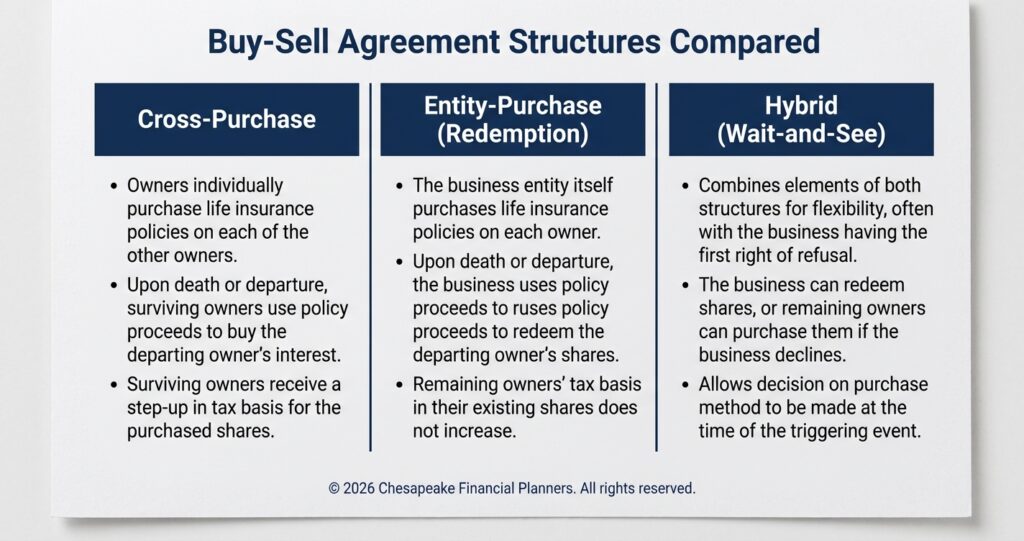
Life insurance covers the death trigger cleanly. The company or the surviving owners are named as beneficiaries, the death benefit is received generally income-tax-free, and the cash funds the buyout the day after death. Two structures dominate: entity-purchase, where the business owns one policy on each owner; and cross-purchase, where each owner owns a policy on each other owner. Cross-purchase is administratively heavier with three or more owners but gives surviving owners a stepped-up basis in the purchased interest, which can save real tax dollars when the business sells later. The structure choice often determines whether the policy serves both buy-sell and What is key person insurance, and does my business need it? purposes.
Disability buyout insurance is a separate product from disability income insurance. It pays a lump sum or structured payments once a defined elimination period passes, typically twelve to twenty-four months. The premium is higher than most owners expect because the insurer is underwriting medical and business risk together, and the policy must align with the agreement's definition of disability. When the two definitions diverge, the company faces a buyout obligation with no corresponding insurance payout.
A sinking fund (sometimes called an internal redemption reserve) makes sense for retirement and voluntary-exit triggers because those events have long lead times. The drawback is cash drag. Most established co-owned businesses use a hybrid: insurance for the unpredictable triggers, a sinking fund or installment-note structure for the predictable ones.
Chesapeake's What Is the R.U.D.D.E.R. Method™? applies here too. The R.U.D.D.E.R. Method™ is Chesapeake Financial Planners' six-step planning process: Review and Recognize, Uncover and Understand, Design and Develop, Discuss and Decide, Execute and Empower, and Reassess and Refine. For a buy-sell, Reassess and Refine is the step that catches the funding gap between a 2015 agreement priced at $2 million and a 2026 business worth $6 million.
What disability and death provisions belong in every agreement?
Every buy-sell needs death and disability provisions that name the trigger event precisely, set a valuation method that does not depend on negotiation at the worst moment, identify the funding source, and lay out the payment terms. Vague language in any of these four creates the litigation risk the agreement was supposed to prevent.
For the death trigger, the core provisions are mandatory versus optional purchase, the price formula, the closing window, and the funding source. Mandatory purchase obligates the surviving owners to buy the deceased owner's interest; optional gives them the right but not the duty. Most well-drafted agreements use mandatory for the percentage covered by insurance and optional for any excess, which prevents the survivors from being forced to write a check they cannot cover.
Valuation language is where most disputes start. The three common methods are a fixed price updated periodically, a formula tied to revenue or EBITDA multiples, and a third-party appraisal triggered at the event. Each fails differently. A fixed price drifts; a 2015 valuation of $3 million is not what the company is worth in 2026. A formula multiple captures growth but breaks during industry downturns. A third-party appraisal at the trigger date is fair but slow, and the appraiser's number is whatever it is. Jeff puts it this way: "The most expensive buy-sell agreement is the one signed twenty years ago and never reviewed. The price is wrong, the funding is light, and the triggers no longer match the business." The hybrid he generally recommends is a stated price refreshed every two years by signed certificate, with a third-party appraisal as a backstop if more than three years have passed.
For the disability trigger, the agreement needs to define disability, set an elimination period, and specify the funding source. The elimination period is the waiting time between the start of the disability and the company's obligation to buy. Twelve to twenty-four months is standard; less creates ambiguity, and more leaves the company carrying a non-working owner too long. The disability buyout policy's elimination period should match the agreement's. If the policy waits twenty-four months and the agreement triggers at twelve, the company owes twelve months of payments with no insurance proceeds.
Payment terms control the cash-flow shock. A lump-sum payment is cleanest but only possible if fully funded by insurance. Most agreements blend a lump sum at closing with an installment note for any unfunded balance, typically over five to seven years at a stated interest rate. The note should be subordinated to operating debt so the buyout does not violate the company's bank covenants. The agreement should also specify whether the price is paid in nominal dollars or whether it carries an interest factor; for the underlying numbers, business valuation methods dives into the formula choices that drive these calculations.
Estate and gift tax consequences also belong here. With the federal estate exemption now at $15 million per person for 2026 under the One Big Beautiful Bill Act, fewer estates owe federal tax, but state-level estate taxes still bite in jurisdictions like Maryland, where the Maryland Comptroller maintains a separate exemption below the federal threshold. The buy-sell valuation also drives gift tax exposure during the owners' lifetimes; selling an interest to a family member below the formula price can produce a deemed gift, applied first against the annual gift exclusion of $19,000 per donee for 2026 and then against the lifetime exemption.
To make that valuation stick for estate-tax purposes, the agreement must satisfy Internal Revenue Code Section 2703: a bona fide business arrangement, not a device to transfer wealth to family for less than full consideration, and terms comparable to similar arrangements among unrelated parties. Fail any prong and the IRS substitutes fair market value, which is usually higher.

Related Topics Worth Reading
A buy-sell agreement sits at the center of a broader planning picture. The topics below expand on the funding, valuation, and succession decisions that feed into it.
When Should Business Exit Planning Start Before a Sale? covers how early the planning work should begin before a planned sale. The answer is usually earlier than owners think, and the buy-sell often needs to be rewritten before an external sale process begins.
What is key person insurance, and does my business need it? explains the difference between buy-sell funding and key person coverage, which protects the business from operational loss rather than ownership transfer. Many co-owned businesses need both.
business valuation methods goes deeper on the formula choices that drive buy-sell pricing: discounted cash flow, EBITDA multiples, revenue multiples, and asset-based approaches.
What Does Business Owner Estate Planning Miss When the Business Is Worth $4 Million? connects the buy-sell to wills, trusts, and beneficiary designations. A buy-sell that conflicts with the estate plan creates exactly the dispute the agreement was meant to prevent.
succession planning for co-owners covers the non-document side: management succession, leadership development, and the conversations co-owners need before they document the answers.
Frequently Asked Questions
How often should we update a buy-sell agreement?
A buy-sell agreement should be reviewed every two to three years and updated whenever the business value, ownership, or tax law changes materially. Co-owned businesses that wait five or more years between reviews typically find the price is stale, the funding is light, and the triggers no longer match the operating reality. A short signed addendum refreshing price and funding is usually faster than redrafting the full agreement.
Does a buy-sell agreement need to be funded by insurance?
A buy-sell agreement does not technically need to be insurance-funded, but unfunded agreements are the most common reason buy-sells fail in practice. The agreement creates a binding obligation; the funding source determines whether that obligation can actually be met. Insurance covers the death and disability triggers cleanly. Retirement, divorce, and voluntary exits are typically funded through a sinking fund, an installment note, or a combination, since their timing is more predictable than a death.
What's the difference between entity-purchase and cross-purchase buy-sell structures?
In an entity-purchase, the business itself owns the policies on each co-owner and uses the death benefit to redeem the deceased owner's shares. In a cross-purchase, each owner personally owns a policy on each other owner and uses the proceeds to buy the deceased owner's interest directly. Cross-purchase generally provides a stepped-up basis to the surviving owners, which can save substantial capital gains tax if the business is sold later. The trade-off is administrative complexity once three or more owners are involved. A trusteed cross-purchase captures much of the basis benefit with one policy per owner.
Can a buy-sell agreement fix the value of the business for estate tax purposes?
A buy-sell agreement can fix the value for estate tax purposes only if it satisfies Internal Revenue Code Section 2703. The three requirements: a bona fide business arrangement, not a device to transfer wealth to family for less than adequate consideration, and terms comparable to arrangements among unrelated parties. Family-owned businesses face particular scrutiny. Even with the federal estate exemption at $15 million per person for 2026, Section 2703 still matters for businesses near that threshold and for state-level estate tax.
What happens if one partner refuses to sign an updated buy-sell agreement?
If one partner refuses to update an existing buy-sell, the existing agreement stays in force on whatever terms it originally contained. There is no automatic right to force an update. The practical response is one of three options: continue under the old agreement, restructure the underlying operating agreement to require periodic buy-sell review, or plan for one owner to exit on terms the other can live with. Refusal to update is often a signal of a deeper partnership disagreement that the buy-sell cannot resolve on its own.
Do we need a separate buy-sell if our operating agreement already addresses transfers?
Most co-owned businesses benefit from a standalone buy-sell even if the operating agreement covers transfer restrictions. Operating agreements usually address transfer mechanics, like who consents and rights of first refusal, but rarely contain the level of detail a buy-sell needs: trigger definitions, valuation formulas, funding obligations, and payment terms. A short transfer-restriction clause in the operating agreement that points to a separately drafted buy-sell is the cleanest approach.
How much does a buy-sell agreement cost to draft and maintain?
Drafting a buy-sell for a typical co-owned business runs roughly $3,000 to $10,000 in legal fees depending on complexity, the number of owners, and whether it ties into an existing operating agreement. The larger ongoing cost is funding: life insurance and disability buyout premiums, which depend on owner age and benefit size, often add up to between 1% and 3% of annual revenue for a fully insured agreement. Most co-owners view this as cheap relative to the cost of an unfunded transition.
If you found this helpful and want a clearer picture of how a buy-sell agreement fits into your broader planning, our Business Owner Planning Guide walks through trigger language, funding choices, and valuation methods with examples you can apply to your own agreement. Download it at chesapeakefp.com.
Disclosures
The information provided is for educational purposes only and should not be construed as investment advice. Investment strategies should be tailored to individual circumstances, risk tolerance, and goals. Past performance doesn't guarantee future results. Consult with qualified financial professionals regarding your specific situation.
Advisors associated with Chesapeake Financial Planners may be either (1) LPL Financial Registered Representatives offering securities through LPL Financial, Member FINRA and SIPC, and investment advisor representatives offering investment advice through Great Valley Advisor Group; or (2) solely investment advisor representatives offering investment advice through Great Valley Advisor Group and not affiliated with LPL Financial. Great Valley Advisor Group, and Chesapeake Financial Planners are separate entities from LPL Financial.


