

Published: | Last reviewed: November 2026 by Jeff Judge, CFP®
Part of our guide: What Is a Succession Plan for a Financial Advisor?
How should I prepare my advisory practice for sale three to five years out? Work on four things in order: clean up your records and agreements, shift transaction revenue toward recurring advisory fees, lessen your own key-person dependency, and get a valuation while planning your personal finances. Starting early gives you time to fix each one before a buyer sees it.
Key Takeaways
- Advisor Legacy recommends starting 3 to 5 years before exit to get a valuation, clean up books, document operations, and prepare clients.
- J.D. Power's 2025 study, cited by RightCapital, found 30% of advisors retiring within five years have no formal succession plan.
- Schwab Advisor Services, citing DeVoe & Company, reports more than 300 RIA deals closed in 2025, so buyers are active.
- Capital gains rates of 0%, 15%, or 20% and a possible 3.8% net investment income tax belong in your own financial plan.
About the Author: Jeff Judge, CFP®, AEP®, ChFC®, CLU® is Managing Partner of Chesapeake Financial Planners in Forest Hill, Maryland. He has been helping families and business owners in Harford County and the Baltimore metro area navigate business transitions and exit planning since earning his CFP® certification in 2013, by using Chesapeake's signature process, the R.U.D.D.E.R. Method™. "The practices that sell well were not rushed. Somebody started years earlier and fixed the unglamorous things."
This post is neutral. Chesapeake Financial Planners acquires advisory practices, but these steps are general market guidance, not the firm's own requirements.
How Should I Prepare My Advisory Practice for Sale, Year by Year?
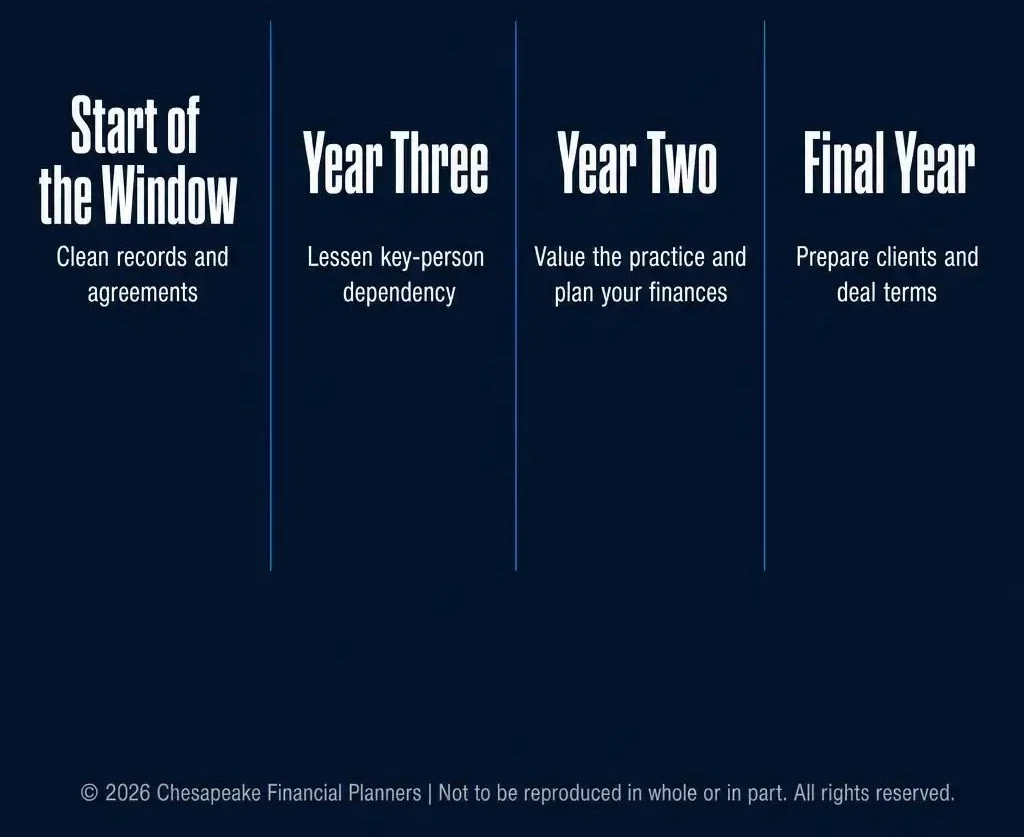
Advisor Legacy advises you to "begin planning 3–5 years ahead, even if you're not ready to list." The advisory practice succession timeline below turns that into phases. Adjust it to your own date.
| Phase | Focus | Output to have in hand |
|---|---|---|
| Years 5 to 4 | Records, agreements, and revenue mix | Normalized financials, signed agreements, current client data |
| Year 3 | Key-person dependency and team | Second advisor in place, documented processes |
| Year 2 | Valuation and personal finances | Data-driven valuation, retirement and tax projection |
| Final year | Client transition and deal terms | Named successor plan, advisors lined up |
A tighter window of three years compresses the first two rows into one year. The order still holds, because each phase makes the next one easier. Use the table as a checklist: put each output on a calendar with an owner, and review it every quarter. An item that slips a quarter is easy to catch up, and one that slips a year is not. Jeff Judge often tells advisors that the first year feels like housekeeping and pays off the longest.
How Do I Clean Up Records and Agreements?
Start with the paper a buyer will ask for. Advisor Legacy says unreconciled books, personal expenses mixed with business expenses, and outdated CRM data create red flags, and that buyers and lenders need clean, normalized financials showing recurring revenue, client segments, profitability, and cash flow. SEC rules also require advisers to keep written agreements entered into with any client, so match each household to a current signed agreement. Our post on the red flags buyers find in due diligence shows what buyers look for. Fix small gaps now: a missing signature or a stale client record is a quick repair today and an awkward conversation during a buyer's review.
What records will a buyer ask for first?
Clean, normalized profit and loss statements, a split of recurring and transactional revenue, client segmentation by age and household size, updated CRM data, and reconciled accounts. Advisor Legacy lists these as the core set. Assemble them once, keep them current, and your preparation to sell an advisory practice gets easier each year.
Why Shift Toward Recurring Advisory Fees?
Because buyers pay more for revenue that renews. The FPA Journal states that "the value of recurring revenue is much higher compared to that of commission revenue from one-time transactions." RightCapital lists recurring revenue percentage, client retention rate, average client age, revenue growth, and documentation quality among the factors that affect value. Commonwealth adds that moving from commission-based to fee-based service can lay the groundwork for stronger long-term revenue.
Shifting takes time because clients must agree to new arrangements, and the change goes better when the scope of ongoing service is written down. Begin with new clients and with households whose needs have changed, and track the recurring share each quarter. Our post on what makes a practice more valuable to a buyer explains how buyers weigh recurring advisory fees.
How Do I Lessen Key-Person Dependency?
Make the practice work without you, because buyers price key person risk. Advisor Legacy says that if you cannot show the practice would keep serving clients in the event of your death or disability, buyers see risk and price it in or walk away. One warning sign it lists: you cannot explain how the practice would run without you for 90 days.
Three steps help. Add a second advisor and give that person real client responsibility. Document your planning process and service calendar so the work does not live in your head. Introduce clients to the team early, so the relationship belongs to the firm, and let the second advisor lead a few meetings so clients see the handoff working before it matters. Our guide to succession planning for a financial advisor covers continuity in more depth.
When should I tell clients about a sale?
RightCapital says communication should happen once there is a named successor and a defined timeline, in the two-to-three year window before a planned exit. The first conversation presents the transition as a continuity decision and offers a joint meeting with both advisors. Because advisory contracts require client consent to assignment, clients will hear about it eventually, so plan the message.

How Do I Value My Practice and Plan My Own Finances?
Get an advisory practice valuation grounded in data, not a number you heard at a conference. Advisor Legacy says a data-driven valuation accounts for client age, revenue mix, recurring versus transactional income, profitability, and operational efficiency, and that overestimated valuations stop qualified buyers and financing. It also recommends a team: an M&A advisor who specializes in advisory practices, an attorney, a CPA, and a valuation specialist. Refresh valuations and readiness assessments each year, because client age, revenue mix, and the recurring share each move.
Then build your own plan, and share it with your own advisors well before you list, so tax and retirement choices are made on purpose rather than in a hurry. Model the income you need in retirement, the after-tax proceeds you can expect, and what happens to your plan if the price or the payment terms change. Capital gains rates and the net investment income tax shape the result, and so does how the deal is paid, as our post on how the sale of a practice is taxed explains. Chesapeake Financial Planners uses the R.U.D.D.E.R. Method™ for client planning. The R.U.D.D.E.R. Method™ is Chesapeake Financial Planners' six-step planning process: Review and Recognize, Uncover and Understand, Design and Develop, Discuss and Decide, Execute and Empower, and Reassess and Refine.
Thinking about "how should I prepare my advisory practice for sale"? Jeff Judge and the Chesapeake team welcome an early, confidential conversation about your timeline. Schedule a fit call with Jeff at chesapeakefp.com.
Frequently Asked Questions
How early should I start preparing my advisory practice for sale?
Three to five years before your target exit is a practical window, according to Advisor Legacy. RightCapital notes that external sales benefit from two to three years of preparation, while internal successions need five or more. Starting earlier gives you time to fix records, revenue mix, and dependency.
What should I clean up first?
Start with financials and client agreements. Reconcile your books, separate personal and business expenses, update your CRM, and match each household to a current signed agreement. Buyers and lenders need clean, normalized numbers, so this work shapes every later step, including valuation.
Do I need to shift to recurring fees before selling?
It is not required, but it helps. The FPA Journal says recurring revenue is worth much more than commission revenue from one-time transactions. Moving clients toward ongoing advisory fees takes time, so begin early, track the recurring share each quarter, and keep the change documented.
Who should be on my sale team?
Advisor Legacy recommends an M&A advisor who specializes in advisory practices, an attorney experienced in advisory deals and securities regulation, a CPA who understands deal tax effects, and a valuation specialist. Add your own planner to connect the deal to your retirement and tax picture.
When should I tell my clients?
Wait until you have a named successor and a defined timeline, which RightCapital places in the two-to-three year window before a planned exit. Present the change as continuity and offer a joint meeting. Clients must consent to contract assignment, so a clear message prevents surprises.
Disclosures
The information provided is for educational purposes only and should not be construed as investment advice. Investment strategies should be tailored to individual circumstances, risk tolerance, and goals. Past performance doesn't guarantee future results. Consult with qualified financial professionals regarding your specific situation.
This information is not intended to be a substitute for specific individualized tax, investment or legal advice. We suggest that you discuss your specific situation with a qualified tax, legal or financial advisor.
Advisors associated with Chesapeake Financial Planners may be either (1) LPL Financial Registered Representatives offering securities through LPL Financial, Member FINRA and SIPC, and investment advisor representatives offering investment advice through Great Valley Advisor Group; or (2) solely investment advisor representatives offering investment advice through Great Valley Advisor Group and not affiliated with LPL Financial. Great Valley Advisor Group, and Chesapeake Financial Planners are separate entities from LPL Financial.
Chesapeake Financial Planners | 2402 Scotlon Ct, Forest Hill, MD 21050 | (410) 652-7868 | www.chesapeakefp.com
© 2026 Chesapeake Financial Planners | Not to be reproduced in whole or in part. All rights reserved.


