

Published: | Last reviewed: November 2026 by Jeff Judge, CFP®
Part of our guide: How Does Aberdeen Proving Ground Retirement Work With FERS and TSP?
The FERS supplement is a monthly payment from OPM that fills the income gap for federal employees who retire before age 62. Officially called the FERS annuity supplement, it approximates the Social Security benefit you earned during your federal service, and it stops at age 62 whether or not you have claimed Social Security. If you plan to retire in your mid-to-late 50s, that stop date is one of the most important numbers in your plan.
Key Takeaways
- The FERS supplement is paid only until age 62, and it stops then whether or not you have applied for Social Security.
- It starts at retirement with an immediate annuity, such as at your Minimum Retirement Age with 30 years or at age 60 with 20 years.
- In 2026, earning more than $24,480 can shrink the supplement by $1 for every $2 above that exempt amount.
- Federal employees can defer up to $24,500 into the TSP in 2026, which helps fund the years after the supplement ends.
About the Author: Jeff Judge, CFP®, AEP®, ChFC®, CLU® is Managing Partner of Chesapeake Financial Planners in Forest Hill, Maryland. He has been helping families and business owners in Harford County and the Baltimore metro area navigate federal retirement benefits since earning his CFP® certification in 2013, by using Chesapeake's signature process, the R.U.D.D.E.R. Method™. "The supplement is a bridge, not a raise," Jeff says. "The planning question is what you're standing on when the bridge ends at 62."
What Is the FERS Supplement and How Is It Calculated?
The FERS supplement is an extra monthly benefit paid on top of your basic annuity, and its job is to stand in for Social Security until you can claim it. OPM's handbook says the supplement approximates the value of FERS service in a Social Security benefit, paid until age 62 to certain employees who retire before that age on an immediate annuity. You will see it called the FERS annuity supplement, the FERS retirement supplement or the FERS special retirement supplement. OPM's handbook titles the chapter the retiree annuity supplement.
OPM does not pull your Social Security record. It builds a full-career earnings history from your federal basic pay, updates it for inflation, applies the Social Security benefit formula, then multiplies the result by a fraction representing the share of a full career you spent under FERS. That is why a short federal career produces a smaller supplement, and why any online FERS supplement calculator can give you only a rough estimate. Your agency's retirement estimate is the number that counts.
Is the FERS supplement the same as Social Security? No. Social Security is paid by SSA based on your entire work history, while the supplement is paid by OPM based on your federal service alone, and it ends at 62 either way.
Who Qualifies for the FERS Supplement at Retirement?
You qualify at retirement if you leave on an immediate annuity before age 62 and have at least one full calendar year of FERS civilian service. OPM's handbook lays out the main routes:
| How you retire | Supplement starts at retirement? |
|---|---|
| At your Minimum Retirement Age (MRA) with 30 years of service | Yes |
| At age 60 with 20 years of service | Yes |
| Under the special provisions for law enforcement officers, firefighters and air traffic controllers | Yes |
| Disability, involuntary separation or early retirement before your MRA | Not yet; it begins when you reach your MRA |
| At age 62 or later | No supplement |
Your MRA depends on your birth year. OPM's table puts it at 56 for birth years 1953 through 1964 and 57 for anyone born after 1969, with small steps in between. For employees at Maryland installations such as Aberdeen Proving Ground and Fort Meade, and at agencies from the Social Security Administration in Woodlawn to NIH in Bethesda, the practical question is usually whether you can reach 30 years of service by your MRA. Falling a little short can change what you receive, so ask your agency benefits office to run the numbers on both dates before you submit paperwork.
When Does the FERS Supplement Stop?
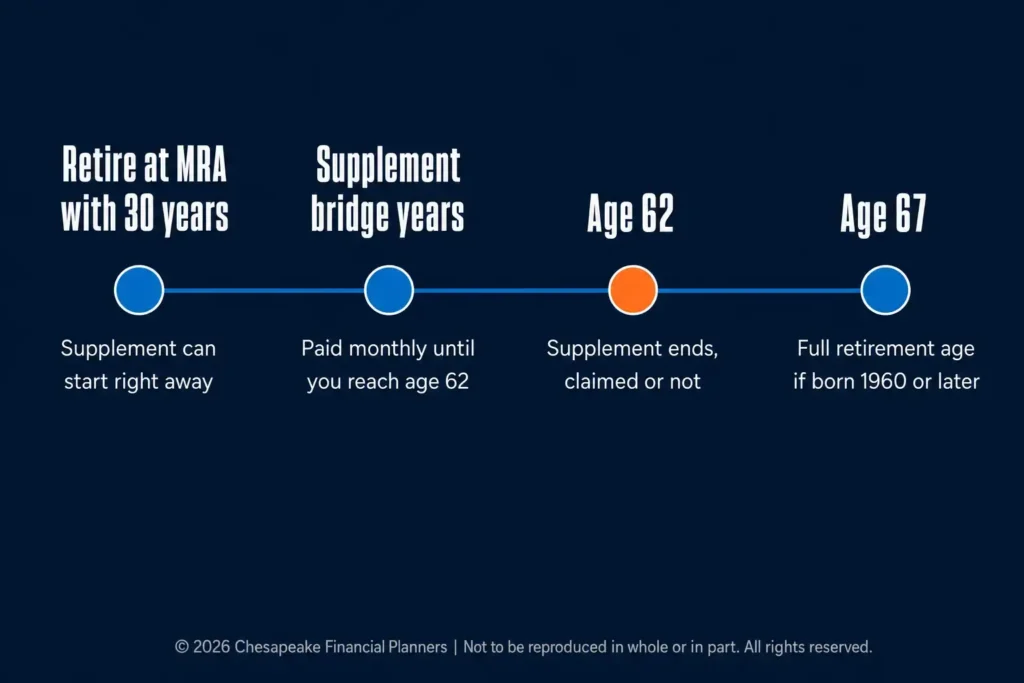
The FERS supplement stops at age 62, and claiming Social Security is not what triggers the end. In OPM's words, "Your annuity supplement will stop at the end of the month prior to you turning age 62." The same OPM FAQ adds that you do not have to apply for Social Security at 62. In edge cases the last payment can land a month later, such as a birthday on the second of the month for someone not yet entitled to Social Security, so confirm your final date with OPM.
Two other rules shape the bridge. The supplement is not increased by cost-of-living adjustments, so it buys a little less each year. And work income can cut it: the handbook says the supplement is reduced $1 for every $2 you earn above the Social Security exempt amount, which is $24,480 in 2026 for people under full retirement age all year. Wages and net self-employment earnings both count.
Here is what changes at 62:
- The supplement payments end.
- Social Security becomes available, but for anyone born in 1960 or later, claiming at 62 cuts the benefit by 30%.
- Full retirement age is 67 for that same birth-year group.
Does the FERS supplement continue if I delay Social Security? No. The supplement ends at 62 regardless of when you claim, so delaying Social Security means you cover the gap from other sources. Jeff Judge often tells federal employees that the supplement's end date matters more than its start date, because the paycheck drop arrives on a known day and it is the one people forget to plan for.
How Should You Plan for Income After the FERS Supplement Ends?
Start by listing every source of retirement income by age, because the supplement ending at 62 and Social Security reaching full value at 67 sit five years apart. For anyone who waits, delayed retirement credits add 8% a year after full retirement age, up to age 70, so claiming later pays more but leaves a gap to fill. The TSP is the usual tool for that gap, and our guide to TSP withdrawal strategies covers how to draw it down. If you are weighing Social Security timing, bridging income to delay Social Security to 70 walks through the trade-offs.
The R.U.D.D.E.R. Method™ is Chesapeake Financial Planners' six-step planning process: Review and Recognize, Uncover and Understand, Design and Develop, Discuss and Decide, Execute and Empower, and Reassess and Refine. For federal households, Uncover and Understand means mapping the pensionA defined benefit retirement plan where your employer promises a specific monthly payment for life in retirement, typically based on salary and years of service. Pensions are increasingly rare in the private sector but remain common in government and some union jobs — and if you have one, understanding your payout options is an important financial decision., the supplement, the TSP and Social Security on one timeline before anyone picks a retirement date. Jeff Judge finds that federal employees who see the 62 cliff on paper make calmer decisions about when to leave, because they are choosing a date rather than reacting to one.
Our hub on how Aberdeen Proving Ground retirement works with FERS and TSP and the full federal employee retirement guide show how these pieces fit together for Harford County and Anne Arundel County households.

Frequently Asked Questions
What is the FERS supplement?
The FERS supplement is a monthly payment from OPM, also called the FERS annuity supplement, that approximates the Social Security benefit earned through federal service. It goes to employees who retire on an immediate annuity before age 62 and runs until they turn 62, whether or not they claim Social Security.
At what age does the FERS supplement end?
The FERS supplement ends at age 62. OPM says it stops at the end of the month before you turn 62, and that holds even if you wait to claim Social Security. Because the date follows your birthday, confirm the exact final payment with OPM or your agency's benefits office.
Can I get the FERS supplement if I retire at 62 or older?
No. The FERS supplement is paid only to people who retire before age 62 on an immediate annuity. If you separate at 62 or later, you receive your basic annuity but no supplement, so your first Social Security claim becomes the main income decision to plan around.
Does working after retirement reduce the FERS supplement?
Yes, it can. The supplement is reduced $1 for every $2 you earn above the Social Security exempt amount, which is $24,480 in 2026 for people under full retirement age all year. Both wages and net self-employment earnings count toward the limit, and retirees must report earnings to OPM.
Does the FERS supplement get cost-of-living increases?
No. OPM's handbook states the retiree annuity supplement is not increased by cost-of-living adjustments, unlike a basic FERS annuity once you qualify for COLAs. The payment stays flat until it ends at 62, so any plan built on it should assume its purchasing power slowly shrinks.
How Will You Cover the Years After the FERS Supplement Ends?
Decide that before you pick a retirement date, not after. Jeff Judge and the Chesapeake Financial Planners team work with federal employees across Harford County and the Baltimore metro on exactly this timeline, from the pension and the FERS supplement to the TSP and Social Security. Book your no-cost 30-minute fit call with Chesapeake Financial Planners, and we will map your income by age. Book your no-cost 30-minute fit call
Disclosures
The information provided is for educational purposes only and should not be construed as investment advice. Investment strategies should be tailored to individual circumstances, risk tolerance, and goals. Past performance doesn't guarantee future results. Consult with qualified financial professionals regarding your specific situation.
Advisors associated with Chesapeake Financial Planners may be either (1) LPL Financial Registered Representatives offering securities through LPL Financial, Member FINRA and SIPC, and investment advisor representatives offering investment advice through Great Valley Advisor Group; or (2) solely investment advisor representatives offering investment advice through Great Valley Advisor Group and not affiliated with LPL Financial. Great Valley Advisor Group, and Chesapeake Financial Planners are separate entities from LPL Financial.
Chesapeake Financial Planners | 2402 Scotlon Ct, Forest Hill, MD 21050 | (410) 652-7868 | www.chesapeakefp.com
© 2026 Chesapeake Financial Planners | Not to be reproduced in whole or in part. All rights reserved.


