

How Do I Use a Social Security Bridge Strategy to Delay Benefits to 70?
Last reviewed: July 2026
A social security bridge strategy uses your portfolio, part-time work, or other income to replace what Social Security would have paid you between retirement and age 70. The goal is locking in delayed retirement credits worth roughly 8% per year past full retirement age, which raises your monthly benefit by 24% versus claiming at 67 (a permanent inflation-adjusted raise). Done right, the bridge buys a larger check for life. Done sloppily, it drains the wrong accounts in the wrong order and costs you more in taxes than the strategy gains in benefits.
On This Page
- Key Takeaways
- Step 1: Estimate Your Income Gap Between Retirement and Age 70
- Step 2: Map Your Savings Buckets to the Bridge Years
- Step 3: Sequence Withdrawals to Manage Taxes and Medicare Costs
- Step 4: Pressure-Test Your Social Security Bridge Strategy Against Real-World Risks
- Related Topics Worth Reading
- Frequently Asked Questions
- Disclosures
Key Takeaways
- Delaying from full retirement age to 70 raises your monthly benefit to 124% of the FRA amount for anyone born 1960 or later, a permanent inflation-adjusted increase.
- Bridge years between retirement and 70 are typically funded by taxable brokerage, pre-tax retirement accounts, Roth conversions, or part-time work.
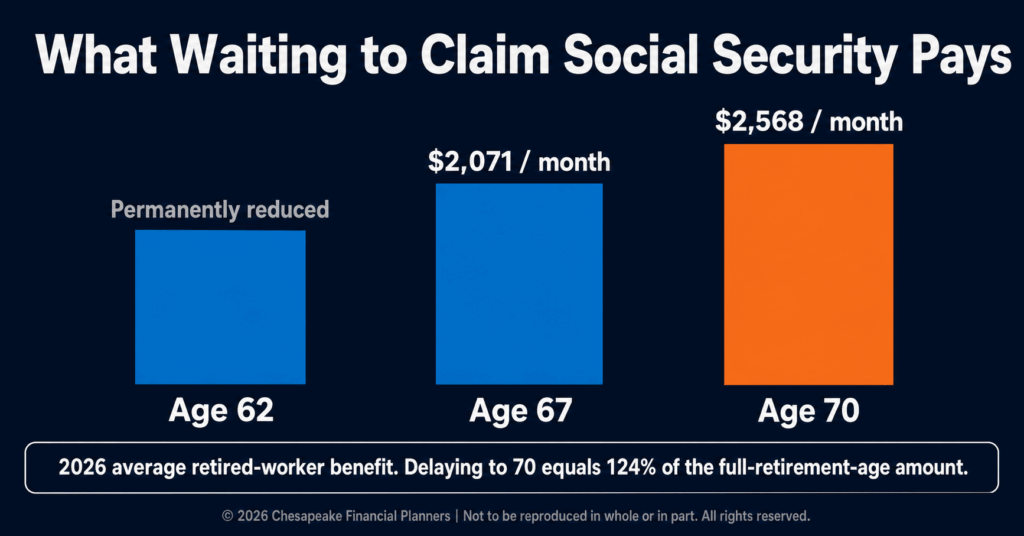
- With the 2026 average monthly retired-worker benefit at $2,071, an eight-year delay can mean replacing roughly $200,000 in foregone payments.
- Withdrawal sequencing matters as much as the delay itself, since pulling from the wrong bucket can trigger taxes, IRMAA surcharges, or capital gains brackets.
- A working spouse, pension, or annuity changes the math significantly and should be modeled before locking in the delay.
About the Author: Jeff Judge, CFP®, AEP®, ChFC®, CLU® is Managing Partner of Chesapeake Financial Planners in Forest Hill, Maryland. He has been helping families and business owners in Harford County and the Baltimore metro area build retirement income plans since earning his CFP® certification in 2013, by using Chesapeake Financial Planners’ signature process, the R.U.D.D.E.R. method™. Jeff has watched the social security bridge strategy add six figures to lifetime benefits for couples who built it deliberately, but only when the bridge is funded before the year benefits are claimed, not in the middle of it.
Step 1: Estimate Your Income Gap Between Retirement and Age 70
Before you can bridge anything, you need to know how big the gap is. Pull your personal Social Security statement from ssa.gov/myaccount and look at three numbers: your estimated benefit at 62, your benefit at full retirement age (67 for anyone born 1960 or later), and your benefit at 70. The difference between the age-67 number and the age-70 number is what delayed retirement credits buy you. The Social Security Administration credits roughly 8% per year for each year you defer past full retirement age, which compounds to a 24% bump by 70 for someone with an FRA of 67.
Now multiply your projected monthly benefit at 70 by the number of months between your planned retirement date and your 70th birthday. That dollar figure is your bridge target. If you plan to retire at 65 with a projected age-70 benefit of $3,500 per month, you need roughly $210,000 to replace what Social Security would have paid out over those 60 months. If you plan to retire at 63, the bridge stretches seven years and the target climbs accordingly.
One number people skip: cost-of-living adjustments. The 2026 COLA was set at 2.8%, and historically COLAs have averaged around 2.6% since 2000. Building a modest annual escalator into the bridge target keeps the plan honest. Jeff Judge often tells pre-retirees that the most common mistake at this step is anchoring the bridge to the age-62 benefit instead of the age-70 benefit, because the whole point of bridging is to fund the larger eventual check.
Should I Take Social Security at 62 or Wait Until 70?
Step 2: Map Your Savings Buckets to the Bridge Years
Most pre-retirees enter retirement with three account types: taxable brokerage, pre-tax (401(k), traditional IRA, 403(b)), and Roth. A useful bridge plan assigns a role to each.
Taxable brokerage is usually the first bucket to fund the early bridge years. Long-term capital gains carry their own preferential bracket structure, basis steps up over time as new contributions are added, and withdrawals from this bucket do not interact with the Social Security earnings test. If you have cash, CDs, or a maturing Treasury ladder, those are even simpler and trigger no taxable event beyond the interest already reported.
Pre-tax accounts come next, often in deliberately small slices. The bridge years are a planning window where taxable income is artificially low, which creates room to do Roth conversions at the 12% and 22% federal brackets while filling the standard deduction. Filling those low brackets now lowers future required minimum distributions, which in turn protects your delayed-claim Social Security benefit from being taxed at the higher rates of the 85% inclusion bracket later.
Roth is the bucket of last resort during the bridge. It does not generate taxable income, which is exactly why pulling from it during low-income bridge years wastes the planning opportunity. Save Roth for years when traditional pre-tax withdrawals would push you into IRMAA surcharges, the next tax bracket, or another costly cliff.
A few practical anchors before you start. The 2026 Social Security wage base is $184,500, which matters mostly for those still working in a high-income year during the bridge. The 2026 retirement earnings test exempt amount is $24,480 per year for those who have already started benefits before full retirement age, but if you're delaying you don't face this test. A working spouse claiming on their own record changes withdrawal sequencing significantly, since their benefit may cover a meaningful share of the bridge gap.
Step 3: Sequence Withdrawals to Manage Taxes and Medicare Costs
Sequencing is where good bridges turn into great ones. The decisions are not abstract. They show up in your 1040 and on your Medicare premiums.
The first sequencing rule is to avoid stacking large pre-tax withdrawals on top of Social Security if you have any flexibility. Up to 85% of Social Security benefits can become taxable once provisional income clears IRS thresholds, so concentrating pre-tax draws into pre-Social Security years often keeps more dollars in your hand than spreading them evenly.
The second rule is Medicare's Income-Related Monthly Adjustment Amount, or IRMAA. IRMAA uses your modified adjusted gross income from two years prior to set Medicare Part B and Part D surcharges. A spike year, like one large Roth conversion or a real estate sale, can push a single year's premiums up several thousand dollars per spouse. Modeling each bridge year against IRMAA brackets prevents nasty surprises in the year you turn 65 and again at 67.
The third rule is to use the bridge to consolidate. The years between retirement and 70 are an excellent window to roll over old 401(k)s, simplify investment accounts, and clean up beneficiary designations. This is where the Reassess and Refine phase of the R.U.D.D.E.R. Method™ earns its place: The R.U.D.D.E.R. Method™ is Chesapeake Financial Planners' six-step planning process: Review and Recognize, Uncover and Understand, Design and Develop, Discuss and Decide, Execute and Empower, and Reassess and Refine.
Jeff Judge puts it plainly: "The bridge years are the only window most retirees have where they actually control their tax bracket. Spend them sleepwalking, and you pay for it the rest of retirement." In his experience with retirees in their mid-sixties, pre-retirees walk in expecting to talk about portfolio allocation. He walks them through the conversion math first because the dollars at stake in the tax decision tend to dwarf the dollars at stake in the equity-versus-bond decision.
What is IRMAA, and how does income raise my Medicare premium?
Step 4: Pressure-Test Your Social Security Bridge Strategy Against Real-World Risks
A bridge plan that looks perfect in a spreadsheet still has to survive contact with reality. Three risks tend to break the plan if they are not modeled in advance.
The first risk is a market drawdown in the early bridge years. If the S&P 500 falls 25% during your first 18 months of retirement and you keep pulling from equity-heavy taxable accounts, you crystallize losses that the recovery cannot fully repair. The fix is to keep the first two to three years of bridge spending in cash, short-duration Treasuries, or other low-volatility holdings before you retire, not after. Sometimes called a bond tent or a cash reserve bucket, this design lets you ride through downturns without selling equities at the bottom.
The second risk is a health event. Healthcare between retirement and Medicare eligibility at 65 is one of the largest line items on most early-retiree budgets. The ACA marketplace makes coverage available, but premiums and subsidies are tied to modified adjusted gross income. The same Roth conversion that helps long-term taxes can also disqualify a couple from premium tax credits if it pushes income past the subsidy cliff. Run both numbers before pulling either trigger.
The third risk is a working spouse or a delayed retirement that changes the bridge length. If your spouse continues to work part-time, files for their own benefit, or has a pension, the bridge gets shorter and easier. Many pre-retirees plan as if both spouses retire on the same day and claim on the same day, which is rarely the optimal choice. Jeff Judge often runs split-claim scenarios where one spouse claims at full retirement age and the other delays to 70, especially when the higher earner's record will eventually anchor the survivor benefit. With the 2026 maximum benefit at full retirement age now $4,152 per month, the higher earner's delayed claim has outsized value for the surviving spouse.
A clean pressure test answers three questions: Does the plan survive a 30% portfolio drawdown in the first three years? Does it survive a $50,000 unexpected medical or family expense? Does it survive one spouse dying earlier than the joint-life assumption? If the plan breaks under any of those, the bridge needs to be redesigned, not just adjusted.

Related Topics Worth Reading
If the bridge strategy is the spine of your retirement income plan, these related topics fill in the rest of the skeleton.
The first companion piece looks at the claim decision itself. The bridge only makes sense if delaying to 70 is right for your specific situation, which depends on health, marital status, other assets, and tax picture. Should I Take Social Security at 62 or Wait Until 70? walks through the trade-offs.
A second piece covers the planning sweet spot inside the bridge. The low-income window between retirement and 70 is where Roth conversion math works best, but the sizing and timing matter. Roth conversion ladder for pre-retirees explains how to size and sequence the conversions without tripping IRMAA or marketplace subsidy cliffs.
A third companion piece tackles sequence of returns risk. Withdrawing during a downturn at the start of retirement does outsized damage to a long retirement horizon. What is sequence of returns risk, and why do the first years of retirement matter most? covers the bond tent, the cash reserve bucket, and other defenses.
Survivor benefit math earns its own piece, especially for couples with a meaningful earnings gap. A delayed claim by the higher earner permanently raises the surviving spouse's check, often by more than the household saves on income taxes during the bridge. How do Social Security survivor benefits work for a widow? covers the calculation.
Healthcare deserves its own deep look. The ACA marketplace, COBRA, and spouse coverage each have different cost trajectories and interact with bridge year withdrawals. How do I get health insurance between early retirement and Medicare? covers the options.
Frequently Asked Questions
How much extra Social Security do you get by waiting until 70?
For anyone born in 1960 or later, delaying from full retirement age (67) to 70 produces a monthly benefit equal to 124% of the FRA amount. That's a permanent inflation-adjusted increase of 24%, plus any future cost-of-living adjustments. In 2026, that delay applied to the average retired-worker benefit of $2,071 per month would push the check to roughly $2,568 per month for life. The surviving spouse later receives the same elevated benefit.
Is a social security bridge strategy worth it if I'm in poor health?
A social security bridge strategy is generally not worth it for a single person with serious health conditions that materially shorten life expectancy. The break-even point on a typical delay from 67 to 70 lands somewhere between age 80 and 83, depending on assumed investment returns. For couples, the calculation changes, because the higher earner's delay protects the longer-lived spouse through the survivor benefit. A married high earner with a healthy younger spouse often still wins by delaying even if their own life expectancy is below average.
How much money do I need to bridge income to age 70?
A single person retiring at 65 with a projected age-70 benefit of $3,000 per month needs roughly $180,000 to bridge five years before adjusting for inflation. Retire at 62 with the same projected benefit and the bridge stretches eight years, pushing the target above $290,000. Couples need to model both spouses separately, since one may bridge while the other claims earlier. The exact figure depends on your benefit estimate, other income, and assumed investment growth on the bridge portfolio.
Can I work part-time while bridging income to age 70?
Yes, part-time work is one of the most efficient bridge sources because it reduces how much portfolio you draw and may add credits to your Social Security record. Because you have not yet claimed benefits, the earnings test does not apply to you. Part-time income also lowers required Roth conversion sizes by keeping you in lower tax brackets during the bridge years. Many of Jeff Judge's clients use a phased retirement of two or three days a week as the bridge backbone, often through the same employer they're winding down with.
What's the best account to draw from first during the bridge?
Taxable brokerage and cash accounts are usually the right first source during the bridge years. Long-term capital gains receive preferential tax treatment, and these withdrawals don't generate ordinary income that would crowd out Roth conversion room. Pre-tax accounts come next, often in deliberate slices sized to fill the 12% and 22% federal brackets. Roth accounts come last because the tax-free growth is most valuable in the later, higher-income years after Social Security and required minimum distributions begin.
What happens to my bridge plan if Social Security benefits are cut?
Even in published Social Security trustee scenarios where the program pays a reduced share of scheduled benefits after trust fund depletion, your delayed age-70 amount typically still exceeds a reduced early-claim amount. A reduction applied to your delayed benefit still leaves you better off than the early-claiming penalty applied to a smaller age-62 amount. The bridge strategy still wins in most modeled scenarios, though the breakeven age moves a few years later. Modeling both a full-benefit and a partial-benefit scenario gives you a planning floor.
If this guide on social security bridge strategy helped you frame the decision, our free download "The Pre-Retiree's Tax-Smart Withdrawal Playbook" walks through Roth conversion sizing, IRMAA brackets, and account sequencing year by year. Download it at chesapeakefp.com.
Prefer a different starting point? Our Tax Strategy Readiness Quiz is worth a look.
Disclosures
The information provided is for educational purposes only and should not be construed as investment advice. Investment strategies should be tailored to individual circumstances, risk tolerance, and goals. Past performance doesn't guarantee future results. Consult with qualified financial professionals regarding your specific situation.
Advisors associated with Chesapeake Financial Planners may be either (1) LPL Financial Registered Representatives offering securities through LPL Financial, Member FINRA and SIPC, and investment advisor representatives offering investment advice through Great Valley Advisor Group; or (2) solely investment advisor representatives offering investment advice through Great Valley Advisor Group and not affiliated with LPL Financial. Great Valley Advisor Group, and Chesapeake Financial Planners are separate entities from LPL Financial.


