

Published: | Last reviewed: by Jeff Judge, CFP®
Part of our guide: How do you choose the right financial advisor and what should you look for?
Related service: our financial planning and investment management services
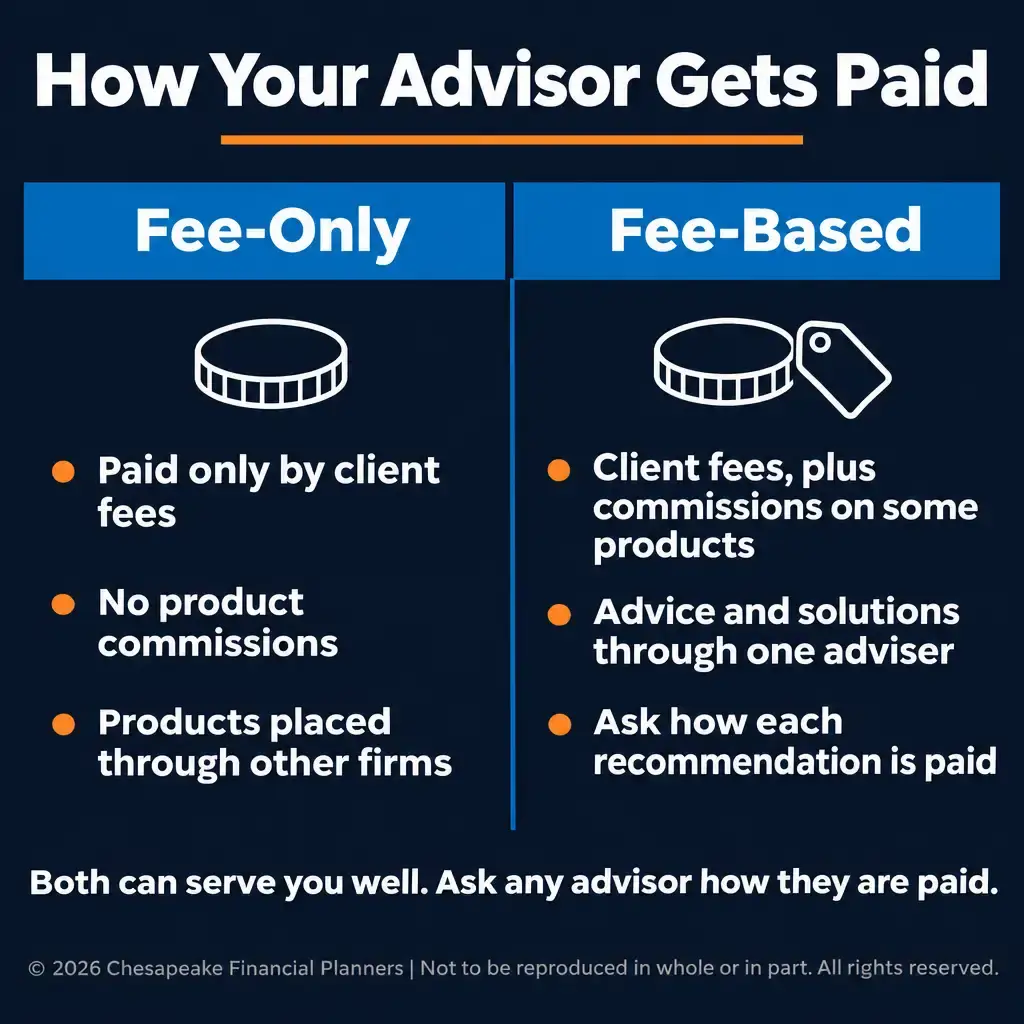
A fee-only financial advisor is paid solely by the client through flat fees, hourly rates, or a percentage of assets, and earns no commissions from selling products. A fee-based financial advisor charges client fees too, but can also earn commissions on certain products like insurance or annuities. That single word difference (only versus based) changes how an advisor gets paid, and sometimes whose interest comes first. Understanding the fee-based vs fee-only financial advisor distinction matters because it tells you exactly where your advisor's money comes from before you hand over yours.
Key Takeaways
- A fee-only advisor earns money exclusively from client-paid fees and accepts no commissions from product sales.
- A fee-based advisor charges client fees and can also collect commissions on insurance, annuities, or other products.
- Both can act as fiduciaries in advisory relationships. Fee-only structures have no commission conflict by design, while fee-based firms can offer a wider range of solutions and must disclose any commission conflicts.
- The SEC requires every advisor to disclose how they are compensated, so ask and read the answer.
- Compensation structure matters less than transparency, fiduciary duty, and whether the advice fits your situation.
About the Author: Jeff Judge, CFP®, AEP®, ChFC®, CLU® is Managing Partner of Chesapeake Financial Planners in Forest Hill, Maryland. He has been helping families and business owners in Harford County and the Baltimore metro area navigate financial advisor compensation decisions since earning his CFP® certification in 2013, by using Chesapeake Financial Planners’ signature process, the R.U.D.D.E.R. method™. Jeff tells clients the label on an advisor matters far less than whether that advisor will put your interests first in writing.
About Jeff Judge, CFP®: meet Jeff and the Chesapeake Financial Planners team.
What Does Fee-Only Actually Mean?
A fee-only advisor is compensated entirely by the client. No commissions. No kickbacks from a mutual fund company. No bonus for steering you into a particular annuity. The advisor's revenue comes from one place: you.
That payment usually takes one of three forms. A percentage of assets under management (often around 1% per year, though it varies). A flat annual retainer. Or an hourly or project rate for specific planning work. The National Association of Personal Financial Advisors defines fee-only strictly: an advisor and their firm accept no compensation from any source other than the client.
Why does this matter? Because commissions can create a conflict: when a product provider pays the advisor, there can be an incentive to favor one product. Fee-only removes that particular conflict. It doesn't guarantee great advice, and it also means the advisor does not implement commission-based products such as insurance or annuities.
How much does it cost to hire a financial planner in 2026?
What Does Fee-Based Mean, and How Is It Different?
A fee-based advisor charges client-paid fees, just like fee-only, but is also licensed to earn commissions on certain products. Think insurance policies, annuities, or some investment products sold through a broker-dealer. So the advisor might charge you a planning fee or an assets-under-management fee, and separately earn a commission when you buy a product they recommend.
The two terms sound nearly identical, and that's exactly the problem. Surveys have repeatedly found that most consumers can't tell them apart. The word "based" is doing a lot of quiet work.
Here is the honest part. Many excellent advisors are fee-based, including advisors affiliated with broker-dealers like LPL Financial. Being fee-based is not a red flag by itself. It simply means there is a second revenue channel, and you should understand when and how that channel is used. A fee-based advisor who fully discloses commissions and still acts as a fiduciary can serve you well. The key is transparency.
The strength of the fee-based model is range. One adviser can offer advisory services and, where appropriate, commission-based insurance or annuity solutions, so you are not sent to a second firm to put a recommendation in place. It can also suit people whose needs change over time, who may want ongoing advice in some years and a single product solution in others. The trade-off is that commissions can create conflicts of interest, which a fee-based firm should disclose to you.
| Feature | Fee-Only | Fee-Based |
|---|---|---|
| Earns client-paid fees | Yes | Yes |
| Earns product commissions | No | Yes, on certain products |
| Commission conflict | None, no commissions | Possible on some products, must be disclosed |
| Advisory and commission-based solutions through one adviser | No | Yes, where appropriate |
| Can act as fiduciary | Yes | Yes |
| Sells insurance or annuities for commission | No | Sometimes |
How does a CFP differ from a financial advisor?
Does Fee Structure Determine Whether an Advisor Is a Fiduciary?
No. Fee structure and fiduciary duty are related but separate ideas, and confusing them is the most common mistake people make here.
A fiduciary is legally required to act in your best interest. A registered investment advisor (RIA) owes a fiduciary duty under the Investment Advisers Act. The CFP Board requires every CFP® professional to act as a fiduciary at all times when providing financial advice, regardless of how they are paid. So a fee-based CFP® professional is still bound to put your interests first.
Want to go deeper? Read our article on how much financial planning costs.
What changes between fee-only and fee-based is not whether the duty exists, but how many potential conflicts that duty has to manage. Fee-only has no commission conflict to manage. Fee-based has one, and relies on disclosure and fiduciary obligation to handle it, in exchange for access to commission-based solutions. Jeff often reminds clients that the real question is not "are you fee-only?" but "which standard applies to each thing you recommend, and will you put it in writing?"
This is also where Chesapeake's planning process shows up. The R.U.D.D.E.R. Method™ is Chesapeake Financial Planners' six-step planning process: Review and Recognize, Uncover and Understand, Design and Develop, Discuss and Decide, Execute and Empower, and Reassess and Refine. The "Discuss and Decide" step is where compensation and conflicts get put on the table openly, before any product or strategy is chosen.
Why Do So Many Financial Plans Fail at the Execution Stage?
How Do You Find Out How an Advisor Is Paid?
You ask, directly, and then you verify. Every advisor is required to disclose compensation, and you have the right to that answer in plain language. The SEC's Form ADV requires registered advisors to describe their fees and conflicts of interest in a brochure you can request and read.
Three questions cut through the fog. First, "Which of your recommendations are made as a fiduciary?" Second, "Do you earn any commissions or compensation from anyone other than me, and if so, on what?" Third, "Can you put both answers in writing?" An advisor who answers all three cleanly is being transparent, whether they are fee-only or fee-based. One who dodges any of the three is telling you something. Jeff Judge notes: "If an advisor hesitates when you ask whether they earn compensation from anyone other than you, that hesitation is the answer — a truly transparent advisor can put their fee structure and fiduciary commitment in writing without blinking."
You can also check an advisor's record yourself. FINRA's BrokerCheck and the SEC's Investment Adviser Public Disclosure tool let you look up registration, licenses, and any disclosures for free. Two minutes there can save you a lot of regret later.
How Do You Transition to a New Financial Advisor Without Losing Ground?
More in this guide:
Frequently Asked Questions
Is a fee-only advisor always better than a fee-based advisor?
Not automatically. A fee-only advisor removes the commission conflict by design, which many people prefer for simplicity. A fee-based advisor who fully discloses commissions and acts as a fiduciary can serve you just as well, and can offer both advisory and commission-based solutions through one adviser, which suits clients who want a single relationship or who need an insurance or annuity product only occasionally. What matters most is transparency, fiduciary commitment, and whether the advice fits your situation, not the label alone.
Can a fee-based advisor still be a fiduciary?
Yes. Fiduciary duty depends on the advisor's role and credentials, not their fee structure. A registered investment advisor and every CFP® professional must act in your best interest when giving advice. A fee-based advisor manages the commission conflict through disclosure and fiduciary obligation, but the duty to put you first still fully applies to recommendations they make.
Why are the terms fee-based and fee-only so easy to confuse?
The two terms differ by a single word, and that word change hides a real difference in how the advisor gets paid. Fee-only means client payments only. Fee-based means client payments plus possible commissions. Consumer surveys consistently show most people cannot distinguish them, which is exactly why you should ask the advisor to explain their compensation directly.
How can I verify how a financial advisor is actually paid?
Request the advisor's Form ADV brochure, which the SEC requires registered advisors to provide, and read the fees and conflicts sections. Ask directly whether they earn any compensation beyond your fees. Then check FINRA's BrokerCheck or the SEC's public disclosure tool for free to confirm their registration, licenses, and any disclosures on record.
Does fee structure affect how much I pay overall?
It can. Fee-only advisors typically charge a percentage of assets, a flat retainer, or hourly rates, all paid directly by you. Fee-based advisors may charge similar fees plus earn commissions built into certain products, which can be less visible than an advisory fee. Costs vary by product and situation, so always ask for the all-in cost in writing before deciding.
Choosing between a fee-based and fee-only advisor is less about the label and more about who is willing to commit, in writing, to putting your interests first. Jeff Judge and the Chesapeake Financial Planners team work through exactly this kind of decision with families and business owners across Harford County and the Baltimore metro every week. If you want a straight answer about how an advisor gets paid and whether that structure fits your goals, schedule a free fit call at chesapeakefp.com.
Disclosures
The information provided is for educational purposes only and should not be construed as investment advice. Investment strategies should be tailored to individual circumstances, risk tolerance, and goals. Past performance doesn't guarantee future results. Consult with qualified financial professionals regarding your specific situation.
Advisors associated with Chesapeake Financial Planners may be either (1) LPL Financial Registered Representatives offering securities through LPL Financial, Member FINRA and SIPC, and investment advisor representatives offering investment advice through Great Valley Advisor Group; or (2) solely investment advisor representatives offering investment advice through Great Valley Advisor Group and not affiliated with LPL Financial. Great Valley Advisor Group, and Chesapeake Financial Planners are separate entities from LPL Financial.


