

How Much Does a Financial Advisor Cost?
Last reviewed: July 2026
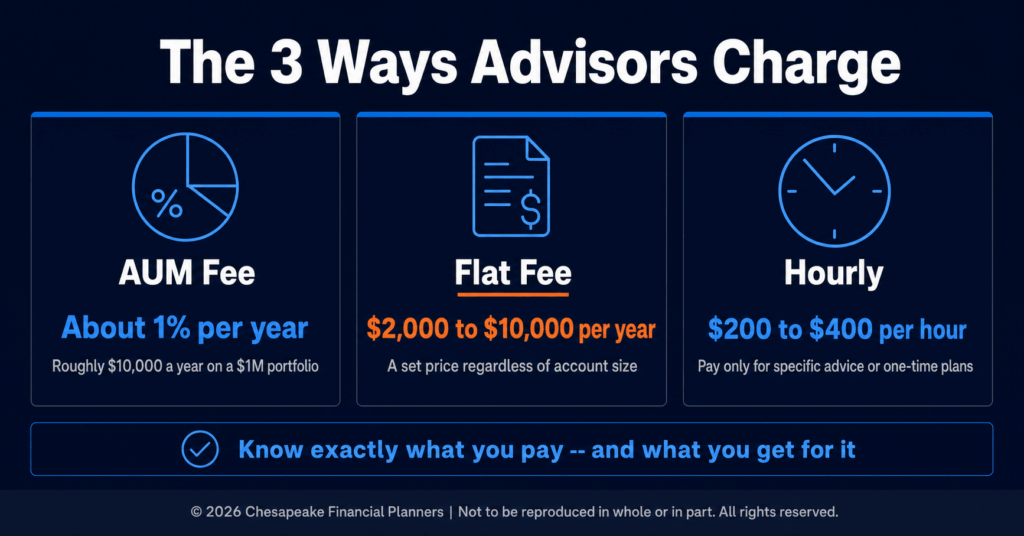
A financial advisor typically costs about 1% of your assets under management per year, though the real number depends on how the advisor charges. Common models are AUM fees (often 0.5% to 1.25% annually), flat fees ($2,000 to $10,000 a year), and hourly rates ($200 to $400 an hour). What you pay should map to the complexity of your situation, not just the size of your account. The cheapest option is rarely the right one, and the most expensive rarely is either.
Key Takeaways
- The most common pricing model is the AUM fee, usually 0.5% to 1.25% per year, with 1% as the rough industry average.
- Flat-fee planning runs roughly $2,000 to $10,000 annually and decouples cost from portfolio size.
- Hourly financial advisor fees typically range from $200 to $400, per the CFP Board.
- Fee-only advisors avoid commissions, reducing conflicts that can quietly raise your real cost.
About the Author: Jeff Judge, CFP®, AEP®, ChFC®, CLU® is Managing Partner of Chesapeake Financial Planners in Forest Hill, Maryland. He has been helping families and business owners in Harford County and the Baltimore metro area navigate advisor fees and planning costs since earning his CFP® certification in 2013, by using Chesapeake Financial Planners’ signature process, the R.U.D.D.E.R. method™. Jeff often tells clients that the headline fee matters less than what sits underneath it. A 1% fee on top of expensive funds and a tax-blind plan costs far more than the number suggests.
Most people ask how much a financial advisor costs and stop at the percentage. That's the wrong place to stop. The bigger question is what you get for the money and whether the pricing model fits how you actually need help.
What Is the Average Financial Advisor Cost?
The average financial advisor cost lands around 1% of assets under management per year, but the spread is wide. Smaller accounts often pay a higher percentage, and larger accounts negotiate down. According to FINRA, advisors are required to disclose how they're paid, so you should always be able to see the number in writing before you sign anything.
Here's the part that gets missed: a 1% AUM fee on a $1 million portfolio is $10,000 a year, every year, whether the market is up or down. That's not a knock on the model. It's a reminder that the dollar figure grows as your account grows, even if the work stays roughly the same. Jeff has watched clients pay rising fees for years without ever asking whether the service kept pace.
How Do AUM, Flat, and Hourly Fees Compare?
The three main fee structures charge for the same advice in very different ways. The right one depends on your assets, your need for ongoing management, and how much complexity you're dealing with.
| Fee Model | Typical Cost | Best For |
|---|---|---|
| AUM (1% AUM fee) | 0.5% to 1.25% per year | Investors who want ongoing portfolio management |
| Flat fee | $2,000 to $10,000 per year | People who want planning without paying on asset size |
| Hourly | $200 to $400 per hour | One-time questions or a second opinion |
A 1% AUM fee aligns the advisor's pay with your account growth, which sounds good until your portfolio is large enough that 1% buys more service than you use. Flat fees fix that by charging for the work, not the balance. Hourly works when you need a specific answer and not a long-term relationship. There's no universally correct model. There's only the one that fits your situation. If you're still weighing how advisors get paid, our guide on What is the difference between a fee-based and fee-only financial advisor? breaks down the conflict-of-interest piece in detail.
What Affects How Much You Pay?
Your final cost moves with the complexity of your financial life, not just your account balance. A retiree with a pension, rental property, and a taxable brokerage account needs more work than a single 401(k) holder with the same net worth.
Three things drive the number up: tax complexity, the number of accounts and entities involved, and whether you need ongoing decisions or a one-time plan. Business owners almost always pay more, because their planning touches both personal and business finances. The SEC requires registered investment advisors to file a Form ADV that spells out their fee schedule, and reading it is the fastest way to understand what you'll actually pay. For a broader look at what these costs cover, see our companion piece on How much does it cost to hire a financial planner in 2026?.
Are Financial Advisor Fees Worth It?
Financial advisor fees are worth it when the advisor's work produces more value than the cost, which usually shows up in taxes, behavior, and avoided mistakes rather than raw investment returns. The biggest dollar swings rarely come from picking better funds. They come from Roth conversion timing, tax-efficient withdrawals, and keeping clients invested during a downturn.
This is where the R.U.D.D.E.R. Method™ matters. The R.U.D.D.E.R. Method™ is Chesapeake Financial Planners' six-step planning process: Review and Recognize, Uncover and Understand, Design and Develop, Discuss and Decide, Execute and Empower, and Reassess and Refine. A fee covers a process, not a product. If the process catches a $40,000 tax mistake, the fee paid for itself several times over. If it doesn't, you're overpaying regardless of the percentage. For the behavioral side of that value, read What behavioral biases most commonly hurt investment decisions and how do you fix them?. Jeff Judge notes: "The fee question I'd encourage clients to ask isn't 'what percentage do you charge' but 'can you show me a specific situation where your process saved a client more than the annual fee' — if the advisor can't answer that concretely, keep looking."
Frequently Asked Questions
How much does a financial advisor cost per year?
A financial advisor typically costs around 1% of your assets under management per year, which is $10,000 annually on a $1 million portfolio. Flat-fee advisors charge roughly $2,000 to $10,000 per year regardless of account size, and hourly advisors charge $200 to $400 per hour for specific questions or one-time plans.
What is a 1% AUM fee?
A 1% AUM fee means you pay 1% of your assets under management to the advisor each year. On a $500,000 account, that's $5,000 annually, usually billed quarterly. The fee grows as your portfolio grows, so it's worth confirming the level of service keeps pace with the rising dollar cost over time.
Are financial advisor fees tax deductible?
Financial advisor fees are not deductible on federal returns for most individuals, since the Tax Cuts and Jobs Act suspended miscellaneous itemized deductions through 2025. According to the IRS, this includes investment advisory fees. Fees paid inside certain retirement accounts work differently, so confirm your specific situation with a tax advisor.
Is a fee-only financial advisor cheaper?
A fee-only financial advisor isn't always cheaper on paper, but the total cost is often lower because there are no commissions buried in product recommendations. Fee-only advisors are paid directly by you, which removes the incentive to sell higher-commission products. That structure reduces hidden costs that don't appear on a fee schedule.
How do I know if I'm paying too much?
You're likely paying too much if your fee keeps rising with your account while the service stays flat, or if you can't clearly explain what the advisor does for you. Compare the total cost, including fund expenses, against the value you receive in planning, tax strategy, and ongoing decisions, not just investment returns.
Ready to Put a Plan Around Your Costs?
Knowing what a financial advisor costs is the easy part. Knowing whether you're getting your money's worth takes a real conversation. Jeff Judge and the Chesapeake team serve families and business owners across Harford County and the Baltimore metro, and we believe in showing you exactly what you pay and exactly what it buys. Schedule a free fit call at chesapeakefp.com.
Want to go deeper? Our guide to what financial planning costs walks through this step by step.
Disclosures
The information provided is for educational purposes only and should not be construed as investment advice. Investment strategies should be tailored to individual circumstances, risk tolerance, and goals. Past performance doesn't guarantee future results. Consult with qualified financial professionals regarding your specific situation.
Advisors associated with Chesapeake Financial Planners may be either (1) LPL Financial Registered Representatives offering securities through LPL Financial, Member FINRA and SIPC, and investment advisor representatives offering investment advice through Great Valley Advisor Group; or (2) solely investment advisor representatives offering investment advice through Great Valley Advisor Group and not affiliated with LPL Financial. Great Valley Advisor Group, and Chesapeake Financial Planners are separate entities from LPL Financial.


