

What Does Diversification Mean in Investment Portfolio Management?
Last reviewed: July 2026
Portfolio diversification means spreading your money across different investments that don't all rise and fall together, so a loss in one area gets cushioned by stability or gains somewhere else. The goal isn't owning everything. It's owning the right mix of assets that respond differently to the same economic events, which lowers the odds that any single bad outcome wrecks your savings. Done right, diversification reduces risk without forcing you to give up meaningful long-term return.
Most people think they understand diversification until you ask them to prove their portfolio is actually diversified. They own ten stocks and feel safe. They own three index funds and assume they're covered. Then a sector tanks, or one market region stalls for a decade, and they learn the hard way that owning a lot of things isn't the same as owning a lot of different things.
On This Page
- Key Takeaways
- What Diversification Really Means
- Why Does Portfolio Diversification Matter?
- What Are the Building Blocks of a Diversified Portfolio?
- How Much Diversification Is Enough?
- How Does Rebalancing Keep a Portfolio Diversified?
- What Are the Limits of Diversification?
- How Chesapeake Financial Planners Approaches Diversification
- Frequently Asked Questions
- Ready to Pressure-Test Your Portfolio?
- Disclosures
Key Takeaways
- Portfolio diversification spreads risk across asset classes, sectors, geographies, and styles so one bad outcome cannot devastate your savings.
- Owning many stocks in one sector is concentration, not diversification, and feels safe until that sector falls.
- U.S. stocks make up roughly 64% of global stock market value, per MSCI data.
- Rebalancing forces you to sell high and buy low automatically, which is one of diversification's most underrated benefits.
- Diversification cannot prevent loss in a broad market crash, but it consistently reduces the depth of the drawdown.
About the Author: Jeff Judge, CFP®, AEP®, ChFC®, CLU® is Managing Partner of Chesapeake Financial Planners in Forest Hill, Maryland. He has been helping families and business owners in Harford County and the Baltimore metro area navigate portfolio diversification and risk management since earning his CFP® certification in 2013, by using Chesapeake Financial Planners’ signature process, the R.U.D.D.E.R. method™. Jeff has watched plenty of investors confuse activity for diversification, owning twenty funds that all hold the same forty stocks and wondering why their "diversified" portfolio still dropped like a rock.
What Diversification Really Means
Portfolio diversification is the practice of spreading investments across assets that behave differently from one another, so that poor performance in one area is offset, at least partly, by stability or strength elsewhere. The point is not to own as many holdings as possible. The point is to own holdings that don't all move in the same direction at the same time.
Why Is Owning Many Stocks Not the Same as Diversification?
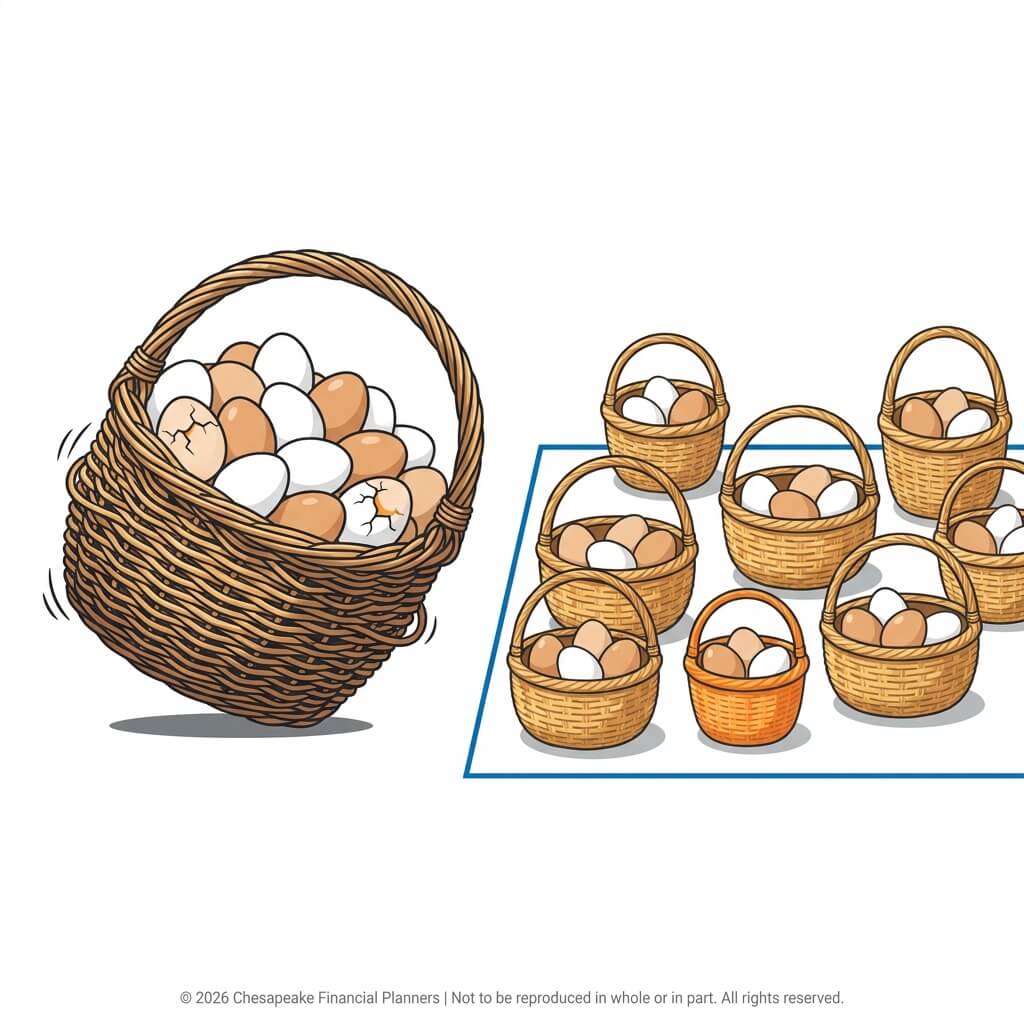
Owning many stocks is not diversification if those stocks all share the same risk. Fifty technology stocks rise and fall together because they respond to the same interest-rate moves, the same earnings cycles, and the same investor sentiment. When the sector falls, all fifty fall. That is concentration wearing a diversification costume.
Here's what diversification is not:
- Owning twenty technology stocks (you're still concentrated in one sector)
- Holding ten large-cap U.S. stocks (you're still exposed to one market and one size band)
- Stacking multiple funds that own the same underlying companies
Real diversification spreads risk across four dimensions: asset classes, sectors, geographies, and investment styles. When stocks fall, high-quality bonds often hold steady or rise. When U.S. markets stall, international markets sometimes lead. When growth stocks tumble, value stocks may hold up. The math behind this is correlation, which simply measures how closely two investments move together. Assets with low or negative correlation are what make a portfolio resilient.
Nobel laureate Harry Markowitz, whose Modern Portfolio Theory underpins how the industry thinks about this, famously described diversification as "the only free lunch in investing." The idea is that combining assets with different return patterns can lower a portfolio's overall volatility without proportionally lowering its expected return. That is a rare thing in finance, where almost every benefit comes with a cost.
Jeff Judge often tells clients that the goal of diversification is not to win in any given year. It's to make sure no single year can take you out of the game. An investor who never loses 40% in a downturn doesn't need a 67% gain just to break even, and that math is the quiet engine behind long-term wealth.
Why Does Portfolio Diversification Matter?
Portfolio diversification matters because it reduces the depth of losses, smooths the ride enough that you can stay invested, and keeps you positioned to benefit from whichever asset class leads next. Each of these benefits compounds over time, and together they protect both your money and your behavior, which is often the bigger threat.
How Does Diversification Reduce Investment Risk?
Diversification reduces investment risk by limiting how much any single failure can hurt you. Individual companies can go to zero. Entire sectors can collapse, as Enron's shareholders and Lehman Brothers' employees learned. A diversified portfolio survives these events because no single holding represents enough of the whole to be fatal.
The 2022 market gives a clean illustration. Investors concentrated in high-growth technology stocks watched the tech-heavy Nasdaq Composite fall roughly 33% for the year. A portfolio blending U.S. stocks, international stocks, and bonds still lost money that year, but the loss was meaningfully shallower because the pieces didn't all crater in lockstep.
This connects to investment risk management more broadly. Diversification is the single most accessible risk-management tool available to an ordinary investor. It costs almost nothing to implement through low-cost index funds, and it requires no forecast about which company or sector will stumble next.
Why Do Smoother Returns Help You Build More Wealth?
Smoother returns help you build more wealth because they keep you invested through the periods when undisciplined investors sell. A diversified portfolio that drops 15% in a bad year is far easier to hold than one that drops 40%. The difference between those two experiences is the difference between staying the course and capitulating at the bottom.
Behavioral research consistently finds that investors underperform the very funds they own because they buy after gains and sell after losses. According to DALBAR's Quantitative Analysis of Investor Behavior, the average equity fund investor has historically trailed the S&P 500 by a wide margin over multi-decade periods, and a large share of that gap comes from poorly timed buying and selling. Diversification softens the drawdowns that trigger those panic decisions.
Jeff has watched this play out for more than a decade. The clients who build real wealth aren't the ones who picked the hottest fund. They're the ones who owned a sensible, diversified mix and never panic-sold during a downturn. Diversification is as much a behavioral tool as a financial one.
Why Does Diversification Keep You Positioned for Opportunity?
Diversification keeps you positioned for opportunity because no one reliably knows which asset class will lead next. U.S. large-cap stocks dominated the 2010s. International developed markets led much of the 2000s. Bonds outpaced stocks across long stretches of the 1970s and early 1980s. Leadership rotates, and it rarely announces itself in advance.
By holding multiple asset classes, you guarantee you own a piece of whatever performs well next, rather than betting your retirement on a single forecast. This is the upside of diversification that gets ignored during bull markets, when concentrating in last year's winner always looks smart in hindsight.
What Are the Building Blocks of a Diversified Portfolio?
The building blocks of a diversified portfolio are four layers stacked on top of each other: asset class, geography, sector, and investment style. Asset allocation, the mix between stocks, bonds, and other categories, does the heaviest lifting and is the layer most worth getting right first.
How Does Asset Class Diversification Work?
Asset class diversification works by combining categories of investments that respond differently to the same economic conditions. This is asset allocation, and it is the most important diversification decision you will make. Each asset class plays a distinct role.
Stocks (equities) offer high growth potential and high volatility. They suit long-term goals of ten years or more and tend to perform well during periods of strong economic growth.
Bonds (fixed income) deliver lower returns with lower volatility. They provide income and stability and frequently hold up or rise when stocks fall, though that relationship has weakened in some recent inflationary periods.
Real estate (often held through REITs) generates income through dividends, often moves on a different rhythm than stocks and bonds, and can act as a partial hedge against inflation.
Cash and cash alternatives like money market funds, CDs, and Treasury bills produce low returns but high stability. They serve short-term needs and emergency reserves rather than long-term growth.
A common diversified mix for an investor with a long time horizon might hold 60% to 80% in stocks, 20% to 40% in bonds, and a modest slice in real estate or other alternatives. The right number depends entirely on your goals, time horizon, and tolerance for volatility, which is why a one-size-fits-all rule rarely fits anyone well. For a deeper look at how this mix should evolve, see our guide on asset allocation across life stages. How should my investment mix change as I get closer to retirement?

Why Does Geographic Diversification Matter?
Geographic diversification matters because no single country leads forever, and concentrating entirely in one market exposes you to that market's specific risks. The United States has dominated global stock returns for roughly fifteen years, but home-country dominance has reversed many times in history.
The U.S. represents a large but shrinking share of global investment opportunity. According to MSCI index data, U.S. stocks make up roughly 64% of total global stock market capitalization, which means more than a third of the world's investable equity value sits outside the United States. An investor who owns only U.S. funds is, by definition, ignoring a third of the global market.
Here's a simple comparison of the main geographic buckets and what each one brings:
| Region | Role in a portfolio | Key characteristic |
|---|---|---|
| U.S. stocks | Core growth engine | Largest, most liquid market; ~64% of global cap |
| International developed | Diversifies away from U.S.-specific risk | Europe, Japan, and other mature economies |
| Emerging markets | Higher growth potential, higher volatility | Faster-growing economies, currency and political risk |
Spreading across regions reduces the chance that a lost decade in one market drags your entire portfolio down with it.
What Is Sector and Style Diversification?
Sector and style diversification is the practice of spreading holdings across industries (technology, healthcare, financials, energy, consumer staples) and across investment styles (growth versus value, large-cap versus small-cap). These layers matter because sectors and styles move in cycles that often run counter to each other. When high-flying growth stocks fall out of favor, steadier value stocks frequently hold up better, and vice versa.
A broad total-market index fund delivers a great deal of sector and style diversification automatically, which is why these low-cost funds are such a sensible foundation. But it's worth understanding what's under the hood, because a market-cap-weighted index can become quietly concentrated when a handful of giant companies dominate. If you want to dig into how fund costs affect your outcome, our explainer on investment fees is a good next stop. How Do Investment Fees Impact My Long-Term Returns?
How Much Diversification Is Enough?
Enough diversification means you own assets across all four layers (class, geography, sector, style) without spreading so thin that you can't track what you own or why. There is a real point of diminishing returns. Research has long suggested that a stock portfolio captures most of the available diversification benefit somewhere in the range of 20 to 30 well-chosen individual stocks across different sectors, after which adding more names removes very little additional risk.
Can You Be Over-Diversified?
Yes, you can be over-diversified, a condition sometimes called "diworsification." This happens when an investor owns so many overlapping funds that the portfolio becomes complicated, expensive, and no better diversified than a simpler version would be. Owning ten different U.S. large-cap funds doesn't make you ten times as diversified. It makes you confused and probably overpaying in fees.
The practical answer for most people is straightforward. A handful of broad, low-cost index funds (a total U.S. stock fund, a total international stock fund, and a total bond fund) delivers genuine diversification across thousands of securities at minimal cost. The complexity that impresses people at cocktail parties usually does nothing for their actual results.
Jeff has reviewed prospective-client portfolios holding more than thirty funds that, when you looked through them, came down to the same handful of U.S. mega-cap stocks repeated over and over. Stripping that down to a clean three-fund or four-fund core typically improved diversification and cut costs at the same time. More moving parts is not more diversification.
This is also a place where an honest second opinion helps, because it's genuinely hard to assess your own portfolio's true exposure without looking through every fund's holdings. If you've ever wondered whether your mix is actually built to handle a downturn, that's exactly the question worth answering before the downturn arrives. Is my portfolio diversified enough to handle market volatility?

How Does Rebalancing Keep a Portfolio Diversified?
Rebalancing keeps a portfolio diversified by periodically resetting it back to your target mix, which forces you to trim what has grown and add to what has lagged. Over time, a portfolio drifts. A strong run in stocks pushes your stock allocation above target, which quietly raises your risk right when valuations are highest. Rebalancing pulls it back into line.
Why Is Rebalancing Sometimes Called "Buy Low, Sell High on Autopilot"?
Rebalancing is called buy low, sell high on autopilot because it mechanically does what emotional investors fail to do. When stocks soar, rebalancing sells a slice of stocks (selling high) and moves the proceeds into the underweight asset, often bonds (buying relatively low). When stocks crash, rebalancing does the opposite, buying stocks while they're cheap. It removes the emotion from a decision that most people get backward.
There are two common approaches. Calendar rebalancing resets the portfolio on a fixed schedule, often annually. Threshold rebalancing resets whenever an asset class drifts more than a set percentage from its target, such as five percentage points. Both work. The annual approach is simpler and easier to stick with for most investors.
One caution: rebalancing inside a taxable account can trigger capital gains taxes, so the timing and method deserve thought. Inside tax-advantaged accounts like IRAs and 401(k)s, you can rebalance freely without tax consequences. Coordinating where you rebalance is part of building a tax-aware plan, and it ties directly into how an advisor structures your overall investment approach. How do financial advisors choose investments for my portfolio?
This is one stage of how we work with clients through the R.U.D.D.E.R. Method™, Chesapeake Financial Planners' six-step planning process: Review and Recognize, Uncover and Understand, Design and Develop, Discuss and Decide, Execute and Empower, and Reassess and Refine. Rebalancing lives squarely in that final step, Reassess and Refine, where a portfolio gets checked against its targets and brought back into balance on a disciplined schedule rather than on a hunch.
What Are the Limits of Diversification?
The limits of diversification are real and worth understanding, because overselling it sets investors up for disappointment. Diversification reduces the kind of risk tied to a single company, sector, or country. It cannot eliminate market risk, the risk that the entire market falls at once.
Can Diversification Protect You in a Market Crash?
Diversification cannot fully protect you in a broad market crash, but it consistently softens the blow. In a severe downturn like early 2020 or 2008, correlations between asset classes can spike, meaning things that normally move independently fall together for a stretch. Investors sometimes feel betrayed when their "diversified" portfolio still drops during these moments.
The honest framing is this: diversification limits the depth and duration of your losses, even when it can't prevent them entirely. A diversified investor in 2008 still lost money, but typically far less than someone concentrated in financial stocks or real estate, and recovered faster. That difference, repeated across a lifetime of market cycles, is enormous. For perspective on what to actually do when markets drop, our crash playbook walks through the decisions that matter. What should I do if the stock market crashes?
There's also a concentration trap worth naming. Many people accumulate a large position in a single stock, often through an employer, and it can quietly become the dominant risk in their entire financial life. No amount of diversification elsewhere fixes a portfolio where 40% of your net worth sits in one company. That's a separate, urgent problem. How Much of My Portfolio Should Be in One Stock?
Finally, diversification works against you emotionally during bull markets. There will always be a year when the concentrated bet would have crushed your diversified portfolio. Staying diversified means accepting that you will never have the best-performing portfolio in any given year, in exchange for never having the worst. Most people, when they think it through, take that trade gladly. How Can I Avoid Making Emotional Investment Decisions?
How Chesapeake Financial Planners Approaches Diversification
At Chesapeake Financial Planners, diversification isn't a product we sell. It's a discipline we build around your specific goals, time horizon, and tolerance for volatility. We start by looking through every holding you own to find hidden overlaps and concentration, because the portfolio you think you have and the portfolio you actually own are often two different things.
From there, we design an allocation built for your situation rather than a generic model, and we put a rebalancing discipline in place so the plan holds up through real market cycles. We also coordinate diversification with the tax side, because where you hold each asset class matters as much as what you hold. If you'd like a clearer read on whether your current mix is genuinely diversified or just complicated, that's a conversation worth having before the next downturn forces the question. Should I manage my own investments or hire a financial advisor?
Frequently Asked Questions
What is portfolio diversification in simple terms?
Portfolio diversification means spreading your money across different types of investments that don't all rise and fall together. The idea is that when one investment struggles, others may hold steady or gain, which cushions your overall losses. It lowers risk without requiring you to predict which investment will do well next.
How many stocks do I need for a diversified portfolio?
Research suggests a stock portfolio captures most available diversification benefit at roughly 20 to 30 individual stocks spread across different sectors, after which adding more names removes very little additional risk. For most investors, a broad index fund holding hundreds or thousands of companies is simpler and more effective than picking individual stocks.
Does owning an S&P 500 index fund make me diversified?
An S&P 500 index fund gives you broad U.S. large-cap diversification across 500 companies and many sectors, which is a strong foundation. But it leaves you exposed to U.S.-specific risk, concentrated in the largest companies, and missing international markets, bonds, and smaller stocks. True diversification usually adds those layers on top.
Can diversification eliminate the risk of losing money?
No, diversification cannot eliminate the risk of losing money. It reduces risk tied to a single company, sector, or country, but it cannot protect against market risk, where the entire market falls at once. In a broad crash, a diversified portfolio still loses value, just typically far less than a concentrated one.
What is the difference between diversification and asset allocation?
Asset allocation is the specific mix between asset classes, such as 70% stocks and 30% bonds, and it is the most important layer of diversification. Diversification is the broader concept of spreading risk across classes, geographies, sectors, and styles. Asset allocation is one major tool you use to achieve a diversified portfolio.
How often should I rebalance a diversified portfolio?
Most investors do well rebalancing once a year, or whenever an asset class drifts more than about five percentage points from its target. Annual rebalancing is simple and easy to maintain. Inside IRAs and 401(k)s you can rebalance freely, while rebalancing taxable accounts may trigger capital gains taxes and deserves more careful timing.
Can I be too diversified?
Yes, over-diversification, sometimes called diworsification, happens when you own so many overlapping funds that your portfolio becomes complex and expensive without being better diversified. Owning ten U.S. large-cap funds adds cost and confusion, not protection. A handful of broad, low-cost index funds usually delivers genuine diversification more effectively than a sprawling collection.
Why does my diversified portfolio still lose money in a downturn?
A diversified portfolio still loses money in a downturn because diversification softens losses rather than preventing them, and during severe crashes many asset classes fall together as correlations spike. The benefit shows up in the depth and duration of the loss. Diversified investors typically lose less and recover faster than concentrated ones.
Ready to Pressure-Test Your Portfolio?
Understanding diversification is one thing. Knowing whether your own portfolio is genuinely built to handle the next downturn is another, and it's hard to judge from the inside. If this guide was useful, our investor resources go deeper on building and stress-testing a diversified portfolio. Download them at chesapeakefp.com, and bring your questions about portfolio diversification when you're ready to talk.
Want to go deeper? Our R.U.D.D.E.R Audit for DIY Investors walks through this step by step.
Investing involves risk including loss of principal. No strategy, including diversification and asset allocation, assures success or protects against loss. There is no guarantee that a diversified portfolio will outperform a non-diversified portfolio. Past performance is no guarantee of future results.
Disclosures
The information provided is for educational purposes only and should not be construed as investment advice. Investment strategies should be tailored to individual circumstances, risk tolerance, and goals. Past performance doesn't guarantee future results. Consult with qualified financial professionals regarding your specific situation.
There is no guarantee that a diversified portfolio will enhance overall returns or outperform a non-diversified portfolio. Diversification does not protect against market risk.
Advisors associated with Chesapeake Financial Planners may be either (1) LPL Financial Registered Representatives offering securities through LPL Financial, Member FINRA and SIPC, and investment advisor representatives offering investment advice through Great Valley Advisor Group; or (2) solely investment advisor representatives offering investment advice through Great Valley Advisor Group and not affiliated with LPL Financial. Great Valley Advisor Group, and Chesapeake Financial Planners are separate entities from LPL Financial.


