Divorce Asset Split After-Tax Calculator
Is Your Divorce Asset Split Even After Tax?
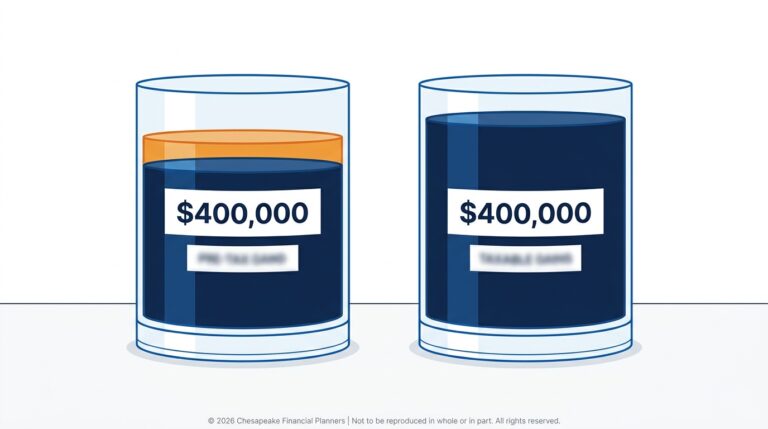
Often not. A dollar in a pre-tax 401(k) is taxed as income when it is withdrawn, while cash and a kept home carry no tax here, so a 50/50 split on paper can be uneven after tax. This calculator compares the split at face value and in three after-tax views, using each person’s 2026 brackets, state and age.
What Does the Divorce Asset Split Calculator Estimate?
Divorce settlements are often negotiated on account balances. After-tax value is what an asset is worth once the tax due on selling or withdrawing it is paid. A pre-tax 401(k) will be taxed as income when it is withdrawn, a taxable account carries a built-in gain that moves with it, and cash and a kept home carry no tax here at all. Two lists that are equal on paper can be far apart after tax, depending on each person’s income, state, and age.
This calculator lets you list up to eight assets or debts, say who would receive what share of each, and enter each person’s tax picture after the divorce. It shows the two sides at face value and in three after-tax views side by side: as if everything were sold or withdrawn this year, with pre-tax money withdrawn over several years, and at each person’s marginal rate. It also shows ways retirement money can move between spouses and the tax change from new filing statuses. None of the views is ranked, and it does not propose a split or say what a court will order. It is an educational illustration, not tax, legal, or investment advice.
How Is the After-Tax Value of a Divorce Split Calculated?
What it estimates: each side’s total at face value and after tax in three views, the gap between the sides, the cash that would even the gap in the view you choose, the tax on different ways of moving retirement money, and the yearly tax change from going from a married return to two single returns.
What you enter: What You Own and Who Gets What: Number of Assets (up to 8), and for each one its type (cash, taxable account, home kept or sold, workplace plan, governmental 457(b), IRA, pensionA defined benefit retirement plan where your employer promises a specific monthly payment for life in retirement, typically based on salary and years of service. Pensions are increasingly rare in the private sector but remain common in government and some union jobs — and if you have one, understanding your payout options is an important financial decision. by lump-sum value or monthly benefit, Roth, HSA, or debt), its value, and the details that type needs (cost basis, mortgage, selling costs, whose name it is in, a pension’s monthly benefit, start age, cost-of-living increase, and discount rate), plus Your Share. How to Compare: Headline View, Years of Withdrawals, Plan Money Received by QDROA Qualified Domestic Relations Order — a court order that allows retirement account assets to be divided between spouses in a divorce without triggering early withdrawal penalties or taxes at the time of the split. Without a QDRO, dividing a 401(k) or pension in divorce can create unintended and costly tax consequences., and Filing Status During the Marriage. Your Tax Picture After the Divorce and Their Tax Picture After the Divorce: Filing Status, Other Income Each Year, State, Local Income Tax (shown when the state has one: a Maryland county or Baltimore City, a city, county or school district in Alabama, Colorado, Delaware, Indiana, Iowa, Kentucky, Michigan, Missouri, New York, Ohio, Oregon or Pennsylvania, or a rate you enter), and Age. The calculator opens in Quick estimate mode with three example assets and the details each one needs, your filing status, both incomes and states, and your age; Detailed mode shows every field.
1. Face value
Each asset’s value, minus any mortgage, split by the shares you enter. A debt counts against the side that takes it on.
2. Tax by asset type
Cash and a kept home have no tax here. A taxable account’s gain is taxed as a long-term gain when sold. Pre-tax retirement money is taxed as income when withdrawn. Roth and HSA money is assumed to come out tax free.
3. The 10% additional tax
Pre-tax money taken out before 59½ generally owes it, except money a former spouse takes straight from a workplace plan under a QDRO, a governmental 457(b), a plan the owner left at 55 or older, or a pension paid from the plan.
4. Three after-tax views
Each person’s share taxed on their own filing status, income, state, and age: all sold or withdrawn this year, pre-tax money withdrawn evenly over the years you choose, or at each person’s rate on the next dollar of income.
5. The gap
Your side’s total minus theirs in each view, and the cash that would even it in the headline view.
6. Moving retirement money
The tax on moving your share into your own IRA, taking it straight from the plan under a QDRO, cashing out after an IRA rollover, or the owner withdrawing and handing over cash.
7. Filing status
The tax on the same yearly income on the married return and on each person’s own return after the divorce.
What you see: the Gap Between the Two Sides in the headline view first, then each side’s total, the cash that evens it, and the Yearly Tax Change From the New Filing Status. Tables show what each side’s list is worth asset by asset, the same split four ways, the ways retirement money can move, and the tax before and after the divorce.
What Assumptions and Sources Does It Use?
- Tax year: 2026. Later withdrawal years use 2026 tax law and brackets held flat.
- Federal and state tax: 2026 federal brackets and standard deduction (IRS Revenue Procedure 2025-32), the 0%, 15%, and 20% long-term capital gains rates (IRS Topic 409), the 3.8% Net Investment Income Tax (IRS), and each person’s state brackets for their filing status. Local income tax is the one each person picks: Maryland’s county and Baltimore City taxes and taxes that follow state income, such as New York City’s, apply to withdrawals and gains; a local tax on earned income only, such as a Pennsylvania or Ohio city’s, does not reach them, so it adds nothing here.
- Transfers between spouses: property transferred incident to a divorce is not taxed, and the receiver keeps the original cost basis, so the gain goes with the asset (Internal Revenue Code section 1041). An IRA moved under a divorce or separation instrument becomes the receiver’s IRA with no tax (section 408(d)(6)).
- The 10% additional tax: applies to pre-tax withdrawals before 59½ (section 72(t)(1); IRS), but not to a QDRO payment from a workplace plan (section 72(t)(2)(C)), a governmental 457(b), or a plan the owner left at 55 or older (section 72(t)(2)(A)(v)). The QDRO and age-55 exceptions do not apply to IRAs (section 72(t)(3)(A)).
- The home: a kept home counts at value minus mortgage. On a home sold at a gain, each person’s share of the gain is reduced by up to $250,000 if they meet the 2-of-5-year ownership and use test (section 121; IRS Topic 701), and the rest is taxed as a long-term gain.
- Pensions by monthly benefit: valued with the owner’s life expectancy from the IRS Single Life Table and the cost-of-living increase and discount rate you enter. This is an illustration, not an actuarial valuation, and it overstates the value of a pension not yet started.
- Alimony: under agreements executed after 2018, it is not deductible by the payer or income to the recipient (IRS Topic 452).
- Not modeled: federal civilian and military retirement pay, which are divided by different orders than a QDRO; what a court would order; and each state’s own rules on dividing property.
Worked Example
The example
This is the calculator’s built-in Detailed example (the “Reset to example” values). Every figure below is the calculator’s own output for these inputs. It is hypothetical and uses 2026 rules. Quick estimate mode opens with only the first three example assets (no taxable account), so its figures differ; switch to Detailed mode to see these.
Inputs
| Input | Example value |
|---|---|
| Asset 1 | Home (Kept, Not Sold): $600,000 value, $250,000 mortgage, 100% to you |
| Asset 2 | Workplace Plan: 401(k) or 403(b) (Pre-Tax): $500,000, in their name, 20% to you |
| Asset 3 | Cash or Bank Account: $100,000, 50% to you |
| Asset 4 | Taxable Investment Account: $50,000 value, $20,000 cost basis, 0% to you |
| Headline View | Face Value (Dollars on Paper) |
| Plan Money Received by QDRO | Taken Straight From the Plan |
| Filing Status During the Marriage | Married Filing Jointly |
| You After the Divorce | Single, $60,000 other income, Maryland, age 52 |
| Them After the Divorce | Single, $140,000 other income, Maryland, age 54 |
| Local Income Tax | Typical Maryland rate (3.20%) for both |
Results
| Result | Estimate |
|---|---|
| Gap Between the Two Sides (Face Value) | $0 |
| Your Side at Face Value | $500,000 |
| Their Side at Face Value | $500,000 |
| Your Side If Sold or Withdrawn This Year | $469,699 |
| Their Side If Sold or Withdrawn This Year | $285,038 |
| Your Side, Withdrawn Over 10 Years | $476,550 |
| Their Side, Withdrawn Over 10 Years | $338,044 |
| Your Side at Each Person’s Marginal Rate | $480,050 |
| Their Side at Each Person’s Marginal Rate | $323,165 |
| Yearly Tax Change From the New Filing Status | $928 |
The calculator summarizes it this way: “Split by dollars on paper, the two sides are even. After tax: if sold or withdrawn this year, your side is ahead by $184,660; withdrawn over 10 years, your side is ahead by $138,506; at each person’s marginal rate, your side is ahead by $156,885.” The difference comes mostly from the 401(k): their $400,000 share is pre-tax money that will be taxed as income when withdrawn, while your side is mostly home equity and cash. The tax on the couple’s same yearly income goes from $41,809 on one joint return to $42,737 on two single returns, $928 more each year. Results for your own inputs will differ.
Reviewed by Jeff Judge, CFP®, AEP®, ChFC®, CLU®, Managing Partner, Chesapeake Financial Planners. Last updated November 2, 2026. Tax year 2026.
Frequently Asked Questions
Why is a 50/50 split on paper not even after tax?
Because different assets carry different tax. Pre-tax retirement money is taxed as income when it is withdrawn, a taxable account’s gain is taxed when it is sold, and cash or a kept home carries no tax here. In the example, both sides are worth $500,000 on paper, but after tax one side is ahead by $138,506 to $184,660, depending on the view.
What is a QDRO, and does it avoid the 10% early withdrawal tax?
A qualified domestic relations order (QDRO) is a court order that divides a workplace retirement plan. A former spouse who takes money straight from the plan under a QDRO owes income tax on it but no 10% additional tax, even before 59½. In the example, $100,000 of your share taken that way would owe $30,301 of income tax and leave $69,699. Rolled to your own IRA first and then cashed out, it would also owe a $10,000 additional tax. Moved into your own IRA and left there, nothing is owed now. IRAs are divided by the divorce decree, not a QDRO, and the QDRO exception does not apply to them.
Does the person who keeps the house owe tax on it?
Not when it is transferred. A transfer between spouses incident to a divorce is not taxed, and the person who keeps the home keeps the original cost basis, so the gain goes with it. Tax may be owed later when the home is sold, after the home sale exclusion of up to $250,000 for a single owner who meets the ownership and use test.
Which after-tax view should we use?
The calculator does not pick one. Face value counts dollars on paper; the three after-tax views assume the money is spent this year, over several years, or at each person’s marginal rate. Courts and negotiators treat tax differently, so the calculator shows all four side by side. A family law attorney and a tax professional can help you decide how to weigh them.
Will our taxes go up after the divorce?
They can. Two single or head of household returns can owe more or less than one joint return on the same income. In the example, the couple’s tax on the same yearly income rises by $928 a year. Marital status on December 31 decides your filing status for the whole year.
Related planning services: Divorce, Financial Planning for Women.
Related calculators: Pension Lump Sum vs. Monthly Pension Calculator, Financial Independence Target Estimator and Life Insurance Needs Estimator.
See all financial planning calculators
Want to talk through your own numbers with an adviser?
Important disclosures
This calculator is for educational purposes only. It provides a simplified, hypothetical illustration of how taxes can change the value of the same assets, based on the information you enter and on 2026 federal and state tax rules. Each view illustrates one way of counting; none is ranked above the others, and none proposes a split. It does not say what a court will order or what either person is entitled to, and pension values are illustrations, not actuarial valuations. It is not tax, legal, investment, or financial planning advice. Talk with a family law attorney and a qualified tax professional about your situation. Tax laws change, and results are not guaranteed.
The opinions voiced in this material are for general information only and are not intended to provide specific advice or recommendations for any individual. This information is not intended to be a substitute for specific individualized tax, investment or legal advice. We suggest that you discuss your specific situation with a qualified tax, legal or financial advisor. All investing involves risk including loss of principal. No strategy assures success or protects against loss. There is no guarantee that a diversified portfolio will enhance overall returns or outperform a non-diversified portfolio. DiversificationSpreading investments across multiple asset classes, sectors, and geographies so a loss in one area doesn’t devastate your entire portfolio. It’s the financial equivalent of not putting all your eggs in one basket — and it’s one of the few strategies that can reduce risk without necessarily reducing expected returns. does not protect against market risk.
A Roth IRAA retirement account funded with after-tax dollars where your money grows completely tax-free and qualified withdrawals in retirement are also tax-free — including all the gains. There are no Required Minimum Distributions during your lifetime, making the Roth one of the most flexible and powerful long-term savings tools available. offers tax deferral on any earnings in the account. Qualified withdrawals of earnings from the account are tax-free. Withdrawals of earnings prior to age 59 ½ or prior to the account being opened for 5 years, whichever is later, may result in a 10% IRS penalty tax. Limitations and restrictions may apply. Contributions to a traditional IRA may be tax deductible in the contribution year, with current income tax due at withdrawal. Withdrawals prior to age 59 ½ may result in a 10% IRS penalty tax in addition to current income tax. This material is for educational purposes only. Insurance products contain exclusions, limitations, and terms for keeping them in force. Please contact a qualified insurance professional for costs and complete details.
Advisors associated with Chesapeake Financial Planners may be either (1) LPL Financial Registered Representatives offering securities through LPL Financial, Member FINRA and SIPC, and investment advisor representatives offering investment advice through Great Valley Advisor Group; or (2) solely investment advisor representatives offering investment advice through Great Valley Advisor Group and not affiliated with LPL Financial. Great Valley Advisor Group and Chesapeake Financial Planners are separate entities from LPL Financial.